


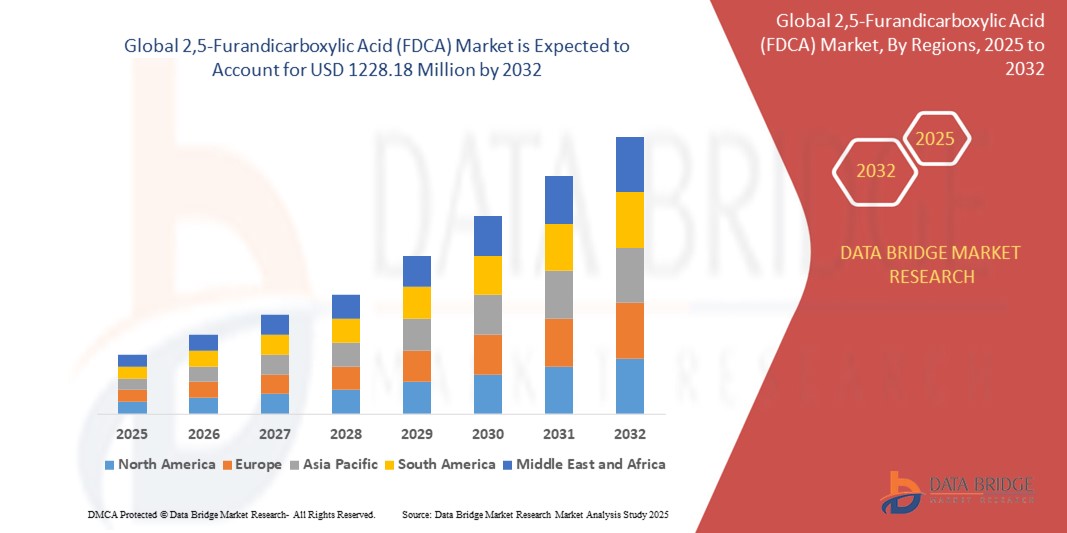
What is the Global 2,5-Furandicarboxylic Acid (FDCA) Market Size and Growth Rate?
- The global 2,5-Furandicarboxylic Acid (FDCA) market size was valued at USD 620.82 million in 2024 and is expected to reach USD 1228.18 million by 2032, at a CAGR of 8.90% during the forecast period
- Market growth is largely driven by increasing demand for bio-based polymers, particularly polyethylene furanoate (PEF), as a sustainable alternative to traditional plastics
- In addition, environmental regulations and consumer preference for eco-friendly packaging materials are accelerating the shift towards FDCA-based products, supporting consistent market expansion
What are the Major Takeaways of 2,5-Furandicarboxylic Acid (FDCA) Market?
- FDCA is a key bio-based chemical building block used in the production of biodegradable plastics and renewable polyesters such as PEF, which offer superior barrier properties over conventional PET
- The market is experiencing growth due to rising awareness of plastic pollution, increased R&D in green chemistry, and global efforts to reduce dependence on fossil-based raw materials
- Demand is further strengthened by the food and beverage packaging industry, where FDCA-derived polymers are gaining traction as high-performance, sustainable alternatives to conventional plastic packaging
- Europe dominated the 2,5-Furandicarboxylic Acid (FDCA) market with the largest revenue share of 38.5% in 2024, driven by strong environmental regulations, emphasis on sustainability, and rising demand for bio-based polymers
- Asia-Pacific is projected to grow at the fastest CAGR of 13.87% from 2025 to 2032, driven by rapid industrialization, expanding consumer markets, and increasing demand for sustainable materials. Countries such as China, Japan, and India are investing heavily in bioplastics and green technologies to meet global sustainability targets
- The PET segment dominated the 2,5-Furandicarboxylic Acid (FDCA) market with the largest market revenue share of 43.2% in 2024, due to FDCA’s key role as a monomer in the production of polyethylene furanoate (PEF), a bio-based alternative to traditional PET
Report Scope and 2,5-Furandicarboxylic Acid (FDCA) Market Segmentation
|
Attributes |
2,5-Furandicarboxylic Acid (FDCA) Key Market Insights |
|
Segments Covered |
|
|
Countries Covered |
North America
Europe
Asia-Pacific
Middle East and Africa
South America
|
|
|
|
Market Opportunities |
|
|
Value Added Data Infosets |
In addition to the insights on market scenarios such as market value, growth rate, segmentation, geographical coverage, and major players, the market reports curated by the Data Bridge Market Research also include in-depth expert analysis, pricing analysis, brand share analysis, consumer survey, demography analysis, supply chain analysis, value chain analysis, raw material/consumables overview, vendor selection criteria, PESTLE Analysis, Porter Analysis, and regulatory framework. |
What is the Key Trend in the 2,5-Furandicarboxylic Acid (FDCA) Market?
“Shift Toward Bio-Based and Sustainable Packaging Solutions”
- A key trend shaping the global 2,5-Furandicarboxylic Acid (FDCA) market is the increasing preference for sustainable and bio-based packaging materials, driven by environmental regulations and consumer demand for eco-friendly products
- FDCA, derived from renewable feedstocks such as fructose, is gaining traction as a green alternative to petroleum-based monomers in the production of bioplastics, especially polyethylene furanoate (PEF), which boasts superior recyclability and barrier properties
- For instance, Avantium’s FDCA-based PEF technology is being adopted by major packaging players such as Carlsberg and Coca-Cola to develop sustainable bottles with lower carbon footprints
- FDCA’s compatibility with existing PET recycling streams and its improved performance over fossil-based plastics are making it an attractive innovation for food, beverage, and cosmetics packaging
- As global efforts to curb plastic pollution intensify, FDCA is positioned as a core component in the transition to a circular economy, with companies investing in scale-up and commercialization of FDCA-based biopolymers
- The growing alignment of corporate sustainability goals and government regulations with bio-based material use is expected to fuel long-term adoption of FDCA in key industries
What are the Key Drivers of 2,5-Furandicarboxylic Acid (FDCA) Maret?
- The rising demand for bio-based plastics as sustainable alternatives to fossil-based polymers is a major growth driver for the FDCA market
- In April 2024, Avantium signed a major supply agreement with Sucafina for the use of FDCA in sustainable coffee packaging, signaling increasing commercial momentum for FDCA-based applications
- Stringent environmental regulations, such as the EU’s Green Deal and single-use plastic bans, are encouraging manufacturers to shift towards renewable and recyclable materials such as FDCA
- Growing investments in biotechnology and green chemistry are boosting the production efficiency and scalability of FDCA, making it more economically viable for industrial use
- Increasing end-user awareness and preference for low-carbon footprint materials in sectors such as packaging, textiles, and automotive are accelerating the integration of FDCA into mainstream applications
Which Factor is Challenging the Growth of the 2,5-Furandicarboxylic Acid (FDCA) Market?
- One of the key challenges hampering the growth of the FDCA market is the high production cost and limited commercial-scale availability compared to traditional petrochemical alternatives
- Despite technological advancements, FDCA production remains cost-intensive, largely due to the complex conversion processes and the need for high-purity raw materials
- For instance, while Avantium has made progress with its YXY® technology, large-scale cost-competitive production is still in the early stages, limiting broader adoption across price-sensitive sectors
- In addition, the lack of widespread infrastructure for PEF recycling and processing poses a hurdle to market penetration, particularly in regions where PET recycling systems are still underdeveloped
- Overcoming these barriers will require continued R&D investment, partnerships with major brands, and supportive government policies to encourage the use of bio-based alternatives
- Market players must also address consumer and manufacturer skepticism regarding performance parity with conventional plastics to ensure robust market acceptance
How is the 2,5-Furandicarboxylic Acid (FDCA) Market Segmented?
The market is segmented on the basis of type, application, method, and end-user.
• By Type
On the basis of type, the 2,5-Furandicarboxylic Acid (FDCA) market is segmented into PET, Polyamides, Polycarbonates, Plasticizers, Polyester Polyols, and Others. The PET segment dominated the 2,5-Furandicarboxylic Acid (FDCA) market with the largest market revenue share of 43.2% in 2024, due to FDCA’s key role as a monomer in the production of polyethylene furanoate (PEF), a bio-based alternative to traditional PET. The PET application benefits from the rising demand for sustainable and recyclable packaging, especially in food and beverage industries.
Polyamides are expected to witness the fastest CAGR from 2025 to 2032, driven by increasing interest in bio-based polymers for engineering plastics, textiles, and automotive parts. FDCA’s use in polyamide production aligns with trends in lightweight and eco-friendly material development.
• By Method
On the basis of method, the 2,5-Furandicarboxylic Acid (FDCA) market is segmented into Dehydration of Hexose Derivatives, Oxidation of 2,5-Disubstituted Furans, Catalytic Conversions of Various Furan Derivatives, and Biological Conversion of HMF. The Dehydration of Hexose Derivatives segment held the largest market share of 40.1% in 2024, as this method is the most commercially viable for producing HMF, the key precursor to FDCA, from renewable sugars. This process is widely adopted due to its scalability and alignment with green chemistry principles.
The Biological Conversion of HMF method is expected to grow at the fastest CAGR during the forecast period, driven by advancements in enzyme engineering and microbial fermentation technologies, which offer low-energy and eco-friendly alternatives for FDCA production.
• By Application
On the basis of application, the 2,5-Furandicarboxylic Acid (FDCA) market is segmented into Chemical, Pharmaceutical, and Scientific Research. The Chemical segment dominated the market in 2024 with a share of 56.7%, driven by extensive use of FDCA as a platform chemical for manufacturing bio-based polymers, resins, and plasticizers. Its application in the production of polyethylene furanoate (PEF) and other high-performance materials supports the transition to sustainable industrial processes.
The Pharmaceutical segment is projected to grow at the fastest CAGR from 2025 to 2032, fueled by increasing research into FDCA derivatives for use in drug delivery systems and as potential intermediates in active pharmaceutical ingredients (APIs).
Which Region Holds the Largest Share of the 2,5-Furandicarboxylic Acid (FDCA) Maret?
- Europe dominated the 2,5-Furandicarboxylic Acid (FDCA) market with the largest revenue share of 38.5% in 2024, driven by strong environmental regulations, emphasis on sustainability, and rising demand for bio-based polymers
- European countries are proactively adopting FDCA as a substitute for fossil-based alternatives, particularly in packaging, automotive, and textiles sectors
- Supportive government policies, investments in green technologies, and rising consumer preference for biodegradable and recyclable products fuel regional market expansion
- The European Union’s Green Deal and circular economy initiatives are accelerating the development and commercialization of FDCA-based materials across industries
France 2,5-Furandicarboxylic Acid (FDCA) Market Insight
France is expected to witness robust CAGR during the forecast period due to increased efforts in reducing carbon footprint and promoting bio-based raw materials. Government-backed initiatives to ban single-use plastics and develop sustainable packaging have fueled demand for FDCA-based PEF. The country’s innovation in food packaging and consumer goods enhances FDCA utilization.
U.K. 2,5-Furandicarboxylic Acid (FDCA) Market Insight
The U.K. FDCA market is growing steadily, driven by policy-driven sustainability goals and increasing adoption of bioplastics across packaging and consumer sectors. The shift towards eco-friendly consumer behavior and strong awareness of plastic pollution push industries to seek FDCA-based alternatives. Investments in green chemistry and collaborative R&D initiatives further stimulate market expansion.
Which Region is the Fastest Growing Region in the 2,5-Furandicarboxylic Acid (FDCA) Market?
Asia-Pacific is projected to grow at the fastest CAGR of 13.87% from 2025 to 2032, driven by rapid industrialization, expanding consumer markets, and increasing demand for sustainable materials. Countries such as China, Japan, and India are investing heavily in bioplastics and green technologies to meet global sustainability targets. Government support for bio-based product manufacturing, rising environmental awareness, and growing middle-class population are accelerating FDCA market adoption. Local production capabilities, cost-effective manufacturing, and strong demand from packaging and textile sectors contribute to APAC’s rapid growth.
China 2,5-Furandicarboxylic Acid (FDCA) Market Insight
China dominated the Asia-Pacific FDCA market in 2024, supported by strong domestic production, high demand for bio-based packaging, and its status as a global manufacturing hub. The government's green initiatives and the presence of large-scale FDCA and PEF production facilities are key growth drivers.
Japan 2,5-Furandicarboxylic Acid (FDCA) Market Insight
Japan’s FDCA market is gaining momentum due to a strong focus on environmental innovation and high adoption of sustainable materials. The country’s industrial sector is increasingly incorporating FDCA into eco-friendly plastics, with continued R&D efforts by major chemical players enhancing market prospects.
India 2,5-Furandicarboxylic Acid (FDCA) Market Insight
India is emerging as a promising market, driven by government initiatives promoting bio-economy and increasing awareness of environmental issues. Investments in green chemistry, coupled with a growing demand for biodegradable packaging in food and retail sectors, support long-term FDCA market growth in the country.
Which are the Top Companies in 2,5-Furandicarboxylic Acid (FDCA) Market?
The 2,5-Furandicarboxylic Acid (FDCA) industry is primarily led by well-established companies, including:
- Avantium (Netherlands)
- LGC Limited (Canada)
- V & V PHARMA INDUSTRIES (India)
- Tokyo Chemical Industry (India) Pvt. Ltd. (India)
- AVA Biochem AG (Switzerland)
- Thermo Fisher Scientific Inc. (India)
- AstaTech, Inc. (U.S.)
- Novamont S.p.A. (Italy)
- Eastman Chemical Company (U.S.)
- Merck KGaA (Germany)
- Sai Carbohydrates (India)
- GODAVARI BIOREFINERIES LTD. (India)
- BASF SE (Germany)
- Tokyo Chemical Industry Co., Ltd. (Japan)
- R&D Synbias Ltd (South Korea)
What are the Recent Developments in Global 2,5-Furandicarboxylic Acid (FDCA) Market?
- In December 2021, Avantium secured USD 100 million in financing to construct a furandicarboxylic acid (FDCA) production plant in Delfzijl, the Netherlands, enabling the company to move forward with its commercial-scale operations. This funding marked a significant milestone in Avantium’s transition toward sustainable material innovation
- In January 2020, Avantium Renewable Polymers, a subsidiary of Avantium, unveiled its intention to establish a 5-kiloton flagship FDCA plant at Chemie Park Delfzijl, Netherlands, dedicated to producing plant-based FDCA for applications in bio-based plastics such as PEF (polyethylene furanoate). This strategic move highlighted Avantium’s leadership in the bio-based chemical sector

- Interactive Data Analysis Dashboard
- Company Analysis Dashboard for high growth potential opportunities
- Research Analyst Access for customization & queries
- Competitor Analysis with Interactive dashboard
- Latest News, Updates & Trend analysis
- Harness the Power of Benchmark Analysis for Comprehensive Competitor Tracking
Table of Content
1 INTRODUCTION
1.1 OBJECTIVES OF THE STUDY
1.2 MARKET DEFINITION
1.3 OVERVIEW OF GLOBAL 2,5-FURANDICARBOXYLIC ACID (FDCA) MARKET
1.4 CURRENCY AND PRICING
1.5 LIMITATION
1.6 MARKETS COVERED
2 MARKET SEGMENTATION
2.1 KEY TAKEAWAYS
2.2 ARRIVING AT THE GLOBAL 2,5-FURANDICARBOXYLIC ACID (FDCA) MARKET SIZE
2.3 VENDOR POSITIONING GRID
2.4 MARKETS COVERED
2.5 GEOGRAPHIC SCOPE
2.6 YEARS CONSIDERED FOR THE STUDY
2.7 RESEARCH METHODOLOGY
2.8 TECHNOLOGY LIFE LINE CURVE
2.9 MULTIVARIATE MODELLING
2.1 PRIMARY INTERVIEWS WITH KEY OPINION LEADERS
2.11 DBMR MARKET POSITION GRID
2.12 MARKET APPLICATION COVERAGE GRID
2.13 DBMR MARKET CHALLENGE MATRIX
2.14 IMPORT AND EXPORT DATA
2.15 SECONDARY SOURCES
2.16 GLOBAL 2,5-FURANDICARBOXYLIC ACID (FDCA) MARKET : RESEARCH SNAPSHOT
2.17 ASSUMPTIONS
3 MARKET OVERVIEW
3.1 DRIVERS
3.2 RESTRAINTS
3.3 OPPORTUNITIES
3.4 CHALLENGES
4 EXECUTIVE SUMMARY
5 PREMIUM INSIGHTS
5.1 RAW MATERIAL COVERAGE
5.2 PRODUCTION CONSUMPTION ANALYSIS
5.3 IMPORT EXPORT SCENARIO
5.4 TECHNOLOGICAL ADVANCEMENT BY MANUFACTURERS
5.5 PORTER’S FIVE FORCES
5.6 VENDOR SELECTION CRITERIA
5.7 KPIS
5.8 COMPARATIVE ANALYSIS WITH CRCS
5.9 PESTEL ANALYSIS
5.1 REGULATION COVERAGE
5.10.1 PRODUCT CODES
5.10.2 CERTIFIED STANDARDS
5.10.3 SAFETY STANDARDS
5.10.3.1. MATERIAL HANDLING & STORAGE
5.10.3.2. TRANSPORT & PRECAUTIONS
5.10.3.3. HARAD IDENTIFICATION
6 PRICE INDEX
7 PRODUCTION CAPACITY OVERVIEW
8 SUPPLY CHAIN ANALYSIS
8.1 OVERVIEW
8.2 LOGISTIC COST SCENARIO
8.3 IMPORTANCE OF LOGISTICS SERVICE PROVIDERS
9 CLIMATE CHANGE SCENARIO
9.1 ENVIRONMENTAL CONCERNS
9.2 INDUSTRY RESPONSE
9.3 GOVERNMENT’S ROLE
9.4 ANALYST RECOMMENDATIONS
10 GLOBAL 2,5-FURANDICARBOXYLIC ACID (FDCA) MARKET, BY TYPE, (2022-2031), (METRIC TONS), (USD MILLION)
(VALUE AND VOLUME FOR EACH SEGMENT WILL BE PROVIDED)
10.1 OVERVIEW
10.2 0.99
10.3 0.98
11 GLOBAL 2,5-FURANDICARBOXYLIC ACID (FDCA) MARKET, BY APPLICATION, (2022-2031), (USD MILLION)
(VALUE AND VOLUME FOR EACH SEGMENT WILL BE PROVIDED)
11.1 OVERVIEW
11.2 PET
11.3 POLYAMIDES
11.4 POLYCARBONATES
11.5 PLASTICIZERS
11.6 POLYESTERS POLYOLS
11.7 OTHERS
12 GLOBAL 2,5-FURANDICARBOXYLIC ACID (FDCA) MARKET, BY METHOD , (2022-2031), (USD MILLION)
12.1 OVERVIEW
12.2 DEHYDRATION OF HEXOSE DERIVATIVES
12.3 OXIDATION OF 2,5-DISUBSTITUTED FURANS
12.4 CATALYTIC CONVERSIONS OF VARIOUS FURAN DERIVATIVES
12.5 BIOLOGICAL CONVERSION OF HMF
13 GLOBAL 2,5-FURANDICARBOXYLIC ACID (FDCA) MARKET, BY END-USER, (2022-2031), (USD MILLION)
13.1 OVERVIEW
13.2 CHEMICAL
13.3 PHARMACEUTICAL
13.4 SCIENTIFIC RESEARCH)
13.5 OTHERS
14 GLOBAL 2,5-FURANDICARBOXYLIC ACID (FDCA) MARKET, BY GEOGRAPHY, 2022-2031), (USD MILLION) (METRIC TONS)
GLOBAL 2,5-FURANDICARBOXYLIC ACID (FDCA) MARKET, (ALL SEGMENTATION PROVIDED ABOVE IS REPRESENTED IN THIS CHAPTER BY COUNTRY)
14.1 NORTH AMERICA
14.1.1 U.S.
14.1.2 CANADA
14.1.3 MEXICO
14.2 EUROPE
14.2.1 GERMANY
14.2.2 U.K.
14.2.3 ITALY
14.2.4 FRANCE
14.2.5 SPAIN
14.2.6 SWITZERLAND
14.2.7 RUSSIA
14.2.8 TURKEY
14.2.9 BELGIUM
14.2.10 NETHERLANDS
14.2.11 REST OF EUROPE
14.3 ASIA-PACIFIC
14.3.1 JAPAN
14.3.2 CHINA
14.3.3 SOUTH KOREA
14.3.4 SINGAPORE
14.3.5 THAILAND
14.3.6 INDONESIA
14.3.7 MALAYSIA
14.3.8 PHILIPPINES
14.3.9 AUSTRALIA AND NEW ZEALAND
14.3.10 REST OF ASIA-PACIFIC
14.4 SOUTH AMERICA
14.4.1 BRAZIL
14.4.2 ARGENTINA
14.4.3 REST OF SOUTH AMERICA
14.5 MIDDLE EAST AND AFRICA
14.5.1 SOUTH AFRICA
14.5.2 EGYPT
14.5.3 SAUDI ARABIA
14.5.4 UNITED ARAB EMIRATES
14.5.5 ISRAEL
14.5.6 REST OF MIDDLE EAST AND AFRICA
15 GLOBAL 2,5-FURANDICARBOXYLIC ACID (FDCA) MARKET, COMPANY LANDSCAPE
15.1 COMPANY SHARE ANALYSIS: GLOBAL
15.2 COMPANY SHARE ANALYSIS: NORTH AMERICA
15.3 COMPANY SHARE ANALYSIS: EUROPE
15.4 COMPANY SHARE ANALYSIS: ASIA-PACIFIC
15.5 MERGERS & ACQUISITIONS
15.6 NEW PRODUCT DEVELOPMENT & APPROVALS
15.7 EXPANSIONS
15.8 PARTNERSHIP AND OTHER STRATEGIC DEVELOPMENTS
16 SWOT ANALYSIS AND DATA BRIDGE MARKET RESEARCH ANALYSIS
17 GLOBAL 2,5-FURANDICARBOXYLIC ACID (FDCA) MARKET – COMPANY PROFILE
17.1 AVANTIUM HOLDINGS NV
17.1.1 COMPANY SNAPSHOT
17.1.2 REVENUE ANALYSIS
17.1.3 PRODUCT PORTFOLIO
17.1.4 RECENT UPDATES
17.2 AVA BIOCHEM
17.2.1 COMPANY SNAPSHOT
17.2.2 REVENUE ANALYSIS
17.2.3 PRODUCT PORTFOLIO
17.2.4 RECENT UPDATES
17.3 TRC CANADA
17.3.1 COMPANY SNAPSHOT
17.3.2 REVENUE ANALYSIS
17.3.3 PRODUCT PORTFOLIO
17.3.4 RECENT UPDATES
17.4 MERCK
17.4.1 COMPANY SNAPSHOT
17.4.2 REVENUE ANALYSIS
17.4.3 PRODUCT PORTFOLIO
17.4.4 RECENT UPDATES
17.5 BIOCHEM AG
17.5.1 COMPANY SNAPSHOT
17.5.2 REVENUE ANALYSIS
17.5.3 PRODUCT PORTFOLIO
17.5.4 RECENT UPDATES
17.6 TCI
17.6.1 COMPANY SNAPSHOT
17.6.2 REVENUE ANALYSIS
17.6.3 PRODUCT PORTFOLIO
17.6.4 RECENT UPDATES
17.7 V & V PHARMA INDUSTRIES
17.7.1 COMPANY SNAPSHOT
17.7.2 REVENUE ANALYSIS
17.7.3 PRODUCT PORTFOLIO
17.7.4 RECENT UPDATES
17.8 ASTATECH, INC.
17.8.1 COMPANY SNAPSHOT
17.8.2 REVENUE ANALYSIS
17.8.3 PRODUCT PORTFOLIO
17.8.4 RECENT UPDATES
17.9 NOVAMONT S.P.A
17.9.1 COMPANY SNAPSHOT
17.9.2 REVENUE ANALYSIS
17.9.3 PRODUCT PORTFOLIO
17.9.4 RECENT UPDATES
17.1 EASTMAN CHEMICAL COMPANY
17.10.1 COMPANY SNAPSHOT
17.10.2 REVENUE ANALYSIS
17.10.3 PRODUCT PORTFOLIO
17.10.4 RECENT UPDATES
17.11 GODAVARI BIOREFINERIES LTD
17.11.1 COMPANY SNAPSHOT
17.11.2 REVENUE ANALYSIS
17.11.3 PRODUCT PORTFOLIO
17.11.4 RECENT UPDATES
18 CONCLUSION
19 QUESTIONNAIRE
20 RELATED REPORTS
21 ABOUT DATA BRIDGE MARKET RESEARCH

Global Fdca Market, Supply Chain Analysis and Ecosystem Framework
To support market growth and help clients navigate the impact of geopolitical shifts, DBMR has integrated in-depth supply chain analysis into its Global Fdca Market research reports. This addition empowers clients to respond effectively to global changes affecting their industries. The supply chain analysis section includes detailed insights such as Global Fdca Market consumption and production by country, price trend analysis, the impact of tariffs and geopolitical developments, and import and export trends by country and HSN code. It also highlights major suppliers with data on production capacity and company profiles, as well as key importers and exporters. In addition to research, DBMR offers specialized supply chain consulting services backed by over a decade of experience, providing solutions like supplier discovery, supplier risk assessment, price trend analysis, impact evaluation of inflation and trade route changes, and comprehensive market trend analysis.
Data collection and base year analysis are done using data collection modules with large sample sizes. The stage includes obtaining market information or related data through various sources and strategies. It includes examining and planning all the data acquired from the past in advance. It likewise envelops the examination of information inconsistencies seen across different information sources. The market data is analysed and estimated using market statistical and coherent models. Also, market share analysis and key trend analysis are the major success factors in the market report. To know more, please request an analyst call or drop down your inquiry.
The key research methodology used by DBMR research team is data triangulation which involves data mining, analysis of the impact of data variables on the market and primary (industry expert) validation. Data models include Vendor Positioning Grid, Market Time Line Analysis, Market Overview and Guide, Company Positioning Grid, Patent Analysis, Pricing Analysis, Company Market Share Analysis, Standards of Measurement, Global versus Regional and Vendor Share Analysis. To know more about the research methodology, drop in an inquiry to speak to our industry experts.
Data Bridge Market Research is a leader in advanced formative research. We take pride in servicing our existing and new customers with data and analysis that match and suits their goal. The report can be customized to include price trend analysis of target brands understanding the market for additional countries (ask for the list of countries), clinical trial results data, literature review, refurbished market and product base analysis. Market analysis of target competitors can be analyzed from technology-based analysis to market portfolio strategies. We can add as many competitors that you require data about in the format and data style you are looking for. Our team of analysts can also provide you data in crude raw excel files pivot tables (Fact book) or can assist you in creating presentations from the data sets available in the report.













