What is the Feed Acidulants Market Size and Growth Rate?
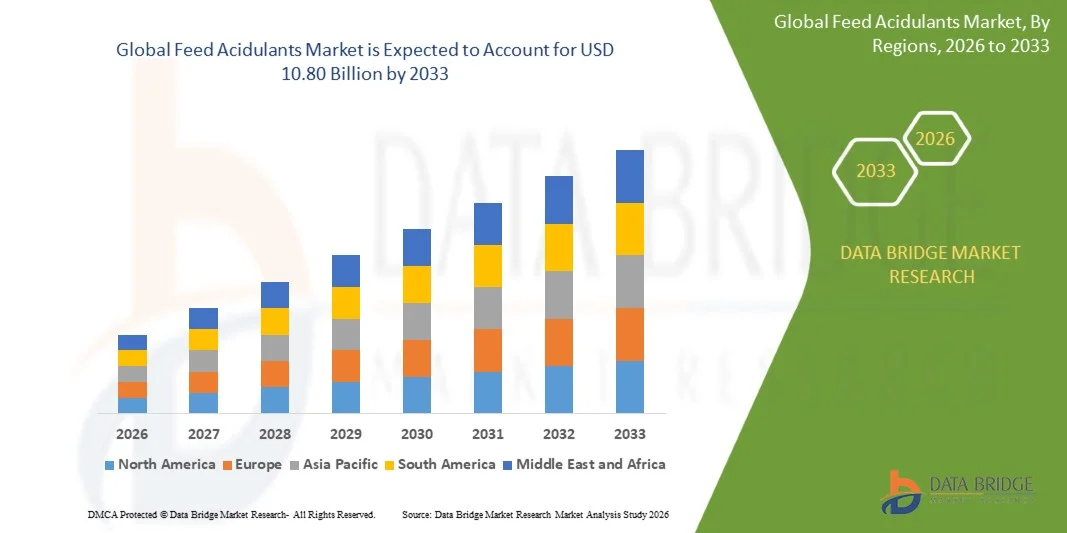
- As per Data Bridge Market Research analysis, the feed acidulants market was valued at USD 6.78 billion in 2025 and is projected to reach USD 10.80 billion by 2033, growing at a CAGR of 6.00% from 2026 to 2033.
- The market is experiencing consistent growth driven by rising demand for improved animal nutrition, increasing adoption of feed acidulants as alternatives to antibiotics, and expanding applications across poultry, swine, ruminants, aquaculture, and pet nutrition.
- The increasing emphasis on animal gut health and feed quality, combined with restrictions on antibiotic use in animal production, is compelling livestock producers and feed manufacturers to adopt acidulants. Organic and blended acidulants are gaining adoption as they help regulate feed pH, support nutrient utilization, suppress harmful microorganisms, and preserve feed quality, while advances in precision nutrition and controlled-release formulations are further supporting market growth.
Market Size & Forecast
- Global Market Value (2025): USD 6.78 Billion
- Expected Market Value (2033): USD 10.80 Billion
- Forecast CAGR (2026–2033): 6.00%
- Leading Region in 2025: North America
- Fastest Growing Region: Asia Pacific
What are the Major Takeaways of the Feed Acidulants Market?
- North America dominated the feed acidulants market with the largest revenue share of 31.9% in 2025, supported by large-scale livestock production, advanced feed manufacturing infrastructure, and widespread adoption of specialty feed additives.
- Asia-Pacific is expected to be the fastest-growing region at a CAGR of 6.5% from 2026 to 2033, fueled by rising meat, dairy, and egg consumption, expanding livestock production, and increasing adoption of acidulants for gut health and feed efficiency.
- The propionic acid segment led the market with a 34.12% share in 2025, driven by its strong antimicrobial properties and effectiveness in controlling mold and bacterial growth in animal feed.
- Formic acid are the fastest-growing source type, projected to register a CAGR of 7.5%, reflecting the surge in demand for acidulants that support gut health and microbial control.
- The poultry segment dominated the animal type category with a 43.15% revenue share in 2025, led by the large global poultry population and extensive commercial production of meat and eggs
- Organic feed acidulants accounted for 66% of the market share in 2025, preferred by increasing preference for functional acid solutions that improve feed quality and animal performance
- The apple segment is the fastest-growing fruit type category, with a CAGR of 6.5%, driven by increasing interest in fruit-derived flavor profiles and palatability-enhancing feed formulations.
Report Scope and Feed Acidulants Market Segmentation
|
Attributes |
Feed Acidulants Key Market Insights |
|
Segments Covered |
|
|
Countries Covered |
North America
Europe
Asia-Pacific
Middle East and Africa
South America
|
|
Key Market Players |
|
|
Market Opportunities |
|
|
Value Added Data Infosets |
In addition to the insights on market scenarios such as market value, growth rate, segmentation, geographical coverage, and major players, the market reports curated by the Data Bridge Market Research also include import export analysis, production capacity overview, production consumption analysis, price trend analysis, climate change scenario, supply chain analysis, value chain analysis, raw material/consumables overview, vendor selection criteria, PESTLE Analysis, Porter Analysis, and regulatory framework. |
What is the Key Trend in the Feed Acidulants Market?
- Feed manufacturers are increasingly adopting blended, buffered, and encapsulated acidulant formulations to improve pathogen control, feed preservation, gut health, and targeted delivery while overcoming the limitations associated with individual organic acids.
- For instance, in June 2024, Kemin Industries launched FORMYL in the U.S., a feed acidifier for swine that uses a proprietary blend of encapsulated calcium formate and citric acid. The encapsulation technology is designed to improve delivery and efficacy while supporting pathogen control and intestinal health.
- Advanced acidifier formulations enable manufacturers to combine multiple modes of action, improving antimicrobial activity while supporting digestive performance and feed quality.
- Feed producers and animal nutrition companies are increasingly integrating acidifiers with phytogenics, probiotics, and other functional additives to create multifunctional solutions for modern livestock production systems.
- For instance, in March 2025, Kemin Industries launched PROSIDIUM, a new antimicrobial solution for animal feed biosecurity based on peroxy acids, following the industry's development of alternatives to conventional organic-acid blends for controlling pathogens and improving feed safety.
- As livestock producers increasingly prioritize antibiotic reduction, pathogen management, feed safety, and sustainable animal production, the adoption of advanced multifunctional acidulant formulations is expected to accelerate, reinforcing acidifiers as an important component of modern animal nutrition.
What are the Key Drivers of the Feed Acidulants Market?
- The growing global emphasis on reducing antibiotic growth promoters in livestock production has significantly increased demand for feed acidulants capable of supporting gut health, controlling pathogens, and improving nutrient utilization without relying on conventional antibiotics.
- For instance, in August 2025, an article published in Science of the Total Environment identified acidifiers among the major antibiotic alternatives in livestock feeding and reported that these alternatives can improve animal health, feed quality, and production sustainability while helping address antimicrobial resistance
- Livestock producers, feed manufacturers, and animal nutrition companies are integrating organic acids into feeding programs to improve intestinal microbial balance, enhance nutrient digestibility, and maintain animal performance following restrictions on antibiotic growth promoters.
- For instance, in January 2025, an article published in Frontiers in Nutrition evaluated a compound organic acidifier containing L-malic, L-lactic, and acetic acids in 240 broilers over a six-week feeding trial; the study found improvements in growth performance, feed efficiency, carcass traits, and health indicators, supporting the use of organic acids as alternatives to antibiotic-based production practices.
- With livestock industries increasingly focused on antimicrobial resistance, animal health, feed efficiency, and sustainable production, feed acidulants are expected to remain important alternatives for maintaining productivity while reducing dependence on antibiotic growth promoters.
What Factors are Challenging the Growth of the Feed Acidulants Market?
- Corrosive properties, handling requirements, dosage sensitivity, and inconsistent responses across animal species create technical and operational challenges for the wider adoption of feed acidulants, particularly among smaller feed manufacturers.
- For instance, in October 2024, the European Food Safety Authority (EFSA) concluded that propionic acid, a feed additive used for terrestrial animals, is corrosive to skin and mucous membranes and strongly corrosive to the eyes, requiring protective clothing, gloves, eye protection, and respiratory protection during handling.
- The effectiveness of acidulants can also vary according to acid type, inclusion concentration, animal species, feed composition, buffering capacity, and the targeted location within the gastrointestinal tract.
- For instance, in August 2025, an article published in Translational Animal Science found that commercial acidifier blends may require relatively high inclusion rates to achieve targeted acid-binding capacity, with high inclusion potentially affecting diet palatability and feed intake.
- These technical limitations, combined with specialized storage, dosing, protective equipment, and formulation requirements, continue to increase implementation complexity, particularly for smaller feed mills and farms, potentially slowing the adoption of advanced acidulant solutions.
How is the Feed Acidulants Market Segmented?
The feed acidulants market is segmented on the basis of source, animal type, type, fruit type, and application.
- By Source
On the basis of source, the feed acidulants market is segmented into propionic acid, formic acid, citric acid, lactic acid, sorbic acid, malic acid, and acetic acid. The propionic acid segment dominated the market with an estimated 34.12% share in 2025, owing to its strong antimicrobial properties and effectiveness in controlling mold and bacterial growth in animal feed. Propionic acid is widely used as a preservative to extend feed shelf life and maintain feed quality during storage. It is particularly valuable in poultry and swine production, where microbial contamination can negatively affect animal health and productivity. Its dual role in feed preservation and gut-health management is strengthening its adoption among feed manufacturers.
The formic acid segment is projected to register the fastest growth at a CAGR of 7.5% during forecast period, driven by increasing demand for acidulants that support gut health and microbial control. Formic acid helps lower gastrointestinal pH and suppress harmful microorganisms in livestock production. It is increasingly being used as an alternative to conventional antibiotic-based growth-promoting solutions. Its ability to support nutrient digestion and feed efficiency is further increasing its use in intensive animal production. Advances in buffered and stabilized formulations are also improving handling characteristics and expanding commercial applications. Increasing emphasis on antibiotic reduction and improved animal performance is expected to sustain the rapid adoption of formic acid.
- By Animal Type
On the basis of animal type, the feed acidulants market is segmented into poultry, ruminants, swine, aquaculture, pets, and equine. The poultry segment dominated the market with an estimated 43.15% share in 2025, supported by the large global poultry population and extensive commercial production of meat and eggs. Feed acidulants are widely used in poultry diets to support intestinal health, microbial balance, feed preservation, and nutrient utilization. The increasing focus on controlling pathogenic microorganisms is encouraging poultry producers to incorporate acidulants into commercial feed programs. Growing demand for antibiotic-free poultry production is also strengthening the adoption of organic acid-based solutions.
The aquaculture segment is projected to register the fastest growth at a CAGR of 7.5% during forecast period, driven by the expansion of intensive fish and shrimp farming and rising demand for functional aquaculture feeds. Acidulants are increasingly incorporated into aquatic animal diets to support digestion, intestinal microbial balance, and feed utilization. Growing seafood consumption is encouraging producers to improve feed conversion and animal performance in commercial aquaculture systems. Acidulants can also contribute to feed preservation and microbial management in intensive production environments. Increasing investment in modern aquaculture infrastructure is creating additional demand for specialized functional feed additives.
- By Type
On the basis of type, the feed acidulants market is segmented into organic feed acidulants and inorganic feed acidulants. The organic feed acidulants segment dominated the market with an estimated 66% share in 2025, supported by increasing preference for functional acid solutions that improve feed quality and animal performance. Organic acidulants include formic, propionic, lactic, citric, malic, sorbic, and acetic acids, which provide multiple nutritional and preservation benefits. They are widely used for pathogen control, feed preservation, digestion improvement, and nutrient utilization across livestock applications. Increasing demand for antibiotic alternatives is strengthening their adoption in commercial feed formulations.
The organic feed acidulants segment is projected to register the fastest growth at a CAGR of 7.0% during forecast period, driven by increasing demand for natural and functional feed additives. Organic acidulants provide antimicrobial, pH-control, preservation, and digestive-support functions within animal nutrition programs. The shift toward reducing antibiotic use is encouraging livestock producers to adopt organic acids as alternative feed-management solutions. Manufacturers are developing customized formulations to address different animal species, feed compositions, and production objectives. Increasing use across poultry, swine, ruminants, aquaculture, and pet nutrition is expanding the application base of organic acidulants.
- By Fruit Type
On the basis of fruit type, the feed acidulants market is segmented into lemon, apple, orange, and tamarinds. The lemon segment dominated the fruit-type category with an estimated 35% share in 2025, supported by the use of citrus-derived acid profiles in specialized feed formulations. Lemon-based formulations can contribute to flavor management and palatability characteristics in animal feed. They can help mask undesirable flavors associated with certain feed ingredients and improve sensory acceptance. Citrus-derived acid profiles can also complement broader acidification strategies in functional feed products. Increasing interest in naturally derived formulation components is supporting the use of fruit-associated acidulant profiles.
The apple segment is projected to register the fastest growth at a CAGR of 6.5% during forecast period, supported by increasing interest in fruit-derived flavor profiles and palatability-enhancing feed formulations. Apple-based acidulant solutions can provide a mild acidic profile that may complement feed formulations designed for improved sensory acceptance. Increasing demand for natural and recognizable ingredients is encouraging manufacturers to explore fruit-associated formulation options. The segment can also benefit from the broader movement toward multifunctional feed additives that combine nutritional and sensory functions. Growing application across specialized livestock and pet nutrition products is creating additional demand.
- By Application
On the basis of application, the categories provided are bakery & confectionery, beverages, dairy & frozen desserts, meat industry, and others. The beverages segment dominated the application category with an estimated 39% share in 2025, supported by extensive use of acidulants for acidity regulation, flavor enhancement, preservation, and pH stabilization. Acidulants are widely incorporated into carbonated beverages, juices, energy drinks, and other ready-to-drink products. They help balance sweetness and provide the characteristic tartness required in many beverage formulations. Increasing consumption of functional beverages and convenience drinks is further supporting demand for acidulant ingredients. The broad use of acidulants across conventional and innovative beverage products continues to strengthen the leading position of this segment.
The dairy & frozen desserts segment is projected to register the fastest growth at a CAGR of 6.1% during forecast period, driven by increasing demand for yogurt, ice cream, gelato, and other value-added dairy products. Acidulants are used to regulate acidity, improve flavor, and support texture in dairy and frozen dessert formulations. Citric acid can also help prevent fat separation in ice cream and gelato applications. Growing consumer preference for diverse flavors and premium frozen desserts is creating additional demand for functional acidulant ingredients. Product innovation across dairy and frozen dessert categories is further expanding their formulation requirements. These factors are expected to support continued growth of acidulant applications in dairy and frozen dessert products.
Which Region Holds the Largest Share of the Feed Acidulants Market?
- North America dominated the feed acidulants market with the largest revenue share of 31.9% in 2025, supported by large-scale livestock production, advanced feed manufacturing infrastructure, and widespread adoption of specialty feed additives.
- The region also benefits from established poultry, swine, and dairy industries, growing emphasis on antibiotic-free animal production, and increasing use of functional feed additives. Rising investments in animal nutrition technologies and growing awareness of feed safety and microbial control continue to strengthen North America's position in the global feed acidulants market.
U.S. Feed Acidulants Market Insight
The U.S. feed acidulants market is witnessing strong growth due to rising demand for high-quality animal nutrition, expanding poultry and swine production, and increasing adoption of functional feed additives. The country’s mature livestock industry, along with growing emphasis on gut health, feed preservation, and microbial control, is driving demand for acidulant-based feed solutions. In addition, increasing efforts to reduce antibiotic use and improve feed efficiency are accelerating the adoption of feed acidulants across commercial livestock and poultry operations.
Asia-Pacific Feed Acidulants Market Insight
The Asia-Pacific feed acidulants market is expected to witness rapid growth, driven by expanding livestock production, increasing aquaculture activities, and rising demand for animal protein across countries such as China, India, and Japan. Growing awareness regarding animal gut health, feed safety, and microbial management, along with increasing adoption of functional feed additives, is supporting regional market expansion. In addition, the growing modernization of feed manufacturing and increasing focus on antibiotic alternatives are accelerating feed acidulant adoption across commercial animal production.
Japan Feed Acidulants Market Insight
The Japan feed acidulants market is witnessing consistent growth due to rising investments in advanced animal nutrition, feed quality, and livestock health management. Feed manufacturers and livestock producers are increasingly adopting acidulants to support gut health, microbial control, feed preservation, and efficient nutrient utilization. Moreover, increasing emphasis on high-quality animal production and the adoption of specialized functional feed formulations are further contributing to market growth in Japan.
China Feed Acidulants Market Insight
The China feed acidulants market is growing rapidly, driven by its large poultry, swine, and aquaculture industries and rising demand for efficient animal nutrition solutions. Growing emphasis on feed safety, gut health, pathogen control, and improved feed efficiency is significantly boosting demand for acidulant-based feed additives. In addition, modernization of commercial feed manufacturing, increasing awareness of animal health, and growing adoption of alternatives to antibiotic growth promoters are supporting the expansion of feed acidulants across China.
U.K. Feed Acidulants Market Insight
The U.K. feed acidulants market is experiencing steady growth, supported by established livestock production, increasing adoption of functional feed additives, and growing emphasis on animal health and feed safety. Rising demand for non-antibiotic feed solutions is encouraging livestock producers and feed manufacturers to incorporate acidulants for gut health, microbial management, and feed preservation. Furthermore, increasing focus on sustainable livestock production and high-quality animal nutrition is contributing to continued market growth in the U.K.
Germany Feed Acidulants Market Insight
The Germany feed acidulants market is expanding steadily due to the country’s strong livestock and animal feed industries, advanced feed manufacturing capabilities, and increasing adoption of functional feed additives. Feed manufacturers and livestock producers are increasingly utilizing acidulants to support gut health, feed hygiene, microbial control, and nutrient utilization. Continuous emphasis on reducing antibiotic use, improving feed quality, and adopting sustainable animal production practices is further driving the growth of feed acidulants in Germany.
Which are the Top Companies in Feed Acidulants Market?
The feed acidulants industry is primarily led by well-established companies, including:
- Kemin Industries, Inc. (U.S.)
- ADISSEO (France)
- NOVUS International, Inc. (U.S.)
- Corbion (Netherlands)
- Alltech, Inc. (U.S.)
- Jefo (Canada)
- Impextraco N.V. (Belgium)
- EW Nutrition (Germany)
- MIAVIT GmbH (Germany)
- Lucta S.A. (Spain)
- ADDCON GmbH (Germany)
- Anpario plc (U.K.)
- Phibro LLC (U.S.)
- DSM-Firmenich AG (Switzerland)
- Evonik Operations GmbH (Germany)
- BASF SE (Germany)
- Perstorp AB (Sweden)
- Cargill, Incorporated (U.S.)
- ADM Company (U.S.)
- Tate & Lyle PLC (U.K.)
What are Latest Developments in Feed Acidulants Market?
- In March 2025, Kemin Industries launched PROSIDIUM, a new feed pathogen-control solution based on novel peroxy acids at VIV Asia in Bangkok. The product was developed to help raw-material and animal-feed producers control pathogens, including Salmonella and viruses, and improve feed biosecurity for poultry and swine production.
- In August 2024, dsm-firmenich expanded its animal nutrition and health manufacturing capabilities in India through investments supporting its feed-additive portfolio and regional supply capabilities. The development strengthened local production and service capabilities for animal nutrition solutions and supported the company’s growing presence in the Asia-Pacific feed market.
- In June 2024, Kemin Industries launched FORMYL in the U.S., an advanced feed acidifier designed for swine health and productivity. The formulation combines encapsulated calcium formate and citric acid to provide targeted gastrointestinal acidification, support pathogen control, and promote intestinal health as a non-antibiotic feed solution.
- In August 2022, Kemin Industries launched ENTEROSURE, an intestinal-health feed additive for poultry producers in South Asia. The solution was developed to support resilient intestinal health and enhanced control of enteric bacterial pathogens, helping producers improve productivity while reducing reliance on antibiotics.
- In January 2021, Kemin Industries highlighted the increasing use of acidifiers as part of antibiotic-growth-promoter alternative programs in poultry production. The company emphasized acidifier blends containing organic acids and phytochemicals as feed-additive solutions supporting intestinal integrity, gut health, and enzyme function in antibiotic-free production systems.

- Interactive Data Analysis Dashboard
- Company Analysis Dashboard for high growth potential opportunities
- Research Analyst Access for customization & queries
- Competitor Analysis with Interactive dashboard
- Latest News, Updates & Trend analysis
- Harness the Power of Benchmark Analysis for Comprehensive Competitor Tracking
Data collection and base year analysis are done using data collection modules with large sample sizes. The stage includes obtaining market information or related data through various sources and strategies. It includes examining and planning all the data acquired from the past in advance. It likewise envelops the examination of information inconsistencies seen across different information sources. The market data is analysed and estimated using market statistical and coherent models. Also, market share analysis and key trend analysis are the major success factors in the market report. To know more, please request an analyst call or drop down your inquiry.
The key research methodology used by DBMR research team is data triangulation which involves data mining, analysis of the impact of data variables on the market and primary (industry expert) validation. Data models include Vendor Positioning Grid, Market Time Line Analysis, Market Overview and Guide, Company Positioning Grid, Patent Analysis, Pricing Analysis, Company Market Share Analysis, Standards of Measurement, Global versus Regional and Vendor Share Analysis. To know more about the research methodology, drop in an inquiry to speak to our industry experts.
Data Bridge Market Research is a leader in advanced formative research. We take pride in servicing our existing and new customers with data and analysis that match and suits their goal. The report can be customized to include price trend analysis of target brands understanding the market for additional countries (ask for the list of countries), clinical trial results data, literature review, refurbished market and product base analysis. Market analysis of target competitors can be analyzed from technology-based analysis to market portfolio strategies. We can add as many competitors that you require data about in the format and data style you are looking for. Our team of analysts can also provide you data in crude raw excel files pivot tables (Fact book) or can assist you in creating presentations from the data sets available in the report.