What is the Feed Carbohydrase Market Size and Growth Rate?
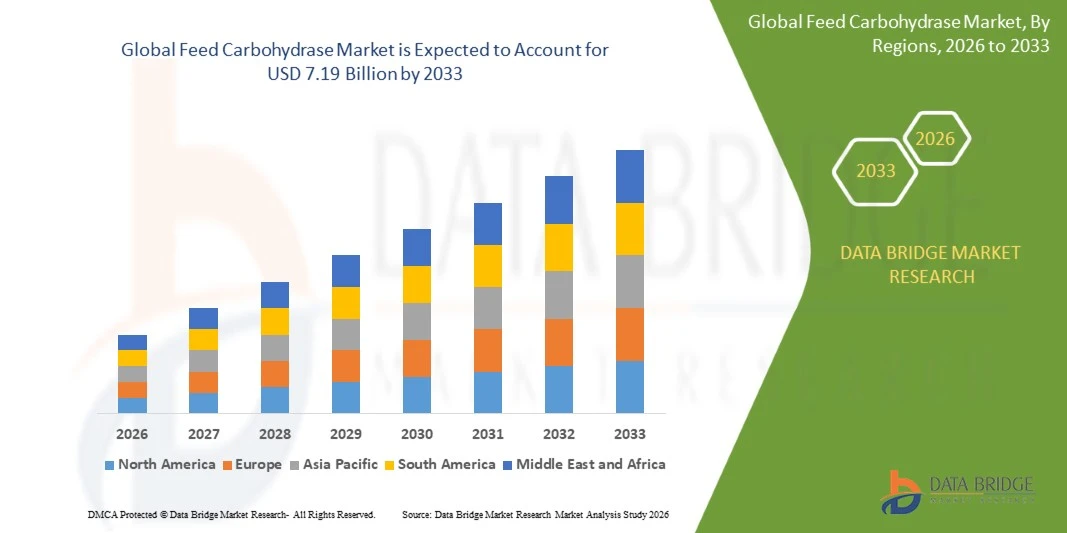
- As per Data Bridge Market Research analysis, the feed carbohydrase market was valued at USD 4.19 billion in 2025 and is projected to reach USD 7.19 billion by 2033, growing at a CAGR of 7.00% from 2026 to 2033.
- The market is experiencing consistent growth driven by rising demand for improved animal nutrition, increasing adoption of feed enzymes to enhance nutrient digestibility, and expanding applications across poultry, swine, ruminants, and aquaculture feed production.
- The increasing demand for high-quality animal protein globally, combined with rising feed costs and growing emphasis on sustainable livestock production, is compelling feed manufacturers and livestock producers to adopt advanced carbohydrase enzyme solutions. Enzymes such as xylanases, beta-glucanases, and cellulases are improving feed conversion efficiency, nutrient absorption, and animal performance, while reducing feed waste and dependence on conventional feed ingredients.
Market Size & Forecast
- Global Market Value (2025): USD 4.19 Billion
- Expected Market Value (2033): USD 7.19 Billion
- Forecast CAGR (2026–2033): 7.00%
- Leading Region in 2025: North America
- Fastest Growing Region: Asia Pacific
What are the Major Takeaways of the Feed Carbohydrase Market?
- North America dominated the feed carbohydrase market with the largest revenue share of 35.4% in 2025, supported by advanced livestock farming practices, established animal feed manufacturing infrastructure, and increasing adoption of feed enzyme technologies.
- Asia-Pacific is expected to be the fastest-growing region at a CAGR of 8.6% from 2026 to 2033, fueled by rising animal protein consumption, expanding livestock production, and growing investments in feed manufacturing across China, India, and Southeast Asia.
- The dry segment led the market with a 53.2% share in 2025, driven by its convenient storage, handling, and compatibility with conventional feed manufacturing processes
- Liquid are the fastest-growing type, projected to register a CAGR of 8.4%, reflecting the surge in demand for flexible enzyme application and specialized feed-processing solutions.
- The microorganism segment dominated the source category with a 82.0% revenue share in 2025, led by the widespread use of bacteria, fungi, and yeasts for commercial enzyme production
- Amylases accounted for 48.3% of the market share in 2025, preferred by the widespread use of starch-degrading enzymes across carbohydrate-processing applications.
- The aquatic animals segment is the fastest-growing livestock category, with a CAGR of 9.2%, driven by rising aquaculture production, increasing demand for high-quality fish and shrimp feed, and growing adoption of carbohydrase enzymes
Report Scope and Feed Carbohydrase Market Segmentation
|
Attributes |
Feed Carbohydrase Key Market Insights |
|
Segments Covered |
|
|
Countries Covered |
North America
Europe
Asia-Pacific
Middle East and Africa
South America
|
|
Key Market Players |
|
|
Market Opportunities |
|
|
Value Added Data Infosets |
In addition to the insights on market scenarios such as market value, growth rate, segmentation, geographical coverage, and major players, the market reports curated by the Data Bridge Market Research also include import export analysis, production capacity overview, production consumption analysis, price trend analysis, climate change scenario, supply chain analysis, value chain analysis, raw material/consumables overview, vendor selection criteria, PESTLE Analysis, Porter Analysis, and regulatory framework. |
What is the Key Trend in the Feed Carbohydrase Market?
- Feed manufacturers are increasingly adopting advanced carbohydrase enzyme blends to improve nutrient digestibility, enhance feed conversion efficiency, and reduce dependence on costly conventional feed ingredients.
- For instance, in March 2024, EW Nutrition launched Axxess XY, a thermostable xylanase at VICTAM Asia 2024 in Bangkok, designed to break down soluble and insoluble fiber in corn, wheat, grain by-products, and oilseed cakes, improving nutrient release and feed formulation flexibility.
- Multi-enzyme formulations combining xylanase, beta-glucanase, and cellulase are gaining attention for their ability to break down non-starch polysaccharides in cereal-based feed ingredients.
- Livestock producers are increasingly integrating enzyme supplementation into precision feeding strategies to improve animal performance while supporting more efficient use of feed resources.
- For instance, in June 2024, IFF announced EU-wide regulatory approval for Axtra XAP, a multi-enzyme blend, and Syncra AVI, an enzyme-probiotic complex, for poultry feed, reflecting the growing trend toward specialized enzyme solutions to improve feed performance and support modern poultry production.
- As feed producers prioritize improved nutrient utilization, cost control, and sustainable animal production, demand for targeted carbohydrase formulations is expected to increase, reinforcing enzyme supplementation as a key component of modern feed management.
What are the Key Drivers of the Feed Carbohydrase Market?
- The rising demand for cost-effective animal protein and increasing feed ingredient prices are encouraging livestock producers to adopt carbohydrase enzymes that improve nutrient availability, enhance feed conversion, and reduce feed formulation costs.
- For instance, in November 2024, a study published in Archives of Animal Nutrition evaluating xylanase supplemented with traces of beta-glucanase in weaned pigs. The study found improved pig performance when the enzyme was used in diets with reduced metabolizable energy, supporting demand for carbohydrases that enhance feed utilization and production efficiency.
- Growing emphasis on sustainable livestock production is encouraging feed manufacturers to improve the utilization of cereal-based ingredients and reduce nutrient losses through targeted enzyme supplementation.
- For instance, in September 2024, a study published in the Journal of Animal Science and Technology examining xylanase supplementation in broiler diets containing wheat bran. The findings highlighted the potential of xylanase to improve broiler performance when diets contain non-starch polysaccharides, reinforcing demand for feed enzymes that improve nutrient utilization and livestock productivity.
- As livestock producers increasingly prioritize feed efficiency, animal productivity, and environmental performance, demand for scientifically validated carbohydrase solutions is expected to strengthen across commercial feed manufacturing and livestock production.
What Factors are Challenging the Growth of the Feed Carbohydrase Market?
- Feed carbohydrase enzymes can lose activity under high-temperature pelleting conditions, creating technical challenges for manufacturers seeking to maintain consistent enzyme performance during commercial feed processing.
- For instance, in April 2023, researchers an article published in Animal Feed Science and Technology examining carbohydrate-active enzymes used in animal feed. The review highlighted challenges in developing and applying enzyme solutions, including variability in performance across feed ingredients and the need to optimize enzyme combinations for different diets.
- These stability limitations may require specialized enzyme formulations, protective technologies, or post-pelleting application methods, increasing production complexity and operational costs for feed manufacturers.
- Variations in feed ingredient composition, processing temperatures, storage conditions, and animal species can also affect enzyme performance, making consistent product formulation and dosage optimization challenging.
- For instance, in November 2022, researchers published a study in Plant Biotechnology Journal investigating the production of feed enzymes directly in barley seeds. The researchers noted that conventional enzyme production through microbial fermentation involves application costs and that enzyme activity can decline during feed granulation, motivating alternative production methods to improve cost efficiency and stability
- These technical constraints, combined with formulation costs and the need for validated performance across different feed ingredients, can limit adoption among price-sensitive feed producers and smaller livestock operations.
How is the Feed Carbohydrase Market Segmented?
The feed carbohydrase market is segmented on the basis of type, source, product type, livestock, and application.
- By Type
On the basis of type, the feed carbohydrase market is segmented into liquid and dry. The dry segment dominated the market with an estimated 53.2% share in 2025, supported by its convenient storage, handling, and compatibility with conventional feed manufacturing processes. Dry enzyme formulations are widely used in commercial feed production because they can be incorporated into premixes and feed blends with relative ease. Their comparatively longer shelf life under appropriate storage conditions supports distribution across different regions. Dry formulations also offer practical advantages for large-scale feed mills that require standardized ingredient handling and dosing procedures. Improvements in enzyme coating and stabilization technologies are helping manufacturers maintain activity during processing.
The liquid segment is projected to register the fastest growth at an estimated CAGR of 8.4% during forecast period, driven by increasing demand for flexible enzyme application and specialized feed-processing solutions. Liquid formulations can support precise dosing in suitable manufacturing systems and may be applied after pelleting to minimize exposure to high temperatures. Their use is particularly relevant when manufacturers need to preserve enzyme activity under demanding processing conditions. Advances in liquid formulation stability and dosing equipment are improving handling efficiency. Growing interest in customized enzyme supplementation is also supporting adoption among technologically advanced feed manufacturers. However, storage requirements, handling procedures, and compatibility with processing equipment can influence adoption.
- By Source
On the basis of source, the feed carbohydrase market is segmented into microorganism, plant, and animal. The microorganism segment dominated the market with an estimated 82.0% share in 2025, driven by the widespread use of bacteria, fungi, and yeasts for commercial enzyme production. Microbial fermentation enables manufacturers to produce enzymes with consistent activity and scalable production volumes. Microorganism-derived carbohydrase can be developed for specific feed ingredients and livestock nutritional requirements. Advances in fermentation technology and microbial strain engineering are improving production efficiency. These enzymes are widely used to break down complex carbohydrates and improve nutrient availability in animal feed.
The plant segment is expected to witness growth at an estimated CAGR of 6.8% during forecast period, as manufacturers explore alternative enzyme sources and diversified production approaches. Plant-derived enzymes can offer useful catalytic properties for specific feed-processing applications. Growing research into natural enzyme sources is encouraging the evaluation of plant-based alternatives. Advances in extraction, purification, and stabilization technologies may improve their commercial feasibility. Demand for specialized enzymes is also encouraging research into feed formulations that use different biological sources. However, production consistency, extraction efficiency, and cost competitiveness remain important considerations.
- By Product Type
On the basis of product type, the feed carbohydrase market is segmented into amylases, cellulases, pectinases, lactase, and others. The amylases segment is expected to dominate the market with an estimated 48.3% share in 2025, supported by the widespread use of starch-degrading enzymes across carbohydrate-processing applications. Starch is an important energy source in many cereal-based animal feed formulations. Amylases help break down starch into smaller carbohydrates that animals can utilize more readily. Their application is relevant across poultry, swine, and other livestock diets. Feed manufacturers use amylases to support energy availability and improve feed formulation efficiency.
The cellulases segment is projected to register the fastest growth at an estimated CAGR of 7.73% during forecast period, as livestock producers seek improved utilization of fibrous feed ingredients. Cellulases break down cellulose, a structural carbohydrate found in plant cell walls. Their use can help make nutrients more accessible in selected agricultural by-products and plant-based feed ingredients. Increasing efforts to incorporate alternative raw materials into feed formulations are supporting research into cellulose-degrading enzymes. Advances in enzyme engineering are helping develop formulations suited to specific feed compositions and processing conditions. Cellulases may complement other carbohydrase in multi-enzyme blends designed to improve feed digestibility.
- By Livestock
On the basis of livestock, the feed carbohydrase market is segmented into poultry, swine, ruminants, aquatic animals, and others. The poultry segment dominated the market with an estimated 43.0% share in 2025, supported by extensive global production of chicken meat and eggs and the widespread use of formulated feed. Poultry diets frequently contain cereal grains that include non-starch polysaccharides, which can limit nutrient utilization. Carbohydrase such as xylanase and beta-glucanase help break down these compounds and improve feed digestibility. Enzyme supplementation can also support feed conversion efficiency and more consistent production performance. Commercial poultry operations benefit from nutritional strategies that improve output while managing feed costs.
The aquatic animals segment is projected to register the fastest growth at an estimated CAGR of 9.2% during forecast period, as aquaculture producers increasingly use formulated feeds to support intensive fish and shrimp farming. Plant-derived ingredients are being incorporated into selected aquafeed formulations to diversify raw material sourcing. However, these ingredients can contain complex carbohydrates that vary in digestibility across aquatic species. Carbohydrase can help break down selected carbohydrate fractions and improve the utilization of suitable feed ingredients. Growing aquaculture production is increasing demand for specialized nutrition strategies tailored to different species. Research into enzyme stability, feed processing, and nutrient availability is further supporting product development.
- By Application
On the basis of application, the feed carbohydrase market is segmented into food and beverages, animal feed, pharmaceuticals, and others. The animal feed segment is expected to dominate the market with an estimated 85.0% share in 2025, as carbohydrase are primarily used to improve the nutritional value and digestibility of livestock feed. These enzymes break down complex carbohydrates in grains and other plant-based ingredients. Their inclusion can improve nutrient availability and support efficient feed conversion across commercial animal production systems. Feed manufacturers also use carbohydrase to help formulate diets containing alternative raw materials. Increasing pressure to control feed costs is encouraging the adoption of enzyme-based nutritional solutions.
The pharmaceuticals segment is projected to register the fastest growth at an estimated CAGR of 7.45% during forecast period, supported by increasing use of carbohydrate-degrading enzymes in digestive health products and specialized therapeutic applications. Carbohydrase can help break down complex carbohydrates into simpler compounds under appropriate conditions. Research into enzyme formulation and delivery is supporting the development of specialized products. Advances in biotechnology are improving the ability to produce enzymes with targeted functional characteristics. Growing interest in enzyme-based health solutions may support demand from pharmaceutical manufacturers. However, pharmaceutical applications differ from animal-feed uses in their formulation requirements, regulatory standards, and quality controls.
Which Region Holds the Largest Share of the Feed Carbohydrase Market?
- North America dominated the feed carbohydrase market with the largest revenue share of 35.4% in 2025, supported by advanced livestock farming practices, established animal feed manufacturing infrastructure, and increasing adoption of feed enzyme technologies.
- The region also benefits from strong demand for high-quality animal protein, widespread use of formulated animal feed, and continuous advancements in feed enzyme technologies. Increasing focus on feed conversion efficiency, improved nutrient digestibility, and sustainable livestock production continues to strengthen North America's position in the global feed carbohydrase market.
U.S. Feed Carbohydrase Market Insight
The U.S. feed carbohydrase market is witnessing strong growth due to rising demand for high-quality animal protein, increasing adoption of advanced animal nutrition solutions, and growing emphasis on feed conversion efficiency. The country’s established livestock industry, along with widespread use of enzyme-supplemented feed in poultry and swine production, is driving demand for carbohydrase. In addition, increasing feed ingredient costs and growing focus on sustainable livestock farming are accelerating the adoption of enzyme technologies to improve nutrient digestibility and optimize feed utilization.
Asia-Pacific Feed Carbohydrase Market Insight
The Asia-Pacific feed carbohydrase market is expected to witness rapid growth, driven by expanding livestock production, rising meat consumption, and increasing investments in commercial feed manufacturing across countries such as China, India, and Japan. Growing awareness regarding animal nutrition, rising demand for cost-effective feed formulations, and increasing adoption of enzyme-based feed additives are supporting regional market expansion. In addition, the growth of poultry farming and aquaculture, along with increasing use of plant-based feed ingredients, is accelerating carbohydrase adoption across the region.
Japan Feed Carbohydrase Market Insight
The Japan feed carbohydrase market is witnessing consistent growth due to increasing demand for efficient animal nutrition, rising focus on feed quality, and continued development of advanced livestock production practices. Feed manufacturers and livestock producers are increasingly adopting enzyme supplementation to improve nutrient digestibility, optimize feed conversion, and reduce feed waste. Moreover, growing interest in sustainable feed formulation, efficient use of alternative feed ingredients, and technological advancements in enzyme production are further contributing to market growth.
China Feed Carbohydrase Market Insight
The China feed carbohydrase market is growing rapidly, driven by large-scale livestock production, rising demand for animal protein, and increasing emphasis on improving feed efficiency. Growing adoption of enzyme-based feed additives across poultry, swine, and aquaculture industries is significantly boosting market demand. In addition, efforts to optimize feed ingredient utilization, reduce production costs, and improve livestock productivity are encouraging feed manufacturers to incorporate carbohydrase into commercial feed formulations, positioning China as an important market for feed enzyme technologies.
U.K. Feed Carbohydrase Market Insight
The U.K. feed carbohydrase market is experiencing steady growth, supported by increasing adoption of advanced animal nutrition technologies, rising emphasis on feed efficiency, and growing demand for sustainable livestock production. Feed manufacturers are increasingly using carbohydrase to improve the digestibility of cereal-based diets and support efficient utilization of alternative feed ingredients. Furthermore, continued innovation in enzyme formulations, growing focus on animal productivity, and efforts to reduce nutrient waste are contributing to the adoption of feed carbohydrase solutions across poultry, swine, and other livestock sectors.
Germany Feed Carbohydrase Market Insight
The Germany feed carbohydrase market is expanding steadily due to the country’s established animal feed manufacturing industry, strong focus on livestock nutrition, and increasing adoption of scientifically developed feed additives. Feed producers are increasingly incorporating carbohydrase into formulated diets to improve nutrient availability, enhance feed conversion efficiency, and optimize the use of cereal-based ingredients. Continuous advancements in enzyme formulation, growing interest in sustainable livestock production, and increasing emphasis on resource-efficient feed manufacturing are further supporting market growth in Germany.
Which are the Top Companies in Feed Carbohydrase Market?
The feed carbohydrase industry is primarily led by well-established companies, including:
- dsm-firmenich (Switzerland)
- International Flavors & Fragrances Inc. (U.S.)
- BASF SE (Germany)
- AB Enzymes GmbH (Germany)
- NOVUS INTERNATIONAL, INC. (U.S.)
- EW Nutrition GmbH (Germany)
- Kemin Industries, Inc. (U.S.)
- Alltech, Inc. (U.S.)
- Amano Enzyme Inc. (Japan)
- Advanced Enzyme Technologies Limited (India)
- BIO-CAT, Inc. (U.S.)
- Aumgene Biosciences (India)
- Lumis Biotech Private Limited (India)
- Enzyme Bioscience (India)
- Specialty Enzymes & Probiotics (U.S.)
- Biovet JSC (Bulgaria)
- Huvepharma EOOD (Bulgaria)
- Nutrex NV (Belgium)
- BioResource International, Inc. (U.S.)
- Adisseo France SAS (France)
What are Latest Developments in Feed Carbohydrase Market?
- In April 2025, NOVUS International introduced CIBENZA® XCEL Xylanase Enzyme Feed Additive in India, expanding access to enzyme-based poultry nutrition solutions. The product is designed to break down soluble and insoluble xylans in feed ingredients, helping improve nutrient availability, gut health, and feed efficiency. The launch also strengthened NOVUS’s regional support for poultry producers seeking to optimize feed formulation and manage ingredient costs.
- In March 2024, EW Nutrition launched Axxess XY at VICTAM 2024 in Bangkok, Thailand. Axxess XY is a thermostable xylanase developed to break down soluble and insoluble fiber fractions in ingredients such as corn, wheat, grain by-products, and oilseed cakes. The enzyme is designed to release nutrients trapped in plant cell walls, reduce digesta viscosity, and provide greater flexibility in feed formulation under different processing conditions
- In March 2023, BASF and Cargill (Provimi) expanded their feed-enzyme partnership to South Korea, marking the first Asian market added to their enzyme development and distribution agreement. The expansion introduced Enzae Manno, made with BASF’s Natupulse TS mannanase, to South Korean customers. The collaboration combined BASF’s enzyme research capabilities with Cargill’s animal nutrition expertise to support feed efficiency, animal productivity, and more sustainable protein production.
- In January 2022, BASF expanded production capacity at its enzyme plant in Ludwigshafen, Germany, with the expanded facility beginning production and larger volumes of feed enzymes becoming available. The additional capacity supported the supply of Natuphos E phytase, Natugrain TS xylanase and glucanase, and Natupulse TS mannanase. The development was intended to help BASF meet increasing demand for feed-enzyme solutions used to improve nutrient utilization in animal nutrition.
- In December 2021, BASF launched Natupulse TS, a mannanase feed enzyme developed to improve nutrient digestion and support more cost-effective animal feed production. The enzyme breaks down beta-mannans into smaller components, helping reduce digesta viscosity and improve the digestibility of feed nutrients. BASF also highlighted its potential to complement existing enzyme products, including phytase and xylanase-based solutions, in poultry feed formulations.
- Interactive Data Analysis Dashboard
- Company Analysis Dashboard for high growth potential opportunities
- Research Analyst Access for customization & queries
- Competitor Analysis with Interactive dashboard
- Latest News, Updates & Trend analysis
- Harness the Power of Benchmark Analysis for Comprehensive Competitor Tracking
Data collection and base year analysis are done using data collection modules with large sample sizes. The stage includes obtaining market information or related data through various sources and strategies. It includes examining and planning all the data acquired from the past in advance. It likewise envelops the examination of information inconsistencies seen across different information sources. The market data is analysed and estimated using market statistical and coherent models. Also, market share analysis and key trend analysis are the major success factors in the market report. To know more, please request an analyst call or drop down your inquiry.
The key research methodology used by DBMR research team is data triangulation which involves data mining, analysis of the impact of data variables on the market and primary (industry expert) validation. Data models include Vendor Positioning Grid, Market Time Line Analysis, Market Overview and Guide, Company Positioning Grid, Patent Analysis, Pricing Analysis, Company Market Share Analysis, Standards of Measurement, Global versus Regional and Vendor Share Analysis. To know more about the research methodology, drop in an inquiry to speak to our industry experts.
Data Bridge Market Research is a leader in advanced formative research. We take pride in servicing our existing and new customers with data and analysis that match and suits their goal. The report can be customized to include price trend analysis of target brands understanding the market for additional countries (ask for the list of countries), clinical trial results data, literature review, refurbished market and product base analysis. Market analysis of target competitors can be analyzed from technology-based analysis to market portfolio strategies. We can add as many competitors that you require data about in the format and data style you are looking for. Our team of analysts can also provide you data in crude raw excel files pivot tables (Fact book) or can assist you in creating presentations from the data sets available in the report.