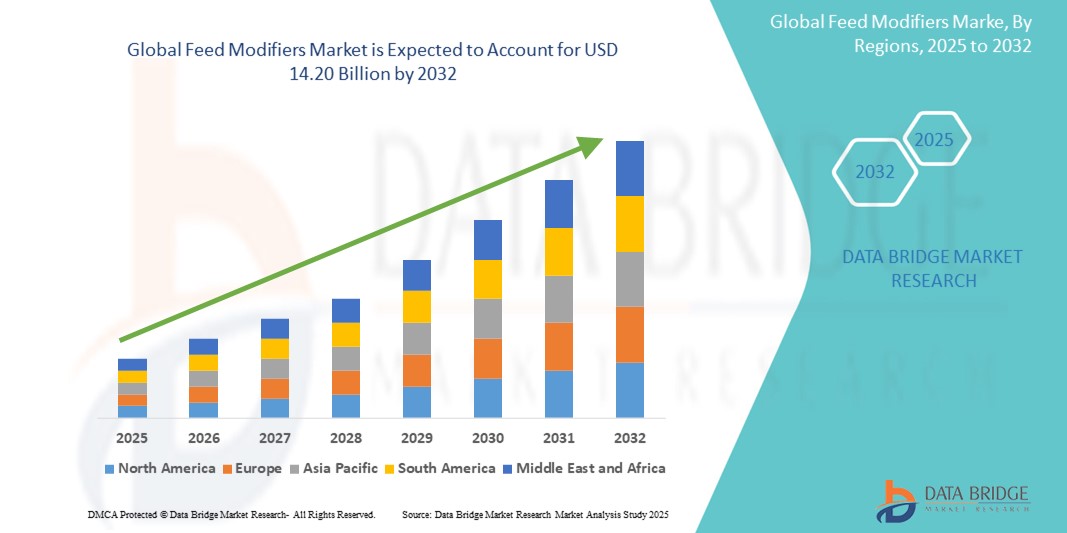
Feed Modifiers Market Size
- The global feed modifiers market size was valued at USD 9.45 billion in 2024 and is expected to reach USD 14.20 billion by 2032, at a CAGR of 5.20% during the forecast period
- The market growth is primarily driven by increasing demand for high-quality animal nutrition, advancements in feed technology, and growing awareness of livestock health and productivity
- Rising consumer preference for sustainable and organic feed solutions, coupled with stringent regulations on animal feed safety, is further accelerating the adoption of feed modifiers across various livestock sectors
Feed Modifiers Market Analysis
- Feed modifiers, such as mycotoxin binders, enhance animal health by improving nutrient absorption, reducing toxin impact, and boosting immunity in livestock such as poultry, swine, and aquatic animals
- The growing demand for feed modifiers is fueled by rising meat consumption, increasing livestock production, and the need for cost-effective feed solutions to improve yield and animal welfare
- North America dominated the feed modifiers market with the largest revenue share of 38.5% in 2024, driven by advanced livestock farming practices, high adoption of feed additives, and the presence of key industry players
- Asia-Pacific is expected to be the fastest-growing region during the forecast period, attributed to rapid urbanization, increasing meat consumption, and rising investments in livestock farming in countries such as China and India
- The mycotoxin binders segment dominated the largest market revenue share of 38.5% in 2024, driven by the rising risk of mycotoxin contamination in feed crops and the critical need to protect livestock health. Mycotoxin binders, such as clay, yeast, and silicates, prevent toxin absorption, enhancing animal performance and safety
Report Scope and Feed Modifiers Market Segmentation
|
Attributes |
Feed Modifiers Key Market Insights |
|
Segments Covered |
|
|
Countries Covered |
North America
Europe
Asia-Pacific
Middle East and Africa
South America
|
|
Key Market Players |
|
|
Market Opportunities |
|
|
Value Added Data Infosets |
In addition to the insights on market scenarios such as market value, growth rate, segmentation, geographical coverage, and major players, the market reports curated by the Data Bridge Market Research also include import export analysis, production capacity overview, production consumption analysis, price trend analysis, climate change scenario, supply chain analysis, value chain analysis, raw material/consumables overview, vendor selection criteria, PESTLE Analysis, Porter Analysis, and regulatory framework. |
Feed Modifiers Market Trends
“Increasing Integration of Advanced Biotechnology and Precision Nutrition”
- The global feed modifiers market is experiencing a notable trend toward the integration of advanced biotechnology and precision nutrition techniques
- These technologies enable enhanced feed formulation and analysis, providing deeper insights into animal health, growth efficiency, and nutritional requirements
- Biotechnology-driven feed modifiers, such as enzyme-based modifiers and microbial solutions, allow for proactive improvement in feed digestibility and nutrient absorption, reducing waste and environmental impact
- For instance, companies are developing precision nutrition platforms that tailor feed compositions to specific livestock needs, optimizing growth rates and health outcomes for poultry, swine, and aquatic animals
- This trend enhances the value proposition of feed modifiers, making them more appealing to livestock producers and feed manufacturers aiming to improve productivity and sustainability
- Advanced analytics can assess a wide range of feed performance metrics, including nutrient uptake, gut health, and resistance to mycotoxin contamination, enabling customized solutions for different livestock types
Feed Modifiers Market Dynamics
Driver
“Rising Demand for High-Quality Animal Feed and Sustainable Livestock Production”
- Increasing global demand for high-quality animal products, such as meat, eggs, and dairy, is a major driver for the feed modifiers market
- Feed modifiers, such as mycotoxin binders and enzyme-based modifiers, enhance animal health by mitigating the harmful effects of mycotoxins, improving feed efficiency, and boosting productivity
- Government regulations, particularly in regions such as North America, mandating strict feed safety and quality standards, are contributing to the widespread adoption of feed modifiers
- The growth of precision livestock farming and advancements in biotechnology are further enabling the development of sophisticated feed modifier applications, offering improved animal welfare and reduced environmental impact
- Feed manufacturers are increasingly incorporating advanced feed modifiers as standard or optional additives to meet consumer expectations for safe and sustainable animal products
Restraint/Challenge
“High Cost of Advanced Feed Modifiers and Regulatory Compliance Concerns”
- The significant initial investment required for developing and incorporating advanced feed modifiers, such as organic and enzyme-based solutions, can be a barrier to adoption, particularly for small-scale livestock producers in emerging markets
- Integrating advanced feed modifiers into existing feed production systems can be complex and costly, requiring specialized equipment and expertise
- In addition, regulatory compliance and safety concerns pose a major challenge. Feed modifiers, especially those addressing mycotoxins, must meet stringent safety and efficacy standards, raising concerns about compliance with diverse regional regulations
- The fragmented regulatory landscape across different countries regarding feed additive approvals, usage limits, and safety standards complicates operations for international manufacturers and suppliers
- These factors can deter potential adopters and limit market expansion, particularly in regions with high cost sensitivity or stringent regulatory oversight
Feed Modifiers market Scope
The market is segmented on the basis of type, livestock, source, and form.
- By Type
On the basis of type, the global feed modifiers market is segmented into mycotoxin binders and others. The mycotoxin binders segment dominated the largest market revenue share of 38.5% in 2024, driven by the rising risk of mycotoxin contamination in feed crops and the critical need to protect livestock health. Mycotoxin binders, such as clay, yeast, and silicates, prevent toxin absorption, enhancing animal performance and safety.
The others segment, which includes palatability enhancers and feed preservatives, is expected to witness the fastest growth rate of 5.8% from 2025 to 2032, propelled by increasing demand for natural feed additives and growing awareness of feed quality’s impact on livestock productivity. Advancements in organic feed modifiers further boost adoption in this segment.
- By Livestock
On the basis of livestock, the global feed modifiers market is segmented into poultry (layers, breeders), swine, aquatic animals, and others. The poultry segment dominated the market with a revenue share of 45.2% in 2024, attributed to the high global demand for poultry meat and eggs, coupled with the need for mycotoxin binders to ensure feed safety and enhance egg production and quality. The poultry sector’s rapid expansion, particularly in developing regions, supports this dominance.
The aquatic animals segment is anticipated to experience the fastest growth rate of 6.9% from 2025 to 2032, driven by the expanding aquaculture industry, especially in Asia Pacific. The need for specialized feed modifiers to support fish health and growth in intensive farming systems fuels this segment’s rapid adoption.
- By Source
On the basis of source, the global feed modifiers market is segmented into inorganic and organic. The inorganic segment accounted for the largest market revenue share of 62.8% in 2024, owing to the widespread use of inorganic mycotoxin binders such as bentonite, zeolite, and hydrated sodium calcium aluminosilicate (HSCAS). These binders offer cost-effective solutions and reliable binding properties for various mycotoxins.
The organic segment is projected to witness significant growth at a CAGR of 7.1% from 2025 to 2032, driven by increasing consumer preference for organic livestock products and the shift toward natural growth promoters. Organic binders, such as yeast and charcoal, are gaining traction due to their eco-friendly properties and alignment with sustainable farming practices.
- By Form
On the basis of form, the global feed modifiers market is segmented into dry and liquid. The dry segment held the largest market revenue share of 78.6% in 2024, due to its ease of handling, storage, and accurate dosage measurement. Dry feed modifiers, particularly mycotoxin binders, mix readily with feed ingredients, making them preferred by livestock producers.
The liquid segment is expected to witness the fastest growth rate of 6.4% from 2025 to 2032, driven by advancements in liquid feed modifier formulations that enhance palatability and nutrient absorption. The rising adoption of liquid additives in aquaculture and swine farming, particularly in Asia Pacific, supports this segment’s growth.
Feed Modifiers Market Regional Analysis
- North America dominated the feed modifiers market with the largest revenue share of 38.5% in 2024, driven by advanced livestock farming practices, high adoption of feed additives, and the presence of key industry players
- Consumers prioritize feed modifiers for improving feed efficiency, reducing mycotoxin contamination, and supporting animal welfare, particularly in regions with intensive livestock farming
- Growth is supported by advancements in feed modifier technologies, such as mycotoxin binders and organic additives, alongside rising adoption in both commercial and small-scale farming operations
U.S. Feed Modifiers Market Insight
The U.S. feed modifiers market captured the largest revenue share of 76.6% in 2024 within North America, fueled by strong demand for high-quality livestock nutrition and growing awareness of mycotoxin binders' benefits in ensuring feed safety. The trend towards sustainable farming practices and increasing regulations promoting animal health standards further boost market expansion. The integration of advanced feed modifiers in poultry and swine industries complements the growing demand for organic and inorganic solutions.
Europe Feed Modifiers Market Insight
The Europe feed modifiers market is expected to witness significant growth, supported by regulatory emphasis on animal welfare and feed safety. Consumers seek modifiers that enhance feed efficiency and reduce health risks in livestock. The growth is prominent in both large-scale farming and smaller operations, with countries such as Germany and France showing significant uptake due to rising environmental concerns and stringent regulations on antibiotic use.
U.K. Feed Modifiers Market Insight
The U.K. market for feed modifiers is expected to witness rapid growth, driven by demand for enhanced animal productivity and health in intensive farming systems. Increased interest in organic feed modifiers and rising awareness of mycotoxin binders' benefits encourage adoption. Evolving regulations on feed safety and animal welfare influence consumer choices, balancing efficacy with compliance.
Germany Feed Modifiers Market Insight
Germany is expected to witness rapid growth in the feed modifiers market, attributed to its advanced livestock sector and high consumer focus on animal health and sustainability. German farmers prefer technologically advanced modifiers, such as mycotoxin binders and organic additives, that improve feed conversion and contribute to lower environmental impact. The integration of these modifiers in premium livestock feed and aftermarket solutions supports sustained market growth.
Asia-Pacific Feed Modifiers Market Insight
The Asia-Pacific region is expected to witness the fastest growth rate, driven by expanding livestock production and rising disposable incomes in countries such as China, India, and Japan. Increasing awareness of feed safety, animal health, and productivity is boosting demand for feed modifiers. Government initiatives promoting sustainable agriculture and livestock welfare further encourage the use of advanced feed modifiers such as mycotoxin binders.
Japan Feed Modifiers Market Insight
Japan’s feed modifiers market is expected to witness rapid growth due to strong consumer preference for high-quality, technologically advanced feed additives that enhance livestock health and productivity. The presence of major agricultural players and the integration of feed modifiers in commercial farming accelerate market penetration. Rising interest in organic feed solutions also contributes to growth.
China Feed Modifiers Market Insight
China holds the largest share of the Asia-Pacific feed modifiers market, propelled by rapid urbanization, rising livestock ownership, and increasing demand for feed safety and animal health solutions. The country’s growing middle class and focus on modern farming practices support the adoption of advanced feed modifiers. Strong domestic manufacturing capabilities and competitive pricing enhance market accessibility.
Feed Modifiers Market Share
The feed modifiers industry is primarily led by well-established companies, including:
- Alltech, Inc. (U.S.)
- ADM (U.S.)
- BASF SE (Germany)
- BIOMIN Holding GmbH (Austria)
- Cargill, Incorporated (U.S.)
- Kemin Industries, Inc. (U.S.)
- Novus International (U.S.)
- Nutreco NV (Netherlands)
- Nutriad (Belgium)
- Perstorp Holding AB (Sweden)
- Pancosma SA (Switzerland)
- Corbion NV (Netherlands)
- Nutrex NV (Belgium)
- Impextraco NV (Belgium)
- Jefo Nutrition, Inc. (Canada)
- Kemira (Finland)
What are the Recent Developments in Global Feed Modifiers Market?
- In November 2024, UPL and CH4 Global announced a strategic partnership to bring Methane Tamer™, a methane-reducing cattle feed supplement, to millions of livestock across key global markets. The multi-phase, multi-year collaboration targets India, Brazil, Argentina, Uruguay, and Paraguay, which together account for over 40% of the world’s cattle population. Methane Tamer™, made from Asparagopsis seaweed, has been shown to reduce enteric methane emissions by up to 90% when used as recommended. This partnership reflects a major step toward sustainable livestock farming and reducing agriculture’s greenhouse gas footprint
- In September 2024, Cargill, Incorporated expanded its presence in the U.S. feed and pet food market by acquiring two feed mills from Compana Pet Brands, located in Denver, Colorado, and Kansas City, Kansas. Finalized on September 3, the acquisition strengthens Cargill’s Animal Nutrition and Health business by enhancing production and distribution capabilities across key U.S. regions. The move supports growing demand in both large-scale farming and backyard pet care segments. With dedicated packing lines and modernization plans, the Denver facility is set to become a flagship mill, reinforcing Cargill’s commitment to high-quality, scalable pet nutrition solutions
- In August 2024, Volac International Ltd. (UK) launched a dedicated website for its Feed Additives division, showcasing its scientific expertise and commitment to sustainable livestock production. The platform highlights Volac’s core competencies in microbiology, biochemistry, enzymology, and immunology, supporting its portfolio of evidence-based solutions. These include products for mycotoxin risk management, phytogenic additives, and nutraceuticals, aimed at enhancing animal health, resilience, and productivity across ruminant and monogastric sectors. The website also emphasizes Volac’s global reach and technical support services, reinforcing its role as a leader in innovative feed additive technologies
- In June 2024, International Flavors & Fragrances Inc. (IFF) expanded its poultry nutrition portfolio in Europe with the launch of two innovative feed additives: Axtra® XAP and Syncra® AVI. Developed by IFF’s Danisco Animal Nutrition & Health division, Axtra XAP is a multi-enzyme blend—including xylanase, amylase, and protease—designed to enhance nutrient availability, improve feed efficiency, and reduce production costs. Syncra AVI combines enzymes and probiotics to optimize gut health and overall bird performance. These solutions reflect IFF’s commitment to science-driven, sustainable poultry production strategies
- In March 2025, ADM Animal Nutrition, a division of ADM (NYSE: ADM), issued a recall for select pelleted cattle feed products due to elevated copper levels or deficient zinc levels, which could pose health risks to livestock. The recall affects 33 lot numbers distributed between January 16 and February 27, 2025, across six U.S. states. While no illnesses have been reported, excessive copper can cause gastroenteritis and dehydration, while zinc deficiency may reduce feed intake and growth. ADM initiated the recall after routine testing and is actively removing affected products from retail shelves

- Interactive Data Analysis Dashboard
- Company Analysis Dashboard for high growth potential opportunities
- Research Analyst Access for customization & queries
- Competitor Analysis with Interactive dashboard
- Latest News, Updates & Trend analysis
- Harness the Power of Benchmark Analysis for Comprehensive Competitor Tracking
Data collection and base year analysis are done using data collection modules with large sample sizes. The stage includes obtaining market information or related data through various sources and strategies. It includes examining and planning all the data acquired from the past in advance. It likewise envelops the examination of information inconsistencies seen across different information sources. The market data is analysed and estimated using market statistical and coherent models. Also, market share analysis and key trend analysis are the major success factors in the market report. To know more, please request an analyst call or drop down your inquiry.
The key research methodology used by DBMR research team is data triangulation which involves data mining, analysis of the impact of data variables on the market and primary (industry expert) validation. Data models include Vendor Positioning Grid, Market Time Line Analysis, Market Overview and Guide, Company Positioning Grid, Patent Analysis, Pricing Analysis, Company Market Share Analysis, Standards of Measurement, Global versus Regional and Vendor Share Analysis. To know more about the research methodology, drop in an inquiry to speak to our industry experts.
Data Bridge Market Research is a leader in advanced formative research. We take pride in servicing our existing and new customers with data and analysis that match and suits their goal. The report can be customized to include price trend analysis of target brands understanding the market for additional countries (ask for the list of countries), clinical trial results data, literature review, refurbished market and product base analysis. Market analysis of target competitors can be analyzed from technology-based analysis to market portfolio strategies. We can add as many competitors that you require data about in the format and data style you are looking for. Our team of analysts can also provide you data in crude raw excel files pivot tables (Fact book) or can assist you in creating presentations from the data sets available in the report.