


Femoral Canal Brush Market Size
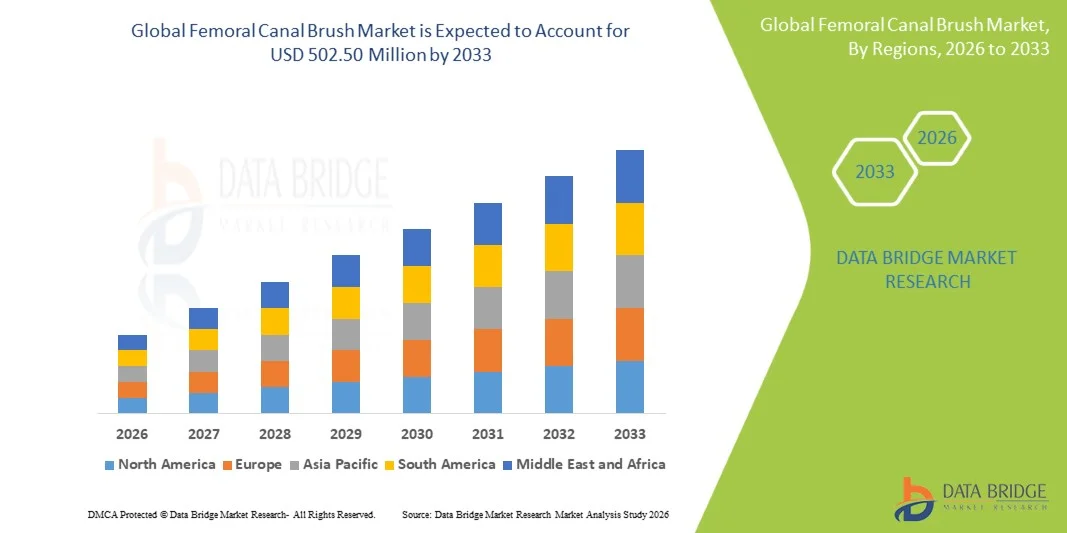
- The global femoral canal brush market size was valued at USD 378.67 million in 2025 and is expected to reach USD 502.50 million by 2033, at a CAGR of 3.6% during the forecast period
- The market growth is largely fueled by the increasing volume of orthopedic procedures, particularly hip replacement surgeries, where femoral canal preparation and cleaning are critical for successful implant fixation and reduced post-operative complications
- Furthermore, the rising emphasis on infection control, improved surgical outcomes, and the adoption of advanced surgical instruments in hospitals and ambulatory surgical centers is establishing femoral canal brushes as an essential component of modern orthopedic surgical protocols, thereby supporting steady market expansion
Femoral Canal Brush Market Analysis
- Femoral canal brushes, used for effective cleaning and debridement of the femoral canal during orthopedic procedures, are increasingly recognized as essential surgical instruments that support proper canal preparation, improve cement interdigitation, and enhance implant fixation in hip and joint replacement surgeries across hospitals and surgical centers
- The escalating demand for femoral canal brushes is primarily fueled by the rising incidence of hip and joint replacement procedures, growing geriatric population, and increasing awareness among surgeons regarding the importance of thorough canal cleaning and preparation to reduce infection risks and improve surgical outcomes
- North America dominated the femoral canal brush market with the largest revenue share of 40.9% in 2025, supported by advanced healthcare infrastructure, high adoption of orthopedic procedures, and the presence of leading medical device manufacturers, with the U.S. witnessing significant procedure volumes driven by aging demographics and continuous advancements in surgical techniques
- Asia-Pacific is expected to be the fastest growing region in the femoral canal brush market during the forecast period due to increasing urbanization, rising healthcare expenditure, expanding access to orthopedic care, and a growing elderly population contributing to higher demand for joint replacement procedures
- The hip replacement segment dominated the femoral canal brush market in 2025 with a market share of 45.3%, driven by the high global prevalence of hip disorders, increasing number of total hip arthroplasty procedures, and the critical role of femoral canal brushes in ensuring optimal cleaning and preparation for effective bone cement application and implant stability
Report Scope and Femoral Canal Brush Market Segmentation
|
Attributes |
Femoral Canal Brush Key Market Insights |
|
Segments Covered |
|
|
Countries Covered |
North America
Europe
Asia-Pacific
Middle East and Africa
South America
|
|
Key Market Players |
|
|
Market Opportunities |
|
|
Value Added Data Infosets |
In addition to the insights on market scenarios such as market value, growth rate, segmentation, geographical coverage, and major players, the market reports curated by the Data Bridge Market Research also include in-depth expert analysis, patient epidemiology, pipeline analysis, pricing analysis, and regulatory framework |
Femoral Canal Brush Market Trends
“Rising Emphasis on Surgical Precision and Infection Control in Orthopedic Procedures”
- A significant and accelerating trend in the global femoral canal brush market is the increasing focus on surgical precision and infection prevention during hip and joint replacement procedures, driving the adoption of specialized brushes designed for effective canal debridement and cement preparation
- For instance, advanced femoral canal brushes with flexible and ergonomically designed bristles are being increasingly used in total hip arthroplasty procedures to ensure thorough removal of debris and improve cement interdigitation
- The growing use of optimized brush designs, including disposable and anatomically shaped variants, is enhancing cleaning efficiency and reducing the risk of cross-contamination in operating rooms. Furthermore, innovations in bristle materials and handle ergonomics are improving surgeon control and ease of use during complex procedures
- The integration of standardized surgical protocols across hospitals and orthopedic centers is further reinforcing the consistent use of femoral canal brushes as part of pre-implant preparation workflows, contributing to improved patient outcomes
- Growing preference for minimally invasive and revision surgeries is also encouraging the development of specialized brush designs that can effectively operate within constrained anatomical spaces while maintaining high cleaning efficiency
- This trend toward more efficient, safety-focused, and procedure-specific instruments is reshaping expectations in orthopedic surgery, with manufacturers increasingly focusing on product differentiation through design improvements and clinical performance
- The demand for advanced femoral canal brushes is growing steadily across both developed and emerging healthcare markets, as surgeons prioritize tools that enhance procedural accuracy, reduce complications, and support better long-term implant success
Femoral Canal Brush Market Dynamics
Driver
“Growing Volume of Hip and Joint Replacement Surgeries and Aging Population”
- The increasing prevalence of hip and joint replacement surgeries, coupled with a rapidly aging global population, is a significant driver for the heightened demand for femoral canal brushes
- For instance, rising cases of osteoporosis, osteoarthritis, and hip fractures are contributing to a higher number of total hip arthroplasty procedures, thereby increasing the need for effective femoral canal preparation tools
- As healthcare systems focus on improving surgical outcomes and reducing post-operative complications, femoral canal brushes play a critical role in ensuring proper canal cleaning and optimal bone cement application
- Furthermore, advancements in orthopedic surgical techniques and expanding access to healthcare services in developing regions are encouraging more procedures, thereby supporting consistent market growth. The growing awareness among surgeons regarding infection prevention and implant stability is also boosting adoption of these brushes in clinical practice
- Increasing hospital investments in advanced orthopedic equipment and operating room efficiency is further supporting the adoption of specialized consumables such as femoral canal brushes in routine surgical workflows
- Rising demand for revision surgeries due to implant failures and complications is also contributing to higher utilization of canal preparation instruments, reinforcing steady market expansion
- The convenience, effectiveness, and procedural importance of femoral canal brushes in modern orthopedic surgeries are key factors propelling their demand across hospitals and ambulatory surgical centers.
Restraint/Challenge
“Limited Standardization and Cost Sensitivity Along with Procedural Dependence”
- Concerns surrounding the lack of universal standardization in femoral canal brush designs and variations in surgical preferences pose a challenge to consistent product adoption across healthcare facilities
- For instance, differences in surgeon techniques and compatibility with various implant systems can limit the uniform use of specific brush types in orthopedic procedure
- Addressing these challenges through standardized product specifications, clinical validation, and improved compatibility with diverse surgical workflows is crucial for broader acceptance among healthcare providers. In addition, the relatively limited awareness in some emerging markets regarding the importance of canal preparation tools can slow adoption rates
- While femoral canal brushes are essential in hip replacement procedures, their usage is highly dependent on surgical practices, which may vary across institutions, potentially restricting uniform demand. The cost sensitivity of healthcare providers in developing regions can also impact procurement decisions, especially where budget constraints are a concern
- Limited availability of trained orthopedic specialists in certain regions may also restrict optimal utilization of femoral canal brushes, thereby affecting market penetration in underserved healthcare systems
- Dependence on hospital procurement policies and bundled purchasing agreements can further influence adoption rates, making market access challenging for smaller manufacturers
- Overcoming these challenges through increased clinical training, surgeon education, and the development of cost-effective yet high-performance brush solutions will be vital for sustained market expansion
Femoral Canal Brush Market Scope
The market is segmented on the basis of usage, material, application, and end-use.
- By Usage
On the basis of usage, the femoral canal brush market is segmented into cleaning and debride. The cleaning segment dominated the market with the largest market share of 65% in 2025, driven by its critical role in removing bone debris, fat, and residual tissue from the femoral canal prior to implant placement. Effective cleaning is essential to ensure proper cement interdigitation and long-term implant stability in hip and joint replacement procedures. Surgeons widely prefer cleaning brushes as a standard preparatory step in orthopedic surgeries, making them a routine consumable across hospitals and surgical centers. The increasing number of hip arthroplasty procedures and emphasis on infection prevention further support the dominance of this segment. In addition, standardized surgical protocols across healthcare facilities reinforce consistent usage of cleaning brushes in operating rooms. The segment continues to benefit from its foundational role in achieving optimal surgical outcomes.
The debride segment is expected to witness the fastest growth rate during the forecast period, driven by the rising complexity of revision surgeries and trauma-related orthopedic procedures. Debridement brushes are increasingly used in cases requiring thorough removal of necrotic tissue, infected material, or residual cement from previous implants. The growing prevalence of implant failures and revision hip surgeries is boosting demand for more advanced debridement tools. Surgeons are also placing greater emphasis on complete canal preparation to minimize post-operative complications and infection risks. Technological improvements in brush design, including enhanced bristle configurations for deeper penetration, are further supporting adoption. Increasing awareness among orthopedic specialists regarding the importance of meticulous canal debridement is accelerating the growth of this segment.
- By Material
On the basis of material, the femoral canal brush market is segmented into disposable (single-use), flexible, twisted, and metallic wire with bristles. The disposable (single-use) segment dominated the market with the largest share of 50% in 2025, primarily driven by stringent infection control protocols and the growing preference for single-use surgical instruments in hospitals. Disposable brushes help eliminate the risk of cross-contamination and reduce the need for sterilization, making them highly efficient in high-volume surgical environments. Hospitals and ambulatory surgical centers increasingly favor disposable options to improve operational efficiency and maintain hygiene standards. Regulatory guidelines promoting patient safety and infection prevention also contribute to the widespread adoption of this segment. In addition, the convenience and time-saving benefits associated with single-use products further reinforce their dominance. The segment benefits from increasing procedural volumes and rising awareness of hospital-acquired infection risks.
The flexible segment is expected to witness the fastest growth rate during the forecast period, driven by the increasing demand for brushes that can adapt to varying anatomical structures of the femoral canal. Flexible brushes offer enhanced maneuverability, allowing surgeons to effectively clean irregular canal surfaces and improve cement application. These brushes are particularly useful in minimally invasive and revision procedures where access is limited. Advances in material engineering have improved the durability and performance of flexible brushes, making them more reliable during surgeries. The growing complexity of orthopedic procedures and the need for precision tools are further accelerating adoption. Increasing preference for ergonomically designed instruments that reduce surgeon fatigue is also contributing to the growth of this segment.
- By Application
On the basis of application, the femoral canal brush market is segmented into bone cement, hip replacement, joint replacement, and others. The hip replacement segment dominated the market with the largest share of 45.3% in 2025, driven by the high global incidence of hip disorders, fractures, and degenerative joint diseases. Femoral canal brushes play a crucial role in preparing the canal for implant insertion, ensuring proper alignment and fixation of prosthetic components. The increasing geriatric population and rising prevalence of osteoporosis are major factors contributing to the growth of hip replacement procedures worldwide. Surgeons rely heavily on canal brushes to achieve optimal surgical outcomes and reduce complications such as implant loosening. The segment benefits from standardized surgical practices and continuous advancements in hip arthroplasty techniques. Growing healthcare infrastructure and access to orthopedic surgeries further support its dominance.
The joint replacement segment is expected to witness the fastest growth rate during the forecast period, driven by the rising number of knee, shoulder, and other joint replacement procedures globally. Increasing lifestyle-related joint disorders, obesity, and sports injuries are contributing to higher demand for joint replacement surgeries. Femoral canal brushes are increasingly used in these procedures to ensure proper preparation of bone surfaces for implant placement. The growing adoption of advanced surgical techniques and improved implant technologies is further supporting segment growth. Expanding access to orthopedic care in emerging markets is also accelerating procedure volumes. Rising awareness among patients regarding joint replacement options and improved post-surgical outcomes is boosting demand in this segment.
- By End-Use
On the basis of end-use, the femoral canal brush market is segmented into hospitals, ambulatory surgical centers, and others. The hospitals segment dominated the market with the largest share of 70% in 2025, driven by the high volume of orthopedic surgeries performed in hospital settings. Hospitals are equipped with advanced surgical infrastructure, skilled orthopedic surgeons, and comprehensive post-operative care facilities, making them the primary choice for complex procedures such as hip and joint replacements. The availability of specialized operating rooms and adherence to strict surgical protocols further support the extensive use of femoral canal brushes in hospitals. Increasing patient inflow and the growing number of inpatient surgeries contribute to the segment’s dominance. In addition, hospitals often have established procurement systems that ensure consistent availability of surgical consumables. The segment continues to benefit from centralized healthcare delivery and higher procedure complexity handled in hospital environments.
The ambulatory surgical centers (ASCs) segment is expected to witness the fastest growth rate during the forecast period, driven by the increasing shift toward outpatient surgical procedures and cost-effective care models. ASCs offer shorter hospital stays, reduced healthcare costs, and faster patient recovery times, making them an attractive alternative for elective orthopedic procedures. The rising adoption of minimally invasive techniques has enabled more surgeries to be performed in outpatient settings. Improvements in surgical technologies and anesthesia methods are further supporting this transition. ASCs are increasingly investing in advanced surgical instruments, including femoral canal brushes, to enhance procedural efficiency and outcomes. Growing patient preference for convenient and time-efficient care is also contributing to the rapid expansion of this segment.
Femoral Canal Brush Market Regional Analysis
- North America dominated the femoral canal brush market with the largest revenue share of 40.9% in 2025, supported by advanced healthcare infrastructure, high adoption of orthopedic procedures, and the presence of leading medical device manufacturers
- Healthcare providers in the region highly value the importance of precise femoral canal preparation, infection prevention, and improved implant fixation in hip and joint replacement surgeries, leading to consistent adoption of femoral canal brushes in operating rooms
- This widespread adoption is further supported by advanced hospital infrastructure, high healthcare expenditure, a large geriatric population, and the presence of leading medical device manufacturers, establishing femoral canal brushes as a standard component in orthopedic surgical procedures across both hospital and ambulatory settings
U.S. Femoral Canal Brush Market Insight
The U.S. femoral canal brush market captured the largest revenue share of 80% within North America in 2025, driven by the high volume of hip and joint replacement surgeries and the strong presence of advanced healthcare infrastructure. The country’s well-established hospital systems and ambulatory surgical centers consistently adopt specialized surgical consumables to ensure optimal canal preparation and implant fixation. Increasing prevalence of osteoarthritis, osteoporosis, and age-related joint disorders is contributing to a steady rise in orthopedic procedures, thereby supporting demand for femoral canal brushes. Healthcare providers in the U.S. highly prioritize infection control, surgical precision, and improved patient outcomes, leading to widespread use of femoral canal brushes as part of standard orthopedic surgical protocols. The presence of leading medical device manufacturers and continuous innovation in surgical tools further enhances product availability and adoption across healthcare facilities.
Europe Femoral Canal Brush Market Insight
The Europe femoral canal brush market is projected to expand at a steady CAGR throughout the forecast period, primarily driven by the increasing number of hip and joint replacement procedures and strong emphasis on surgical hygiene and standardized clinical practices. The region’s well-developed healthcare systems, coupled with stringent regulatory frameworks and infection control guidelines, are encouraging the consistent use of femoral canal brushes in orthopedic surgeries. Growing geriatric population and rising prevalence of degenerative joint diseases are further contributing to procedure volumes. In addition, hospitals and surgical centers across Europe are increasingly adopting advanced surgical tools to improve outcomes, supporting market growth across residential healthcare facilities and specialized orthopedic centers.
U.K. Femoral Canal Brush Market Insight
The U.K. femoral canal brush market is anticipated to grow at a notable CAGR during the forecast period, driven by the increasing demand for hip replacement procedures and the country’s focus on improving surgical outcomes through advanced medical instruments. Rising awareness regarding infection prevention and the importance of proper femoral canal preparation is encouraging the adoption of specialized brushes in orthopedic surgeries. The presence of a well-structured public healthcare system, along with growing investments in surgical technologies, is supporting market expansion. Furthermore, increasing patient preference for minimally invasive procedures and improved post-operative recovery is contributing to higher utilization of femoral canal brushes in both NHS hospitals and private healthcare facilities.
Germany Femoral Canal Brush Market Insight
The Germany femoral canal brush market is expected to expand at a considerable CAGR during the forecast period, fueled by the country’s strong focus on healthcare innovation, precision medicine, and high-quality surgical standards. Germany’s advanced hospital infrastructure and emphasis on orthopedic excellence are promoting the adoption of specialized surgical tools such as femoral canal brushes. The rising number of hip and joint replacement procedures, driven by an aging population and lifestyle-related joint disorders, is further supporting demand. In addition, Germany’s commitment to infection control and sustainability in medical practices is encouraging the use of efficient, often single-use surgical instruments in operating rooms across hospitals and specialty clinics.
Asia-Pacific Femoral Canal Brush Market Insight
The Asia-Pacific femoral canal brush market is poised to grow at the fastest CAGR of 8% during the forecast period, driven by increasing urbanization, rising healthcare expenditure, and growing awareness of advanced orthopedic procedures in countries such as China, Japan, and India. The region’s expanding elderly population and rising incidence of hip-related disorders are contributing to higher demand for joint replacement surgeries, thereby boosting the need for femoral canal brushes. Government initiatives to improve healthcare infrastructure and expand access to surgical care are further accelerating market growth. In addition, the region’s role as a manufacturing hub for medical devices is improving affordability and availability, enabling wider adoption across both public and private healthcare facilities.
Japan Femoral Canal Brush Market Insight
The Japan femoral canal brush market is gaining momentum due to the country’s aging population, high healthcare standards, and strong emphasis on precision in surgical procedures. The increasing number of hip and joint replacement surgeries is driving demand for effective canal preparation tools such as femoral canal brushes. Japan’s advanced medical technology ecosystem and widespread adoption of minimally invasive surgical techniques are further supporting market growth. In addition, the integration of high-quality surgical instruments in hospitals and orthopedic centers, along with a focus on patient safety and infection control, is encouraging consistent usage of femoral canal brushes in clinical practice.
India Femoral Canal Brush Market Insight
The India femoral canal brush market accounted for a significant revenue share in Asia-Pacific in 2025, attributed to rapid urbanization, increasing healthcare awareness, and a growing number of orthopedic procedures across the country. India’s expanding middle class and improving access to advanced medical care are contributing to higher adoption of hip and joint replacement surgeries. Government initiatives aimed at strengthening healthcare infrastructure, along with the growth of private hospitals and surgical centers, are further supporting market expansion. In addition, the availability of cost-effective medical devices and the presence of domestic manufacturers are making femoral canal brushes more accessible, thereby driving their adoption in both urban and semi-urban healthcare facilities.
Femoral Canal Brush Market Share
The Femoral Canal Brush industry is primarily led by well-established companies, including:
- Stryker (U.S.)
- Zimmer Biomet. (U.S.)
- Medline Industries, LP (U.S.)
- Medtronic (Ireland)
- Grayline Medical (U.S.)
- Judd Medical Limited (U.K.)
- Changzhou Kangxin Medical Instruments Co. Ltd. (China)
- Cardio Medical GmbH (Germany)
- Andocor (Germany)
- McKesson Medical-Surgical Inc. (U.S.)
- Advanced Medical Systems Limited (India)
- Subiton LABORATORIOS SL S.A. (Spain)
- Demetra Holding S.p.A. (Italy)
- Osartis GmbH (Germany)
- Smith & Nephew plc (U.K.)
- B. Braun SE (Germany)
- DJO, LLC (U.S.)
- Arthrex, Inc. (U.S.)
- CONMED Corporation (U.S.)
What are the Recent Developments in Global Femoral Canal Brush Market?
- In July 2025, a major orthopedic market analysis highlighted ongoing innovations in femoral canal brush design and materials to enhance procedural efficacy and patient outcomes, indicating continued product development and interest from device manufacturers
- In June 2024, orthopedic procedure volumes, including hip replacements, were highlighted as increasing globally, driving demand for femoral canal brushes and related surgical tools used to prepare the femoral canal before implant placement, reflecting ongoing growth in clinical use of these instruments
- In November 2023, the U.S. FDA hosted a virtual workshop on extended reality (XR) technologies in orthopedic surgical devices, bringing together clinicians and device manufacturers to discuss improving user experience and patient safety in orthopedic procedures advances which can influence tools such as femoral canal brushes used during hip replacements
- In October 2023, surgeons published a clinical technique report highlighting mechanical cleaning of the femoral canal using manual brushes or brush-tipped lavage devices during total hip arthroplasty procedures, underscoring the evolving clinical emphasis on improved canal preparation tools and techniques in orthopedic surgery
- In September 25, 2023, Newfoundland and Labrador expanded its Travelling Orthopedics Program, enabling surgeons to perform orthopedic surgeries, including hip replacements, across multiple locations increasing surgical volumes and indirectly boosting demand for surgical tools such as femoral canal brushes

- Interactive Data Analysis Dashboard
- Company Analysis Dashboard for high growth potential opportunities
- Research Analyst Access for customization & queries
- Competitor Analysis with Interactive dashboard
- Latest News, Updates & Trend analysis
- Harness the Power of Benchmark Analysis for Comprehensive Competitor Tracking
Data collection and base year analysis are done using data collection modules with large sample sizes. The stage includes obtaining market information or related data through various sources and strategies. It includes examining and planning all the data acquired from the past in advance. It likewise envelops the examination of information inconsistencies seen across different information sources. The market data is analysed and estimated using market statistical and coherent models. Also, market share analysis and key trend analysis are the major success factors in the market report. To know more, please request an analyst call or drop down your inquiry.
The key research methodology used by DBMR research team is data triangulation which involves data mining, analysis of the impact of data variables on the market and primary (industry expert) validation. Data models include Vendor Positioning Grid, Market Time Line Analysis, Market Overview and Guide, Company Positioning Grid, Patent Analysis, Pricing Analysis, Company Market Share Analysis, Standards of Measurement, Global versus Regional and Vendor Share Analysis. To know more about the research methodology, drop in an inquiry to speak to our industry experts.
Data Bridge Market Research is a leader in advanced formative research. We take pride in servicing our existing and new customers with data and analysis that match and suits their goal. The report can be customized to include price trend analysis of target brands understanding the market for additional countries (ask for the list of countries), clinical trial results data, literature review, refurbished market and product base analysis. Market analysis of target competitors can be analyzed from technology-based analysis to market portfolio strategies. We can add as many competitors that you require data about in the format and data style you are looking for. Our team of analysts can also provide you data in crude raw excel files pivot tables (Fact book) or can assist you in creating presentations from the data sets available in the report.













