


What is the Fiber Optics Components Market Size and Growth Rate ?
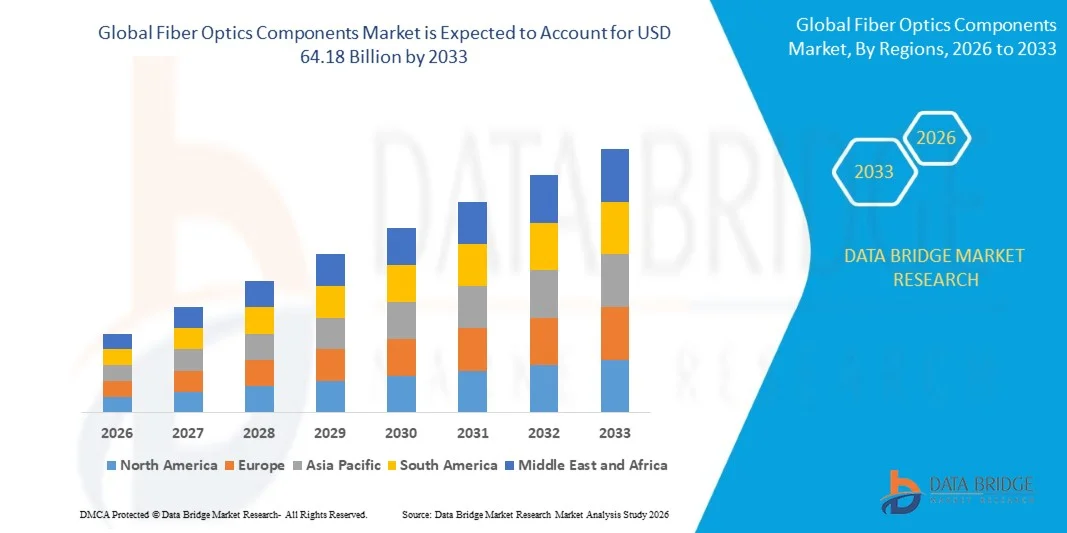
- As per Data Bridge Market Research Analysis the global fiber optics components market size was valued at USD 28.15 billion in 2025 and is expected to reach USD 64.18 billion by 2033, at a CAGR of 10.85% during the forecast period
- The market growth is largely fuelled by the rapid expansion of high-speed internet infrastructure and increasing deployment of fiber optic networks to support rising data traffic
- Growing adoption of cloud computing, data centers, and 5G communication networks is significantly driving demand for advanced fiber optic components across telecommunications and IT sectors
Market Size & Forecast
- Global Market Value (2025): USD 28.15 billion
- Expected Market Value (2033): USD 64.18 billion
- Forecast CAGR (2026–2033): 10.85%
What are the Major Takeaways of Fiber Optics Components Market ?
- The market is experiencing strong growth due to the rising need for high-bandwidth communication networks capable of supporting large-scale data transmission, streaming services, and enterprise connectivity
- Continuous technological advancements in optical transmission technologies, combined with increasing demand for reliable and energy-efficient communication infrastructure, are encouraging telecom operators and enterprises to expand fiber optic component deployment across multiple industries
- North America dominated the fiber optics components market with the largest revenue share in 2025, driven by the strong presence of advanced telecommunications infrastructure, large-scale data centers, and continuous investments in high-speed broadband networks
- Asia-Pacific region is expected to witness the highest growth rate in the global fiber optics components market, driven by rapid urbanization, expansion of telecommunications networks, growing data center investments, and strong adoption of 5G technologies
- The Cables segment held the largest market revenue share in 2025 driven by their extensive use in telecommunications infrastructure, data centers, and broadband networks for high-speed data transmission. Fiber optic cables form the backbone of modern communication systems, offering high bandwidth, low signal loss, and long-distance transmission capabilities, making them essential for network expansion and digital connectivity
Report Scope and Fiber Optics Components Market Segmentation
|
Attributes |
Fiber Optics Components Key Market Insights |
|
Segments Covered |
|
|
Countries Covered |
North America
Europe
Asia-Pacific
Middle East and Africa
South America
|
|
Key Market Players |
• Schlumberger Limited (U.S.) |
|
Market Opportunities |
• Increasing Deployment Of 5G And Next-Generation Communication Networks |
|
Value Added Data Infosets |
In addition to the insights on market scenarios such as market value, growth rate, segmentation, geographical coverage, and major players, the market reports curated by the Data Bridge Market Research also include in-depth expert analysis, geographically represented company-wise production and capacity, network layouts of distributors and partners, detailed and updated price trend analysis and deficit analysis of supply chain and demand. |
What is the Key Trend in the Fiber Optics Components Market ?
“Increasing Demand for High-Speed Data Transmission and Network Capacity”
• The rapid growth of global data traffic is significantly shaping the fiber optics components market, as businesses and consumers increasingly require faster and more reliable communication networks. Fiber optic components such as transceivers, connectors, amplifiers, and cables are gaining strong demand due to their ability to support high-bandwidth data transmission with minimal signal loss. This trend is encouraging telecom operators and network providers to expand fiber-based infrastructure to support growing digital connectivity needs
• Rising adoption of cloud computing, video streaming, online gaming, and enterprise digital services has accelerated the demand for fiber optic networks. Data centers and telecommunications providers are investing heavily in advanced fiber optic components to ensure high-speed data transfer and network stability. The increasing reliance on digital platforms across industries is further strengthening the importance of optical communication technologies
• Continuous advancements in optical technologies are influencing purchasing decisions, with manufacturers emphasizing higher transmission efficiency, improved signal quality, and energy-efficient network components. These innovations are helping service providers improve network performance while reducing operational costs. Companies are also focusing on developing compact and scalable optical components to support evolving network architectures
• For instance, in 2024, Nokia in Finland and Cisco Systems in the U.S. expanded their optical networking solutions by introducing advanced fiber optic components designed for high-capacity data transmission in telecommunications networks. These solutions were developed to support growing bandwidth demand from 5G networks and cloud computing platforms. The products were introduced across telecom infrastructure and enterprise networking channels to enhance connectivity performance
• While the demand for fiber optic components continues to rise, sustained market expansion depends on continuous technological innovation, cost-effective deployment, and reliable supply chains. Manufacturers are also focusing on improving component durability, signal performance, and integration capabilities to meet the growing needs of next-generation communication networks
Fiber Optics Components Market Dynamics
Driver
“Rapid Expansion of 5G Networks and High-Speed Communication Infrastructure”
• The increasing deployment of 5G networks worldwide is a major driver for the fiber optics components market. Fiber optic infrastructure is essential for supporting high-speed data transmission, low latency communication, and large-scale connectivity required by next-generation wireless networks. Telecom operators are investing in fiber optic components to strengthen network backhaul and ensure efficient data transfer
• Expanding applications in telecommunications, data centers, cloud computing, and enterprise networking are influencing market growth. Fiber optic components enable reliable long-distance data transmission while maintaining high signal quality, making them critical for modern communication systems. The growing digital transformation across industries is further supporting the adoption of optical networking technologies
• Technology providers and telecom companies are actively promoting advanced fiber optic solutions through infrastructure expansion, strategic partnerships, and product innovation. These efforts are supported by the growing demand for high-speed internet and the rising use of connected devices. Collaboration between optical component manufacturers and network service providers is also encouraging the development of next-generation communication technologies
• For instance, in 2023, Corning Incorporated in the U.S. and Huawei Technologies in China increased their investments in optical communication technologies to expand fiber optic component production and strengthen global telecom infrastructure. This expansion followed the increasing demand for high-capacity data networks and broadband connectivity. Both companies emphasized improved transmission performance and scalable network solutions to support next-generation digital services
• Although the expansion of communication networks supports market growth, large-scale fiber deployment requires significant infrastructure investment and skilled technical expertise. Companies are focusing on improving installation efficiency, reducing component costs, and strengthening supply chains to support long-term market development
Restraint/Challenge
“High Infrastructure Deployment Costs and Complex Installation Processes”
• The high cost associated with installing fiber optic infrastructure remains a key challenge for the fiber optics components market. Deployment requires specialized equipment, skilled labor, and extensive network planning, which can increase overall project costs. These financial requirements may limit fiber adoption in regions with limited investment capacity or insufficient telecommunications infrastructure
• Technical complexity in fiber network installation and maintenance also impacts market growth. Optical components must meet strict performance and compatibility standards to ensure efficient network operation. Any installation errors or component failures can affect network reliability, requiring regular monitoring and maintenance to maintain optimal performance
• Supply chain and operational challenges also influence market expansion, as fiber optic components require precise manufacturing processes and specialized materials. Fluctuations in raw material availability and global logistics disruptions can affect production timelines and distribution efficiency. Companies must invest in strong supplier networks and advanced manufacturing technologies to maintain consistent supply
• For instance, in 2024, telecommunications operators in Brazil and South Africa reported slower deployment of fiber optic networks in rural and remote areas due to high infrastructure costs and technical complexities. Limited skilled workforce availability and long installation timelines were additional barriers affecting project implementation. These factors also influenced the pace of network expansion in certain developing markets
• Addressing these challenges will require improved infrastructure investment, supportive government policies, and the development of cost-efficient fiber deployment technologies. Collaboration between telecom operators, equipment manufacturers, and policymakers can help accelerate network expansion and unlock the long-term growth potential of the global fiber optics components market
How is the Fiber Optics Components Market Segmented ?
The market is segmented on the basis of type, data rate, and application.
• By Type
On the basis of type, the fiber optics components market is segmented into Cables, Amplifiers, Active Optic Cables, Connectors, Splitters, Transceivers, and Other Types. The Cables segment held the largest market revenue share in 2025 driven by their extensive use in telecommunications infrastructure, data centers, and broadband networks for high-speed data transmission. Fiber optic cables form the backbone of modern communication systems, offering high bandwidth, low signal loss, and long-distance transmission capabilities, making them essential for network expansion and digital connectivity.
The Transceivers segment is expected to witness the fastest growth rate from 2026 to 2033, driven by increasing demand for high-speed data communication and network upgrades. Optical transceivers enable efficient data transmission between network devices and are widely used in data centers and telecom networks. Their growing importance in supporting high-capacity networks and next-generation communication technologies is accelerating their adoption.
• By Data Rate
On the basis of data rate, the fiber optics components market is segmented into 10G, 40G, 100G, and Above 100G. The 100G segment held the largest market revenue share in 2025 driven by the increasing need for high-bandwidth connectivity in data centers, cloud computing, and enterprise networks. 100G solutions provide a balance between performance and cost, making them widely adopted for modern network infrastructure upgrades.
The Above 100G segment is expected to witness the fastest growth rate from 2026 to 2033, driven by the rapid expansion of hyperscale data centers and 5G networks requiring ultra-high-speed data transmission. These high-capacity solutions support large-scale data processing and low-latency communication, making them critical for future network development.
• By Application
On the basis of application, the fiber optics components market is segmented into Communication, Distributed Sensing, Temperature Sensing, Acoustic Sensing, Data Sensors, Analytical and Medical Equipment, and Lighting. The Communication segment held the largest market revenue share in 2025 driven by the widespread deployment of fiber optic networks in telecommunications and internet infrastructure. Increasing demand for high-speed internet, video streaming, and cloud services is significantly contributing to the growth of this segment.
The Analytical and Medical Equipment segment is expected to witness the fastest growth rate from 2026 to 2033, driven by increasing adoption of fiber optic technologies in advanced diagnostics, imaging systems, and laboratory instruments. Fiber optics enable precise data transmission and sensing capabilities, supporting innovations in healthcare and scientific research applications.
Which Region Holds the Largest Share of the Fiber Optics Components Market ?
• North America dominated the fiber optics components market with the largest revenue share in 2025, driven by the strong presence of advanced telecommunications infrastructure, large-scale data centers, and continuous investments in high-speed broadband networks
• Organizations and service providers in the region prioritize high-capacity data transmission and reliable communication networks, increasing the adoption of advanced fiber optic components across telecom and enterprise applications
• This widespread adoption is further supported by strong technological capabilities, significant investments in 5G deployment, and the growing demand for cloud computing and streaming services, establishing fiber optic components as critical elements in modern digital communication systems
U.S. Fiber Optics Components Market Insight
The U.S. fiber optics components market captured the largest revenue share in 2025 within North America, fueled by the rapid expansion of data centers, cloud computing platforms, and next-generation telecommunications infrastructure. The increasing demand for high-speed internet and the continuous growth of digital services are encouraging telecom operators to expand fiber optic network deployments. In addition, the strong presence of leading technology companies and ongoing investments in 5G networks are significantly supporting the growth of the fiber optics components market in the country.
Europe Fiber Optics Components Market Insight
The Europe fiber optics components market is expected to witness significant growth from 2026 to 2033, primarily driven by increasing investments in digital infrastructure and the expansion of high-speed broadband networks across the region. Governments and telecom providers are focusing on strengthening communication infrastructure to support digital transformation initiatives. The growing adoption of cloud services, advanced networking technologies, and smart infrastructure projects is also contributing to the rising demand for fiber optic components.
U.K. Fiber Optics Components Market Insight
The U.K. fiber optics components market is expected to witness strong growth from 2026 to 2033, driven by increasing deployment of fiber-to-the-home (FTTH) networks and rising demand for high-speed internet connectivity. Telecommunications providers are expanding fiber-based communication infrastructure to meet growing consumer and enterprise data requirements. The country’s focus on digital transformation and smart city initiatives is also encouraging the adoption of advanced fiber optic technologies.
Germany Fiber Optics Components Market Insight
The Germany fiber optics components market is expected to witness significant growth from 2026 to 2033, fueled by the country’s strong industrial base and increasing demand for high-performance communication networks. Germany’s emphasis on Industry 4.0, digital manufacturing, and advanced networking infrastructure is promoting the adoption of fiber optic technologies across industrial and commercial sectors. Investments in broadband expansion and smart infrastructure projects are further supporting market development.
Asia-Pacific Fiber Optics Components Market Insight
The Asia-Pacific fiber optics components market is expected to witness the fastest growth rate from 2026 to 2033, driven by rapid urbanization, expanding telecommunications infrastructure, and increasing investments in high-speed internet networks. Countries across the region are focusing on strengthening digital connectivity and supporting large-scale deployment of 5G networks. The rising demand for data centers and digital services is also accelerating the adoption of fiber optic components across emerging economies.
Japan Fiber Optics Components Market Insight
The Japan fiber optics components market is expected to witness notable growth from 2026 to 2033 due to the country’s advanced telecommunications infrastructure and strong focus on technological innovation. Japan’s increasing investments in 5G networks, high-speed communication systems, and smart infrastructure are supporting the adoption of fiber optic components. The growing demand for reliable and high-capacity data transmission solutions across industries is also contributing to market expansion.
China Fiber Optics Components Market Insight
The China fiber optics components market accounted for the largest market revenue share in Asia Pacific in 2025, attributed to the country’s rapid expansion of telecommunications networks and strong government support for digital infrastructure development. China is one of the largest markets for fiber optic deployment due to its large population and increasing demand for high-speed internet services. The growth of data centers, cloud computing, and smart city initiatives is also driving the demand for advanced fiber optic components across the country.
Which are the Top Companies in Fiber Optics Components Market ?
The Fiber Optics Components industry is primarily led by well-established companies, including:
• Schlumberger Limited (U.S.)
• ADVA Optical Networking (Germany)
• Fujikura Ltd. (Japan)
• EXFO Inc. (Canada)
• Sumitomo Electric Industries, Ltd. (Japan)
• NeoPhotonics Corporation (U.S.)
• DSIT Solutions Ltd. (Israel)
• Bandweaver (U.K.)
• Lumentum Operations LLC (U.S.)
• Qualitrol Company LLC (U.S.)
• VIAVI Solutions Inc. (U.S.)
• Omnisens (Switzerland)
• NBG Holding GmbH (Germany)
• Zayo Group, LLC (U.S.)
• Finisar Corporation (U.S.)
• CommVerge Solutions (Singapore)
• Halliburton (U.S.)
• Lancier Components GmbH (Germany)
• M2 Optics Inc. (U.S.)
• Furukawa Electric Co., Ltd. (Japan)
What are Latest Developments in Fiber Optics Components Market ?
- In April 2025, Nortech Systems, a digital connectivity and engineering solutions provider, announced the development of a patented non-magnetic expanded beam fiber optic cable technology designed to improve connectivity performance. The innovation enables lighter, faster, and more sustainable fiber optic connections, enhancing reliability in complex environments. This development is expected to support advanced communication infrastructure and strengthen efficiency in industries requiring high-performance connectivity, thereby contributing to the expansion of the fiber optics components market
- In July 2024, STL, an optical and digital solutions provider, launched high-density 864F Micro Cables developed to support dense fiber networks across the U.S. These cables enable faster deployment and improved network capacity, addressing the increasing demand for high-speed broadband connectivity. The introduction is expected to accelerate fiber network expansion and support telecom operators in strengthening high-capacity communication infrastructure
- In April 2024, Broadcom introduced its 200G PAM-4 Vertical-Cavity Surface-Emitting Laser (VCSEL) transmitter module designed for next-generation data centers. The module delivers higher data transmission speeds and enhanced signal integrity, enabling faster and more reliable short-distance data communication. This innovation supports the growing requirements of cloud computing and hyperscale data centers, further driving demand for advanced optical components
- In February 2024, Approved Networks, a brand of Legrand specializing in optical networking technology, launched an O-band transceiver capable of transmitting high-speed data over distances of up to 25 kilometers. The solution enhances network efficiency and reliability for enterprise and telecom applications. Its introduction is expected to support improved optical network performance and expand deployment opportunities for high-speed communication infrastructure
- In March 2023, Lumentum Holdings Inc., a provider of optical and photonic technologies, showcased its portfolio of full-band optical tunable transceivers through a live product demonstration. These advanced transceivers enable flexible wavelength tuning and improved network efficiency for cloud and telecommunications applications. The development highlights the growing focus on scalable optical networking solutions, strengthening innovation and competition within the fiber optics components market

- Interactive Data Analysis Dashboard
- Company Analysis Dashboard for high growth potential opportunities
- Research Analyst Access for customization & queries
- Competitor Analysis with Interactive dashboard
- Latest News, Updates & Trend analysis
- Harness the Power of Benchmark Analysis for Comprehensive Competitor Tracking
Global Fiber Optics Components Market, Supply Chain Analysis and Ecosystem Framework
To support market growth and help clients navigate the impact of geopolitical shifts, DBMR has integrated in-depth supply chain analysis into its Global Fiber Optics Components Market research reports. This addition empowers clients to respond effectively to global changes affecting their industries. The supply chain analysis section includes detailed insights such as Global Fiber Optics Components Market consumption and production by country, price trend analysis, the impact of tariffs and geopolitical developments, and import and export trends by country and HSN code. It also highlights major suppliers with data on production capacity and company profiles, as well as key importers and exporters. In addition to research, DBMR offers specialized supply chain consulting services backed by over a decade of experience, providing solutions like supplier discovery, supplier risk assessment, price trend analysis, impact evaluation of inflation and trade route changes, and comprehensive market trend analysis.
Data collection and base year analysis are done using data collection modules with large sample sizes. The stage includes obtaining market information or related data through various sources and strategies. It includes examining and planning all the data acquired from the past in advance. It likewise envelops the examination of information inconsistencies seen across different information sources. The market data is analysed and estimated using market statistical and coherent models. Also, market share analysis and key trend analysis are the major success factors in the market report. To know more, please request an analyst call or drop down your inquiry.
The key research methodology used by DBMR research team is data triangulation which involves data mining, analysis of the impact of data variables on the market and primary (industry expert) validation. Data models include Vendor Positioning Grid, Market Time Line Analysis, Market Overview and Guide, Company Positioning Grid, Patent Analysis, Pricing Analysis, Company Market Share Analysis, Standards of Measurement, Global versus Regional and Vendor Share Analysis. To know more about the research methodology, drop in an inquiry to speak to our industry experts.
Data Bridge Market Research is a leader in advanced formative research. We take pride in servicing our existing and new customers with data and analysis that match and suits their goal. The report can be customized to include price trend analysis of target brands understanding the market for additional countries (ask for the list of countries), clinical trial results data, literature review, refurbished market and product base analysis. Market analysis of target competitors can be analyzed from technology-based analysis to market portfolio strategies. We can add as many competitors that you require data about in the format and data style you are looking for. Our team of analysts can also provide you data in crude raw excel files pivot tables (Fact book) or can assist you in creating presentations from the data sets available in the report.













