


 Market Analysis and Insights : Global Field Programmable Gate Array (FPGA) Security Market
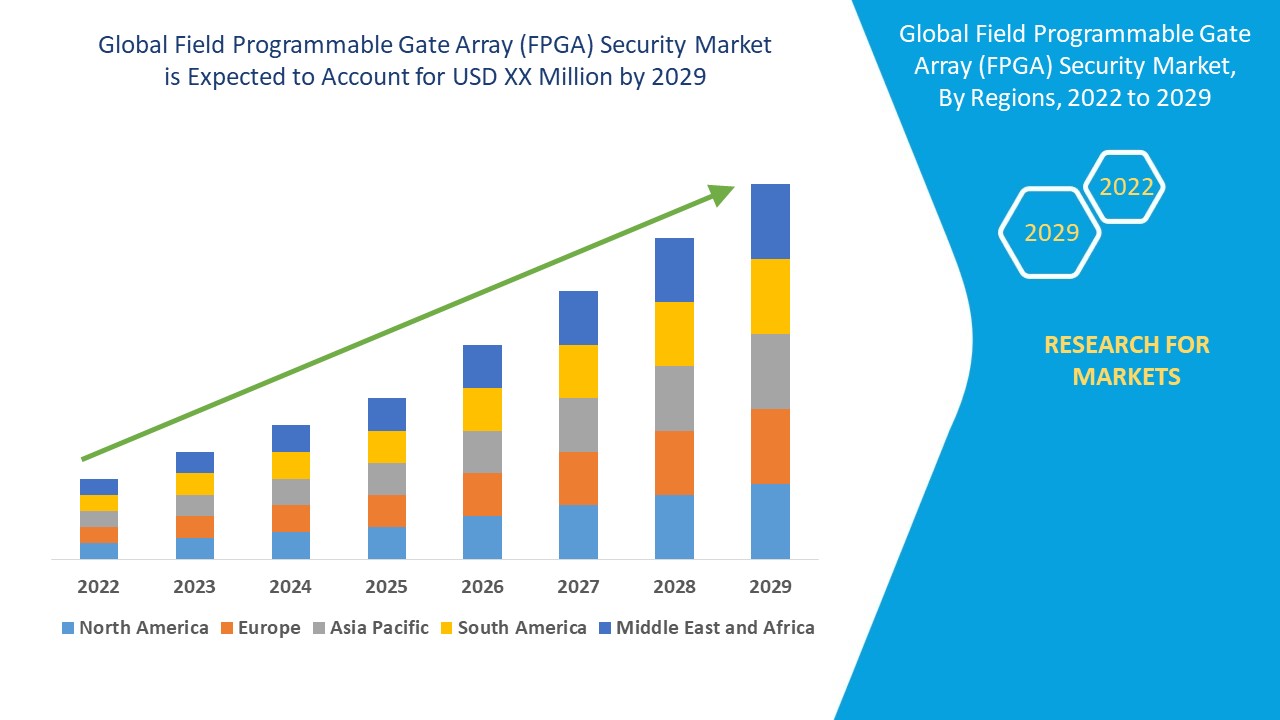
Data Bridge Market Research analyses the field programmable gate array (FPGA) security market will exhibit a CAGR of 10.10% for the forecast period of 2022-2029 and would likely to reach an estimated value of 2,325.76 million by 2029.
Field programmable gate array (FPGA) security is a silicon Integrated Circuit (IC) chip made up of arrays of programmable logic gates, memory, or other elements. You can programme these FPGA arrays to create your own digital circuits. You can also overwrite existing configurations with new desired functionality or application requirements. The programming can be as simple as a single logic gate, such as an OR AND function. It may also include a number of complex functions that are similar to those found in a multi-core processor.
Telecommunications is one of the most promising industries, with high demand for FPGAs. The increasing investments and advancements in telecom infrastructure across developed and developing countries are fuelling the global telecom sector's growth. IoT, AI, and edge computing technologies are further enabling a paradigm shift in customer demands and preferences; these technologies present both opportunities and challenges for telecommunications companies.
Because of the complex operations involved and rising customer demand, the operational needs of telecommunications equipment/hardware and demand for secure communications are growing at a rapid pace. FPGAs are widely used in this sector for a variety of applications including packet processing and data packet switching. Benefits such as easy configurability, flexibility, efficient hardware acceleration, and low costs are expected to drive the growth of the FPGA security market in the telecommunications sector further.
However, FPGAs are vulnerable to security attacks due to a major flaw in their hardware, which allows hackers to gain complete control of chips and steal sensitive data. FPGA chips, as opposed to traditional hardware chips with fixed functionalities, have the advantage of being reprogrammable. As FPGA technology has become more efficient in terms of size, performance, and power, superior and advanced security techniques are required to prevent security attacks. This could work as a hindrance to the use of FPGAs.
This field programmable gate array (FPGA) security market report provides details of new recent developments, trade regulations, import export analysis, production analysis, value chain optimization, market share, impact of domestic and localised market players, analyses opportunities in terms of emerging revenue pockets, changes in market regulations, strategic market growth analysis, market size, category market growths, application niches and dominance, product approvals, product launches, geographical expansions, technological innovations in the market. To gain more info on field programmable gate array (FPGA) security market contact Data Bridge Market Research for an Analyst Brief, our team will help you take an informed market decision to achieve market growth.
Global Field Programmable Gate Array (FPGA) Security Market Scope and Market Size
The field programmable gate array (FPGA) security market is segmented on the basis of configuration, technology, node size, application and end user industry. The growth amongst the different segments helps you in attaining the knowledge related to the different growth factors expected to be prevalent throughout the market and formulate different strategies to help identify core application areas and the difference in your target market.
- Based on configuration, the field programmable gate array (FPGA) security market is segmented into low-end field programmable gate array, mid-range field programmable gate array, and high-end field programmable gate array.
- On the basis of technology, the global field programmable gate array security market is segmented into static random-access memory, flash and antifuse.
- On the basis of node size, the field programmable gate array (FPGA) security market is segmented into ≤16 nm, 22/28–90 nm, and >90 nm.
- On the basis of application, the field programmable gate array (FPGA) security market is segmented into field programmable gate array synthesis flow, applied cryptography algorithmic cryptographic security.
- On the basis of end user industry, the field programmable gate array (FPGA) security market is segmented into telecommunications, consumer electronics, data centres and computing, military and aerospace, industrial, automotive, and other end users.
Field Programmable Gate Array (FPGA) Security Market Country Level Analysis
The field programmable gate array (FPGA) security market is analysed and market size, volume information is provided by country, configuration, technology, node size, application and end user industry as referenced above.
The countries covered in the field programmable gate array (FPGA) security market report are U.S., Canada and Mexico in North America, Germany, France, U.K., Netherlands, Switzerland, Belgium, Russia, Italy, Spain, Turkey, Rest of Europe in Europe, China, Japan, India, South Korea, Singapore, Malaysia, Australia, Thailand, Indonesia, Philippines, Rest of Asia-Pacific (APAC) in the Asia-Pacific (APAC), Saudi Arabia, U.A.E, Israel, Egypt, South Africa, Rest of Middle East and Africa (MEA) as a part of Middle East and Africa (MEA), Brazil, Argentina and Rest of South America as part of South America.
Asia-Pacific is expected to dominate the field programmable gate array (FPGA) security market due to the rising demand for consumer electronics, the increasing trend of automation in the automotive and industrial sectors, and the increasing penetration of technologies such as AI, IoT, and cloud computing are just a few of the key factors driving the growth of the FPGA security market. China, Japan, Taiwan, and South Korea are among the key countries where the majority of electronics and semiconductor manufacturers are located, and these companies are constantly investing in R&D activities to keep up with the rapidly evolving technology landscape.
The country section of the field programmable gate array (FPGA) security market report also provides individual market impacting factors and changes in regulation in the market domestically that impacts the current and future trends of the market. Data points such as consumption volumes, production sites and volumes, import export analysis, price trend analysis, cost of raw materials, down-stream and upstream value chain analysis are some of the major pointers used to forecast the market scenario for individual countries. Also, presence and availability of global brands and their challenges faced due to large or scarce competition from local and domestic brands, impact of domestic tariffs and trade routes are considered while providing forecast analysis of the country data.
Competitive Landscape and Field Programmable Gate Array (FPGA) Security Market Share Analysis
The field programmable gate array (FPGA) security market competitive landscape provides details by competitor. Details included are company overview, company financials, revenue generated, market potential, investment in research and development, new market initiatives, global presence, production sites and facilities, production capacities, company strengths and weaknesses, product launch, product width and breadth, application dominance. The above data points provided are only related to the companies’ focus related to field programmable gate array (FPGA) security market.
Some of the major players operating in the field programmable gate array (FPGA) security market report are Achronix Semiconductor Corporation, Quick Logic Corporation, Cobham Limited, Efinix Inc., Flex Logix Technologies, Inc., Intel Corporation, Xilinx, Aldec, Inc., GOWIN Semiconductor Corp., Lattice Semiconductor, Omnitek (Intel), EnSilica, Gidel, BitSim AB, ByteSnap Design, Cyient, Enclustra, Mistral Solution Pvt. Ltd., Microsemi Corporation and Nuvation, among other.
Our team of

- Interactive Data Analysis Dashboard
- Company Analysis Dashboard for high growth potential opportunities
- Research Analyst Access for customization & queries
- Competitor Analysis with Interactive dashboard
- Latest News, Updates & Trend analysis
- Harness the Power of Benchmark Analysis for Comprehensive Competitor Tracking
Table of Content
1 INTRODUCTION
1.1 OBJECTIVES OF THE STUDY
1.2 MARKET DEFINITION
1.3 OVERVIEW OF GLOBAL FIELD PROGRAMMABLE GATE ARRAY (FPGA) SECURITY MARKET
1.4 CURRENCY AND PRICING
1.5 LIMITATION
1.6 MARKETS COVERED
2 MARKET SEGMENTATION
2.1 KEY TAKEAWAYS
2.2 ARRIVING AT THE GLOBAL FIELD PROGRAMMABLE GATE ARRAY (FPGA) SECURITY MARKET
2.2.1 VENDOR POSITIONING GRID
2.2.2 TECHNOLOGY LIFE LINE CURVE
2.2.3 MARKET GUIDE
2.2.4 COMPANY POSITIONING GRID
2.2.5 COMAPANY MARKET SHARE ANALYSIS
2.2.6 MULTIVARIATE MODELLING
2.2.7 TOP TO BOTTOM ANALYSIS
2.2.8 STANDARDS OF MEASUREMENT
2.2.9 VENDOR SHARE ANALYSIS
2.2.10 DATA POINTS FROM KEY PRIMARY INTERVIEWS
2.2.11 DATA POINTS FROM KEY SECONDARY DATABASES
2.3 GLOBAL FIELD PROGRAMMABLE GATE ARRAY (FPGA) SECURITY MARKET: RESEARCH SNAPSHOT
2.4 ASSUMPTIONS
3 MARKET OVERVIEW
3.1 DRIVERS
3.2 RESTRAINTS
3.3 OPPORTUNITIES
3.4 CHALLENGES
4 EXECUTIVE SUMMARY
5 PREMIUM INSIGHTS
5.1 REGULATORY FRAMEWORK
5.2 PORTERS MODEL
5.3 TECHNOLOGICAL TRENDS
5.4 PATENT ANALYSIS
5.5 COMPANY COMPARITIVE ANALYSIS
5.6 VALUE CHAIN ANALYSIS
5.7 PRICING ANALYSIS
6 GLOBAL FIELD PROGRAMMABLE GATE ARRAY (FPGA) SECURITY MARKET, BY TYPE
6.1 OVERVIEW
6.2 HIGH-END FPGA
6.3 MID-END FPGA
6.4 LOW-END FPGA
7 GLOBAL FIELD PROGRAMMABLE GATE ARRAY (FPGA) SECURITY MARKET, BY NODE SIZE (VALUE & VOLUME)
7.1 OVERVIEW
7.2 LESS THAN 28 NM
7.3 28NM - 90 NM
7.4 MORE THAN 90 NM
8 GLOBAL FIELD PROGRAMMABLE GATE ARRAY (FPGA) SECURITY MARKET, BY TECHNOLOGY
8.1 OVERVIEW
8.2 SRAM
8.3 FLASH BASED/EEPROM
8.4 ANTIFUSE
8.5 EPROM
8.6 FUSE
9 GLOBAL FIELD PROGRAMMABLE GATE ARRAY (FPGA) SECURITY MARKET, BY MEMORY
9.1 OVERVIEW
9.2 BLOCK MEMORY
9.3 DISTRIBUTED MEMORY
10 GLOBAL FIELD PROGRAMMABLE GATE ARRAY (FPGA) SECURITY MARKET, BY SECURITY
10.1 OVERVIEW
10.2 PHYSICAL MEMORY PROTECTION (PMP)
10.3 DEFENSE-GRADE SECURITY
10.3.1 SECURE HARDWARE
10.3.2 DESIGN SECURITY
10.3.3 DATA SECURITY
11 GLOBAL FIELD PROGRAMMABLE GATE ARRAY (FPGA) SECURITY MARKET, BY FUNCTIONAL BLOCK
11.1 OVERVIEW
11.2 LOGIC BLOCKS
11.2.1 COMBINATIONAL GATES
11.2.2 MULTIPLEXES
11.2.3 TRANSISTOR PAIRS
11.2.4 OTHERS
11.3 ROUTING
12 GLOBAL FIELD PROGRAMMABLE GATE ARRAY (FPGA) SECURITY MARKET, BY END USER
12.1 OVERVIEW
12.2 IT AND TELECOMMUNICATION
12.2.1 BY TYPE
12.2.1.1. HIGH-END FPGA
12.2.1.2. MID-END FPGA
12.2.1.3. LOW-END FPGA
12.2.2 BY TYPE
12.2.2.1. WIRED COMMUNICATION
12.2.2.1.1. NETWORK PROCESSING
12.2.2.1.2. BACKHAUL AND ACCESS NETWORK
12.2.2.1.3. OPTICAL TRANSPORT NETWORK (OTN)
12.2.2.1.4. PACKET BASED PROCESSING
12.2.2.1.5. OTHERS
12.2.2.2. 5G
12.2.2.3. WIRELESS COMMUNICATION
12.2.2.3.1. RADIO SOLUTION
12.2.2.3.2. BASEBAND SOLUTION
12.2.2.3.3. OTHERS
12.3 CONSUMER ELECTRONICS
12.3.1 BY APPLICATION
12.3.1.1. HOME NETWORKING
12.3.1.2. DIGITAL FLAT PANEL DISPLAYS
12.3.1.3. SET-TOP BOXES
12.3.1.4. INFORMATION APPLIANCES
12.3.1.5. OTHERS
12.3.2 CONSUMER ELECTRONICS, BY TYPE
12.3.2.1. LAPTOPS
12.3.2.2. SMARTPHONES
12.3.2.3. DIGITAL CAMERAS
12.3.2.4. TABLETS
12.3.2.5. GAMING CONSOLES
12.3.2.6. OTHERS
12.3.3 BY TYPE
12.3.3.1. HIGH-END FPGA
12.3.3.2. MID-END FPGA
12.3.3.3. LOW-END FPGA
12.4 AUTOMOTIVE
12.4.1 BY APPLICATION
12.4.1.1. DRIVER ASSISTANCE SYSTEMS
12.4.1.2. IN-VEHICLE INFOTAINMENT
12.4.1.3. ELECTRIC VEHICLE
12.4.2 BY TYPE
12.4.2.1. HIGH-END FPGA
12.4.2.2. MID-END FPGA
12.4.2.3. LOW-END FPGA
12.5 AEROSPACE AND DEFENSE
12.5.1 BY APPLICATION
12.5.1.1. WAVEFORM GENERATION
12.5.1.2. PARTIAL RECONFIGURATION FOR SDRS
12.5.1.3. IMAGE PROCESSING
12.5.2 BY TYPE
12.5.2.1. HIGH-END FPGA
12.5.2.2. MID-END FPGA
12.5.2.3. LOW-END FPGA
12.6 HEALTHCARE
12.6.1 BY APPLICATION
12.6.1.1. IMAGING DIAGNOSTICS
12.6.1.2. X-RAY
12.6.1.3. ULTRASOUND
12.6.1.4. MRI
12.6.1.5. CT SCANNER
12.6.1.6. WEARABLE DEVICES
12.6.2 BY TYPE
12.6.2.1. HIGH-END FPGA
12.6.2.2. MID-END FPGA
12.6.2.3. LOW-END FPGA
12.7 INDUSTRIAL
12.7.1 BY APPLICATION
12.7.1.1. INDUSTRIAL AUTOMATION
12.7.1.2. ROBOTICS
12.7.1.3. MACHINE VISION
12.7.1.4. INDUSTRIAL SENSOR
12.7.1.5. INDUSTRIAL NETWORKING SOLUTION
12.7.1.6. OTHERS
12.7.1.7. IMAGING AND SURVILLENCE
12.7.2 BY TYPE
12.7.2.1. HIGH-END FPGA
12.7.2.2. MID-END FPGA
12.7.2.3. LOW-END FPGA
12.8 DATACENTER
12.8.1 BY APPLICATION
12.8.1.1. STORAGE INTERFACE CONTROL
12.8.1.2. NETWORK INTERFACE CONTROL
12.8.1.3. ASIC DESIGNING
12.8.1.4. OTHERS
12.8.2 BY TYPE
12.8.2.1. HIGH-END FPGA
12.8.2.2. MID-END FPGA
12.8.2.3. LOW-END FPGA
12.9 OTHERS
13 GLOBAL FIELD PROGRAMMABLE GATE ARRAY (FPGA) SECURITY MARKET, BY REGION
13.1 GLOBAL FIELD PROGRAMMABLE GATE ARRAY (FPGA) SECURITY MARKET SEGMENTATION PROVIDED ABOVE IS REPRESENTED IN THIS CHAPTER BY COUNTRY)
13.1.1 NORTH AMERICA
13.1.1.1. U.S.
13.1.1.2. CANADA
13.1.1.3. MEXICO
13.1.2 EUROPE
13.1.2.1. GERMANY
13.1.2.2. U.K.
13.1.2.3. FRANCE
13.1.2.4. ITALY
13.1.2.5. SPAIN
13.1.2.6. THE NETHERLANDS
13.1.2.7. SWITZERLAND
13.1.2.8. TURKEY
13.1.2.9. BELGIUM
13.1.2.10. RUSSIA
13.1.2.11. SWEDEN
13.1.2.12. DENMARK
13.1.2.13. POLAND
13.1.2.14. REST OF EUROPE
13.1.3 ASIA-PACIFIC
13.1.3.1. CHINA
13.1.3.2. JAPAN
13.1.3.3. SOUTH KOREA
13.1.3.4. INDIA
13.1.3.5. SINGAPORE
13.1.3.6. AUSTRALIA
13.1.3.7. MALAYSIA
13.1.3.8. PHILIPPINES
13.1.3.9. THAILAND
13.1.3.10. INDONESIA
13.1.3.11. TAIWAN
13.1.3.12. VIETNAM
13.1.3.13. REST OF ASIA-PACIFIC
13.1.4 SOUTH AMERICA
13.1.4.1. BRAZIL
13.1.4.2. ARGENTINA
13.1.4.3. REST OF SOUTH AMERICA
13.1.5 MIDDLE EAST AND AFRICA
13.1.5.1. SOUTH AFRICA
13.1.5.2. EGYPT
13.1.5.3. SAUDI ARABIA
13.1.5.4. U.A.E
13.1.5.5. ISRAEL
13.1.5.6. KUWAIT
13.1.5.7. QATAR
13.1.5.8. REST OF MIDDLE EAST AND AFRICA
13.2 KEY PRIMARY INSIGHTS: BY MAJOR COUNTRIES
14 GLOBAL FIELD PROGRAMMABLE GATE ARRAY (FPGA) SECURITY MARKET, COMPANY LANDSCAPE
14.1 COMPANY SHARE ANALYSIS: GLOBAL
14.2 COMPANY SHARE ANALYSIS: NORTH AMERICA
14.3 COMPANY SHARE ANALYSIS: EUROPE
14.4 COMPANY SHARE ANALYSIS: ASIA-PACIFIC
14.5 MERGERS & ACQUISITIONS
14.6 NEW PRODUCT DEVELOPMENT & APPROVALS
14.7 EXPANSIONS
14.8 REGULATORY CHANGES
14.9 PARTNERSHIP AND OTHER STRATEGIC DEVELOPMENTS
15 GLOBAL FIELD PROGRAMMABLE GATE ARRAY (FPGA) SECURITY MARKET, SWOT AND DBMR ANALYSIS
16 GLOBAL FIELD PROGRAMMABLE GATE ARRAY (FPGA) SECURITY MARKET, COMPANY PROFILE
16.1 FLEX LOGIX TECHNOLOGIES, INC.
16.1.1 COMPANY SNAPSHOT
16.1.2 REVENUE ANALYSIS
16.1.3 PRODUCT PORTFOLIO
16.1.4 RECENT DEVELOPMENTS
16.2 MICROCHIP TECHNOLOGY INC
16.2.1 COMPANY SNAPSHOT
16.2.2 REVENUE ANALYSIS
16.2.3 PRODUCT PORTFOLIO
16.2.4 RECENT DEVELOPMENTS
16.3 ACHRONIX SEMICONDUCTOR CORPORATION
16.3.1 COMPANY SNAPSHOT
16.3.2 REVENUE ANALYSIS
16.3.3 PRODUCT PORTFOLIO
16.3.4 RECENT DEVELOPMENTS
16.4 LATTICE SEMICONDUCTOR
16.4.1 COMPANY SNAPSHOT
16.4.2 REVENUE ANALYSIS
16.4.3 PRODUCT PORTFOLIO
16.4.4 RECENT DEVELOPMENTS
16.5 QUICKLOGIC CORP
16.5.1 COMPANY SNAPSHOT
16.5.2 REVENUE ANALYSIS
16.5.3 PRODUCT PORTFOLIO
16.5.4 RECENT DEVELOPMENTS
16.6 XILINX INC
16.6.1 COMPANY SNAPSHOT
16.6.2 REVENUE ANALYSIS
16.6.3 PRODUCT PORTFOLIO
16.6.4 RECENT DEVELOPMENTS
16.7 TELEDYNE TECHNOLOGIES INCORPORATED
16.7.1 COMPANY SNAPSHOT
16.7.2 REVENUE ANALYSIS
16.7.3 PRODUCT PORTFOLIO
16.7.4 RECENT DEVELOPMENTS
16.8 CYPRESS SEMICONDUCTOR CORPORATION
16.8.1 COMPANY SNAPSHOT
16.8.2 REVENUE ANALYSIS
16.8.3 PRODUCT PORTFOLIO
16.8.4 RECENT DEVELOPMENTS
16.9 EFINIX, INC.
16.9.1 COMPANY SNAPSHOT
16.9.2 REVENUE ANALYSIS
16.9.3 PRODUCT PORTFOLIO
16.9.4 RECENT DEVELOPMENTS
16.1 INTEL CORPORATION (ALTERA)
16.10.1 COMPANY SNAPSHOT
16.10.2 REVENUE ANALYSIS
16.10.3 PRODUCT PORTFOLIO
16.10.4 RECENT DEVELOPMENTS
16.11 RED PITAYA
16.11.1 COMPANY SNAPSHOT
16.11.2 REVENUE ANALYSIS
16.11.3 PRODUCT PORTFOLIO
16.11.4 RECENT DEVELOPMENTS
16.12 ACTEL (MICROSEMI)
16.12.1 COMPANY SNAPSHOT
16.12.2 REVENUE ANALYSIS
16.12.3 PRODUCT PORTFOLIO
16.12.4 RECENT DEVELOPMENTS
16.13 S2C, INC.
16.13.1 COMPANY SNAPSHOT
16.13.2 REVENUE ANALYSIS
16.13.3 PRODUCT PORTFOLIO
16.13.4 RECENT DEVELOPMENTS
16.14 GOWIN SEMICONDUCTOR CORPORATION
16.14.1 COMPANY SNAPSHOT
16.14.2 REVENUE ANALYSIS
16.14.3 PRODUCT PORTFOLIO
16.14.4 RECENT DEVELOPMENTS
16.15 SHANGHAI ANLOGIC INFOTECH CO., LTD.
16.15.1 COMPANY SNAPSHOT
16.15.2 REVENUE ANALYSIS
16.15.3 PRODUCT PORTFOLIO
16.15.4 RECENT DEVELOPMENTS
16.16 LEAFLABS, LLC.
16.16.1 COMPANY SNAPSHOT
16.16.2 REVENUE ANALYSIS
16.16.3 PRODUCT PORTFOLIO
16.16.4 RECENT DEVELOPMENTS
16.17 COLOGNE CHIP AG
16.17.1 COMPANY SNAPSHOT
16.17.2 REVENUE ANALYSIS
16.17.3 PRODUCT PORTFOLIO
16.17.4 RECENT DEVELOPMENTS
16.18 GIDEL
16.18.1 COMPANY SNAPSHOT
16.18.2 REVENUE ANALYSIS
16.18.3 PRODUCT PORTFOLIO
16.18.4 RECENT DEVELOPMENTS
16.19 RENESAS ELECTRONICS CORPORATION.
16.19.1 COMPANY SNAPSHOT
16.19.2 REVENUE ANALYSIS
16.19.3 PRODUCT PORTFOLIO
16.19.4 RECENT DEVELOPMENTS
16.2 QUALCOMM TECHNOLOGIES, INC.
16.20.1 COMPANY SNAPSHOT
16.20.2 REVENUE ANALYSIS
16.20.3 PRODUCT PORTFOLIO
16.20.4 RECENT DEVELOPMENTS
16.21 TAIWAN SEMICONDUCTOR MANUFACTURING CO.
16.21.1 COMPANY SNAPSHOT
16.21.2 REVENUE ANALYSIS
16.21.3 PRODUCT PORTFOLIO
16.21.4 RECENT DEVELOPMENTS
16.22 NUVATION ENGINEERING
16.22.1 COMPANY SNAPSHOT
16.22.2 REVENUE ANALYSIS
16.22.3 PRODUCT PORTFOLIO
16.22.4 RECENT DEVELOPMENTS
NOTE: THE COMPANIES PROFILED IS NOT EXHAUSTIVE LIST AND IS AS PER OUR PREVIOUS CLIENT REQUIREMENT. WE PROFILE MORE THAN 100 COMPANIES IN OUR STUDY AND HENCE THE LIST OF COMPANIES CAN BE MODIFIED OR REPLACED ON REQUEST
17 CONCLUSION
18 QUESTIONNAIRE
19 RELATED REPORTS
20 ABOUT DATA BRIDGE MARKET RESEARCH

Global Field Programmable Gate Array Fpga Security Market, Supply Chain Analysis and Ecosystem Framework
To support market growth and help clients navigate the impact of geopolitical shifts, DBMR has integrated in-depth supply chain analysis into its Global Field Programmable Gate Array Fpga Security Market research reports. This addition empowers clients to respond effectively to global changes affecting their industries. The supply chain analysis section includes detailed insights such as Global Field Programmable Gate Array Fpga Security Market consumption and production by country, price trend analysis, the impact of tariffs and geopolitical developments, and import and export trends by country and HSN code. It also highlights major suppliers with data on production capacity and company profiles, as well as key importers and exporters. In addition to research, DBMR offers specialized supply chain consulting services backed by over a decade of experience, providing solutions like supplier discovery, supplier risk assessment, price trend analysis, impact evaluation of inflation and trade route changes, and comprehensive market trend analysis.
Data collection and base year analysis are done using data collection modules with large sample sizes. The stage includes obtaining market information or related data through various sources and strategies. It includes examining and planning all the data acquired from the past in advance. It likewise envelops the examination of information inconsistencies seen across different information sources. The market data is analysed and estimated using market statistical and coherent models. Also, market share analysis and key trend analysis are the major success factors in the market report. To know more, please request an analyst call or drop down your inquiry.
The key research methodology used by DBMR research team is data triangulation which involves data mining, analysis of the impact of data variables on the market and primary (industry expert) validation. Data models include Vendor Positioning Grid, Market Time Line Analysis, Market Overview and Guide, Company Positioning Grid, Patent Analysis, Pricing Analysis, Company Market Share Analysis, Standards of Measurement, Global versus Regional and Vendor Share Analysis. To know more about the research methodology, drop in an inquiry to speak to our industry experts.
Data Bridge Market Research is a leader in advanced formative research. We take pride in servicing our existing and new customers with data and analysis that match and suits their goal. The report can be customized to include price trend analysis of target brands understanding the market for additional countries (ask for the list of countries), clinical trial results data, literature review, refurbished market and product base analysis. Market analysis of target competitors can be analyzed from technology-based analysis to market portfolio strategies. We can add as many competitors that you require data about in the format and data style you are looking for. Our team of analysts can also provide you data in crude raw excel files pivot tables (Fact book) or can assist you in creating presentations from the data sets available in the report.













