What is the Finger Print Vehicle Access Market Size and Growth Rate?
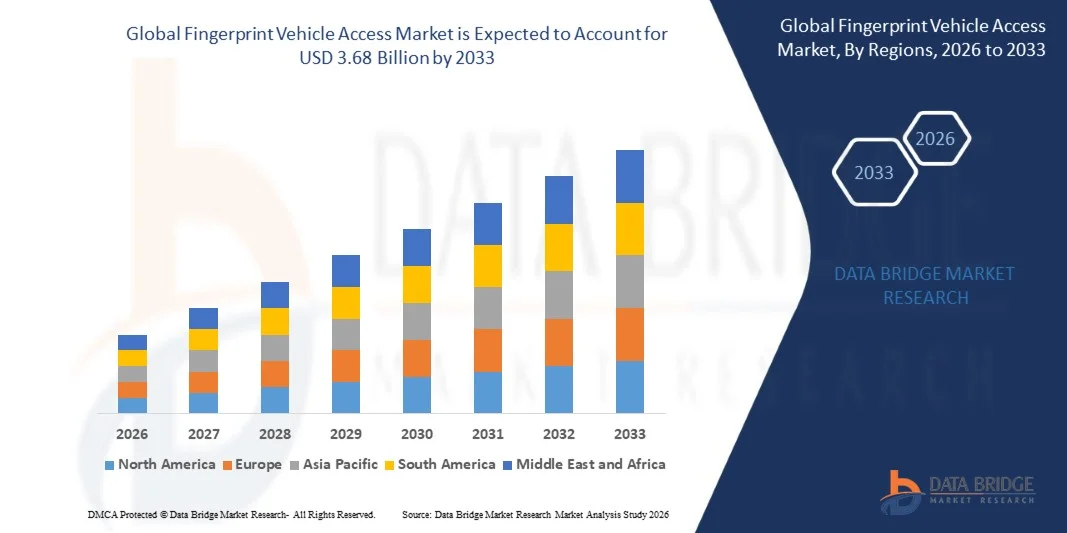
- As per Data Bridge Market Research analysis, the finger print vehicle access market was valued at USD 1.97 billion in 2025 and is projected to reach USD 3.68 billion by 2033, growing at a CAGR of 8.10% from 2026 to 2033.
- The market is expanding steadily as automakers move beyond traditional key fobs and PIN-based keyless entry toward biometric authentication that is harder to clone, immune to relay-attack theft, and capable of automatically applying a driver's personalized seat, mirror, and infotainment settings.
- Rising global vehicle theft rates, growing consumer preference for convenience-led ownership experiences, and increasing OEM investment in software-defined vehicle architectures are together pushing fingerprint recognition from a niche premium feature toward a mainstream vehicle access technology.
Market Size & Forecast
- Global Market Value (2025): USD 1.97 Billion
- Expected Market Value (2033): USD 3.68 Billion
- Forecast CAGR (2026–2033): 8.10%
- Leading Region in 2025: North America
- Fastest Growing Region: Asia-Pacific
What are the Major Takeaways of the Finger Print Vehicle Access Market?
- North America dominated the global finger print vehicle access market with the largest revenue share of 36.84% in 2025, supported by strong OEM adoption of biometric security features, high consumer awareness of vehicle theft prevention, and the presence of leading sensor and semiconductor manufacturers.
- Asia-Pacific is expected to be the fastest-growing region at a CAGR of 10.2% from 2026 to 2033, driven by rapid expansion of domestic vehicle production, rising adoption of biometric technology among Chinese and South Korean automakers, and growing consumer demand for connected, personalized vehicles.
- The sensor module segment led the market with a 41.27% share in 2025, driven by continued integration of capacitive fingerprint sensors into door handles and ignition buttons across a growing number of vehicle trims.
- Software and algorithms are the fastest-growing component segment, projected to register a CAGR of 9.6%, reflecting rising demand for AI-based fingerprint matching engines that reduce false-rejection rates and enable multi-user profile management.
- The passenger cars segment dominated the market with a 78.45% revenue share in 2025, led by growing OEM inclusion of fingerprint access as a standard or optional feature across mid-size and premium trims.
- OEM (factory-fitted) systems accounted for 83.62% of the market share in 2025, preferred for their seamless integration with vehicle immobilizer and personalization systems compared with retrofit aftermarket kits.
- The driver profile personalization application segment is the fastest-growing, with a CAGR of 9.9%, driven by rising consumer demand for vehicles that automatically adjust seating, climate, and infotainment settings the moment a registered fingerprint is detected.
Report Scope and Finger Print Vehicle Access Market Segmentation
|
Attributes |
Finger Print Vehicle Access Market Key Market Insights |
|
Segments Covered |
|
|
Countries Covered |
North America
Europe
Asia-Pacific
Middle East and Africa
South America
|
|
Key Market Players |
|
|
Market Opportunities |
|
|
Value Added Data Infosets |
In addition to the market insights such as market value, growth rate, market segments, geographical coverage, market players, and market scenario, the market report curated by the Data Bridge Market Research team includes in-depth expert analysis, import/export analysis, pricing analysis, production consumption analysis, and pestle analysis. |
What is the Key Trend in the Finger Print Vehicle Access Market?
- Tier-1 suppliers are increasingly combining fingerprint recognition with complementary biometric modalities such as facial and gesture recognition to build layered, touch-free vehicle access systems.
- For instance, in December 2024, Continental unveiled its "Intelligent Vehicle Experience Car" at CES 2025, a demonstration vehicle combining fingerprint-controlled engine start with facial recognition and gesture-based interaction to enable secure, touch-free access as a driver approaches the vehicle.
- Semiconductor and biometrics specialists are also deepening collaboration to bring smartphone-grade fingerprint matching accuracy into the more demanding thermal and vibration conditions of an automotive environment.
- As these combined biometric systems mature, fingerprint recognition is increasingly positioned as one layer within a broader, multi-modal vehicle access and personalization ecosystem rather than a standalone feature.
What are the Key Drivers of the Finger Print Vehicle Access Market?
- Rising global vehicle theft rates, particularly relay-attack theft of traditional keyless entry systems, are pushing automakers to adopt fingerprint recognition as a harder-to-clone alternative to key fobs.
- For instance, in November 2023, Eagle Eye Defense, a South African security company, developed an affordable vehicle biometric security system that uses fingerprint recognition connected to a vehicle's ignition system via a microcontroller, allowing only authorized users to start the engine.
- Growing collaboration between automotive semiconductor makers and biometric software specialists is improving fingerprint recognition accuracy and reliability under real-world automotive conditions.
- For instance, in December 2023, Precise Biometrics announced it would showcase, in collaboration with Infineon, joint automotive biometric identification solutions at CES 2024, demonstrating a fingerprint reader that enables drivers to manage vehicle settings, start the engine, and authenticate app access and payments.
- As OEMs continue shifting toward software-defined vehicle architectures, fingerprint recognition is increasingly being integrated as a native platform feature rather than a bolt-on accessory, supporting sustained market growth.
Which Factors are Challenging the Growth of the Finger Print Vehicle Access Market?
- Fingerprint sensors must perform reliably across a wide range of environmental conditions, including wet, cold, gloved, or dirty fingers, which remains a harder engineering challenge in an automotive setting than in controlled indoor environments such as smartphones.
- The added cost of integrating automotive-grade capacitive sensors, dedicated controllers, and matching software continues to limit fingerprint access to premium and mid-size trims rather than entry-level vehicles.
- Automakers exploring facial and gesture-based biometric alternatives, such as Continental's touch-free access demonstrations, illustrate the competitive pressure fingerprint recognition faces from other biometric modalities that avoid the need for physical contact with a sensor.
- Consumer data privacy concerns around storing biometric identifiers within a vehicle's onboard systems require automakers to invest in secure, on-device storage and encryption, adding further engineering and compliance cost to fingerprint access programs.
How is the Finger Print Vehicle Access Market Segmented?
The finger print vehicle access market is segmented on the basis of component, vehicle type, application, sales channel, vehicle class.
- By Component
On the basis of component, the global finger print vehicle access market is segmented into Sensor Module, Controller/ECU, Software & Algorithms. The sensor module segment dominated the market with a share of 41.27% in 2025 due to capacitive fingerprint sensors embedded in door handles and ignition buttons remain the foundational hardware layer that every fingerprint vehicle access system depends on. Additionally, continued miniaturization and cost reduction of automotive-grade capacitive sensors is expanding their inclusion across a wider range of vehicle trims.
The software & algorithms segment is expected to witness the fastest CAGR of 9.6% from 2026 to 2033, driven by rising demand for AI-based fingerprint matching engines is improving recognition accuracy and reducing false-rejection rates in real-world conditions such as wet or dirty fingers. Additionally, growing support for multi-user profile management is requiring more sophisticated on-device algorithms to distinguish between several registered drivers.
- By Vehicle Type
On the basis of vehicle type, the global finger print vehicle access market is segmented into Passenger Cars, Commercial Vehicles. The passenger cars segment dominated the market with a share of 78.45% in 2025 due to passenger car OEMs have led early commercialization of fingerprint access as a differentiating convenience and security feature across mid-size and premium trims. Additionally, rising consumer willingness to pay for biometric convenience features in personal vehicles continues to reinforce this segment's dominant share.
The commercial vehicles segment is expected to witness the fastest CAGR of 9.1% from 2026 to 2033, driven by fleet operators are increasingly exploring fingerprint-based driver authentication to improve vehicle security, prevent unauthorized use, and log driver identity for compliance purposes. Additionally, growing adoption of telematics and fleet management platforms is creating natural integration points for biometric driver verification in commercial vehicles.
- By Application
On the basis of application, the global finger print vehicle access market is segmented into Door Unlocking, Engine Ignition & Start, Driver Profile Personalization. The door unlocking segment dominated the market with a share of 48.36% in 2025 due to fingerprint-based door unlocking remains the most visible and widely adopted use case, directly replacing or supplementing traditional key fobs. Additionally, growing concern over relay-attack theft of keyless entry systems is pushing automakers to offer fingerprint unlocking as a more secure alternative.
The driver profile personalization segment is expected to witness the fastest CAGR of 9.9% from 2026 to 2033, driven by rising consumer demand for vehicles that automatically adjust seating, mirror, climate, and infotainment settings the moment a registered fingerprint is detected is expanding this application beyond simple access control. Additionally, growing integration between fingerprint recognition and in-vehicle infotainment systems is enabling more granular, driver-specific personalization profiles.
- By Sales channel
On the basis of sales channel, the global finger print vehicle access market is segmented into OEM (Factory-Fitted), Aftermarket. The OEM (factory-fitted) segment dominated the market with a share of 83.62% in 2025 due to factory-fitted systems integrate more seamlessly with a vehicle's immobilizer, personalization, and telematics systems than retrofit kits can achieve. Additionally, growing OEM investment in software-defined vehicle architectures is making fingerprint access a natural factory-installed feature rather than an aftermarket addition.
The aftermarket segment is expected to witness the fastest CAGR of 9.3% from 2026 to 2033, driven by rising demand for retrofit biometric security kits among owners of older vehicles is expanding the aftermarket segment, particularly in regions with high vehicle theft rates. Additionally, declining costs of standalone fingerprint ignition security modules are making aftermarket retrofits more accessible to a broader base of vehicle owners.
- By Vehicle class
On the basis of vehicle class, the global finger print vehicle access market is segmented into Luxury & Premium, Mid-Size, Economy. The luxury & premium segment dominated the market with a share of 52.18% in 2025 due to luxury and premium automakers were the earliest adopters of fingerprint access as a flagship convenience and security feature to differentiate their vehicles. Additionally, higher per-vehicle margins in this class make it easier for automakers to absorb the added cost of biometric sensor integration.
The mid-size segment is expected to witness the fastest CAGR of 9.4% from 2026 to 2033, driven by declining component costs are enabling automakers to extend fingerprint access from flagship luxury trims down into higher-volume mid-size vehicle segments. Additionally, rising consumer expectation for biometric convenience features, previously seen only in luxury vehicles, is pushing mid-size automakers to adopt the technology faster.
Which Region Holds the Largest Share of the Finger Print Vehicle Access Market?
- North America dominated the global finger print vehicle access market with the largest revenue share of 36.84% in 2025, supported by strong OEM adoption of biometric security features, high consumer awareness of vehicle theft prevention, and the presence of leading sensor and semiconductor manufacturers.
- Asia-Pacific is expected to be the fastest-growing region at a CAGR of 10.2% from 2026 to 2033, driven by rapid expansion of domestic vehicle production, rising adoption of biometric technology among Chinese and South Korean automakers, and growing consumer demand for connected, personalized vehicles.
U.S. Finger Print Vehicle Access Market Insight
The U.S. finger print vehicle access market is expanding steadily, supported by strong OEM investment in biometric security features and a high concentration of leading semiconductor and Tier-1 supplier headquarters. Rising consumer concern over keyless entry relay-attack theft is further reinforcing demand for fingerprint-based alternatives.
Germany Finger Print Vehicle Access Market Insight
The Germany finger print vehicle access market is growing steadily, underpinned by the strong presence of European Tier-1 suppliers and premium automakers that were early adopters of biometric access features. Continued innovation in multi-modal biometric access systems is reinforcing Germany's position as a key European hub for automotive biometrics.
Asia-Pacific Finger Print Vehicle Access Market Insight
The Asia-Pacific finger print vehicle access market is expected to witness rapid growth, driven by rapid expansion of domestic vehicle production and rising adoption of biometric technology among Chinese and South Korean automakers. Growing consumer demand for connected, personalized vehicles is further accelerating regional adoption.
South Korea Finger Print Vehicle Access Market Insight
The South Korea finger print vehicle access market is growing at a healthy pace, supported by strong domestic OEM investment in biometric vehicle access technology and a well-established consumer electronics supply chain. Rising export of biometric-equipped vehicles is further contributing to market growth in South Korea.
China Finger Print Vehicle Access Market Insight
The China finger print vehicle access market is expanding rapidly, driven by rising domestic vehicle production, growing consumer demand for connected and personalized vehicle features, and increasing domestic sensor manufacturing capability. Rising investment by domestic automakers in biometriFinger Print Vehicle Access Marketc access technology is positioning China as one of the fastest-growing markets for fingerprint vehicle access globally.
Which are the Top Companies in the ?
The finger print vehicle access market is primarily led by well-established companies, including:
- NXP Semiconductors N.V. (Netherlands)
- Huf Hülsbeck & Fürst GmbH & Co. KG (Germany)
- Aptiv PLC (Ireland)
- Johnson Controls International plc (Ireland)
- Gentex Corporation (U.S.)
- Tokai Rika Co., Ltd. (Japan)
- Valeo S.A. (France)
- Visteon Corporation (U.S.)
- ZF Friedrichshafen AG (Germany)
- Kiekert AG (Germany)
- Omron Corporation (Japan)
- STMicroelectronics N.V. (Switzerland)
- Continental AG (Germany)
- Hyundai Mobis Co., Ltd. (South Korea)
- Synaptics Incorporated (U.S.)
- Precise Biometrics AB (Sweden)
- IDEX Biometrics ASA (Norway)
- Denso Corporation (Japan)
- Robert Bosch GmbH (Germany)
- Infineon Technologies AG (Germany)
What are Latest Developments in the Finger Print Vehicle Access Market?
- In December 2024, Continental unveiled its "Intelligent Vehicle Experience Car" at CES 2025 in Las Vegas, a demonstration vehicle that combines fingerprint-controlled engine start with facial recognition and gesture-based interaction, enabling the vehicle to recognize an approaching driver and unlock, start, or open the tailgate automatically while keeping unauthorized individuals locked out.
- In July 2025, Stellantis (FCA US, LLC) was granted a U.S. patent for a biometric vehicle entry system using facial recognition, underscoring continued automaker investment in biometric alternatives to traditional key fobs across facial and fingerprint modalities alike, following an early preview of similar technology in the Chrysler Halcyon Concept.
- In December 2023, Precise Biometrics announced it would participate in CES 2024 alongside German semiconductor company Infineon to demonstrate joint automotive biometric identification solutions, including a fingerprint reader enabling drivers to manage vehicle settings, start the engine, and authenticate app access and payments.
- In November 2023, Eagle Eye Defense, a South African security company, developed an affordable vehicle biometric security system using fingerprint recognition connected to the vehicle's ignition system via a microcontroller, allowing only registered, authorized users to start the engine and helping prevent unauthorized vehicle use.

- Interactive Data Analysis Dashboard
- Company Analysis Dashboard for high growth potential opportunities
- Research Analyst Access for customization & queries
- Competitor Analysis with Interactive dashboard
- Latest News, Updates & Trend analysis
- Harness the Power of Benchmark Analysis for Comprehensive Competitor Tracking
Data collection and base year analysis are done using data collection modules with large sample sizes. The stage includes obtaining market information or related data through various sources and strategies. It includes examining and planning all the data acquired from the past in advance. It likewise envelops the examination of information inconsistencies seen across different information sources. The market data is analysed and estimated using market statistical and coherent models. Also, market share analysis and key trend analysis are the major success factors in the market report. To know more, please request an analyst call or drop down your inquiry.
The key research methodology used by DBMR research team is data triangulation which involves data mining, analysis of the impact of data variables on the market and primary (industry expert) validation. Data models include Vendor Positioning Grid, Market Time Line Analysis, Market Overview and Guide, Company Positioning Grid, Patent Analysis, Pricing Analysis, Company Market Share Analysis, Standards of Measurement, Global versus Regional and Vendor Share Analysis. To know more about the research methodology, drop in an inquiry to speak to our industry experts.
Data Bridge Market Research is a leader in advanced formative research. We take pride in servicing our existing and new customers with data and analysis that match and suits their goal. The report can be customized to include price trend analysis of target brands understanding the market for additional countries (ask for the list of countries), clinical trial results data, literature review, refurbished market and product base analysis. Market analysis of target competitors can be analyzed from technology-based analysis to market portfolio strategies. We can add as many competitors that you require data about in the format and data style you are looking for. Our team of analysts can also provide you data in crude raw excel files pivot tables (Fact book) or can assist you in creating presentations from the data sets available in the report.