


Fintech Block Chain Market Size
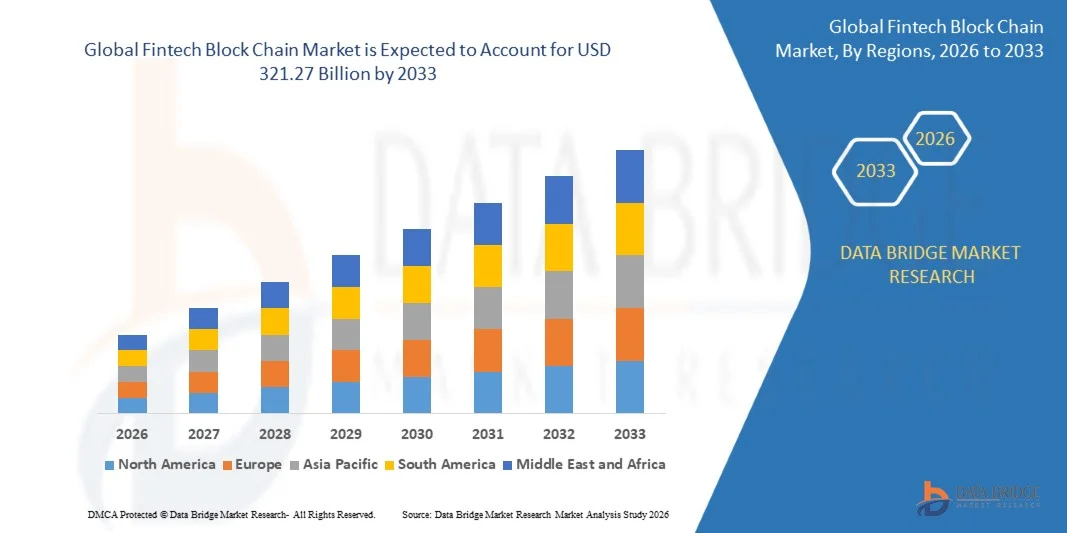
- The global fintech block chain market size was valued at USD 12.81 billion in 2025 and is expected to reach USD 321.27 billion by 2033, at a CAGR of 43.56% during the forecast period
- The market growth is largely fuelled by the increasing adoption of blockchain technology for secure and transparent financial transactions
- Growing demand for decentralized finance (DeFi) solutions, digital payment platforms, and cross-border transaction efficiency is driving market expansion
Fintech Block Chain Market Analysis
- The market is witnessing significant advancements in smart contracts, tokenization, and digital identity management, enhancing operational efficiency and security in financial services
- Integration of blockchain with AI, IoT, and cloud technologies is enabling new applications in payments, lending, and insurance, creating a robust growth environment
- North America dominated the fintech blockchain market with the largest revenue share in 2025, driven by rapid adoption of blockchain technology across banking, financial services, and enterprise operations, as well as increasing investments in digital finance solutions
- Asia-Pacific region is expected to witness the highest growth rate in the global fintech blockchain market, driven by increasing fintech innovation, rapid urbanization, technological advancements, and rising investments in digital banking infrastructure across countries such as China, Japan, and India
- The Smart Contracts segment held the largest market revenue share in 2025, driven by their ability to automate agreements, reduce intermediaries, and enhance transaction transparency. Smart contracts are widely adopted across banking, trade finance, and digital asset management, making them a preferred choice for enterprises seeking operational efficiency and cost savings
Report Scope and Fintech Block Chain Market Segmentation
|
Attributes |
Fintech Block Chain Key Market Insights |
|
Segments Covered |
|
|
Countries Covered |
North America
Europe
Asia-Pacific
Middle East and Africa
South America
|
|
Key Market Players |
• IBM (U.S.) |
|
Market Opportunities |
• Increasing Adoption Of Decentralized Finance (DeFi) Solutions |
|
Value Added Data Infosets |
In addition to the market insights such as market value, growth rate, market segments, geographical coverage, market players, and market scenario, the market report curated by the Data Bridge Market Research team includes in-depth expert analysis, import/export analysis, pricing analysis, production consumption analysis, and pestle analysis. |
Fintech Block Chain Market Trends
“Rising Adoption of Decentralized Finance (DeFi) and Digital Payment Solutions”
• The increasing focus on secure, transparent, and decentralized financial systems is significantly shaping the fintech blockchain market, as businesses and consumers seek alternatives to traditional banking infrastructure. Blockchain technology is gaining traction for its ability to enable fast, tamper-proof, and low-cost transactions, strengthening adoption across banking, payment processing, and cross-border remittance services. This trend encourages fintech firms to innovate with new solutions that enhance financial inclusion and transactional efficiency
• Expanding awareness of digital finance, cryptocurrency adoption, and cross-border transaction efficiency has accelerated the demand for blockchain-based solutions in lending, trade finance, and insurance. Financial institutions, technology providers, and startups are actively implementing blockchain to streamline operations, reduce intermediaries, and improve transparency
• Security, transparency, and cost-effectiveness trends are influencing technology investments, with companies emphasizing scalable blockchain infrastructure, robust cryptography, and regulatory compliance. These factors are helping brands differentiate solutions in a competitive fintech landscape while driving adoption among enterprises and retail users
• For instance, in 2025, Ripple in the U.S. and Binance in Malta expanded their blockchain-based payment networks to support cross-border transactions and decentralized finance offerings. These initiatives were introduced in response to growing demand for faster, secure, and low-cost financial services, with deployment across banks, fintech apps, and corporate platforms
• While adoption is growing, sustained market expansion depends on continuous technological innovation, cost-effective implementation, and regulatory alignment. Companies are also focusing on enhancing interoperability, scalability, and network security to drive broader adoption across global financial ecosystems
Fintech Block Chain Market Dynamics
Driver
“Increasing Demand for Secure, Transparent, and Efficient Financial Transactions”
• Rising adoption of decentralized finance (DeFi), digital payment solutions, and blockchain-based banking services is a major driver for the fintech blockchain market. Companies are increasingly leveraging blockchain to reduce transaction costs, enhance security, and improve transparency, driving innovation across payments, lending, and insurance
• Expanding applications in cross-border payments, trade finance, cryptocurrency trading, and digital identity management are influencing market growth. Blockchain solutions help streamline financial operations, minimize fraud risks, and enhance trust among participants, supporting the global shift toward digital finance
• Fintech companies and banks are actively promoting blockchain-based services through partnerships, product launches, and strategic collaborations. These efforts are reinforced by growing consumer interest in faster, transparent, and cost-effective financial transactions, as well as institutional adoption of digital assets
• For instance, in 2024, Mastercard in the U.S. and SBI Holdings in Japan reported increased integration of blockchain technology in payment processing and supply chain finance. This expansion followed higher demand for secure, real-time, and automated financial services, enhancing efficiency and trust across user networks
• Although growing demand supports market expansion, broader adoption depends on cost optimization, network scalability, and interoperability across financial systems. Investment in blockchain infrastructure, regulatory compliance, and R&D for innovative solutions will be critical to meeting global demand
Restraint/Challenge
“Regulatory Uncertainty and High Implementation Costs”
• Complex and evolving regulations around blockchain and cryptocurrency remain a key challenge, limiting adoption among financial institutions and fintech startups. Compliance costs and uncertainty in legal frameworks can delay project deployment and market penetration
• High initial setup costs and technological complexity restrict adoption among smaller enterprises and emerging market players. Implementing blockchain infrastructure requires significant investment in hardware, software, and skilled personnel
• Interoperability challenges and integration with legacy systems also impact growth, as existing financial networks may not support seamless blockchain adoption. Ensuring network security, scalability, and reliability requires continuous technological enhancements
• For instance, in 2023, several fintech startups in Southeast Asia reported delays in launching blockchain-enabled payment platforms due to regulatory approval issues and high development costs. These factors affected deployment timelines and market visibility
• Overcoming these challenges will require regulatory clarity, cost-effective implementation models, and industry collaboration. Partnerships between fintech firms, financial institutions, and regulators, along with education on blockchain benefits, will be essential to unlocking long-term growth potential in the global fintech blockchain market
Fintech Block Chain Market Scope
The market is segmented on the basis of application, provider, organization size, and industry vertical.
• By Application
On the basis of application, the fintech blockchain market is segmented into Smart Contracts, Identity Management, and Others. The Smart Contracts segment held the largest market revenue share in 2025, driven by their ability to automate agreements, reduce intermediaries, and enhance transaction transparency. Smart contracts are widely adopted across banking, trade finance, and digital asset management, making them a preferred choice for enterprises seeking operational efficiency and cost savings.
The Identity Management segment is expected to witness the fastest growth rate from 2026 to 2033, driven by increasing demand for secure, tamper-proof digital identities and KYC verification solutions. Blockchain-based identity management solutions are particularly popular for reducing fraud, ensuring compliance, and improving user authentication processes, often serving as a critical component for fintech platforms and digital financial services.
• By Provider
On the basis of provider, the market is segmented into Middleware Providers and Others. The Middleware Providers segment held the largest market revenue share in 2025, owing to their role in enabling seamless integration of blockchain networks with enterprise applications, payment systems, and financial platforms. Middleware solutions facilitate real-time transaction processing, interoperability, and scalability, supporting large-scale adoption of blockchain technology.
The Others segment is expected to witness the fastest growth rate from 2026 to 2033, driven by increasing demand for specialized blockchain services such as consulting, network management, and API solutions. These providers help fintech startups and enterprises implement blockchain infrastructure efficiently, ensuring compliance, security, and cost-effectiveness.
• By Organization Size
On the basis of organization size, the market is segmented into Small and Medium-Sized Enterprises (SMEs) and Large Enterprises. The Large Enterprises segment held the largest market revenue share in 2025, supported by substantial investments in blockchain infrastructure, cross-border payment networks, and digital asset platforms. Large organizations leverage blockchain to improve operational efficiency, reduce transactional costs, and enhance transparency across global operations.
The SMEs segment is expected to witness the fastest growth rate from 2026 to 2033, driven by cost-effective blockchain-as-a-service platforms and cloud-based solutions. SMEs are increasingly adopting blockchain for payments, lending, and identity verification, enabling them to compete with larger enterprises while improving security and transaction efficiency.
• By Industry Vertical
On the basis of industry vertical, the market is segmented into Banking and Others. The Banking segment held the largest market revenue share in 2025, driven by adoption of blockchain for cross-border payments, trade finance, and fraud prevention. Banks benefit from faster settlement times, lower transaction costs, and improved transparency, making blockchain an integral part of digital transformation initiatives.
The Others segment is expected to witness the fastest growth rate from 2026 to 2033, fueled by adoption across insurance, logistics, healthcare, and fintech startups. These sectors are leveraging blockchain for secure transactions, data integrity, and automated contract management, expanding the overall blockchain ecosystem beyond traditional banking.
Fintech Block Chain Market Regional Analysis
• North America dominated the fintech blockchain market with the largest revenue share in 2025, driven by rapid adoption of blockchain technology across banking, financial services, and enterprise operations, as well as increasing investments in digital finance solutions
• Businesses and consumers in the region highly value blockchain’s capabilities for secure, transparent, and cost-efficient transactions, along with applications in smart contracts, digital identity management, and cross-border payments
• This widespread adoption is further supported by advanced IT infrastructure, regulatory support, high digital literacy, and a growing preference for automation and decentralized financial services, establishing blockchain as a key technology for enterprises and fintech startups
U.S. Fintech Blockchain Market Insight
The U.S. fintech blockchain market captured the largest revenue share in 2025 within North America, fueled by strong demand for secure and efficient financial transactions. Enterprises are increasingly implementing blockchain for cross-border payments, trade finance, and digital asset management. The rising adoption of blockchain-as-a-service platforms, along with integration of smart contract solutions and identity management systems, is further propelling market growth. Moreover, partnerships between fintech companies, banks, and technology providers are significantly expanding blockchain deployment across multiple industries.
Europe Fintech Blockchain Market Insight
The Europe fintech blockchain market is expected to witness the fastest growth rate from 2026 to 2033, primarily driven by increasing regulatory support, growing digitalization of financial services, and demand for secure transaction networks. Adoption of blockchain in banking, insurance, and trade finance is rising, while European enterprises are also leveraging smart contracts and identity management solutions. The region is experiencing growth across both startups and established organizations, with blockchain being incorporated into new financial platforms and digital services.
U.K. Fintech Blockchain Market Insight
The U.K. fintech blockchain market is expected to witness the fastest growth rate from 2026 to 2033, driven by the adoption of decentralized finance (DeFi), digital identity solutions, and secure payment networks. Increased focus on cybersecurity and regulatory compliance is encouraging financial institutions and fintech firms to implement blockchain-based platforms. The U.K.’s mature fintech ecosystem, along with strong investment in innovation and robust digital infrastructure, is expected to continue supporting market expansion.
Germany Fintech Blockchain Market Insight
The Germany fintech blockchain market is expected to witness the fastest growth rate from 2026 to 2033, fueled by growing awareness of secure digital transactions and increasing deployment of blockchain solutions in banking and trade finance. Germany’s well-established financial and IT infrastructure, combined with an emphasis on innovation and regulatory compliance, promotes adoption of blockchain technology. Enterprises are also integrating blockchain with AI and cloud platforms, enhancing transparency, efficiency, and security across financial operations.
Asia-Pacific Fintech Blockchain Market Insight
The Asia-Pacific fintech blockchain market is expected to witness the fastest growth rate from 2026 to 2033, driven by rapid digitalization, technological advancements, and increasing adoption of blockchain in countries such as China, Japan, and India. The region’s growing interest in decentralized finance, secure digital identity, and smart contract applications is accelerating adoption. In addition, government initiatives promoting blockchain innovation and financial inclusion are boosting accessibility and affordability for enterprises and startups.
Japan Fintech Blockchain Market Insight
The Japan fintech blockchain market is expected to witness the fastest growth rate from 2026 to 2033 due to the country’s technology-driven financial ecosystem, high digital literacy, and strong demand for secure transaction platforms. Japanese banks and fintech firms are implementing blockchain for cross-border payments, identity management, and smart contract applications. Integration with other digital financial technologies, such as AI and IoT, is further driving market growth.
China Fintech Blockchain Market Insight
The China fintech blockchain market accounted for the largest market revenue share in Asia-Pacific in 2025, attributed to rapid digital transformation, strong government support, and high adoption of blockchain by financial institutions. China is one of the largest markets for blockchain-based payments, smart contracts, and digital identity management. The expansion of fintech startups, coupled with cost-effective blockchain solutions and robust technological infrastructure, is a key factor driving market growth across enterprises and financial services.
Fintech Block Chain Market Share
The Fintech Block Chain industry is primarily led by well-established companies, including:
• IBM (U.S.)
• Microsoft (U.S.)
• Ripple (U.S.)
• Chain (U.S.)
• Earthport (U.K.)
• Bitfury Group Ltd. (Netherlands)
• Bloomberg LP (U.S.)
• Oracle (U.S.)
• DigitalAssessment Holdings LLC (U.S.)
• The Circle Group of Companies (U.S.)
• Factom (U.S.)
• AlphaPoint (U.S.)
• Coinbase (U.S.)
• Abra (U.S.)
• Auxesis Services and Technologies Pvt. Ltd. (India)
• BitPay (U.S.)
• BlockCypher Inc. (U.S.)
• Applied Blockchain Ltd. (U.K.)
• RecordKeeper (U.S.)
• Symbiont Group Holdings Pvt. Ltd. (U.S.)
• Guardtime (Estonia)
• Cambridge Bitfury Group Limited (U.K.)
• TIBCO Software Inc. (U.S.)
• OARO (U.S.)
• Peer Ledger Inc. (Canada)
• Venture Proxy Ltd. (U.K.)
• Datex Corporation (U.S.)
• Omnichain Solutions (U.S.)
• Amazon Web Services, Inc. (U.S.)
• Bitnation (Estonia)
• Blockverify (U.K.)
• BTL Group Ltd. (U.K.)
• Cambridge Blockchain, LLC (U.S.)
• OpenXcell Blockchain (U.S.)
• Tradle (U.S.)
• Blockchain Advisory Mauritius Foundation (Mauritius)
Latest Developments in Global Fintech Block Chain Market
- In December 2025 Circle expanded its USDC stablecoin to six additional blockchain networks, increasing total network integrations to 15. This expansion enables faster and more cost-efficient cross-chain transactions for enterprises and fintech platforms. The move strengthens Circle’s position in the digital payments ecosystem, promotes broader adoption of stablecoins, and enhances liquidity across multiple blockchain networks
- In November 2025 JPMorgan Chase’s Onyx blockchain platform recorded over USD 1 trillion in intraday repo and FX transaction volumes. This milestone demonstrates the platform’s capability to handle high-value, real-time financial operations with enhanced security and transparency. The achievement boosts market confidence in blockchain-based institutional finance solutions and encourages broader adoption by banks and trading firms
- In October 2025 European Investment Bank issued EUR 150 million (USD 162 million) in digital bonds on the Ethereum mainnet, achieving settlement within 60 seconds. This initiative showcases blockchain’s ability to reduce settlement times, lower operational costs, and increase transparency in bond issuance. The adoption of digital bonds by a major financial institution reinforces blockchain’s potential in capital markets and institutional financing
- In September 2025 SWIFT launched a blockchain-based ledger to track real-time cross-border payments with 30 correspondent banks. The ledger aims to improve transparency, speed, and accuracy of international money transfers. By reducing reconciliation issues and enhancing traceability, the solution strengthens confidence in blockchain for global payments and supports wider adoption across financial institutions

- Interactive Data Analysis Dashboard
- Company Analysis Dashboard for high growth potential opportunities
- Research Analyst Access for customization & queries
- Competitor Analysis with Interactive dashboard
- Latest News, Updates & Trend analysis
- Harness the Power of Benchmark Analysis for Comprehensive Competitor Tracking
Data collection and base year analysis are done using data collection modules with large sample sizes. The stage includes obtaining market information or related data through various sources and strategies. It includes examining and planning all the data acquired from the past in advance. It likewise envelops the examination of information inconsistencies seen across different information sources. The market data is analysed and estimated using market statistical and coherent models. Also, market share analysis and key trend analysis are the major success factors in the market report. To know more, please request an analyst call or drop down your inquiry.
The key research methodology used by DBMR research team is data triangulation which involves data mining, analysis of the impact of data variables on the market and primary (industry expert) validation. Data models include Vendor Positioning Grid, Market Time Line Analysis, Market Overview and Guide, Company Positioning Grid, Patent Analysis, Pricing Analysis, Company Market Share Analysis, Standards of Measurement, Global versus Regional and Vendor Share Analysis. To know more about the research methodology, drop in an inquiry to speak to our industry experts.
Data Bridge Market Research is a leader in advanced formative research. We take pride in servicing our existing and new customers with data and analysis that match and suits their goal. The report can be customized to include price trend analysis of target brands understanding the market for additional countries (ask for the list of countries), clinical trial results data, literature review, refurbished market and product base analysis. Market analysis of target competitors can be analyzed from technology-based analysis to market portfolio strategies. We can add as many competitors that you require data about in the format and data style you are looking for. Our team of analysts can also provide you data in crude raw excel files pivot tables (Fact book) or can assist you in creating presentations from the data sets available in the report.













