


What is the Flare Gas Recovery Compressors Market Size and Growth Rate?
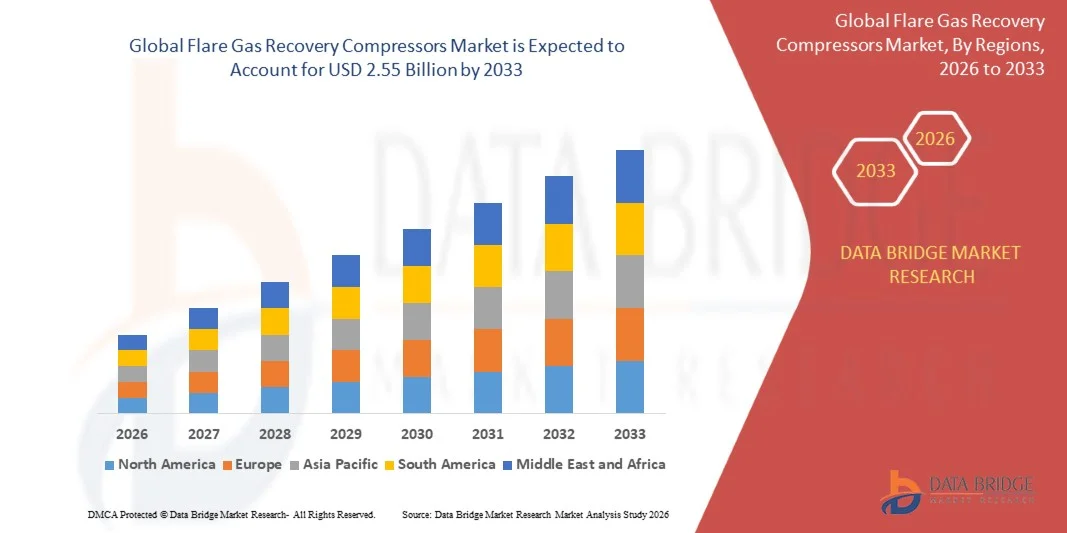
- As per Data Bridge Market Research analysis the flare gas recovery compressors market was valued at USD 1.40 billion in 2025 and is projected to reach USD 2.55 billion by 2033, growing at a CAGR of 7.80% from 2026 to 2033.
- The market is experiencing consistent growth driven by rising demand for flare gas recovery systems, increasing emphasis on reducing hydrocarbon losses and greenhouse gas emissions, and growing adoption of energy-efficient compression technologies across oil and gas facilities.
- The implementation of stringent environmental regulations on routine gas flaring, combined with increasing investments in refinery, petrochemical, and upstream oil and gas infrastructure, is encouraging operators to deploy flare gas recovery compressors to improve energy efficiency, recover valuable hydrocarbons, and reduce emissions.
Market Size & Forecast
- Market Value (2025): USD 1.40 Billion
- Expected Market Value (2033): USD 2.55 Billion
- Forecast CAGR (2026–2033): 7.80%
- Leading Region in 2025: North America
- Fastest Growing Region: Asia-Pacific
What are the Major Takeaways of the Flare Gas Recovery Compressors Market?
- North America dominated the flare gas recovery system market with a revenue share of 32.1% in 2025, supported by stringent environmental regulations, substantial oil and gas production, and increasing investments in technologies designed to reduce routine flaring.
- Asia-Pacific flare gas recovery compressors market is expected to witness the fastest growth from 2026 to 2033, supported by expanding oil and gas production, refinery and petrochemical capacity additions, and increasing regulatory pressure to reduce gas flaring.
- The reciprocating compressors segment held the largest market share in 2025, driven by their high efficiency, reliability, and suitability for high-pressure flare gas recovery applications. Reciprocating compressors are widely used across oil and gas production facilities because they can efficiently manage variable gas conditions and high-pressure requirements.
- The screw compressors segment is projected to register the fastest growth at a CAGR from 2026 to 2033, supported by its compact design, lower maintenance requirements, and ability to operate efficiently across a wide range of flow rates. Increasing demand for continuous-duty compression and cost-effective flare gas recovery solutions is accelerating adoption of screw compressors.
- The oil-injected segment is expected to account for a significant market share in 2025, supported by its established use in industrial gas compression and its ability to provide reliable compression for demanding flare gas applications. Oil-injected compressor configurations are particularly suitable where continuous operation, high compression efficiency, and cost-effective equipment are priorities.
- The oil-free segment is projected to register the fastest growth at a CAGR from 2026 to 2033, driven by increasing demand for contamination-free gas recovery, stringent environmental requirements, and applications where recovered gas quality is critical. Industry market sources identify oil-free compression as a growing solution for flare gas and vapor recovery applications, particularly in facilities requiring cleaner gas handling.
Report Scope and Flare Gas Recovery Compressors Market Segmentation
|
Attributes |
Flare Gas Recovery Compressors Key Market Insights |
|
Segments Covered |
|
|
Countries Covered |
North America
Europe
Asia-Pacific
Middle East and Africa
South America
|
|
Key Market Players |
|
|
Market Opportunities |
|
|
Value Added Data Infosets |
|
What is the Key Trend in the Flare Gas Recovery Compressors Market?
- Oil and gas operators are increasingly adopting advanced flare gas recovery compressors to capture hydrocarbon-rich gases that would otherwise be combusted, improving resource utilization while reducing greenhouse gas emissions and operating losses.
- For instance, AERZEN highlights flare gas recovery as an established oil and gas application for its process gas compression technologies, including oil-free screw compressors designed to handle varying flow rates and demanding gas conditions.
- Compressor manufacturers are increasingly focusing on oil-free, compact, high-efficiency designs capable of handling corrosive, wet, and variable-composition gases while maintaining reliable continuous operation.
- For instance, Sundyne’s LMC process gas compressors are specifically designed for flare gas recovery and can handle corrosive gas mixtures, with configurations offering flows of up to 2,500 acfm and working pressures of up to 2,300 psi.
- As refineries, petrochemical plants, and upstream facilities prioritize hydrocarbon recovery and emissions reduction, the adoption of efficient flare gas recovery compressors is expected to accelerate, making compression technology an increasingly important component of flare-management strategies.
What are the Key Drivers of the Flare Gas Recovery Compressors Market?
- The growing global focus on reducing routine gas flaring and methane emissions is significantly increasing demand for flare gas recovery compressors that enable operators to recover, reuse, or redirect associated gas instead of continuously burning it.
- For instance, the World Bank reported that global gas flaring reached 167 billion cubic meters in 2025, the highest level since 2019, highlighting the need for accelerated investments in technologies that capture and utilize flared gas.
- Governments and oil companies are also strengthening commitments to eliminate routine flaring, encouraging operators to invest in gas recovery, compression, reinjection, and utilization infrastructure.
- For instance, the World Bank’s Zero Routine Flaring by 2030 initiative commits participating governments and oil companies to end routine flaring no later than 2030, creating long-term demand for technologies that enable associated gas to be recovered and utilized.
- With increasing environmental commitments, rising methane-reduction priorities, and the economic value of recovered hydrocarbons, flare gas recovery compressors are expected to remain essential for improving energy efficiency and reducing emissions across oil and gas facilities.
Which Factors are Challenging the Growth of the Flare Gas Recovery Compressors Market?
- Flare gas recovery compressors require substantial investment in compressors, knockout drums, piping, controls, electrical systems, and integration with existing flare infrastructure, making installation costly for smaller facilities and operators with limited capital budgets.
- The highly variable composition, pressure, temperature, and flow rate of flare gas can also increase engineering complexity and require customized compressor configurations, specialized materials, and additional gas-treatment equipment.
- For instance, AERZEN notes that flare gas recovery applications can involve varying flow rates and challenging gas conditions, requiring compressor solutions to be engineered according to gas composition, pressure, flow, environmental conditions, and applicable standards.
- Operators must also maintain conventional flare systems as safety mechanisms even after installing recovery equipment, increasing capital and maintenance requirements and limiting the ability to eliminate all associated flaring.
- The high upfront investment, complex integration requirements, and need to maintain reliable operation under highly variable process conditions continue to restrict adoption, particularly among smaller facilities and in cost-sensitive markets, despite growing regulatory and environmental pressure to reduce routine gas flaring.
How is the Flare Gas Recovery Compressors Market Segmented?
The market is segmented on the basis of compressor type, technology, application, and end-use industry.
- By Compressor Type
On the basis of compressor type, the flare gas recovery compressors market is segmented into reciprocating compressors, screw compressors, centrifugal compressors, rotary vane compressors, and others. The reciprocating compressors segment held the largest market share in 2025, driven by their high efficiency, reliability, and suitability for high-pressure flare gas recovery applications. Reciprocating compressors are widely used across oil and gas production facilities because they can efficiently manage variable gas conditions and high-pressure requirements.
The screw compressors segment is projected to register the fastest growth at a CAGR from 2026 to 2033, supported by its compact design, lower maintenance requirements, and ability to operate efficiently across a wide range of flow rates. Increasing demand for continuous-duty compression and cost-effective flare gas recovery solutions is accelerating adoption of screw compressors.
- By Technology
On the basis of technology, the flare gas recovery compressors market is segmented into oil-injected, oil-free, and others. The oil-injected segment is expected to account for a significant market share in 2025, supported by its established use in industrial gas compression and its ability to provide reliable compression for demanding flare gas applications. Oil-injected compressor configurations are particularly suitable where continuous operation, high compression efficiency, and cost-effective equipment are priorities.
The oil-free segment is projected to register the fastest growth at a CAGR from 2026 to 2033, driven by increasing demand for contamination-free gas recovery, stringent environmental requirements, and applications where recovered gas quality is critical. Industry market sources identify oil-free compression as a growing solution for flare gas and vapor recovery applications, particularly in facilities requiring cleaner gas handling.
- By Application
On the basis of application, the flare gas recovery compressors market is segmented into flare gas recovery, vapor recovery, fuel gas recovery, and others. The flare gas recovery segment held the largest market share in 2025, driven by increasing deployment of recovery units in oil and gas production facilities to reduce routine flaring, recover valuable hydrocarbons, and comply with emissions regulations.
The vapor recovery segment is projected to register the fastest growth at a CAGR from 2026 to 2033, supported by increasing requirements for capturing hydrocarbon vapors from storage, processing, and refinery operations. Rising emphasis on reducing volatile organic compound emissions and recovering saleable hydrocarbons is encouraging the adoption of advanced compression-based vapor recovery solutions.
- By End-Use Industry
On the basis of end-use industry, the flare gas recovery compressors market is segmented into oil and gas, petrochemical, chemical, refining, and others. The oil and gas segment held the largest market share in 2025, driven by extensive deployment of flare gas recovery systems across upstream production, offshore facilities, gas processing, and downstream operations. The segment benefits from stringent emissions regulations and the economic value of recovering hydrocarbons that would otherwise be flared.
The petrochemical and refining segments is projected to register the fastest growth at a CAGR from 2026 to 2033, supported by modernization of processing facilities, increasing investments in emissions-reduction infrastructure, and growing demand to reuse recovered gases as fuel or feedstock. Flare gas recovery systems are increasingly integrated into refinery and petrochemical operations to improve energy efficiency while reducing emissions.
Which Region Holds the Largest Share of the Flare Gas Recovery Compressors Market?
- North America dominated the flare gas recovery system market with a revenue share of 32.1% in 2025, supported by stringent environmental regulations, substantial oil and gas production, and increasing investments in technologies designed to reduce routine flaring.
- The region's established oil and gas infrastructure and continued modernization of aging facilities are encouraging operators to deploy flare gas recovery systems and compressor-based technologies to recover valuable hydrocarbons, improve operational efficiency, and reduce emissions.
U.S. Flare Gas Recovery Compressors Market Insight
The U.S. flare gas recovery system market captured a significant share of the global market in 2025, supported by extensive shale oil and gas production and increasing pressure to control flaring and methane emissions. The country's mature oil and gas infrastructure, combined with environmental regulations and investments in emissions-reduction technologies, is encouraging operators to install compressor-based recovery systems. The U.S. market generated approximately USD 605.4 million in revenue in 2025 and is projected to reach USD 910.1 million by 2033, reflecting continued demand for flare gas recovery technologies.
Europe Flare Gas Recovery Compressors Market Insight
The Europe flare gas recovery compressors market is expected to witness steady growth from 2026 to 2033, driven by stringent environmental policies, decarbonization targets, and increasing emphasis on reducing greenhouse gas emissions from refineries, petrochemical facilities, and oil and gas operations. European operators are increasingly focusing on recovering and reusing flare gases to improve energy efficiency and reduce hydrocarbon losses. The adoption of advanced compression technologies is also supported by modernization of industrial facilities and growing investment in emissions-control infrastructure.
U.K. Flare Gas Recovery Compressors Market Insight
The U.K. flare gas recovery compressors market is projected to register the fastest growth at a CAGR from 2026 to 2033, supported by the country's focus on reducing industrial emissions, improving energy efficiency, and modernizing oil and gas infrastructure. The continued development of offshore oil and gas assets in the North Sea, combined with increasing environmental requirements, is encouraging operators to reduce routine flaring and recover hydrocarbon gases. Flare gas recovery compressors are gaining importance as operators seek to capture usable gas and improve the efficiency of processing and production facilities.
Germany Flare Gas Recovery Compressors Market Insight
The Germany flare gas recovery compressors market is expected to witness steady growth from 2026 to 2033, driven by stringent environmental standards, industrial decarbonization initiatives, and increasing investments in energy-efficient process technologies. Germany's large refining, chemical, and petrochemical industries provide opportunities for flare gas recovery solutions that can capture and reuse gases generated during industrial operations. The country's emphasis on reducing industrial emissions and improving resource efficiency is supporting demand for advanced gas compression and recovery technologies.
Asia-Pacific Flare Gas Recovery Compressors Market Insight
The Asia-Pacific flare gas recovery compressors market is expected to witness the fastest growth from 2026 to 2033, supported by expanding oil and gas production, refinery and petrochemical capacity additions, and increasing regulatory pressure to reduce gas flaring. Rapid industrialization across China, India, Indonesia, and other emerging economies is increasing the need for efficient gas recovery technologies. Asia-Pacific is forecast to register the fastest regional growth in the global flare gas recovery system market, with a projected CAGR of 11.35% through 2031, driven by new infrastructure investments and increasing adoption of emissions-reduction technologies.
Japan Flare Gas Recovery Compressors Market Insight
The Japan flare gas recovery compressors market is expected to witness steady growth from 2026 to 2033, supported by the country's advanced refining and petrochemical infrastructure, focus on energy efficiency, and stringent environmental standards. Japanese industrial operators are increasingly adopting technologies that improve resource utilization and reduce emissions from processing facilities. The modernization of existing industrial infrastructure and demand for reliable, energy-efficient compression equipment are expected to create opportunities for flare gas recovery compressor suppliers.
China Flare Gas Recovery Compressors Market Insight
The China flare gas recovery compressors market is expected to experience strong growth during the forecast period, driven by expanding refining and petrochemical capacity, increasing energy demand, and greater emphasis on reducing industrial emissions. China's large oil and gas processing industry provides substantial opportunities for flare gas recovery technologies that can convert waste gases into usable fuel or feedstock. Rising investments in modern industrial infrastructure and environmental-control systems are further supporting the adoption of compressor-based flare gas recovery solutions across refineries and petrochemical facilities.
Which are the Top Companies in Flare Gas Recovery Compressors Market?
The flare gas recovery compressors industry is primarily led by well-established companies, including:
- Zeeco, Inc. (U.S.)
- Aerzener Maschinenfabrik GmbH (AERZEN) (Germany)
- Gardner Denver Holdings, Inc. (U.S.)
- John Zink Hamworthy Combustion LLC (U.S.)
- Honeywell International Inc. (U.S.)
- Wärtsilä Oyj Abp (Finland)
- SoEnergy International, Inc. (U.S.)
- LUND Offshore AS (Norway)
- Koch Industries, Inc. (U.S.)
- Ingersoll Rand Inc. (U.S.)
- MAN Energy Solutions SE (Germany)
- Transvac Systems Ltd. (U.K.)
- Baker Hughes Company (U.S.)
- Sundyne LLC (U.S.)
- Flowserve Corporation (U.S.)
What are Latest Developments in Flare Gas Recovery Compressors Market?
- In September 2025, AERZEN expanded its Delta Screw compressor portfolio with the new VM 200 model, designed for higher volume flows of 3,500 to 12,200 m³/h and differential pressures of up to 3.5 bar. The oil- and PFAS-free design, combined with intelligent AERtronic monitoring, strengthens the company's energy-efficient compressor offering for demanding industrial gas applications.
- In August 2025, AERZEN introduced two new Delta Hybrid sizes, D23S and D31S, featuring direct-drive technology, optimized rotor profiles, and IE5 synchronous reluctance permanent-magnet motors. The company stated that the technology can achieve energy savings of up to 37% compared with conventional blowers, supporting demand for more efficient compression solutions.
- In April 2025, AERZEN completed the acquisition of ACI – Air Center International GmbH, expanding its compressor portfolio to include oil-free, oil-injected, and water-injected compressor technologies. The development strengthens AERZEN's capabilities across industrial compression applications and bradens its process-gas technology offering.
- In March 2025, AERZEN highlighted its process-gas portfolio at Hannover Messe, including a two-stage screw compressor for gas applications. The company also emphasizes flare gas, vapor recovery, hydrocarbon recovery, and other process-gas applications within its compression technology portfolio.
- The market is increasingly moving toward oil-free compression, energy-efficient drives, intelligent monitoring, and flexible compressor configurations as oil and gas operators seek to recover valuable hydrocarbons while reducing emissions and operating costs. AERZEN's established flare gas recovery portfolio includes oil-free screw compressor packages specifically developed for flare gas applications.

- Interactive Data Analysis Dashboard
- Company Analysis Dashboard for high growth potential opportunities
- Research Analyst Access for customization & queries
- Competitor Analysis with Interactive dashboard
- Latest News, Updates & Trend analysis
- Harness the Power of Benchmark Analysis for Comprehensive Competitor Tracking
Global Flare Gas Recovery Compressors Market, Supply Chain Analysis and Ecosystem Framework
To support market growth and help clients navigate the impact of geopolitical shifts, DBMR has integrated in-depth supply chain analysis into its Global Flare Gas Recovery Compressors Market research reports. This addition empowers clients to respond effectively to global changes affecting their industries. The supply chain analysis section includes detailed insights such as Global Flare Gas Recovery Compressors Market consumption and production by country, price trend analysis, the impact of tariffs and geopolitical developments, and import and export trends by country and HSN code. It also highlights major suppliers with data on production capacity and company profiles, as well as key importers and exporters. In addition to research, DBMR offers specialized supply chain consulting services backed by over a decade of experience, providing solutions like supplier discovery, supplier risk assessment, price trend analysis, impact evaluation of inflation and trade route changes, and comprehensive market trend analysis.
Data collection and base year analysis are done using data collection modules with large sample sizes. The stage includes obtaining market information or related data through various sources and strategies. It includes examining and planning all the data acquired from the past in advance. It likewise envelops the examination of information inconsistencies seen across different information sources. The market data is analysed and estimated using market statistical and coherent models. Also, market share analysis and key trend analysis are the major success factors in the market report. To know more, please request an analyst call or drop down your inquiry.
The key research methodology used by DBMR research team is data triangulation which involves data mining, analysis of the impact of data variables on the market and primary (industry expert) validation. Data models include Vendor Positioning Grid, Market Time Line Analysis, Market Overview and Guide, Company Positioning Grid, Patent Analysis, Pricing Analysis, Company Market Share Analysis, Standards of Measurement, Global versus Regional and Vendor Share Analysis. To know more about the research methodology, drop in an inquiry to speak to our industry experts.
Data Bridge Market Research is a leader in advanced formative research. We take pride in servicing our existing and new customers with data and analysis that match and suits their goal. The report can be customized to include price trend analysis of target brands understanding the market for additional countries (ask for the list of countries), clinical trial results data, literature review, refurbished market and product base analysis. Market analysis of target competitors can be analyzed from technology-based analysis to market portfolio strategies. We can add as many competitors that you require data about in the format and data style you are looking for. Our team of analysts can also provide you data in crude raw excel files pivot tables (Fact book) or can assist you in creating presentations from the data sets available in the report.













