


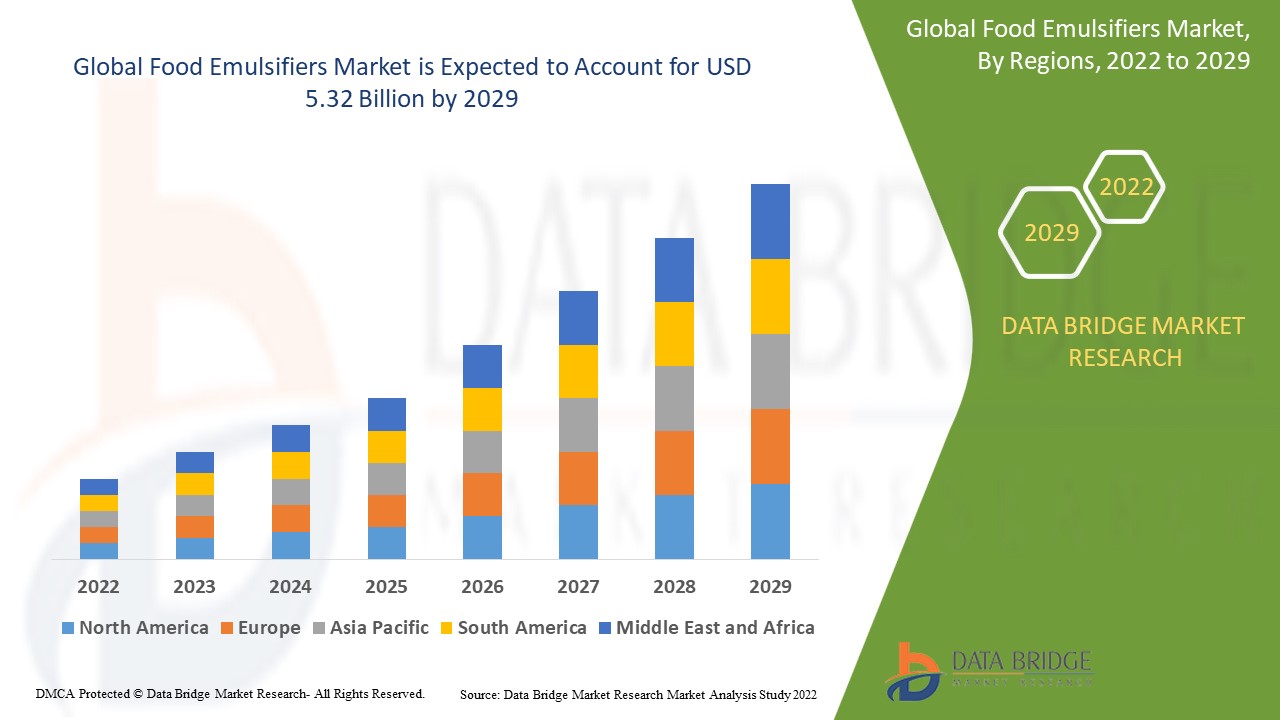
Food Emulsifiers Market Analysis
Consumers' awareness of health issues is growing, which is driving up demand for low-fat foods. As a result, food manufacturers are focusing on developing new products that have the potential to reduce or regulate weight gain. Consumers are also making healthier food choices without sacrificing taste and flavour. Emulsifiers help preserve the sensory characteristics of foods while lowering fat content. This function aids in producing tasty, low-fat food products and has increased consumer acceptance of emulsifiers.
Food Emulsifiers Market Size
Global food emulsifiers market size was valued at USD 4.01 billion in 2024 and is projected to reach USD 6.30 billion by 2032, with a CAGR of 5.80% during the forecast period of 2025 to 2032.
Global Food Emulsifiers Market Trends
“Shift Towards Clean Label and Natural Ingredients”
One of the key trends in the global food emulsifiers market is the increasing shift towards clean label and natural ingredients. As consumers become more health-conscious and demand transparency in food products, there is a growing preference for emulsifiers derived from natural, non-GMO sources over synthetic alternatives. Natural emulsifiers, such as those from plant-based or organic origins, are gaining significant popularity due to their perceived health benefits and alignment with the clean label movement. The demand for emulsifiers that improve texture, stability, and shelf life while being free from artificial additives is driving innovation in the market. Furthermore, as consumer awareness around food quality and sustainability increases, the need for healthier, cleaner food options is expected to fuel the growth of the food emulsifiers market in the coming years.
Report Scope and Market Segmentation
|
Attributes |
Food Emulsifiers Key Market Insights |
|
Segmentation |
|
|
Countries Covered |
U.S., Canada and Mexico in North America, Germany, France, U.K., Netherlands, Switzerland, Belgium, Russia, Italy, Spain, Turkey, Rest of Europe in Europe, China, Japan, India, South Korea, Singapore, Malaysia, Australia, Thailand, Indonesia, Philippines, Rest of Asia-Pacific (APAC) in the Asia-Pacific (APAC), Saudi Arabia, U.A.E, South Africa, Egypt, Israel, Rest of Middle East and Africa (MEA) as a part of Middle East and Africa (MEA), Brazil, Argentina and Rest of South America as part of South America. |
|
Key Market Players |
DSM (Netherlands), BASF SE (Germany), Lonza Group (Switzerland), Glanbia Plc (Ireland), ADM (U.S.), Farbest Brands (U.S.), Adisseo (France), BTSA Biotechnologias Aplicadas S.L. (Spain), Rabar Pty Ltd (Australia) Novus International (U.S), Kerry Group plc (Ireland), Chr. Hansen Holding A/S (Denmark), Lallemand Inc. (Canada), Lesaffre (France), AB Mauri (U.K.), Laffort (France), Alltech, (U.S.), Imperial yeast (U.S.), DCL Food Distributors (U.K.), Agrano GmbH & Co. K.G. (Germany), UNIFERM GmbH & Co. K.G. (Germany) |
|
Market Opportunities |
|
Food Emulsifiers Market Definition
Food emulsifiers are natural ingredients derived from plants and animals that are used to improve food texture, combine ingredients, and provide food with good taste and consistency. They are commonly used in dairy, bakery, convenience, confectionery, and meat products.
Food Emulsifiers Market Dynamics
Drivers
- A global shift towards healthy eating and healthy alternatives
The market's drivers are a shift in consumer preferences toward healthier foods, population growth, improved cold chain logistics, and the adoption of automation systems and products. Players in the food Emulsifiers market are poised to capitalise on this opportunity. Health-conscious consumers have reduced their consumption of sweeteners, carbohydrates, and high-fat foods. Another trend that is expected to grow is the use of new raw materials derived from marine sources which are used due to desirable oil and fibre content.
- The growing trend for nourishment emulsifiers
The global food emulsifier market has expanded rapidly in recent years, owing to rising demand for packaged and ready-to-eat nourishment items. The growing number of health-conscious consumers who prefer low-fat food items is also propelling the global market for food emulsifiers. Furthermore, the candy parlour and bread shop segments are expected to be very interested in nourishment emulsifier. With the growing interest for pastry kitchen items, the demand for nourishment emulsifier is expected to rise in the coming years. The global food emulsifier market is also expected to see positive changes as a result of advancements and developments in the food emulsifier industry.
Opportunity
The overall food and beverage industry's macro trend of clean label ingredients is driving the demand for natural/organic ingredients, presenting a tremendous opportunity for the food emulsifiers market to grow. One of the growing segments in the food processing products market category is the increasing demand for healthy beverages such as protein drinks and juices, which creates market revenue potential for food emulsifiers. Manufacturers of food and beverage products are putting a lot of effort into research and development to improve the nutritional and multifunctional profile of food items with many health benefits, which is driving the global food emulsifiers market growth.
Restraints
The stringent regulation imposed by various governments regarding the manufacture of emulsifiers is a significant restraint on the food emulsifiers’ market growth. Due to a lack of supply of some emulsifiers in the global market, growth is slower than it should be.
This food emulsifiers market report provides details of new recent developments, trade regulations, import-export analysis, production analysis, value chain optimization, market share, impact of domestic and localized market players, analyses opportunities in terms of emerging revenue pockets, changes in market regulations, strategic market growth analysis, market size, category market growths, application niches and dominance, product approvals, product launches, geographic expansions, technological innovations in the market. To gain more info on the food emulsifiers market contact Data Bridge Market Research for an Analyst Brief, our team will help you take an informed market decision to achieve market growth.
Food Emulsifiers Market Scope
The food emulsifiers market is segmented on the basis of type, source, function and application. The growth amongst these segments will help you analyze meagre growth segments in the industries and provide the users with a valuable market overview and market insights to help them make strategic decisions for identifying core market applications.
Type
- Mono, Di-Glycerides and Its Derivatives
- Lecithin
- Sorbitan Esters
- Stearoyl Lactylates
- Polyglycerol Esters
- Polyglycerol Polyricinoleate
- Polyprolene Glycol Esters
Source
- Plant
- Animals
Function
- Emulsification
- Starch Complexing
- Protein Interaction
- Aeration and Stabilization
- Crystal Modification
- Oil Structuring
- Lubrication
- Processing Aids
Application
- Bakery Products
- Confectionery
- Convenience Foods
- Dairy & Frozen Products
- Meat Products
- Fats & Oils
- Dry Powders
- Beverage Base
- Extruded Products
Food Emulsifiers Market Regional Analysis
The food emulsifiers market is analyzed and market size insights and trends are provided by country, type, source, function and application as referenced above.
The countries covered in the food emulsifiers market report are U.S., Canada and Mexico in North America, Germany, Sweden, Poland, Denmark, France, U.K., Netherlands, Switzerland, Belgium, Russia, Italy, Spain, Turkey, Rest of Europe in Europe, China, Japan, India, South Korea, Singapore, Malaysia, Australia, Thailand, Indonesia, Philippines, Rest of Global (APAC) in the Global (APAC), Saudi Arabia, U.A.E, South Africa, Egypt, Israel, Rest of Middle East and Africa (MEA) as a part of Middle East and Africa (MEA), Brazil, Argentina and Rest of South America as part of South America.
Food and beverage consumption in Asia-Pacific is steadily increasing, owing to a growing population, rising incomes, and rapid urbanization. All of these factors have led to an increase in the use of food emulsifiers and other food processing ingredients.
The Asia-Pacific market is expected to grow much faster than the rest of the world. This is due to rising individual disposable income, a shift in preference toward western cuisines and packaged meals, a demanding work life, longer working hours, and a desire for healthy alternatives. Furthermore, the rapid expansion of retail food chains and the growing popularity of eating out are driving up demand for food emulsifiers.
The country section of the report also provides individual market impacting factors and changes in market regulation that impact the current and future trends of the market. Data points like down-stream and upstream value chain analysis, technical trends and porter's five forces analysis, case studies are some of the pointers used to forecast the market scenario for individual countries. Also, the presence and availability of global brands and their challenges faced due to large or scarce competition from local and domestic brands, impact of domestic tariffs and trade routes are considered while providing forecast analysis of the country data.
Food Emulsifiers Market Share
The food emulsifiers market competitive landscape provides details by competitor. Details included are company overview, company financials, revenue generated, market potential, investment in research and development, new market initiatives, global presence, production sites and facilities, production capacities, company strengths and weaknesses, product launch, product width and breadth, application dominance. The above data points provided are only related to the companies' focus related to food emulsifiers market.
Food Emulsifiers Market Leaders Operating in the Market Are:
- DSM (Netherlands)
- BASF SE (Germany)
- Lonza Group (Switzerland)
- Glanbia Plc (Ireland)
- ADM (U.S.)
- Farbest Brands (U.S.)
- Adisseo (France)
- BTSA Biotechnologias Aplicadas S.L. (Spain)
- Rabar Pty Ltd (Australia)
- Novus International (U.S.)
- Kerry Group plc (Ireland)
- Chr. Hansen Holding A/S (Denmark)
- Lallemand Inc. (Canada)
- Lesaffre (France)
- AB Mauri (U.K.)
- Laffort (France)
- Alltech (U.S.)
- Imperial yeast (U.S.)
- DCL Food Distributors (U.K.)
- Agrano GmbH & Co. K.G. (Germany)
- UNIFERM GmbH & Co. K.G. (Germany)
Latest Developments in Food Emulsifiers Market
- Corbion will introduce the Pristine 3000, the company's "most robust dough conditioning innovation yet," in 2021, expanding its pristine range of clean label solutions. The solution allows bakers to overcome common challenges such as wheat protein inconsistencies and high-speed processing without relying on gluten supplementation or traditional solutions such as diacetyl tartaric acid ester of monoglycerides (DATEM).
- Cargill's Brazilian unit will open a new facility in 2020 to produce pectin (which can be used as an emulsifier), a fruit by-product used in jams, beverages, dairy products, and confectionery.
- Kerry Group will open a new regional development and food manufacturing facility in Georgia, Rome, in March 2020. This new location would allow the company to better serve its European customers and expand its operations.

- Interactive Data Analysis Dashboard
- Company Analysis Dashboard for high growth potential opportunities
- Research Analyst Access for customization & queries
- Competitor Analysis with Interactive dashboard
- Latest News, Updates & Trend analysis
- Harness the Power of Benchmark Analysis for Comprehensive Competitor Tracking
Global Food Emulsifiers Market, Supply Chain Analysis and Ecosystem Framework
To support market growth and help clients navigate the impact of geopolitical shifts, DBMR has integrated in-depth supply chain analysis into its Global Food Emulsifiers Market research reports. This addition empowers clients to respond effectively to global changes affecting their industries. The supply chain analysis section includes detailed insights such as Global Food Emulsifiers Market consumption and production by country, price trend analysis, the impact of tariffs and geopolitical developments, and import and export trends by country and HSN code. It also highlights major suppliers with data on production capacity and company profiles, as well as key importers and exporters. In addition to research, DBMR offers specialized supply chain consulting services backed by over a decade of experience, providing solutions like supplier discovery, supplier risk assessment, price trend analysis, impact evaluation of inflation and trade route changes, and comprehensive market trend analysis.
Data collection and base year analysis are done using data collection modules with large sample sizes. The stage includes obtaining market information or related data through various sources and strategies. It includes examining and planning all the data acquired from the past in advance. It likewise envelops the examination of information inconsistencies seen across different information sources. The market data is analysed and estimated using market statistical and coherent models. Also, market share analysis and key trend analysis are the major success factors in the market report. To know more, please request an analyst call or drop down your inquiry.
The key research methodology used by DBMR research team is data triangulation which involves data mining, analysis of the impact of data variables on the market and primary (industry expert) validation. Data models include Vendor Positioning Grid, Market Time Line Analysis, Market Overview and Guide, Company Positioning Grid, Patent Analysis, Pricing Analysis, Company Market Share Analysis, Standards of Measurement, Global versus Regional and Vendor Share Analysis. To know more about the research methodology, drop in an inquiry to speak to our industry experts.
Data Bridge Market Research is a leader in advanced formative research. We take pride in servicing our existing and new customers with data and analysis that match and suits their goal. The report can be customized to include price trend analysis of target brands understanding the market for additional countries (ask for the list of countries), clinical trial results data, literature review, refurbished market and product base analysis. Market analysis of target competitors can be analyzed from technology-based analysis to market portfolio strategies. We can add as many competitors that you require data about in the format and data style you are looking for. Our team of analysts can also provide you data in crude raw excel files pivot tables (Fact book) or can assist you in creating presentations from the data sets available in the report.













