


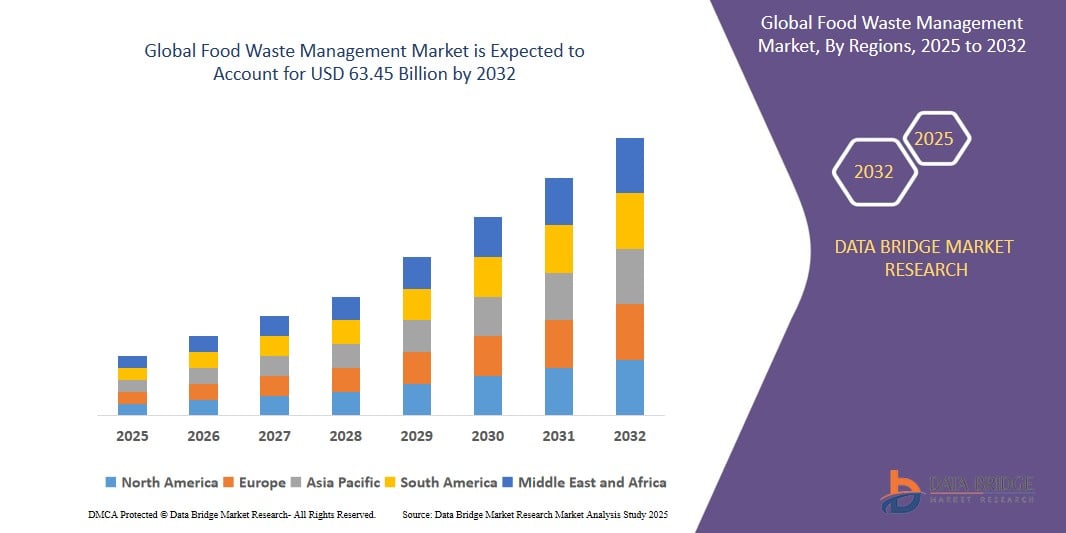
Food Waste Management Market Size
- The global Food Waste Management market size was valued at USD 42.75 billion in 2024 and is expected to reach USD 63.45 billion by 2032, at a CAGR of 5.06% during the forecast period
- The market growth is largely fueled by increasing environmental awareness, stringent government regulations, rising food waste generation, advancements in waste processing technologies, and growing adoption of sustainable practices by food producers, retailers, and consumers to reduce environmental and economic impacts.
- Furthermore, increasing investments in circular economy initiatives, development of innovative recycling technologies, rising consumer demand for eco-friendly waste solutions, and expanding partnerships between governments and private sectors are accelerating the adoption of efficient food waste management practices across global markets.
Food Waste Management Market Analysis
- The growing volume of food waste worldwide, coupled with its significant environmental impact—such as greenhouse gas emissions and land use—has created urgent demand for structured food waste management systems across residential, commercial, and industrial sectors.
- The market is propelled by technological innovations like anaerobic digestion, composting, and waste-to-energy solutions, alongside stringent regulations and government initiatives aimed at waste reduction, recycling mandates, and sustainable resource utilization across developed and emerging economies.
- North America dominates the Food Waste Management market with the largest revenue share of 36% in 2025, characterized by advanced waste processing technologies, stringent government regulations, high environmental awareness among consumers, strong corporate initiatives, and well-established infrastructure supporting sustainable food waste reduction and recycling practices across residential and commercial sectors.
- Asia-Pacific is expected to be the fastest growing region in the Food Waste Management market during the forecast period due to rapid urbanization, increasing food consumption, supportive government initiatives, growing environmental awareness, and adoption of advanced waste management technologies across emerging economies.
- Artificial segment is expected to dominate the Food Waste Management market with a 42% share in 2025, driven by its advanced technology integration, efficiency in waste sorting and processing, growing adoption of AI-powered solutions, and ability to reduce operational costs and environmental impact.
Report Scope and Food Waste Management Market Segmentation
|
Attributes |
Food Waste Management Key Market Insights |
|
Segments Covered |
|
|
Countries Covered |
North America
Europe
Asia-Pacific
Middle East and Africa
South America
|
|
Key Market Players |
|
|
Market Opportunities |
|
|
Value Added Data Infosets |
In addition to the insights on market scenarios such as market value, growth rate, segmentation, geographical coverage, and major players, the market reports curated by the Data Bridge Market Research also include in-depth expert analysis, pricing analysis, brand share analysis, consumer survey, demography analysis, supply chain analysis, value chain analysis, raw material/consumables overview, vendor selection criteria, PESTLE Analysis, Porter Analysis, and regulatory framework. |
Food Waste Management Market Trends
“Rising adoption of AI and IoT in waste management”
- AI-powered systems use machine learning and image recognition to automatically identify and separate different types of waste, significantly improving sorting accuracy and reducing contamination in recycling streams, which boosts overall operational efficiency and cost savings.
- IoT sensors installed in waste bins and processing plants provide real-time data on fill levels, waste composition, and equipment status, enabling better resource allocation, route optimization for collection trucks, and timely maintenance, reducing operational downtime and expenses.
- AI algorithms analyze historical waste generation data, seasonal trends, and population behavior to forecast future waste volumes, allowing municipalities and companies to plan capacity, manpower, and infrastructure investments proactively, optimizing costs and minimizing environmental impact.
- Integration of AI and IoT enables autonomous or semi-autonomous waste collection vehicles, improving safety, efficiency, and reducing labor costs, while also enabling dynamic routing based on real-time bin status, leading to reduced fuel consumption and emissions.
- Smart waste management platforms use AI chatbots and IoT-enabled feedback systems to educate consumers, encourage recycling, and monitor compliance with waste segregation rules, driving higher participation rates and fostering sustainable waste disposal behavior.
Food Waste Management Market Dynamics
Driver
“Growing environmental concerns drive demand for efficient waste management”
- Rising concerns about climate change, pollution, and resource depletion are motivating governments, businesses, and consumers to adopt efficient food waste management practices to minimize landfill use and reduce greenhouse gas emissions globally.
- Governments worldwide are implementing strict policies and mandates to control food waste, including bans on organic waste disposal in landfills and requirements for recycling and composting, driving demand for advanced waste management technologies and services.
- Increasing urban populations generate higher volumes of food waste, creating urgent needs for scalable, efficient waste management infrastructure and solutions in cities, especially in emerging economies with limited existing waste processing capabilities.
- Innovations such as AI-driven sorting, anaerobic digestion, and IoT-enabled monitoring enhance the efficiency and cost-effectiveness of food waste management, encouraging adoption by municipalities and private enterprises aiming to optimize operations and sustainability.
- Businesses, especially in food retail and hospitality sectors, are investing in sustainable waste management practices to meet consumer expectations, reduce operational costs, comply with regulations, and improve corporate social responsibility profiles, fueling market growth.
Restraint/Challenge
“High initial costs hinder adoption of advanced waste technologies”
- Setting up advanced food waste management systems like anaerobic digesters and AI-powered sorting equipment requires significant capital, which can be prohibitive for small municipalities and businesses with limited budgets, delaying adoption and scaling of sustainable waste solutions.
- Beyond installation, advanced technologies often require skilled personnel and regular maintenance, adding to operational expenses. These ongoing costs can strain financial resources, especially for organizations in developing regions with limited technical expertise and funding.
- Many waste management providers and municipalities struggle to secure affordable financing or government subsidies for high-cost technology projects, making it difficult to invest in cutting-edge solutions despite long-term environmental and economic benefits.
- Due to varying waste volumes, regulatory environments, and technology maturity, the financial returns on advanced food waste technologies can be uncertain or slow, causing hesitation among stakeholders reluctant to commit large upfront funds.
- In many emerging markets, limited infrastructure, lack of technical knowledge, and financial constraints exacerbate the challenges of investing in high-cost advanced waste management technologies, slowing market penetration and innovation diffusion in these areas.
Food Waste Management Market Scope
The market is segmented on the basis of product, process, end-user, application, waste type and method.
- By Product
On the basis of product, the food waste management market is segmented into artificial, organic, and natural. The artificial segment dominates the largest market revenue share of 42% in 2025, driven by advanced technology adoption, high efficiency, scalability, and cost-effective waste processing solutions.
The organic segment is anticipated to witness the fastest growth rate of 7.5% from 2025 to 2032, fueled by increasing environmental concerns, government support, and rising demand for sustainable organic waste recycling solutions.
- By Process
On the basis of process, the Food Waste Management market is segmented in to aerobic digestion, anaerobic digestion, incineration/combustion, others. The aerobic digestion is a major driver of the Food Waste Management market due to its ability to efficiently convert organic waste into valuable compost, reduce greenhouse gas emissions, improve soil health, and offer a cost-effective, environmentally friendly alternative to landfill disposal.
The anaerobic digestion segment is expected to witness the fastest CAGR from 2025 to 2032, this growth is driven by its ability to produce renewable energy (biogas), reduce greenhouse gas emissions, and offer effective waste-to-energy solutions aligned with sustainability goals..
- By End-User
On the basis of end-user, the Food Waste Management market is segmented in to primary food producers, food manufacturers, food distributors & suppliers, food service providers, municipalities & households. The primary food producers are a major driver of the Food Waste Management market due to increasing pressure to reduce post-harvest losses, comply with sustainability regulations, minimize environmental impact, and implement efficient waste recycling and resource recovery practices throughout the supply chain.
The food service providers segment is expected to witness the fastest CAGR from 2025 to 2032, driven by rising consumer demand for sustainable practices, stringent government regulations on food waste, growing adoption of advanced waste management technologies, and increasing efforts by restaurants and hotels to minimize waste and improve operational efficiency.
- By Application
On the basis of application, the Food Waste Management market is segmented in to animal feed, fertilizers, biofuel, power generation, renewable energy. The animal feed are a major driver of the Food Waste Management market due to its ability to convert food waste into nutritious feed, reduce landfill burden, lower production costs for livestock farmers, promote circular economy practices, and support sustainable agriculture and waste recycling initiatives globally.
The biofuel segment is expected to witness the fastest CAGR from 2025 to 2032, driven by rising demand for sustainable energy sources, supportive government policies, advancements in biofuel production technologies, and increasing focus on reducing carbon emissions and fossil fuel dependence globally.
- By Waste Type
On the basis of waste type, the Food Waste Management market is segmented in to cereals, dairy products, fruits & vegetables, meat, fish and sea food, oilseeds & pulses, processed food, coffee grounds & tea. The cereals are a major driver of the Food Waste Management market due to their high production volumes, significant post-harvest losses, increasing demand for efficient waste recycling solutions, and growing focus on reducing food wastage in staple crops to ensure food security and sustainability.
The fruits & vegetables segment is expected to witness the fastest CAGR from 2025 to 2032, ue to their high perishability, large volume of waste, and increasing focus on sustainable waste management solutions.
- By Method
On the basis of method, the Food Waste Management market is segmented in to prevention, recovery, recycling, collection, landfill, transfer, others. The prevention segment is dominating Food Waste Management market ue to increasing emphasis on minimizing food loss at the source, rising awareness campaigns, cost-saving benefits for businesses, and strong government initiatives promoting sustainable practices across production, distribution, and consumption stages.
The recycling segment is expected to witness the fastest CAGR from 2025 to 2032, due to increasing environmental regulations, technological advancements, and growing demand for converting food waste into valuable by-products like compost, biofuel, and animal feed.
Food Waste Management Market Regional Analysis
- North America dominates the Food Waste Management market with the largest revenue share of 36% in 2025, characterized by advanced waste processing technologies, stringent government regulations, high environmental awareness among consumers, strong corporate initiatives, and well-established infrastructure supporting sustainable food waste reduction and recycling practices across residential and commercial sectors.
- North America’s leadership in the Food Waste Management market is supported by robust regulations at federal and state levels that mandate food waste reduction, promote composting, and encourage public-private partnerships for innovative and large-scale waste processing initiatives.
- The region's dominance is further fueled by early adoption of smart waste management technologies such as IoT-enabled monitoring, AI-based sorting systems, and data-driven solutions, enhancing operational efficiency and driving investment across municipal, industrial, and institutional food waste management efforts.
U.S. Food Waste Management Market Insight
The U.S. Food Waste Management market captured the largest revenue share of approximately 82% within North America in 2025, fueled by advanced infrastructure, strong regulations, high waste generation, and widespread adoption of sustainable practices.
Europe Food Waste Management Market Insight
The European Food Waste Management market is projected to expand at a substantial CAGR due to rising environmental awareness, strict EU regulations on waste reduction, increased food industry waste generation, and growing adoption of sustainable practices. Technological advancements in recycling and composting further support market growth across the region.
U.K. Food Waste Management Market Insight
The U.K. Food Waste Management market is set to grow at a notable CAGR, driven by government regulations, rising organic waste, technological advancements, consumer demand for sustainability, and expansion of the food service sector increasing the need for efficient waste solutions.
Germany Food Waste Management Market Insight
The German Food Waste Management market is expected to expand at a considerable CAGR, fueled by stringent EU regulations, advanced recycling technologies, a strong circular economy focus, and high consumer awareness driving sustainable practices across industries.
North America Food Waste Management Market Insight
The North America Food Waste Management market is poised to grow at the fastest CAGR in 2025, driven by strict environmental regulations, rising landfill costs, advanced recycling and composting technologies, increasing food waste generation, strong government initiatives, and growing consumer awareness regarding sustainability and the environmental impact of food disposal.
U.S. Food Waste Management Market Insight
The U.S. Food Waste Management market is gaining momentum due to strict environmental regulations, rising landfill costs, and increased consumer awareness about sustainability. Technological advancements in waste tracking and bio-conversion, along with strong government initiatives and economic incentives for businesses, are also driving the adoption of efficient waste management practices.
Food Waste Management Market Share
The Food Waste Management industry is primarily led by well-established companies, including:
- Waste Management, Inc. (USA)
- Republic Services, Inc. (USA)
- Veolia Environnement S.A. (France)
- Suez S.A. (France)
- Clean Harbors, Inc. (USA)
- Advanced Disposal Services, Inc. (USA)
- Biffa plc (United Kingdom)
- Stericycle, Inc. (USA)
- Recology Inc. (USA)
- BioHiTech Global, Inc. (USA)
- Renewi plc (United Kingdom)
- Covanta Holding Corporation (USA)
- Ecolab Inc. (USA)
- GreenTech Environmental Corporation (Canada)
- Tomra Systems ASA (Norway)
Latest Developments in Global Food Waste Management Market
- In May 2025, The City of Rockingham is implementing the Food Organics and Garden Organics (FOGO) system, introducing new lime green-lidded bins for food and garden waste. This initiative, part of Western Australia's Waste Avoidance and Resource Recovery Strategy 2030, aims to enhance waste separation and reduce landfill use.
- In May 2025, The anti-food waste app, Too Good To Go, launched in Pittsburgh, allowing consumers to purchase surplus food from local businesses at reduced prices. This expansion aims to combat food waste and provide affordable meals to consumers.
- In February 2025, SUEZ Recycling and Recovery UK announced plans to establish an anaerobic digestion facility near Sipson, West London. The facility aims to process food waste into renewable gas, potentially powering up to 8,200 homes and contributing to the UK's energy security.
- In January 2025, New York City expanded its curbside composting program to all boroughs, mandating composting of food scraps and yard waste. Non-compliance incurs escalating fines, emphasizing the city's commitment to reducing organic waste and promoting sustainability.

- Interactive Data Analysis Dashboard
- Company Analysis Dashboard for high growth potential opportunities
- Research Analyst Access for customization & queries
- Competitor Analysis with Interactive dashboard
- Latest News, Updates & Trend analysis
- Harness the Power of Benchmark Analysis for Comprehensive Competitor Tracking
Global Food Waste Management Market, Supply Chain Analysis and Ecosystem Framework
To support market growth and help clients navigate the impact of geopolitical shifts, DBMR has integrated in-depth supply chain analysis into its Global Food Waste Management Market research reports. This addition empowers clients to respond effectively to global changes affecting their industries. The supply chain analysis section includes detailed insights such as Global Food Waste Management Market consumption and production by country, price trend analysis, the impact of tariffs and geopolitical developments, and import and export trends by country and HSN code. It also highlights major suppliers with data on production capacity and company profiles, as well as key importers and exporters. In addition to research, DBMR offers specialized supply chain consulting services backed by over a decade of experience, providing solutions like supplier discovery, supplier risk assessment, price trend analysis, impact evaluation of inflation and trade route changes, and comprehensive market trend analysis.
Data collection and base year analysis are done using data collection modules with large sample sizes. The stage includes obtaining market information or related data through various sources and strategies. It includes examining and planning all the data acquired from the past in advance. It likewise envelops the examination of information inconsistencies seen across different information sources. The market data is analysed and estimated using market statistical and coherent models. Also, market share analysis and key trend analysis are the major success factors in the market report. To know more, please request an analyst call or drop down your inquiry.
The key research methodology used by DBMR research team is data triangulation which involves data mining, analysis of the impact of data variables on the market and primary (industry expert) validation. Data models include Vendor Positioning Grid, Market Time Line Analysis, Market Overview and Guide, Company Positioning Grid, Patent Analysis, Pricing Analysis, Company Market Share Analysis, Standards of Measurement, Global versus Regional and Vendor Share Analysis. To know more about the research methodology, drop in an inquiry to speak to our industry experts.
Data Bridge Market Research is a leader in advanced formative research. We take pride in servicing our existing and new customers with data and analysis that match and suits their goal. The report can be customized to include price trend analysis of target brands understanding the market for additional countries (ask for the list of countries), clinical trial results data, literature review, refurbished market and product base analysis. Market analysis of target competitors can be analyzed from technology-based analysis to market portfolio strategies. We can add as many competitors that you require data about in the format and data style you are looking for. Our team of analysts can also provide you data in crude raw excel files pivot tables (Fact book) or can assist you in creating presentations from the data sets available in the report.













