


What is the Foot and Ankle Allografts Market Size and Overview?
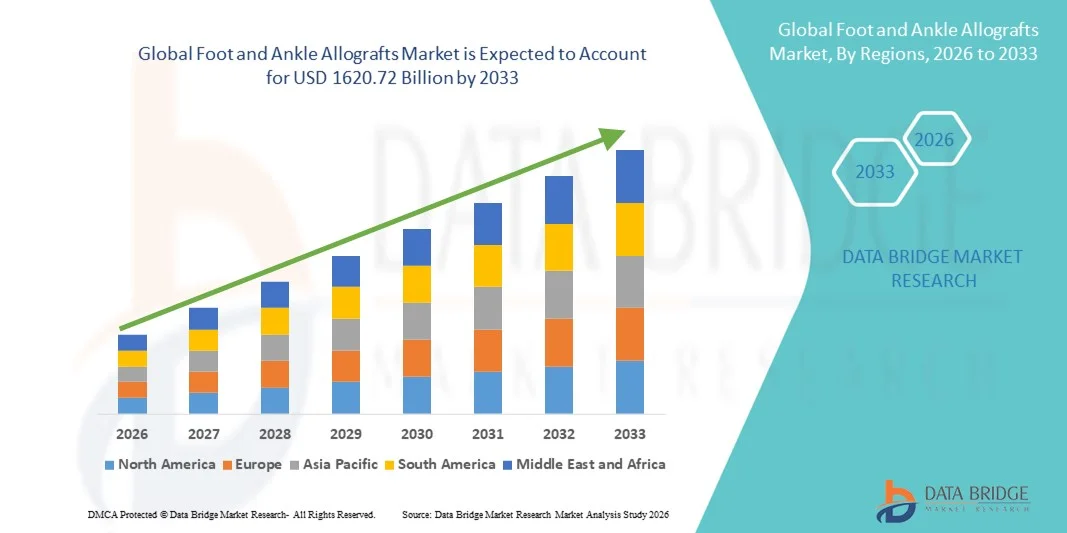
- As per Data Bridge Market Research Analysis the global Foot and Ankle Allografts market size was valued at USD 778.44 billion in 2025 and is expected to reach USD 1620.72 billion by 2033, at a CAGR of 9.60% during the forecast period
- The market growth is largely fueled by the increasing prevalence of foot and ankle injuries, rising sports participation, and growing demand for advanced orthopedic solutions, leading to greater adoption of foot and ankle allograft procedures across hospitals, orthopedic clinics, and ambulatory surgical centers. Technological advancements in graft processing, tissue preservation, and minimally invasive surgical techniques are further driving market expansion and improving patient outcomes in both developed and emerging regions
- Furthermore, the growing preference for biologically compatible, durable, and patient-specific allografts, along with rising awareness among surgeons and patients about the benefits of allograft procedures, is establishing foot and ankle allografts as a preferred treatment option for complex orthopedic injuries. Increasing investments in orthopedic infrastructure, supportive reimbursement policies, and expanding sports medicine programs are accelerating the uptake of these solutions, thereby significantly boosting overall industry growth
Market Size & Forecast
- Global Market Value (2025): 778.44 billion USD
- Expected Market Value (2033): 1620.72 billion USD
- Forecast CAGR (2026–2033): 9.60%
What are the Major Takeaways of Foot and Ankle Allografts Market?
- Foot and ankle allograft solutions, including grafts for ligament, tendon, and bone reconstruction, are increasingly vital in orthopedic care due to their ability to restore function, reduce recovery time, and improve patient outcomes in cases of trauma, sports injuries, and degenerative conditions. Advancements in graft preservation, sterilization, and minimally invasive surgical techniques are further boosting adoption across hospitals, orthopedic clinics, and ambulatory surgical centers
- The escalating demand for foot and ankle allografts is primarily fueled by the growing incidence of musculoskeletal injuries, increasing sports participation, and rising awareness of allograft benefits among surgeons and patients. Integration of advanced tissue processing technologies, supportive reimbursement policies, and expansion of orthopedic infrastructure are accelerating uptake, enhancing market growth globally
- North America dominated the Foot and Ankle Allografts market with the largest revenue share of approximately 41.8% in 2025, driven by advanced healthcare infrastructure, a high rate of orthopedic surgeries, and strong adoption of innovative allograft solutions in the U.S.
- Asia-Pacific is expected to be the fastest-growing region in the Foot and Ankle Allografts market during the forecast period, projected to register a CAGR of approximately 12.3%, due to increasing urbanization, rising sports participation, and expanding orthopedic healthcare infrastructure in countries such as India, China, and Japan
- The hindfoot procedures segment dominated the largest market revenue share of 55% in 2025, attributed to the high prevalence of ankle and heel injuries requiring reconstruction
Report Scope and Foot and Ankle Allografts Market Segmentation
|
Attributes |
Foot and Ankle Allografts Key Market Insights |
|
Segments Covered |
|
|
Countries Covered |
North America
Europe
Asia-Pacific
Middle East and Africa
South America
|
|
Key Market Players |
|
|
Market Opportunities |
|
|
Value Added Data Infosets |
In addition to the insights on market scenarios such as market value, growth rate, segmentation, geographical coverage, and major players, the market reports curated by the Data Bridge Market Research also include in-depth expert analysis, patient epidemiology, pipeline analysis, pricing analysis, and regulatory framework. |
What is the Key Trend in the Foot and Ankle Allografts Market?
Growing Demand Due to Rising Orthopedic Surgeries and Sports Injuries
- The increasing prevalence of foot and ankle injuries, coupled with a rise in orthopedic surgeries, is driving the demand for high-quality allografts. Patients with trauma, degenerative joint diseases, or sports-related injuries are seeking reconstructive procedures, fueling market growth
- For instance, in 2025, American Orthopaedic Foot & Ankle Society reported that hospitals adopting standardized allograft protocols saw a 15% improvement in surgical outcomes and patient recovery times, encouraging wider adoption of Foot and Ankle Allografts
- Advancements in surgical techniques and minimally invasive procedures have increased the success rate of allograft transplantation, making them a preferred option among surgeons and patients
- Growing awareness among patients regarding the benefits of allograft tissues, including faster recovery, lower risk of donor-site complications, and improved functional outcomes, is positively influencing market demand
- The expansion of sports medicine clinics and rehabilitation centers across urban and semi-urban regions is creating additional channels for allograft utilization, further supporting market growth
Foot and Ankle Allografts Market Dynamics
Driver
Increasing Adoption of Advanced Surgical Techniques and Biologic Grafts
- A significant trend in the global Foot and Ankle Allografts market is the growing adoption of minimally invasive surgical techniques combined with biologic grafts. Surgeons are increasingly favoring allografts over autografts due to reduced patient morbidity and faster recovery times
- For instance, hospitals implementing arthroscopic techniques alongside allograft transplants have reported improved post-operative outcomes and shorter hospital stays, according to American Academy of Orthopaedic Surgeons
- The development of sterilization and preservation technologies is enhancing graft quality and safety, making allografts a preferred choice in reconstructive foot and ankle procedures
- Growing collaboration between tissue banks and orthopedic centers is improving accessibility and standardization of allograft products across regions
- Increased awareness among patients and surgeons about the benefits of allografts, such as lower risk of donor-site complications and better functional recovery, continues to drive market adoption
Restraint/Challenge
Limited Tissue Availability and Regulatory Barriers
- Limited availability of donor tissues and stringent regulatory guidelines for tissue procurement and transplantation pose significant challenges to the market. These constraints can delay surgeries and increase operational costs for healthcare providers
- For instance, FDA emphasizes strict compliance requirements for donor screening, tissue processing, and storage, making it challenging for smaller hospitals or clinics to maintain consistent supply
- High procedural costs and lack of insurance coverage for some allograft procedures may restrict access, particularly in developing regions or among patients with limited financial resources
- Variability in graft quality, risk of graft rejection, and potential for disease transmission remain clinical concerns that can influence surgeon and patient preferences
- The need for specialized storage, handling, and surgical expertise adds complexity to operations, limiting adoption in smaller medical facilities
- Continuous education for surgeons and staff on best practices for allograft handling, coupled with efforts to improve tissue availability, will be critical to overcoming these market challenges and sustaining growth
How is the Foot and Ankle Allografts Market Segmented?
The market is segmented on the basis of product type, surgery type, procedure, and end-user.
- By Product Type
On the basis of product type, the market is segmented into allograft wedges, allograft tendons, allograft acellular dermal matrix, cartilage allograft matrix, skin allografts, and amniotic membranes. The allograft tendons segment dominated the largest market revenue share of 31.8% in 2025, driven by high demand in ligament and tendon reconstruction surgeries. Tendons are widely used in anterior cruciate ligament (ACL) repairs and other soft tissue reconstructions. Surgeons prefer allograft tendons due to reduced donor site morbidity and faster recovery times. Increasing orthopedic procedures, sports-related injuries, and aging populations are boosting demand. Hospitals and orthopedic clinics have adopted tendons extensively in both inpatient and outpatient surgeries. Research and clinical trials support enhanced graft integration and biomechanical performance. Improved sterilization and storage technologies increase safety and shelf life. Tendons also benefit from insurance coverage in key markets like the U.S. and Europe. Rising sports participation and road traffic injuries further contribute. Awareness campaigns and orthopedic society guidelines strengthen utilization.
The allograft wedges segment is expected to witness the fastest CAGR of 10.5% from 2026 to 2033, fueled by increasing midfoot and hindfoot reconstructive procedures. Wedges are used in osteotomy and joint realignment surgeries to restore foot biomechanics. Technological advancements in wedge design, including pre-shaped and customizable implants, enhance surgical outcomes. Growing adoption in hospitals and ambulatory surgical centers drives market growth. Surgeons value their ease of handling, precise fit, and reduced operative time. Insurance reimbursement and growing orthopedic surgeon training programs support adoption. Rising incidence of foot deformities, arthritis, and trauma-related injuries are key drivers. Academic and research institutions are investing in wedge-related studies. Increasing sports injuries in adolescents and adults boost demand. Emerging markets in Asia-Pacific and Latin America show rising adoption due to healthcare infrastructure expansion.
- By Surgery Type
On the basis of surgery type, the market is segmented into orthopedic reconstruction, cartilage restoration, soft tissue tendon and ligament repair, and wound care. The soft tissue tendon and ligament repair segment dominated the largest market revenue share of 37% in 2025, driven by increasing sports injuries, aging populations, and post-trauma reconstructions. Tendon and ligament repair surgeries are common in both hospital and outpatient settings. Availability of ready-to-use allografts accelerates surgical procedures and improves patient recovery. High success rates and reduced surgical complications drive preference. Hospitals, orthopedic clinics, and ambulatory surgical centers extensively adopt these procedures. Insurance coverage and clinical guidelines further support utilization. Advanced sterilization and storage protocols enhance product safety. Telemedicine and rehabilitation programs improve post-operative outcomes. Increasing awareness about minimally invasive techniques supports adoption. Research and innovation in tendon grafts continue to enhance biomechanical performance. Surgeons are increasingly trained in allograft-based techniques.
The cartilage restoration segment is expected to witness the fastest CAGR of 11% from 2026 to 2033, fueled by rising sports injuries and joint degeneration cases. Cartilage allografts are used in osteochondral defects, joint resurfacing, and repair of damaged cartilage. Technological innovations, including scaffold-based matrices, support tissue integration and regeneration. Hospitals and orthopedic clinics are increasingly adopting cartilage restoration procedures due to better patient outcomes. Awareness programs and sports medicine advancements drive demand. Emerging markets in APAC and LATAM are expanding access to cartilage restoration surgeries. Academic and research institutions are investing in regenerative therapies. Insurance coverage is gradually increasing. Aging populations with arthritis further support growth.
- By Procedure
On the basis of procedure, the market is segmented into midfoot procedures and hindfoot procedures. The hindfoot procedures segment dominated the largest market revenue share of 55% in 2025, attributed to the high prevalence of ankle and heel injuries requiring reconstruction. Hindfoot procedures involve complex joint realignment and tendon repair, where allografts are extensively utilized. Hospitals and orthopedic clinics prefer allograft use to reduce donor site morbidity and improve surgical outcomes. Surgeons benefit from ready-to-use grafts for precise fit and reduced operative time. Rising incidence of trauma, arthritis, and sports injuries supports demand. Tele-rehabilitation and physiotherapy integration enhance post-operative recovery. Advanced storage and sterilization technologies ensure graft safety. Insurance coverage in developed markets supports adoption. Clinical guidelines and surgeon training programs promote standardized use.
The midfoot procedures segment is expected to witness the fastest CAGR of 9.8% from 2026 to 2033, driven by increasing adoption in foot deformity corrections and osteotomy procedures. Wedges and cartilage allografts are primarily used in midfoot reconstructions. Technological improvements in implant design and pre-shaped allografts enhance surgical precision. Rising awareness among orthopedic surgeons and patients fuels adoption. Academic and research studies support procedural efficacy. Growth in sports injuries, congenital deformities, and trauma cases contributes to rising demand. Emerging markets show increasing procedure adoption due to improving healthcare infrastructure.
- By End-User
On the basis of end-user, the market is segmented into hospitals, orthopedic clinics, ambulatory surgical centres, academic and research institutes, and other end users. The hospitals segment dominated the largest market revenue share of 45% in 2025, driven by the presence of specialized orthopedic departments, high patient volumes, and complex reconstructive procedures. Hospitals adopt allografts extensively for inpatient surgeries, outpatient procedures, and trauma care. Insurance coverage and reimbursement policies facilitate high utilization. Hospitals invest in cold storage and sterilization facilities to maintain graft safety. Surgeons in hospitals are trained for advanced allograft techniques. Integration of digital surgical planning tools supports precision. Tele-rehabilitation and follow-up care enhance patient outcomes. Rising trauma and sports-related injuries further drive hospital adoption.
The orthopedic clinics segment is expected to witness the fastest CAGR of 10.3% from 2026 to 2033, due to increasing outpatient surgeries, minimally invasive techniques, and accessibility of allografts for tendon and ligament repairs. Clinics benefit from ready-to-use grafts and reduced surgical complexity. Surgeons increasingly adopt allografts for cosmetic and functional outcomes. Insurance and government healthcare programs improve affordability. Rising awareness about reconstructive options in the private sector fuels adoption.
Which Region Holds the Largest Share of the Foot and Ankle Allografts Market?
- North America dominated the foot and ankle allografts market with a revenue share of approximately 41.8% in 2025. The region’s growth is driven by advanced healthcare infrastructure, a high rate of orthopedic surgeries, and strong adoption of innovative allograft solutions
- Rising prevalence of sports injuries, trauma cases, and degenerative foot and ankle disorders supports market expansion. Hospitals and specialized orthopedic centers are increasingly incorporating advanced allograft technologies. High disposable incomes and favorable reimbursement policies encourage patient uptake
- Technological advancements in tissue engineering and graft preservation further boost adoption. Overall, North America represents a mature and innovation-driven market for foot and ankle allografts
U.S. Foot and Ankle Allografts Market Insight
The U.S. foot and ankle allografts market accounted for the largest revenue share within North America, driven by the increasing number of orthopedic surgeries and high adoption of innovative allograft solutions. Advanced hospitals and outpatient orthopedic clinics are increasingly using tissue-engineered grafts and minimally invasive procedures. High patient awareness, supportive reimbursement frameworks, and strong insurance coverage further fuel market growth. Sports injuries and an aging population contribute to rising demand for foot and ankle reconstruction procedures. Integration of advanced surgical tools, navigation systems, and biologics enhances treatment outcomes. Overall, the U.S. market continues to lead North America in both size and technological advancement.
Europe Foot and Ankle Allografts Market Insight
Europe’s foot and ankle allografts market is projected to expand steadily, driven by an established healthcare system and increasing awareness of orthopedic treatments. Germany, France, and the U.K. are witnessing adoption of advanced allograft solutions in hospitals, trauma centers, and outpatient orthopedic clinics. Rising sports injuries, aging population, and degenerative disorders further support demand. Technological innovations, including bioengineered grafts and tissue preservation techniques, are increasingly utilized. Reimbursement policies and insurance coverage facilitate patient access. Government initiatives promoting orthopedic care and patient education further boost growth. Overall, Europe combines regulatory support and technological adoption for steady market expansion.
U.K. Foot and Ankle Allografts Market Insight
The U.K. foot and ankle allografts market is anticipated to grow at a notable rate, driven by rising orthopedic procedures and adoption of advanced graft solutions. Hospitals, outpatient clinics, and sports medicine centers are increasingly offering allograft procedures. The country’s emphasis on patient-centric care and minimally invasive treatments encourages adoption. Growing awareness of foot and ankle injuries and rising sports participation contribute to market growth. Reimbursement policies, government initiatives, and digital healthcare platforms further facilitate access. High-quality surgical training and advanced hospital infrastructure support market expansion. Overall, the U.K. represents a steadily growing market in Europe.
Germany Foot and Ankle Allografts Market Insight
Germany foot and ankle allografts market remains a key European market, supported by a strong healthcare system and high awareness of orthopedic treatments. Adoption of advanced tissue-engineered grafts and minimally invasive surgical procedures is rising in hospitals and specialized orthopedic centers. The aging population, increasing trauma cases, and prevalence of sports injuries are driving demand. Technological innovation, including graft preservation and surgical navigation tools, enhances clinical outcomes. Reimbursement policies and well-developed hospital infrastructure support widespread adoption. Private and public hospitals are expanding their orthopedic care capabilities. Overall, Germany represents a technologically advanced and steady-growth market in Europe.
Asia-Pacific Foot and Ankle Allografts Market Insight
Asia-Pacific foot and ankle allografts market is expected to be the fastest-growing region in the Foot and Ankle Allografts market, with an anticipated CAGR of approximately 12.3% during the forecast period. Growth is driven by increasing urbanization, rising sports participation, and expanding orthopedic healthcare infrastructure in countries such as India, China, and Japan. Rising incidence of trauma and degenerative foot and ankle conditions boosts demand. Hospitals and outpatient orthopedic clinics are increasingly adopting innovative allograft solutions. Government initiatives, rising healthcare expenditure, and expanding insurance coverage further support market growth. Technological adoption and increasing patient awareness enhance market penetration. Overall, Asia-Pacific offers significant growth potential for foot and ankle allograft solutions.
Japan Foot and Ankle Allografts Market Insight
Japan’s foot and ankle allografts market is gaining momentum due to an aging population, urbanization, and high demand for advanced orthopedic solutions. Hospitals and sports medicine centers are increasingly adopting tissue-engineered allografts and minimally invasive procedures. Rising awareness of foot and ankle disorders and technological advancements in surgical procedures support market expansion. Government initiatives promoting healthcare access and patient safety further encourage adoption. Integration of digital platforms, surgical navigation systems, and advanced biologics improves treatment outcomes. High patient awareness and preference for advanced therapies are fueling demand. Overall, Japan is a fast-growing market within Asia-Pacific.
China Foot and Ankle Allografts Market Insight
China foot and ankle allografts market accounted for the largest revenue share in Asia-Pacific in 2025, driven by urbanization, growing sports participation, and increasing healthcare investment. Rising orthopedic surgeries, trauma cases, and awareness of advanced allograft solutions support market growth. Hospitals and outpatient clinics are adopting tissue-engineered grafts and minimally invasive procedures. Government initiatives, healthcare funding, and expanding insurance coverage further enhance adoption. Technological advancements and the presence of domestic manufacturers contribute to the affordability and availability of solutions. Patient awareness and increasing demand for quality orthopedic care accelerate market penetration. Overall, China is a highly dynamic and fast-growing market for foot and ankle allografts.
Which are the Top Companies in Foot and Ankle Allografts Market?
The Foot and Ankle Allografts industry is primarily led by well-established companies, including:
- AlloSource (U.S.)
- LifeNet Health (U.S.)
- Medtronic plc (Ireland)
- Stryker Corporation (U.S.)
- Arthrex, Inc. (U.S.)
- DePuy Synthes (U.S.)
- JRF Ortho (India)
- Smith & Nephew (U.K.)
- Zimmer Biomet Holdings, Inc. (U.S.)
- Orthofix Medical Inc. (U.S.)
- Carestream Health, Inc. (U.S.)
- Exactech, Inc. (U.S.)
- Integra LifeSciences Holdings Corporation (U.S.)
- LifeCell Corporation (U.S.)
- Osiris Therapeutics, Inc. (U.S.)
- Baxter International Inc. (U.S.)
- MiMedx Group, Inc. (U.S.)
What are Latest Developments in Global Foot and Ankle Allografts Market?
- In January 2025, Zimmer Biomet Holdings, Inc. announced a definitive agreement to acquire Paragon 28, Inc., a specialist in foot and ankle orthopedic solutions, for approximately US$1.1 billion, aiming to expand its footprint in the foot and ankle allografts and implants segment. The deal brought Paragon 28’s broad portfolio — including products for fracture fixation, deformity correction, and joint replacement — into Zimmer Biomet’s global operations
- In April 2025, Zimmer Biomet completed the acquisition of Paragon 28, strengthening its position in the high‑growth foot and ankle orthopedic market and integrating Paragon 28’s innovative foot and ankle technology and dedicated commercial channel into its portfolio to accelerate global adoption
- In September 2025, Zimmer Biomet (via Paragon 28) announced its participation at the American Orthopedic Foot and Ankle Society Annual Conference (AOFAS), showcasing its latest foot and ankle innovations including digital planning tools and advanced 3D total ankle replacement implants, reflecting ongoing product development and market engagement following the acquisition

- Interactive Data Analysis Dashboard
- Company Analysis Dashboard for high growth potential opportunities
- Research Analyst Access for customization & queries
- Competitor Analysis with Interactive dashboard
- Latest News, Updates & Trend analysis
- Harness the Power of Benchmark Analysis for Comprehensive Competitor Tracking
Data collection and base year analysis are done using data collection modules with large sample sizes. The stage includes obtaining market information or related data through various sources and strategies. It includes examining and planning all the data acquired from the past in advance. It likewise envelops the examination of information inconsistencies seen across different information sources. The market data is analysed and estimated using market statistical and coherent models. Also, market share analysis and key trend analysis are the major success factors in the market report. To know more, please request an analyst call or drop down your inquiry.
The key research methodology used by DBMR research team is data triangulation which involves data mining, analysis of the impact of data variables on the market and primary (industry expert) validation. Data models include Vendor Positioning Grid, Market Time Line Analysis, Market Overview and Guide, Company Positioning Grid, Patent Analysis, Pricing Analysis, Company Market Share Analysis, Standards of Measurement, Global versus Regional and Vendor Share Analysis. To know more about the research methodology, drop in an inquiry to speak to our industry experts.
Data Bridge Market Research is a leader in advanced formative research. We take pride in servicing our existing and new customers with data and analysis that match and suits their goal. The report can be customized to include price trend analysis of target brands understanding the market for additional countries (ask for the list of countries), clinical trial results data, literature review, refurbished market and product base analysis. Market analysis of target competitors can be analyzed from technology-based analysis to market portfolio strategies. We can add as many competitors that you require data about in the format and data style you are looking for. Our team of analysts can also provide you data in crude raw excel files pivot tables (Fact book) or can assist you in creating presentations from the data sets available in the report.













