


Foundry Equipment Market Size
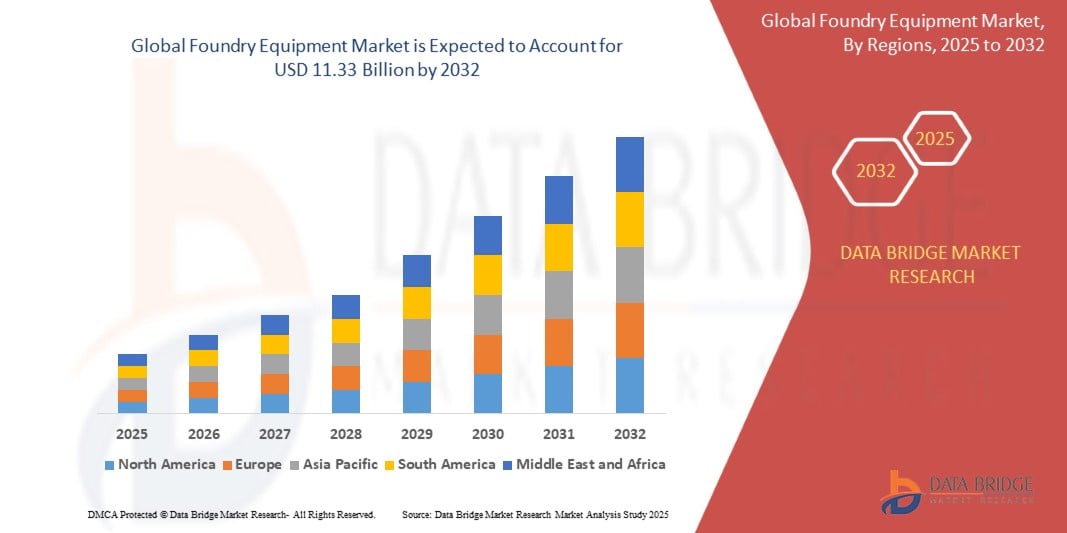
- The global foundry equipment market was valued at USD 8.60 billion in 2024 and is expected to reach USD 11.33 billion by 2032
- During the forecast period of 2025 to 2032 the market is likely to grow at a CAGR of 3.50%, primarily driven by technological advancements and the increasing demand for precision manufacturing across various industries
- The growth is fueled by factors such as rising demand for automotive and aerospace components, the shift toward automation in manufacturing processes, and increasing investments in modernization and process optimization in foundries
Foundry Equipment Market Analysis
- Foundry equipment is critical for the manufacturing of metal castings, used in various industries such as automotive, aerospace, and heavy machinery. These tools are essential for processes such as molding, casting, and metal shaping, providing high precision and efficiency
- The demand for foundry equipment is significantly driven by the increasing need for advanced casting technologies, rising industrialization, and the growing automotive and aerospace sectors. A large portion of the global demand is fueled by the automotive industry's need for lightweight and high-performance metal components
- The North America region remains a dominant market for foundry equipment, supported by its strong manufacturing base, technological innovations, and adoption of advanced automated solutions
- For instance, in the U.S., the automotive sector has witnessed a steady increase in demand for high-quality metal parts, driving the adoption of advanced foundry equipment. Innovations in casting technologies and the shift toward sustainable manufacturing are also contributing to the region's growth
- Globally, foundry equipment plays a pivotal role in ensuring high-quality production and reduced operational costs in metal casting. Its ability to meet the increasing demands for precision and efficiency makes it a key component in modern manufacturing processes
Report Scope and Foundry Equipment
Market Segmentation
|
Attributes |
Foundry Equipment Key Market Insights |
|
Segments Covered |
|
|
Countries Covered |
North America
Europe
Asia-Pacific
Middle East and Africa
South America
|
|
Key Market Players |
|
|
Market Opportunities |
|
|
Value Added Data Infosets |
In addition to the insights on market scenarios such as market value, growth rate, segmentation, geographical coverage, and major players, the market reports curated by the Data Bridge Market Research also include import export analysis, production capacity overview, production consumption analysis, price trend analysis, climate change scenario, supply chain analysis, value chain analysis, raw material/consumables overview, vendor selection criteria, PESTLE Analysis, Porter Analysis, and regulatory framework. |
Foundry Equipment Market Trends
“Integration of Automation and Smart Technologies”
- One prominent trend in the global foundry equipment market is the increasing integration of automation, robotics, and smart technologies
- These advanced technologies enhance operational efficiency, reduce labor costs, and improve product consistency and quality across foundries
- For instance, automated molding lines and robotic arms are being adopted for high-volume production, reducing the reliance on manual labor while ensuring precision in casting
- The implementation of smart sensors and IoT in foundry equipment is enabling real-time monitoring and predictive maintenance, reducing downtime and improving the overall productivity of the facility
- This trend is driving the demand for advanced foundry equipment, helping manufacturers meet the growing demand for high-quality castings with faster turnaround times
Foundry Equipment Market Dynamics
Driver
“Growing Demand for High-Precision Castings in Various Industries”
- The increasing demand for high-precision castings in industries such as automotive, aerospace, and construction is significantly driving the growth of the global foundry equipment market
- The automotive sector, in particular, is a major contributor to this trend, as manufacturers require high-quality, lightweight, and durable cast components for vehicles, including engine blocks, transmission cases, and suspension parts
- As industries continue to demand greater precision in their castings, foundry equipment needs to evolve to meet these requirements, leading to innovations in casting technology such as 3D printing, automated molding, and high-pressure die casting
- The ongoing advancements in materials, such as high-performance alloys, also increase the need for sophisticated foundry equipment capable of producing complex, intricate parts with tight tolerances
- These factors combined are propelling the demand for state-of-the-art foundry equipment to ensure the delivery of high-quality castings at a competitive pace
For instance,
- In March 2023, a KUKA AG (Germany) a leading foundry equipment manufacturer, according to an industry report, introduced AI-based predictive analytics tools, enabling companies to improve their equipment uptime and decrease maintenance costs
- In August 2022, a global automotive manufacturer adopted AI-driven foundry systems that enhanced casting accuracy and reduced scrap rates, driving further investment in advanced foundry technologies
- This trend toward automation and AI-driven solutions offers substantial opportunities for innovation, leading to higher productivity, lower operational costs, and more precise foundry operations
Opportunity
“Integration of Automation and AI in Foundry Processes”
- The integration of automation and AI into foundry operations is a significant opportunity driving the growth of the global foundry equipment market
- AI-powered systems can optimize the casting process by improving efficiency, reducing defects, and enhancing the precision of final products. These technologies enable smarter decision-making by analyzing real-time data from sensors and machines
- Automation, including robotic arms and AI-driven quality control systems, reduces human error, increases productivity, and cuts costs, all of which are essential for foundries aiming to remain competitive in the evolving manufacturing landscape
- Moreover, AI-powered predictive maintenance tools can monitor equipment health and prevent unscheduled downtimes by forecasting potential failures before they occur, ensuring smooth operations in the foundry
For instance,
- In March 2023, KUKA AG (Germany) a leading foundry equipment manufacturer, according to an industry report, introduced AI-based predictive analytics tools, enabling companies to improve their equipment uptime and decrease maintenance costs
- In August 2022, Bühler Group (Switzerland) a global automotive manufacturer adopted AI-driven foundry systems that enhanced casting accuracy and reduced scrap rates, driving further investment in advanced foundry technologies
- This trend toward automation and AI-driven solutions offers substantial opportunities for innovation, leading to higher productivity, lower operational costs, and more precise foundry operations
Restraint/Challenge
“High Capital Investment and Maintenance Costs Impeding Market Growth”
- The high capital investment required for advanced foundry equipment poses a significant barrier to entry for many companies, especially those in developing economies or small to medium-sized enterprises (SMEs)
- Equipment like induction furnaces, molding machines, and automated systems often come with substantial upfront costs, which can deter potential buyers from making investments in new technology.
- Additionally, the ongoing maintenance and operational costs associated with this high-tech machinery further increase the financial burden, making it challenging for companies to upgrade or expand their operations
For instance,
- In January 2023, an industry report from the International Foundry Organization highlighted that the high costs of advanced casting technologies were a critical factor limiting the adoption of state-of-the-art equipment, particularly in emerging markets
- In June 2022, a report revealed that small and mid-sized foundries in Europe faced significant challenges with the high upfront costs of robotic automation systems, which often hindered their ability to upgrade facilities and forced them to continue using older, less efficient equipment
- These financial constraints hinder the growth of the market by limiting the ability of smaller players to compete, thus reducing the overall adoption of modern foundry technologies
Foundry Equipment Market Scope
The market is segmented on the basis of product and end user.
|
Segmentation |
Sub-Segmentation |
|
By Product |
|
|
By End User |
|
Foundry Equipment Market Regional Analysis
“North America is the Dominant Region in the Foundry Equipment Market”
- North America holds the largest share of the global foundry equipment market, driven by advanced manufacturing capabilities, high technological adoption, and a robust presence of key industry players
- The U.S. continues to dominate the market due to strong demand from automotive, aerospace, and metal casting industries, alongside continuous innovations in foundry technologies and equipment
- Additionally, the region benefits from well-established regulations, substantial R&D investments, and government support for industrial growth, further boosting the adoption of advanced foundry equipment
- The increasing demand for precision casting, automation, and high-efficiency foundry solutions in North America continues to foster the growth of the market
“Asia-Pacific is Projected to Register the Highest Growth Rate”
- The Asia-Pacific region is anticipated to register the highest growth rate in the foundry equipment market, propelled by rapid industrialization, expansion of manufacturing hubs, and increasing demand for high-quality metal products
- Key countries such as China, India, and Japan are emerging as major markets due to their growing manufacturing sectors, rising urbanization, and increasing demand for automotive, electronics, and consumer goods
- China remains a significant player in the market, with its large industrial base and increasing investments in upgrading foundry technologies to meet the needs of its expanding manufacturing industries
- India, with its growing manufacturing and infrastructure sectors, is witnessing a surge in demand for foundry equipment, driven by the need for improved production capacities and quality in metal casting. The region's emphasis on modernization and automation in foundries further fuels market growth
Foundry Equipment Market Share
The market competitive landscape provides details by competitor. Details included are company overview, company financials, revenue generated, market potential, investment in research and development, new market initiatives, global presence, production sites and facilities, production capacities, company strengths and weaknesses, product launch, product width and breadth, application dominance. The above data points provided are only related to the companies' focus related to market.
The Major Market Leaders Operating in the Market Are:
- DISA Industries A/S (Denmark)
- Bühler Group (Switzerland)
- KUKA AG (Germany)
- Inductotherm Group (U.S.)
- Foseco (U.K.)
- Sinto Group (Japan)
- Vulcan Engineering Co., Inc. (U.S.)
- Laempe Reich (Germany)
- Mitsubishi Heavy Industries, Ltd. (Japan)
- Foundry Machinery Ltd. (U.K.)
- Krell Industries (U.S.)
- ABP Induction Systems GmbH (Germany)
- ASK Chemicals (Germany)
- TATA Steel (India)
- Harris Group (U.S.)
- Yizumi Precision Machinery Co., Ltd. (China)
- Zollern GmbH & Co. KG (Germany)
- Fryer Machine Systems (U.S.)
- Meltlab (Germany)
- Schuler Group (Germany)
Latest Developments in Global Foundry Equipment Market
- In April 2024, GlobalFoundries and IBM have successfully resolved a long-standing legal dispute that stemmed from a 2015 technology transfer agreement. The settlement, which comes after several years of litigation, marks a significant step toward reconciliation between the two tech giants. The settlement between GlobalFoundries and IBM in 2024 may lead to stronger collaboration, influencing the advancement of foundry technologies and impacting the foundry equipment market
- In April 2024, Intel disclosed an operating loss of USD7 billion for its foundry business in 2023, a substantial increase from the previous year’s loss of USD5.2 billion. The unit's revenue declined by 31%, falling to USD18.9 billion from USD27.49 billion in 2022. Intel's significant operating loss in its foundry business highlights potential challenges in the semiconductor manufacturing sector, which could affect demand for foundry equipment and technology advancements
- In April 2024, Taiwanese semiconductor companies are increasingly turning to Japan as they seek to diversify their operations amid the growing decoupling between the U.S. and China. This shift is a response to heightened geopolitical tensions and the tightening of U.S. sanctions on China’s access to advanced chip technologies. Taiwanese semiconductor companies diversifying operations in Japan may drive increased demand for advanced foundry equipment, as they seek to mitigate geopolitical risks and expand manufacturing capabilities
- In March 2022, Primetals Technologies and Tata Steel entered into a collaboration on projects and technologies related to green steel production and decarbonization. This partnership underscores the industry's commitment to sustainable practices and technological innovation. The collaboration between Primetals Technologies and Tata Steel on green steel production and decarbonization highlights the growing demand for advanced foundry equipment to
- In August 2022, Inductotherm Group acquired KMA (a leading producer of induction furnaces), expanding its portfolio to include advanced metal melting technologies. The acquisition was designed to strengthen their market presence and offer better technological solutions to customers worldwide. Inductotherm Group's acquisition of KMA enhances its portfolio with advanced metal melting technologies, bolstering its position in the global foundry equipment market by providing more innovative solutions for metal production

- Interactive Data Analysis Dashboard
- Company Analysis Dashboard for high growth potential opportunities
- Research Analyst Access for customization & queries
- Competitor Analysis with Interactive dashboard
- Latest News, Updates & Trend analysis
- Harness the Power of Benchmark Analysis for Comprehensive Competitor Tracking
Global Foundry Equipment Market, Supply Chain Analysis and Ecosystem Framework
To support market growth and help clients navigate the impact of geopolitical shifts, DBMR has integrated in-depth supply chain analysis into its Global Foundry Equipment Market research reports. This addition empowers clients to respond effectively to global changes affecting their industries. The supply chain analysis section includes detailed insights such as Global Foundry Equipment Market consumption and production by country, price trend analysis, the impact of tariffs and geopolitical developments, and import and export trends by country and HSN code. It also highlights major suppliers with data on production capacity and company profiles, as well as key importers and exporters. In addition to research, DBMR offers specialized supply chain consulting services backed by over a decade of experience, providing solutions like supplier discovery, supplier risk assessment, price trend analysis, impact evaluation of inflation and trade route changes, and comprehensive market trend analysis.
Data collection and base year analysis are done using data collection modules with large sample sizes. The stage includes obtaining market information or related data through various sources and strategies. It includes examining and planning all the data acquired from the past in advance. It likewise envelops the examination of information inconsistencies seen across different information sources. The market data is analysed and estimated using market statistical and coherent models. Also, market share analysis and key trend analysis are the major success factors in the market report. To know more, please request an analyst call or drop down your inquiry.
The key research methodology used by DBMR research team is data triangulation which involves data mining, analysis of the impact of data variables on the market and primary (industry expert) validation. Data models include Vendor Positioning Grid, Market Time Line Analysis, Market Overview and Guide, Company Positioning Grid, Patent Analysis, Pricing Analysis, Company Market Share Analysis, Standards of Measurement, Global versus Regional and Vendor Share Analysis. To know more about the research methodology, drop in an inquiry to speak to our industry experts.
Data Bridge Market Research is a leader in advanced formative research. We take pride in servicing our existing and new customers with data and analysis that match and suits their goal. The report can be customized to include price trend analysis of target brands understanding the market for additional countries (ask for the list of countries), clinical trial results data, literature review, refurbished market and product base analysis. Market analysis of target competitors can be analyzed from technology-based analysis to market portfolio strategies. We can add as many competitors that you require data about in the format and data style you are looking for. Our team of analysts can also provide you data in crude raw excel files pivot tables (Fact book) or can assist you in creating presentations from the data sets available in the report.













