


What is the Free from Certification Market Size and Growth Rate?
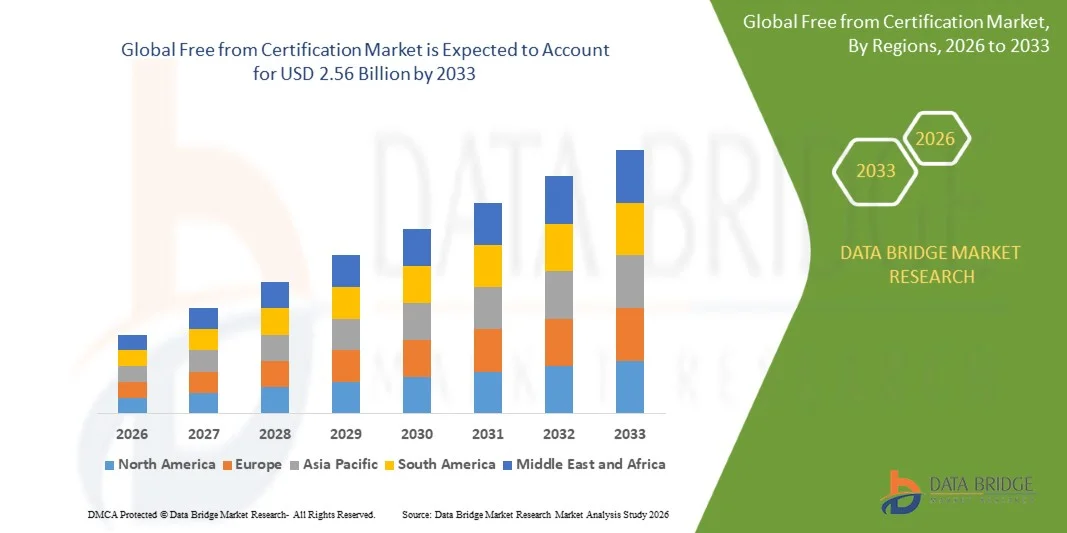
- As per Data Bridge Market Research analysis, the free from certification market was valued at USD 1.55 billion in 2025 and is projected to reach USD 2.56 billion by 2033, growing at a CAGR of 6.50% from 2026 to 2033.
- The market is experiencing consistent growth driven by rising consumer demand for allergen-free, gluten-free, non-GMO, and other free-from products, increasing awareness of food safety and ingredient transparency, and the expansion of certification requirements across food and beverage manufacturers.
- The increasing prevalence of food allergies and growing consumer focus on natural and health-oriented products, combined with regulatory requirements for accurate allergen and gluten-free labeling, is compelling food manufacturers and brands to adopt free-from certifications. Such certifications provide third-party assurance of product claims and support consumer confidence across meat, dairy, infant food, beverages, bakery, and confectionery applications
Market Size & Forecast
- Global Market Value (2025): USD 1.55 Billion
- Expected Market Value (2033): USD 2.56 Billion
- Forecast CAGR (2026–2033): 6.50%
- Leading Region in 2025: North America
- Fastest Growing Region: Asia Pacific
What are the Major Takeaways of the Free from Certification Market?
- North America dominated the free from certification market with the largest revenue share of 38% in 2025, supported by strong consumer awareness, stringent food safety standards, and widespread adoption of certified free-from products.
- Asia-Pacific is expected to be the fastest-growing region at a CAGR of 6.5% from 2026 to 2033, fueled by increasing food safety awareness, expanding food processing activities, and rising demand for certified products in China, India, and Japan
- The ISO 22000 segment led the market with a 32% share in 2025, driven by its internationally recognized food safety management framework and broad applicability across food manufacturers, processors, suppliers, and other food-chain organizations.
- Halal are the fastest-growing type, projected to register a CAGR of 7.5%, reflecting the surge in demand for certified food products across Muslim-majority markets and expanding international trade in Halal-certified food products.
- The high-risk foods segment dominated the risk category with a 58% revenue share in 2025, led by the greater requirement for stringent food-safety controls, monitoring, testing, and certification in products presenting comparatively higher contamination risks.
- Meat, poultry, and seafood accounted for 34% of the market share in 2025, preferred by stringent food-safety requirements and the need for rigorous controls across processing, handling, storage, and distribution.
- The infant food segment is the fastest-growing application category, with a CAGR of 7.2%, driven by heightened safety requirements and strong consumer sensitivity toward the quality and traceability of products consumed by infants
Report Scope and Free from Certification Market Segmentation
|
Attributes |
Free from Certification Key Market Insights |
|
Segments Covered |
|
|
Countries Covered |
North America
Europe
Asia-Pacific
Middle East and Africa
South America
|
|
Key Market Players |
|
|
Market Opportunities |
|
|
Value Added Data Infosets |
In addition to the insights on market scenarios such as market value, growth rate, segmentation, geographical coverage, and major players, the market reports curated by the Data Bridge Market Research also include in-depth expert analysis, pricing analysis, brand share analysis, consumer survey, demography analysis, supply chain analysis, value chain analysis, raw material/consumables overview, vendor selection criteria, PESTLE Analysis, Porter Analysis, and regulatory framework. |
What is the Key Trend in the Free from Certification Market?
- Demand for third-party free-from certification is increasing as consumers seek verified gluten-free, allergen-free, vegan, and non-GMO claims, encouraging food manufacturers to use recognized certification marks to strengthen transparency, differentiate products, and build confidence across increasingly health-conscious retail and foodservice markets.
- For instance, in February 2025, BRCGS announced that Beyond Celiac introduced a new trademark for certified products in the United States, following BRCGS Global Standard Gluten-Free Issue 4 and requiring new label submissions to use the updated trademark from May 2025.
- Free-from certification is expanding from single dietary claims toward multiple-claim credentials, reflecting consumers managing several dietary requirements simultaneously and manufacturers combining gluten-free, dairy-free, allergen-free, vegan, and other attributes on packaged food labels.
- Digital verification and traceability are becoming more important as certification providers strengthen online directories, product databases, audit documentation, and testing records, enabling manufacturers, retailers, and consumers to verify certified claims more efficiently across increasingly complex international food supply chains.
- For instance, in August 2024, MenuTrinfo announced that Lorissa’s Kitchen became the first meat snack in the U.S. to receive Certified Free From allergen certification, demonstrating the expansion of third-party free-from verification into meat-snack products and allergen-sensitive consumer categories.
- Certification standards are becoming more rigorous as providers emphasize risk-based controls, supplier management, facility audits, ingredient verification, and ongoing testing rather than relying only on final-product claims, increasing the credibility of free-from labels and reducing risks associated with cross-contamination.
What are the Key Drivers of the Free from Certification Market?
- The growing consumer awareness of food allergies, celiac disease, gluten intolerance, and dietary preferences is increasing demand for independently verified free-from claims, encouraging manufacturers to obtain certification that provides recognizable assurance beyond conventional ingredient declarations and supports purchasing decisions across packaged food categories.
- For instance, in February 2024, BRCGS published Issue 4 of its Global Standard Gluten-Free, strengthening the certification framework, with audits commencing in August 2024; the updated standard had certified sites across 34 countries, supporting broader international recognition of gluten-free certification
- Increasing regulatory scrutiny surrounding allergen declarations and gluten-free labeling is encouraging manufacturers to strengthen ingredient controls, testing procedures, supplier verification, and production practices, making third-party certification increasingly valuable for demonstrating compliance and maintaining consumer confidence across domestic and international food markets.
- The rapid expansion of free-from food categories is creating a larger addressable base for certification providers, as gluten-free, allergen-free, dairy-free, vegan, and other specialized claims increasingly move from niche products into mainstream bakery, snacks, beverages, confectionery, and prepared-food categories.
- For instance, in May 2024, the Gluten Intolerance Group withdrew GFCO certification from Best Express Foods after an investigation found gluten above the applicable threshold, demonstrating how independent testing, investigations, and certification controls support product-safety assurance and the credibility of free-from claims
- Growing international food trade is increasing the importance of recognized certification marks because manufacturers selling across multiple markets must demonstrate consistent production controls, ingredient traceability, and claim integrity while addressing different regulatory expectations and consumer requirements across countries and retail channels.
Which Factors are Challenging the Growth of the Free from Certification Market?
- Certification can create additional costs for manufacturers through application fees, audits, laboratory testing, facility assessments, documentation, employee training, and continuing compliance requirements, potentially discouraging smaller food producers from pursuing third-party certification when margins are limited or product volumes remain relatively low.
- For instance, in August 2024, NSF reported that audits for BRCGS Gluten-Free Issue 4 began on August 5, highlighting the need for manufacturers to adapt to revised terminology, clarified onboarding procedures, detailed audit requirements, and strengthened certification processes.
- Maintaining certification can require extensive operational controls because manufacturers must manage ingredient sourcing, supplier documentation, production processes, equipment, storage, sanitation, testing, and cross-contamination risks, increasing administrative complexity and recurring compliance responsibilities for facilities handling multiple product categories.
- Differences among certification programs, national labeling requirements, allergen thresholds, testing protocols, and trademark rules can create complexity for manufacturers seeking certification across multiple countries, particularly when products must satisfy different market-specific standards while maintaining consistent free-from claims.
- For instance, in May 2024, GFCO withdrew certification from Best Express Foods following positive gluten test results above the FDA threshold, illustrating how non-compliance can result in certification withdrawal and create additional costs associated with investigations, corrective actions, testing, and maintaining product-claim integrity.
- Smaller manufacturers may face greater barriers because certification programs can require annual facility audits, recurring product testing, documented quality systems, and ongoing ingredient verification, making compliance comparatively burdensome for companies without dedicated regulatory, quality-assurance, and food-safety resources.
How is the Free from Certification Market Segmented?
The free from certification market is segmented on the basis of type, risk category, distribution channel, and application.
- By Type
On the basis of type, the free from certification market is segmented into ISO 22000, BRC, SQF, IFS, Halal, and Kosher. The ISO 22000 segment dominated the market with share of 32% in 2025, supported by its internationally recognized food safety management framework and broad applicability across food manufacturers, processors, suppliers, and other food-chain organizations. ISO 22000 provides a systematic approach to identifying and controlling food safety hazards throughout the supply chain. Its compatibility with other management-system standards enables companies to integrate food safety into established quality-management structures. Growing international food trade is increasing the importance of standardized certification for manufacturers serving multiple markets.
The halal segment is projected to register the fastest growth at CAGR of 7.5% from 2026 to 2023, driven by increasing demand for certified food products across Muslim-majority markets and expanding international trade in Halal-certified food products. Halal certification provides assurance that ingredients, processing methods, handling, and production practices comply with applicable Islamic dietary requirements. Growing Muslim populations and increasing consumer awareness of certified food quality are expanding demand across meat, poultry, dairy, beverages, and processed foods. Food manufacturers are increasingly obtaining Halal certification to access domestic and export markets where Halal compliance is an important purchasing requirement
- By Risk Category
On the basis of risk category, the free from certification market is segmented into high-risk foods and low-risk foods. The high-risk foods segment dominated the market with share of 58% in 2025, owing to the greater requirement for stringent food-safety controls, monitoring, testing, and certification in products presenting comparatively higher contamination risks. High-risk food categories generally require stronger controls over processing, handling, storage, and distribution to minimize food-safety hazards. Certification provides manufacturers with structured procedures for hazard identification, preventive controls, traceability, and ongoing compliance. Regulatory authorities and retailers also place greater emphasis on documented safety controls for products with elevated food-safety risks.
The low-risk foods segment is projected to register the fastest growth at CAGR of 6.8% from 2026 to 2023, supported by increasing adoption of certification among manufacturers seeking to demonstrate consistent safety and quality controls across a wider range of packaged food products. Although these products present comparatively lower food-safety risks, manufacturers increasingly use certification to strengthen consumer confidence and support market access. Certification can also help companies demonstrate standardized procedures for ingredient sourcing, production, storage, and distribution. Growing demand for transparent food labeling is encouraging producers to substantiate product claims through recognized certification frameworks. Small and medium-sized food businesses are increasingly entering formal retail and export channels, creating additional demand for certification.
- By Distribution Channel
On the basis of distribution channel, the free from certification market is segmented into growers, manufacturers, retailers, and others. The manufacturers segment dominated the market with a share of 40% in 2025, reflecting the central role of food producers in implementing certification requirements and demonstrating compliance with food safety and quality standards. Manufacturers must control ingredients, production processes, sanitation, storage, traceability, and documentation to maintain certified operations. Certification can help manufacturers demonstrate compliance to retailers, foodservice organizations, regulators, and international buyers. Increasing globalization of food supply chains is also encouraging manufacturers to obtain internationally recognized certifications to facilitate market access.
The retailers segment is projected to register the fastest growth at CAGR of 7.0% from 2026 to 2033, driven by increasing consumer demand for certified products and retailers' growing focus on food safety, transparency, and supplier compliance. Retailers increasingly require suppliers to meet recognized certification standards before products can enter organized retail channels. Certified products also enable retailers to communicate verified safety, quality, and dietary attributes to consumers. The expansion of supermarkets, specialty food stores, and e-commerce platforms is increasing the visibility and availability of certified food products. Retailers are consequently becoming more involved in supplier-audit and certification requirements throughout their procurement networks.
- By Application
On the basis of application, the free from certification market is segmented into meat, poultry, and seafood, dairy, infant food, beverages, and bakery & confectionery. The meat, poultry, and seafood segment dominated the market with an approximate share of 34% in 2025, supported by stringent food-safety requirements and the need for rigorous controls across processing, handling, storage, and distribution. These products are particularly sensitive to contamination risks and therefore require robust food-safety management systems. Certification helps producers demonstrate compliance with safety requirements and provides assurance to retailers, foodservice operators, and consumers. Growing international trade in meat and seafood is also increasing demand for recognized certification across supply chains.
The Infant Food segment is projected to register the fastest growth at CAGR of 7.2% from 2026 to 2033, driven by heightened safety requirements and strong consumer sensitivity toward the quality and traceability of products consumed by infants. Infant food manufacturers face stringent expectations concerning ingredients, processing, hygiene, contamination prevention, and quality assurance. Certification provides additional verification of production controls and can strengthen confidence among parents, retailers, and regulators. Growing demand for specialized infant nutrition products is also encouraging manufacturers to strengthen quality-management and certification practices. Expansion of packaged and processed infant foods in emerging economies is creating additional opportunities for certification providers
Which Region Holds the Largest Share of the Free from Certification Market?
- North America dominated the free from certification market with the largest revenue share of 38% in 2025, supported by strong consumer awareness, stringent food safety standards, and widespread adoption of certified free-from products
- The region also benefits from established food safety certification infrastructure, widespread adoption of third-party certification, and strong demand for free-from products across food manufacturing and retail channels. Increasing emphasis on allergen control, transparent labeling, and consumer protection continues to strengthen North America's leadership position in the global market.
U.S. Free from Certification Market Insight
The U.S. free from certification market is witnessing strong growth due to rising consumer awareness of food allergies, gluten intolerance, and dietary requirements, alongside increasing demand for verified allergen-free and gluten-free products. The country’s established food manufacturing and retail ecosystem, along with the adoption of third-party certification programs, is supporting demand across food and beverage categories. In addition, stringent requirements for truthful gluten-free and allergen-related labeling are strengthening the need for rigorous certification, ingredient controls, and cross-contamination prevention.
Asia-Pacific Free From Certification Market Insight
The Asia-Pacific free from certification market is expected to witness rapid growth, driven by increasing consumer awareness of food allergies, dietary preferences, and clean-label products across countries such as China, India, and Japan. Growing development of packaged and specialty food products, rising adoption of international food safety practices, and increasing demand for transparent product claims are supporting regional market expansion. In addition, the growing participation of Asian food manufacturers in international supply chains is encouraging greater adoption of recognized certification and allergen-management practices.
Japan Free From Certification Market Insight
The Japan free from certification market is witnessing consistent growth due to increasing attention to food safety, allergen management, and transparent product information. Food manufacturers and retailers are increasingly emphasizing reliable labeling and controlled production processes to address consumer requirements for products suitable for specific dietary needs. Moreover, the country’s sophisticated food processing sector and emphasis on product quality are contributing to the adoption of certification and verification practices for free-from products.
China Free From Certification Market Insight
The China free from certification market is growing rapidly, driven by expanding packaged food consumption, rising consumer awareness of food safety, and increasing demand for products addressing specific dietary requirements. Food manufacturers are increasingly focusing on standardized production, ingredient traceability, and reliable product claims to strengthen consumer confidence and support access to modern retail channels. In addition, China’s expanding food processing industry and growing participation in international food supply chains are supporting greater adoption of recognized certification and allergen-control practices.
U.K. Free From Certification Market Insight
The U.K. free from certification market is experiencing steady growth, supported by stringent allergen-labeling requirements and increasing demand for verified free-from products. Food businesses producing free-from products must implement rigorous controls to prevent allergen cross-contamination, while gluten-free claims are subject to defined regulatory requirements. Furthermore, the presence of established free-from-focused industry initiatives and growing product innovation across food and beverage categories is supporting certification adoption in the U.K.
Germany Free From Certification Market Insight
The Germany free from certification market is expanding steadily due to strong consumer emphasis on food quality, allergen transparency, and specialized dietary products. Food manufacturers and retailers are increasingly focusing on controlled production processes, ingredient management, and reliable labeling to address demand for gluten-free and allergen-conscious products. Continuous development of specialized food categories, combined with Germany’s strong food processing industry and focus on European food safety requirements, is further supporting the adoption of free-from certification practices.
Which are the Top Companies in Free from Certification Market?
The free from certification industry is primarily led by well-established companies, including:
- MenuTrinfo (U.S.)
- BRCGS (U.K.)
- Scientific Certification Systems, Inc. (U.S.)
- Gluten Intolerance Group (U.S.)
- NSF (U.S.)
- Intertek Group plc (U.K.)
- SGS Société Générale de Surveillance SA (Switzerland)
- Bureau Veritas (France)
- UL LLC (U.S.)
- AIB International, Inc. (U.S.)
- Safe Quality Food Institute (U.S.)
- The Vegan Society (U.K.)
- V-Label (Switzerland)
- ECOCERT GROUP (France)
- Global Standard gGmbH (Germany)
- Eurofins (Luxembourg)
- TÜV SÜD (Germany)
- TÜV Rheinland (Germany)
- Kiwa (Netherlands)
- Certified Humane (U.S.)
What are Latest Developments in Free from Certification Market?
- In August 2025, MenuTrinfo announced that The Greater Knead had received its Certified Free From allergen seal, covering the Top 9 allergens along with gluten-free requirements. The certification provides third-party verification of allergen-control measures and strengthens substantiation of the brand’s free-from claims, reflecting the growing use of formal certification to provide greater transparency to consumers with food allergies. Read the MenuTrinfo announcement
- In August 2024, MenuTrinfo announced that Lorissa’s Kitchen became the first meat snack in the U.S. to receive its Certified Free From™ allergen certification. The certification verified the product against allergen requirements and represented an expansion of third-party free-from certification into the meat-snack category, giving consumers additional assurance regarding allergen transparency. Read the Specialty Food Association article
- In April 2023, Dr. Schär expanded its allergen-control program by having its Swedesboro, New Jersey facility become Certified Free From Soy. The certification followed the company’s existing relationship with MenuTrinfo and resulted in the facility being certified free from eight of the nine major allergens, excluding sesame, demonstrating how established gluten-free manufacturers are extending third-party certification to additional allergen categories. Read the Specialty Food Association article
- In March 2022, MenuTrinfo’s Certified Free From program received ANSI National Accreditation Board recognition for meeting ISO 17065 standards for certification bodies. The accreditation established a formal third-party framework for verifying allergen-free claims and strengthened the credibility of Certified Free From certification for food manufacturers and foodservice operations. Read the accreditation announcement
- In May 2021, Vanderbilt Campus Dining highlighted its use of specialized food-allergy safety services to provide an allergy-conscious dining environment for students. The initiative demonstrated the application of structured allergen-management and certification-related practices within university foodservice, an important area for the development of free-from verification and safer dining standards.

- Interactive Data Analysis Dashboard
- Company Analysis Dashboard for high growth potential opportunities
- Research Analyst Access for customization & queries
- Competitor Analysis with Interactive dashboard
- Latest News, Updates & Trend analysis
- Harness the Power of Benchmark Analysis for Comprehensive Competitor Tracking
Global Free From Certification Market, Supply Chain Analysis and Ecosystem Framework
To support market growth and help clients navigate the impact of geopolitical shifts, DBMR has integrated in-depth supply chain analysis into its Global Free From Certification Market research reports. This addition empowers clients to respond effectively to global changes affecting their industries. The supply chain analysis section includes detailed insights such as Global Free From Certification Market consumption and production by country, price trend analysis, the impact of tariffs and geopolitical developments, and import and export trends by country and HSN code. It also highlights major suppliers with data on production capacity and company profiles, as well as key importers and exporters. In addition to research, DBMR offers specialized supply chain consulting services backed by over a decade of experience, providing solutions like supplier discovery, supplier risk assessment, price trend analysis, impact evaluation of inflation and trade route changes, and comprehensive market trend analysis.
Data collection and base year analysis are done using data collection modules with large sample sizes. The stage includes obtaining market information or related data through various sources and strategies. It includes examining and planning all the data acquired from the past in advance. It likewise envelops the examination of information inconsistencies seen across different information sources. The market data is analysed and estimated using market statistical and coherent models. Also, market share analysis and key trend analysis are the major success factors in the market report. To know more, please request an analyst call or drop down your inquiry.
The key research methodology used by DBMR research team is data triangulation which involves data mining, analysis of the impact of data variables on the market and primary (industry expert) validation. Data models include Vendor Positioning Grid, Market Time Line Analysis, Market Overview and Guide, Company Positioning Grid, Patent Analysis, Pricing Analysis, Company Market Share Analysis, Standards of Measurement, Global versus Regional and Vendor Share Analysis. To know more about the research methodology, drop in an inquiry to speak to our industry experts.
Data Bridge Market Research is a leader in advanced formative research. We take pride in servicing our existing and new customers with data and analysis that match and suits their goal. The report can be customized to include price trend analysis of target brands understanding the market for additional countries (ask for the list of countries), clinical trial results data, literature review, refurbished market and product base analysis. Market analysis of target competitors can be analyzed from technology-based analysis to market portfolio strategies. We can add as many competitors that you require data about in the format and data style you are looking for. Our team of analysts can also provide you data in crude raw excel files pivot tables (Fact book) or can assist you in creating presentations from the data sets available in the report.













