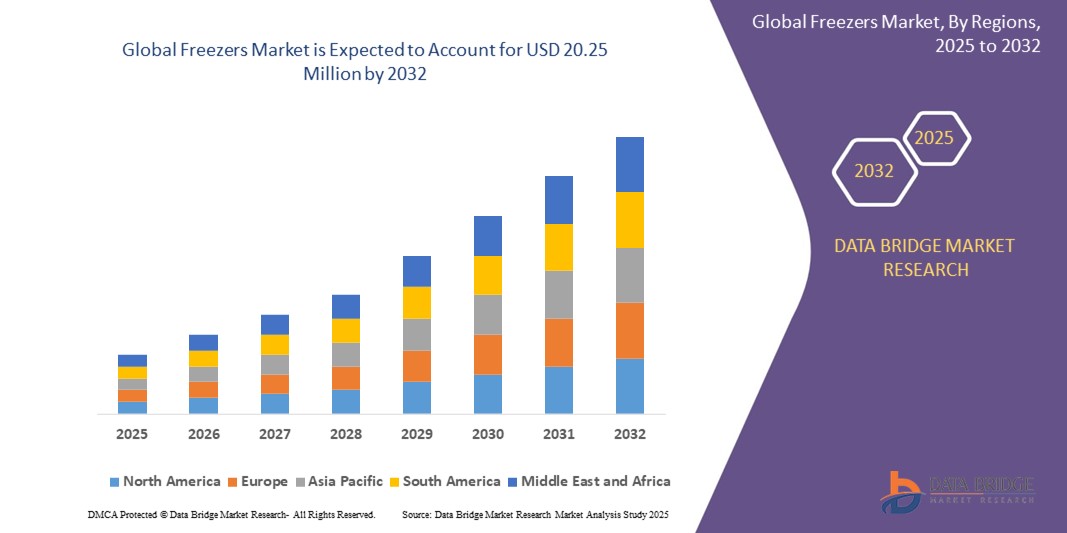
What is the Global Freezers Market Size and Growth Rate?
- The global freezers market size was valued at USD 14.29 billion in 2024 and is expected to reach USD 20.25 billion by 2032, at a CAGR of 4.46% during the forecast period
- Market expansion is primarily driven by the rising demand for frozen food storage, increasing adoption of energy-efficient appliances, and growing penetration of smart kitchen solutions across residential and commercial sectors
- In addition, the rise in urbanization, changing consumer lifestyles, and food safety awareness are encouraging both households and businesses to invest in reliable freezing solutions, thereby fueling consistent market growth
What are the Major Takeaways of Freezers Market?
- Freezers, used for long-term food preservation, have become essential in both domestic and industrial settings due to their temperature precision, storage capacity, and advancements in inverter and smart technology
- The market is witnessing rapid adoption driven by increasing consumption of frozen ready-to-eat meals, expansion of supermarket and cold storage infrastructure, and growing demand for energy-efficient, eco-friendly refrigeration solutions
- Asia-Pacific dominated the Freezers market with the largest revenue share of 37.9% in 2024, driven by strong demand across residential, commercial, and industrial sectors
- Rapid urbanization, rising food consumption, and expansion of retail and cold chain
- North America Freezers market is expected to grow at a fastest CAGR of 8.98% during the forecast period, driven by strong demand from the food & beverage sector, rising consumer preference for frozen food, and an established cold storage infrastructure
- The chest freezer segment dominated the market with the largest revenue share of 49.8% in 2024, attributed to its larger storage capacity, energy efficiency, and cost-effectiveness for bulk storage of frozen goods
Report Scope and Freezers Market Segmentation
|
Attributes |
Freezers Key Market Insights |
|
Segments Covered |
|
|
Countries Covered |
North America
Europe
Asia-Pacific
Middle East and Africa
South America
|
|
Key Market Players |
|
|
Market Opportunities |
|
|
Value Added Data Infosets |
In addition to the insights on market scenarios such as market value, growth rate, segmentation, geographical coverage, and major players, the market reports curated by the Data Bridge Market Research also include in-depth expert analysis, pricing analysis, brand share analysis, consumer survey, demography analysis, supply chain analysis, value chain analysis, raw material/consumables overview, vendor selection criteria, PESTLE Analysis, Porter Analysis, and regulatory framework. |
What is the Key Trend in the Freezers Market?
“Enhanced Convenience through Smart Technology and Energy Efficiency”
- A major trend reshaping the global freezers market is the rising adoption of smart, energy-efficient technologies that allow users to control and monitor freezer performance via mobile apps, IoT platforms, and AI-based tools. These innovations are aligning with consumer demand for more sustainable, connected appliances
- For instance, LG Electronics introduced its Smart Wi-Fi Enabled InstaView Freezer, which features remote temperature monitoring, energy consumption tracking, and smart diagnosis tools for troubleshooting all accessible via smartphone
- Smart freezers equipped with AI-driven temperature sensors can auto-adjust cooling levels based on door usage or ambient temperature, significantly reducing energy waste. In addition, voice assistant integration with Google Assistant or Amazon Alexa enables hands-free control, enhancing kitchen convenience
- The demand for multi-functional freezers—with features such as convertible compartments, fast-freezing modes, and real-time alerts is growing, especially among urban consumers seeking both performance and sustainability
- Brands such as Samsung, Whirlpool, and Haier are investing in AI-powered inverter compressor technology, which reduces energy bills and improves freezer longevity. This trend is particularly prominent in North America, Europe, and emerging markets such as India and China
- The shift towards connected and intelligent freezers is transforming household expectations and commercial usage, reinforcing the freezer’s role as a central appliance in modern kitchens and retail food chains
What are the Key Drivers of Freezers Market?
- Increasing demand for frozen food products, combined with growing cold chain logistics and food safety concerns, is driving global adoption of high-performance freezers across residential, commercial, and industrial sectors
- For instance, in February 2024, Whirlpool Corporation launched a new line of energy-efficient upright and chest freezers with EcoMode features, addressing both environmental concerns and the rising demand for long-term food storage
- The rise of urban nuclear families, especially in Asia-Pacific, and changing eating habits have accelerated the need for home freezers that can support bulk food storage, meal prepping, and emergency storage
- Meanwhile, in the commercial sector, growing investments in cold storage facilities, pharmaceutical logistics, and frozen retail segments are bolstering demand for commercial-grade freezers with temperature control accuracy and smart monitoring systems.
- In addition, government regulations promoting energy efficiency and eco-friendly refrigerants are encouraging manufacturers to innovate with green technologies, further supporting market expansion
Which Factor is challenging the Growth of the Freezers Market?
- One of the significant challenges to freezer market growth is the high upfront cost of advanced freezers featuring smart connectivity, inverter compressors, and AI-enabled controls, especially in price-sensitive developing markets
- For instance, smart freezers with Wi-Fi and voice-assistant features can cost 20–30% more than traditional models, creating a price barrier for budget-conscious consumers in regions such as Latin America and Africa
- In addition, supply chain disruptions and the volatile cost of raw materials (such as steel and refrigerants) are affecting manufacturing costs and leading to fluctuating retail prices.
- Another challenge is the growing awareness around electronic waste and concerns over the environmental impact of discarded appliances, especially older models using harmful refrigerants
- To address these issues, companies are increasingly adopting modular designs for easier repair and upgrade, offering trade-in discounts, and emphasizing eco-friendly refrigerants such as R600a. For instance, Haier and Electrolux have launched EPR-compliant recycling programs in key markets
- While these efforts are helping reduce resistance, overcoming price sensitivity and ensuring long-term durability will remain critical for broader market penetration
How is the Freezers Market Segmented?
The market is segmented on the basis of product type, door type, capacity, and application.
• By Product Type
On the basis of product type, the Freezers market is segmented into chest freezer, upright freezer, and others. The chest freezer segment dominated the market with the largest revenue share of 49.8% in 2024, attributed to its larger storage capacity, energy efficiency, and cost-effectiveness for bulk storage of frozen goods. These freezers are widely used in both residential and commercial settings, particularly in grocery stores, restaurants, and households that require long-term food preservation.
The upright freezer segment is expected to witness the fastest CAGR from 2025 to 2032, driven by its space-saving vertical design, organizational ease with shelves, and growing demand in urban homes where floor space is limited. In addition, technological advancements such as frost-free operation and smart temperature control are enhancing product appeal.
• By Door Type
On the basis of door type, the Freezers market is segmented into 1 door, 2 door, 3 door, and 4 door. The 1 door segment accounted for the largest market revenue share of 38.5% in 2024, primarily due to its dominance in compact and entry-level freezer models commonly used in residential settings and small-scale commercial operations. These units are often more affordable, consume less energy, and are preferred for smaller storage needs.
The 2 door segment is anticipated to witness the fastest growth rate from 2025 to 2032, due to its versatility in separating storage zones for improved organization and hygiene. This design is increasingly favored in restaurants and medical facilities where compartmentalized freezing is essential.
• By Capacity
On the basis of capacity, the Freezers market is segmented into less than 50L, 50L–100L, 100L–200L, 200L–300L, 300L–500L, and 500L and above. The 100L–200L segment held the highest revenue share in 2024 at 27.4%, due to its balance between capacity and space utilization, making it ideal for medium-sized households and retail outlets. These models offer sufficient space for frozen food while being compact enough for urban kitchens and retail backrooms.
The 500L and above segment is projected to grow at the fastest CAGR from 2025 to 2032, supported by increased demand in large commercial kitchens, supermarkets, and cold storage facilities. Growing investments in the food processing and pharmaceutical industries are also driving the need for high-capacity freezing solutions.
• By Application
On the basis of application, the Freezers market is categorized into residential, commercial, and industrial. The residential segment dominated the market with a 46.7% revenue share in 2024, driven by rising household adoption of smart and energy-efficient freezers to support bulk food storage and meal prepping trends. Increasing disposable incomes and urbanization in developing regions are further supporting demand.
The commercial segment is expected to exhibit the fastest CAGR during the forecast period (2025–2032), driven by expanding food retail chains, supermarkets, and the growing cold chain logistics network. Freezers are also being widely adopted across hotels, restaurants, and medical labs requiring consistent and safe low-temperature storage.
Which Region Holds the Largest Share of the Freezers Market?
- Asia-Pacific dominated the Freezers market with the largest revenue share of 37.9% in 2024, driven by strong demand across residential, commercial, and industrial sectors
- Rapid urbanization, rising food consumption, and expansion of retail and cold chain infrastructure have fueled the need for efficient and reliable freezing solutions in countries such as China, India, and Japan
- The region also benefits from the presence of major manufacturers, competitive pricing, and increasing penetration of energy-efficient and smart freezer models, supporting both household and commercial applications
China Freezers Market Insight
China Freezers market captured the largest revenue share in 2024 within Asia-Pacific, driven by strong domestic demand, rapid growth in e-commerce and food delivery sectors, and government initiatives supporting cold chain logistics. With a rising middle class and expanding retail sector, the country is witnessing widespread adoption of both chest and upright freezers in homes, supermarkets, and food service industries. The availability of affordable models from local brands is also expanding market access across rural and urban areas.
Which Region is the Fastest Growing Region in the Freezers Market?
North America Freezers market is expected to grow at a fastest CAGR of 8.98% during the forecast period, driven by strong demand from the food & beverage sector, rising consumer preference for frozen food, and an established cold storage infrastructure. Technological advancements such as energy-efficient inverters and smart control panels are increasing adoption in both residential and commercial sectors. In addition, consumer awareness about food preservation and reduced food waste supports freezer sales in this region.
U.S. Freezers Market Insight
U.S. Freezers market dominated North America with a 79% share in 2024, supported by high consumer purchasing power, changing food habits, and the popularity of bulk food storage. The commercial segment is expanding significantly, particularly among convenience stores, restaurants, and pharmaceutical storage. Demand for garage-ready, frost-free, and Energy Star-rated models is on the rise, driven by consumer preferences for long-term performance and cost savings.
GCC Freezers Market Insight
GCC Freezers market is gaining traction due to the expansion of hypermarkets, tourism, and a rise in per capita food consumption. Countries such as Saudi Arabia and the U.A.E. are investing in retail infrastructure and food supply chains, leading to increased demand for reliable freezing solutions. The market is further boosted by rising imports of frozen food and pharmaceuticals requiring precise cold storage, prompting commercial establishments to upgrade their equipment.
Which are the Top Companies in Freezers Market?
The freezers industry is primarily led by well-established companies, including:
- DAIHAN Scientific Co., Ltd. (South Korea)
- Koninklijke Philips N.V. (Netherlands)
- SAMSUNG (South Korea)
- Thermo Fisher Scientific Inc. (U.S.)
- Haier Inc. (China)
- Hitachi, Ltd. (Japan)
- LG Electronics (South Korea)
- Liebherr Group (Switzerland)
- BSH Hausgeräte GmbH (Germany)
- Beverage Air (U.S.)
- Brandt Group of Companies (France)
- Panasonic Corporation (Japan)
- Diamond Engineering Works (India)
- Rockwell Industries Limited (India)
- Western Refrigeration Private Limited (India)
- Newtronic (India)
- REMI GROUP (India)
- Ice Make Refrigeration Limited (India)
- Elanpro (India)
- Star Scientific Instruments (India)
What are the Recent Developments in Global Freezers Market?
- In May 2023, Entergy Corporation introduced a recycling initiative targeted at residential consumers to promote the efficient replacement of outdated refrigerators and freezers. The program facilitates the responsible disposal and recycling of old appliances while offering participants a USD 25 incentive voucher. This initiative is expected to support energy conservation and promote environmentally friendly appliance usage
- In January 2023, SAMSUNG launched its 2023 lineup of Side-by-Side Refrigerators, entirely manufactured in India and specifically designed to cater to Indian consumer preferences. The new range includes a host of convenience-enhancing features developed through deep consumer insights. This move strengthens SAMSUNG’s local presence and appeals directly to regional demand trends
- In July 2021, PHC Corporation unveiled new models of sliding door pharmaceutical refrigerators, MPR-S500H and S500RH, along with combined refrigerator-freezer units, MPR-N250FH and N250FSH. These models incorporate inverter compressors and natural CFC-free refrigerants and are tailored for research facilities and healthcare environments. These products enhance cold storage capabilities in critical medical and research settings
- In March 2021, Thermo Fisher Scientific Inc. introduced the Thermo Scientific AerosolSense Sampler, a modern air surveillance solution designed to detect the presence of SARS-CoV-2 and other airborne pathogens rapidly and reliably. This innovation plays a key role in airborne pathogen detection and public health preparedness
- In May 2020, Esco launched the Esco CelCulture® CO₂ Incubator with High Heat Sterilization, model CCL-HHS, which uses dry heat up to 180°C to eliminate bacterial spores, vegetative cells, and resilient fungi. This advancement contributes to maintaining sterile conditions in laboratory and research environments

- Interactive Data Analysis Dashboard
- Company Analysis Dashboard for high growth potential opportunities
- Research Analyst Access for customization & queries
- Competitor Analysis with Interactive dashboard
- Latest News, Updates & Trend analysis
- Harness the Power of Benchmark Analysis for Comprehensive Competitor Tracking
Data collection and base year analysis are done using data collection modules with large sample sizes. The stage includes obtaining market information or related data through various sources and strategies. It includes examining and planning all the data acquired from the past in advance. It likewise envelops the examination of information inconsistencies seen across different information sources. The market data is analysed and estimated using market statistical and coherent models. Also, market share analysis and key trend analysis are the major success factors in the market report. To know more, please request an analyst call or drop down your inquiry.
The key research methodology used by DBMR research team is data triangulation which involves data mining, analysis of the impact of data variables on the market and primary (industry expert) validation. Data models include Vendor Positioning Grid, Market Time Line Analysis, Market Overview and Guide, Company Positioning Grid, Patent Analysis, Pricing Analysis, Company Market Share Analysis, Standards of Measurement, Global versus Regional and Vendor Share Analysis. To know more about the research methodology, drop in an inquiry to speak to our industry experts.
Data Bridge Market Research is a leader in advanced formative research. We take pride in servicing our existing and new customers with data and analysis that match and suits their goal. The report can be customized to include price trend analysis of target brands understanding the market for additional countries (ask for the list of countries), clinical trial results data, literature review, refurbished market and product base analysis. Market analysis of target competitors can be analyzed from technology-based analysis to market portfolio strategies. We can add as many competitors that you require data about in the format and data style you are looking for. Our team of analysts can also provide you data in crude raw excel files pivot tables (Fact book) or can assist you in creating presentations from the data sets available in the report.