


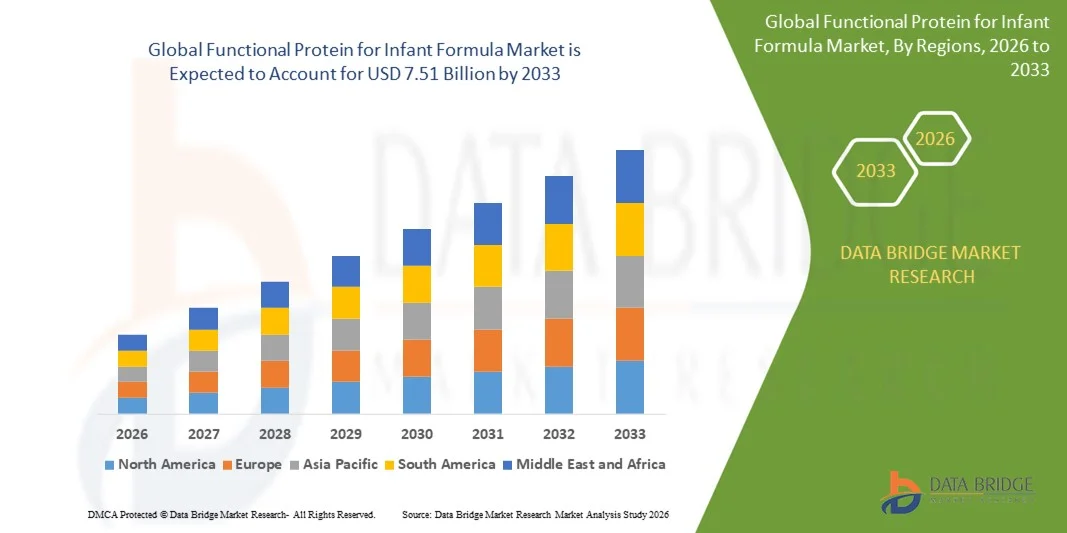
What is the Global Functional Protein for Infant Formula Market Size and Growth Rate?
- The global functional protein for infant formula market size was valued at USD 4.44 billion in 2025 and is expected to reach USD 7.51 billion by 2033, at a CAGR of 6.80% during the forecast period
- Rising technological upgradation in the functional proteins market is a vital factor escalating the market growth, also rising instances of chronic diseases, rising consumers awareness towards a healthy diet, increasing demand for nutraceuticals on account of growing awareness towards maintaining a healthy diet and enhancing the nutritional value of human body, rise in the demand for medical nutrition in developed countries including Germany
- Rising animal feed industry in developing economies including China, India, and Brazil due to the increment in sales of dairy derivatives on a domestic level are the major factors among others driving the functional protein for infant formula market briskly
What are the Major Takeaways of Functional Protein for Infant Formula Market?
- Rising instances of chronic diseases and rising demand from emerging markets will further create new opportunities for the functional protein for infant formula market
- However, growing regulations on the use of animal proteins and lack of awareness are the major factors among others acting as restraints, while low consumer awareness will further challenge the functional protein for infant formula market in the forecast period
- Asia-Pacific dominated the functional protein for infant formula market with a 39.2% revenue share in 2025, supported by rapid industrialization, growing infant nutrition demand, and increasing production of functional protein ingredients in China, India, Japan, and Southeast Asia
- North America is projected to register the fastest CAGR of 7.8% from 2026 to 2033, driven by innovation in protein-based formulas, fortified products, and specialty infant nutrition
- The Hydrolysates segment dominated the market with a revenue share of 42.5% in 2025, driven by its superior digestibility, reduced allergenicity, and enhanced bioavailability, making it ideal for sensitive infant nutrition
Report Scope and Functional Protein for Infant Formula Market Segmentation
|
Attributes |
Functional Protein for Infant Formula Key Market Insights |
|
Segments Covered |
|
|
Countries Covered |
North America
Europe
Asia-Pacific
Middle East and Africa
South America
|
|
Key Market Players |
|
|
Market Opportunities |
|
|
Value Added Data Infosets |
In addition to the insights on market scenarios such as market value, growth rate, segmentation, geographical coverage, and major players, the market reports curated by the Data Bridge Market Research also include in-depth expert analysis, pricing analysis, brand share analysis, consumer survey, demography analysis, supply chain analysis, value chain analysis, raw material/consumables overview, vendor selection criteria, PESTLE Analysis, Porter Analysis, and regulatory framework. |
What is the Key Trend in the Functional Protein for Infant Formula Market?
Rising Demand for Sustainable and High-Performance Functional Proteins in Infant Nutrition
- The functional protein for infant formula market is witnessing a notable trend toward the development of clean-label, high-quality, and bioactive proteins that enhance infant health and digestive tolerance. This trend is fueled by manufacturers focusing on innovation in protein fortification and nutritional optimization
- For instance, leading players such as DSM, Arla Foods, and Friesland Campina have expanded their protein portfolios with hydrolyzed, organic, and lactose-free options to meet evolving nutritional needs across global infant populations
- Rising consumer awareness regarding infant gut health, immunity, and allergen management is accelerating the adoption of advanced functional proteins
- Companies are integrating milk protein isolates, whey hydrolysates, and plant-based proteins to achieve enhanced digestibility, bioavailability, and immune support
- Increased R&D in protein processing, enzymatic hydrolysis, and fortification technology is driving innovation in the infant formula sector
- As parents increasingly prioritize safe, high-performance, and scientifically validated nutrition, functional proteins are expected to remain central to infant formula development globally
What are the Key Drivers of Functional Protein for Infant Formula Market?
- Growing demand for fortified infant formulas with improved digestibility, immunity support, and cognitive development is driving market adoption worldwide
- For instance, in 2025, companies such as Nestlé and Danone expanded production of hydrolyzed and bioactive proteins to address lactose intolerance and allergic sensitivities
- Rising infant populations, urbanization, and increasing maternal awareness of nutritional benefits are fueling adoption across North America, Europe, and Asia-Pacific
- Technological advancements in protein extraction, hydrolysis, and formulation are improving protein stability, bioactivity, and shelf-life in infant formulas
- Regulatory emphasis on protein quality, allergen control, and nutritional labeling is strengthening market growth
- With ongoing investments in R&D, protein innovation, and functional ingredient fortification, the Functional Protein for Infant Formula market is expected to sustain strong growth in the coming years
Which Factor is Challenging the Growth of the Functional Protein for Infant Formula Market?
- High costs of specialized proteins, hydrolysis processes, and organic or non-GMO certifications limit adoption in price-sensitive regions
- For instance, during 2024–2025, fluctuations in whey protein and plant-protein supply impacted production for leading infant formula manufacturers
- Regulatory compliance for infant nutrition safety, labeling standards, and allergen management increases operational complexity and cost
- Limited awareness in emerging markets about functional protein benefits restricts large-scale adoption
- Competition from conventional milk powders, plant-based formulas, and low-cost protein alternatives creates pricing and technological pressures
- To overcome these challenges, companies are focusing on scalable manufacturing, protein blending, cost-efficient sourcing, and fortified formulation innovation to offer reliable, high-quality, and sustainable functional proteins for infant nutrition globally
How is the Functional Protein for Infant Formula Market Segmented?
The market is segmented on the basis of type, source, and application.
- By Type
On the basis of type, the functional protein for infant formula market is segmented into Hydrolysates, Whey Protein Concentrates, Whey Protein Isolates, Casein/Caseinates, and Soy Protein. The Hydrolysates segment dominated the market with a revenue share of 42.5% in 2025, driven by its superior digestibility, reduced allergenicity, and enhanced bioavailability, making it ideal for sensitive infant nutrition. Hydrolysates are widely used in hypoallergenic formulas and premium infant formulas, providing high nutritional value while supporting immune function and gut health. Continuous advancements in enzymatic hydrolysis, flavor masking, and nutrient preservation are further boosting adoption globally.
The Whey Protein Isolates segment is projected to register the fastest CAGR between 2026 and 2033, fueled by rising demand for high-purity proteins, improved growth and development support, and incorporation in follow-on and specialty formulas. Manufacturers are innovating to enhance solubility, digestibility, and functional properties for infant-specific nutritional needs.
- By Source
On the basis of source, the market is segmented into Animal and Plant proteins. The Animal protein segment dominated the market with a revenue share of 61.2% in 2025, driven by extensive use of whey and casein proteins derived from cow’s milk, which are considered the gold standard for infant growth, immunity, and cognitive development. Animal proteins offer high bioavailability, rich essential amino acids, and proven safety profiles, supporting their adoption across standard and specialty infant formulas. Innovation in protein purification, enzymatic treatment, and allergen reduction is enhancing product quality and consumer trust.
The Plant protein segment is projected to grow at the fastest CAGR between 2026 and 2033, fueled by increasing demand for lactose-free, non-dairy, and vegan-friendly formulas. Companies are investing in soy, pea, and other plant-based proteins, improving solubility, taste, and nutrient profile to cater to evolving parental preferences and dietary restrictions globally.
- By Application
On the basis of application, the market is segmented into Growing-up Milk, Standard Infant Formula, Follow-on Formula, and Specialty formulas. The Standard Infant Formula segment dominated the market with a revenue share of 53.4% in 2025, supported by consistent global demand as the primary source of nutrition for infants aged 0–12 months. Adoption is driven by fortified formulations, regulatory compliance, and incorporation of functional proteins to support healthy growth, immunity, and cognitive development.
The Specialty segment is projected to grow at the fastest CAGR from 2026 to 2033, fueled by rising demand for hypoallergenic, lactose-free, prebiotic, and medically tailored formulas. Increasing parental focus on gut health, allergy management, and immune support is encouraging manufacturers to innovate with protein blends, hydrolysates, and bioactive ingredients to meet niche nutritional needs across global markets.
Which Region Holds the Largest Share of the Functional Protein for Infant Formula Market?
- Asia-Pacific dominated the functional protein for infant formula market with a 39.2% revenue share in 2025, supported by rapid industrialization, growing infant nutrition demand, and increasing production of functional protein ingredients in China, India, Japan, and Southeast Asia. Expanding manufacturing capabilities, favorable government policies, and rising health awareness contribute to regional leadership
- Leading players are investing in high-quality protein formulations, innovative processing techniques, and sustainable ingredient sourcing to meet growing regional demand. Collaborations with local dairy and ingredient producers are strengthening market penetration
- Urbanization, rising disposable incomes, and expansion of retail and online distribution channels are accelerating the adoption of Functional Protein for Infant Formulas across Asia-Pacific markets
China Functional Protein for Infant Formula Market Insight
China leads Asia-Pacific, driven by rising birth rates, increasing healthcare awareness, and expanding infant formula production. Adoption of whey protein isolates, hydrolysates, and specialty proteins ensures improved nutritional quality, digestibility, and bioavailability. Government initiatives supporting domestic infant nutrition production and quality standards enhance market growth.
India Functional Protein for Infant Formula Market Insight
India is a key contributor, fueled by growing infant population, urbanization, and rising consumer preference for premium infant formulas. Investments in protein extraction, formulation, and sustainable sourcing strengthen product offerings. Rising awareness about child nutrition and protein-rich formulations supports long-term growth.
North America Functional Protein for Infant Formula Market Insight
North America is projected to register the fastest CAGR of 7.8% from 2026 to 2033, driven by innovation in protein-based formulas, fortified products, and specialty infant nutrition. The U.S. and Canada see strong demand for whey and hydrolyzed proteins, with manufacturers investing in R&D, clean-label products, and sustainable production practices to enhance market adoption.
U.S. Functional Protein for Infant Formula Market Insight
The U.S. leads North America, with high adoption of premium functional proteins, hydrolysates, and specialty formulas. Manufacturers focus on innovative formulations, enhanced digestibility, and nutritional efficacy, supported by robust regulatory standards and strong retail networks.
Canada Functional Protein for Infant Formula Market Insight
Canada contributes steadily, driven by consumer preference for fortified infant formulas, plant-based proteins, and clean-label products. Collaborations between ingredient suppliers and formula manufacturers expand product variety, ensuring compliance with health regulations and meeting evolving nutritional needs.
Europe Functional Protein for Infant Formula Market Insight
Europe holds a significant share, led by Germany, the U.K., France, and the Netherlands. Strong regulatory standards, focus on sustainability, and premium infant formula demand drive adoption. Companies are innovating with protein blends, hydrolysates, and plant-based alternatives to meet consumer and regulatory expectations.
Germany Functional Protein for Infant Formula Market Insight
Germany dominates Europe, driven by advanced infant nutrition R&D, high-quality whey and casein proteins, and adoption of hydrolysates. Investments in sustainable sourcing and bioactive protein development support market growth.
U.K. Functional Protein for Infant Formula Market Insight
The U.K. market is growing steadily, fueled by demand for high-performance protein formulas, plant-based alternatives, and fortified infant nutrition. Strong retail presence and parental awareness support market expansion.
Which are the Top Companies in Functional Protein for Infant Formula Market?
The functional protein for infant formula industry is primarily led by well-established companies, including:
- ADM (U.S.)
- DSM (Netherlands)
- Cargill, Incorporated (U.S.)
- BASF SE (Germany)
- Ingredion Incorporated (U.S.)
- Roquette Frères (France)
- SunOpta (Canada)
- Darling Ingredients (U.S.)
- Omega Protein Corporation (U.S.)
- Dow (U.S.)
- Kemin Industries (U.S.)
- INVIVO THERAPEUTICS (U.S.)
What are the Recent Developments in Global Functional Protein for Infant Formula Market?
- In March 2024, Protein Industries Canada commenced a new project to meet the growing demand for protein ingredients, with co-investments from partners including HPS Food & Ingredients, Burcon NutraScience, and Puratos Canada, enhancing the value of sunflower and hemp flour through protein isolate and concentrate extraction, and this initiative is expected to support food and beverage manufacturers in producing innovative, high-quality products
- In March 2024, NETZSCH and ProteinDistillery entered into a strategic partnership for the development of sustainable and efficient protein sources, focusing on revolutionizing protein production processes, and this collaboration is anticipated to accelerate adoption of eco-friendly and high-performance protein ingredients globally
- In August 2022, Puratos, a leading food ingredient and service provider for bakery and confectionery sectors, announced a partnership with Shiru, a functional ingredient manufacturer, aimed at discovering new functional ingredients for bakery and confectionery applications, and this collaboration is expected to drive innovation in ingredient formulation
- In September 2021, Farmers Edge Inc. and Merit Functional Foods launched a pilot program to enhance protein crop production, quality, and marketing opportunities, focusing on improving ingredient efficiency and sustainability, and this initiative is expected to strengthen the supply of high-quality protein ingredients for infant nutrition and other applications

- Interactive Data Analysis Dashboard
- Company Analysis Dashboard for high growth potential opportunities
- Research Analyst Access for customization & queries
- Competitor Analysis with Interactive dashboard
- Latest News, Updates & Trend analysis
- Harness the Power of Benchmark Analysis for Comprehensive Competitor Tracking
Global Functional Protein For Infant Formula Market, Supply Chain Analysis and Ecosystem Framework
To support market growth and help clients navigate the impact of geopolitical shifts, DBMR has integrated in-depth supply chain analysis into its Global Functional Protein For Infant Formula Market research reports. This addition empowers clients to respond effectively to global changes affecting their industries. The supply chain analysis section includes detailed insights such as Global Functional Protein For Infant Formula Market consumption and production by country, price trend analysis, the impact of tariffs and geopolitical developments, and import and export trends by country and HSN code. It also highlights major suppliers with data on production capacity and company profiles, as well as key importers and exporters. In addition to research, DBMR offers specialized supply chain consulting services backed by over a decade of experience, providing solutions like supplier discovery, supplier risk assessment, price trend analysis, impact evaluation of inflation and trade route changes, and comprehensive market trend analysis.
Data collection and base year analysis are done using data collection modules with large sample sizes. The stage includes obtaining market information or related data through various sources and strategies. It includes examining and planning all the data acquired from the past in advance. It likewise envelops the examination of information inconsistencies seen across different information sources. The market data is analysed and estimated using market statistical and coherent models. Also, market share analysis and key trend analysis are the major success factors in the market report. To know more, please request an analyst call or drop down your inquiry.
The key research methodology used by DBMR research team is data triangulation which involves data mining, analysis of the impact of data variables on the market and primary (industry expert) validation. Data models include Vendor Positioning Grid, Market Time Line Analysis, Market Overview and Guide, Company Positioning Grid, Patent Analysis, Pricing Analysis, Company Market Share Analysis, Standards of Measurement, Global versus Regional and Vendor Share Analysis. To know more about the research methodology, drop in an inquiry to speak to our industry experts.
Data Bridge Market Research is a leader in advanced formative research. We take pride in servicing our existing and new customers with data and analysis that match and suits their goal. The report can be customized to include price trend analysis of target brands understanding the market for additional countries (ask for the list of countries), clinical trial results data, literature review, refurbished market and product base analysis. Market analysis of target competitors can be analyzed from technology-based analysis to market portfolio strategies. We can add as many competitors that you require data about in the format and data style you are looking for. Our team of analysts can also provide you data in crude raw excel files pivot tables (Fact book) or can assist you in creating presentations from the data sets available in the report.













