


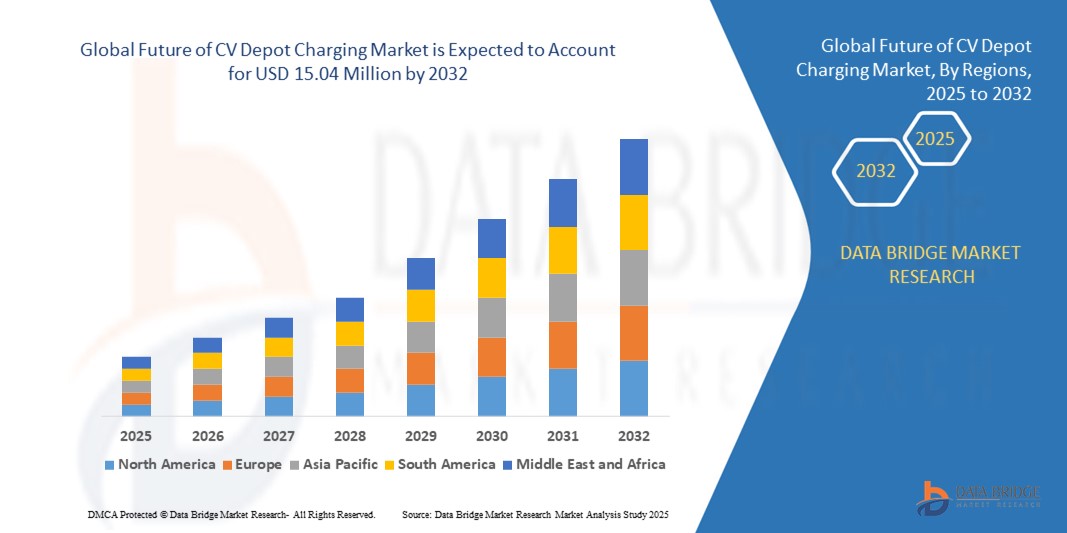
What is the Global Future of CV Depot Charging Market Size and Growth Rate?
- The global future of CV depot charging market size was valued at USD 5.34 million in 2024 and is expected to reach USD 15.04 million by 2032, at a CAGR of 13.80% during the forecast period
- The market is transforming significantly due to the global shift towards electrification. This presents opportunities for scalable, efficient depot charging solutions to support the electrification of commercial vehicle fleets
- However, challenges such as upfront investment costs and interoperability issues must be addressed. Collaboration, technological innovation, and regulatory alignment are essential for unlocking the full potential of depot charging infrastructure in shaping the future of sustainable transportation
What are the Major Takeaways of Future of CV Depot Charging Market?
- The widespread use of commercial electric vehicles for public transportation is altering urban mobility. Governments throughout the world are promoting electrification to reduce emissions and improve air quality. Fleet operators are embracing electric buses and cabs for cost savings and environmental benefits
- Technological developments in batteries and charging infrastructure are speeding this transformation. Electric vehicles provide quieter and smoother rides, boosting the passenger experience. Electric public transportation is gaining popularity due to lower running costs and pollutants. This trend signals a dramatic change towards sustainable urban mobility
- North America dominated the future of CV depot charging market with the largest revenue share of 36.01% in 2024, driven by the rapid growth of electric commercial vehicles, supportive government policies, and extensive charging infrastructure investments
- Asia-Pacific future of CV depot charging market is poised to grow at the fastest CAGR of 4.36% during 2025–2032, driven by rapid urbanization, supportive government policies, and large-scale EV fleet adoption in China, Japan, and India
- The eLCV segment dominated the market with the largest revenue share of 46.5% in 2024, driven by the rapid electrification of last-mile delivery fleets and urban logistics. E-commerce growth, city emission regulations, and increasing fleet operators’ preference for cost-efficient electric vehicles have accelerated adoption of eLCVs
Report Scope and Future of CV Depot Charging Market Segmentation
|
Attributes |
Future of CV Depot Charging Key Market Insights |
|
Segments Covered |
|
|
Countries Covered |
North America
Europe
Asia-Pacific
Middle East and Africa
South America
|
|
Key Market Players |
|
|
Market Opportunities |
|
|
Value Added Data Infosets |
In addition to the insights on market scenarios such as market value, growth rate, segmentation, geographical coverage, and major players, the market reports curated by the Data Bridge Market Research also include in-depth expert analysis, pricing analysis, brand share analysis, consumer survey, demography analysis, supply chain analysis, value chain analysis, raw material/consumables overview, vendor selection criteria, PESTLE Analysis, Porter Analysis, and regulatory framework. |
What is the Key Trend in the Future of CV Depot Charging Market?
Enhanced Efficiency Through AI and Energy Management Integration
- A significant trend in the future of CV depot charging market is the adoption of artificial intelligence (AI) and advanced energy management systems to optimize fleet charging operations. AI helps predict charging demand, manage peak loads, and allocate power intelligently across multiple vehicles, reducing downtime and electricity costs
- For instance, Siemens and Hitachi Energy are deploying AI-powered depot charging solutions that balance grid demand while ensuring vehicles are fully charged for scheduled operations. This enhances operational reliability for commercial vehicle (CV) fleets
- AI-enabled depot systems can also forecast renewable energy availability and align charging schedules with solar or wind supply, enabling greener fleet operations. Voice-activated controls and digital dashboards further enhance user convenience by simplifying fleet managers’ oversight
- The integration of charging stations with smart grids and fleet management platforms allows centralized monitoring of vehicle readiness, energy use, and operational costs, streamlining decision-making for logistics and transit companies
- Companies such as ABB and Kempower are actively developing intelligent depot charging solutions with dynamic load management, predictive maintenance, and real-time energy optimization
- This trend towards intelligent, automated, and eco-friendly depot charging is reshaping fleet electrification strategies, ensuring scalability and sustainability in future CV operations
What are the Key Drivers of Future of CV Depot Charging Market?
- The accelerating shift toward fleet electrification in logistics, public transport, and last-mile delivery is a major driver of depot charging demand, supported by government incentives and zero-emission targets
- For instance, in March 2024, ABB partnered with Lion Electric to deliver depot charging solutions for electric school buses across North America, highlighting growing investment in heavy-duty vehicle electrification
- The rising need for cost-effective, centralized, and reliable charging infrastructure is driving adoption, as depot charging ensures fleet readiness without reliance on public charging networks
- Integration with renewable energy and energy storage systems further enhances the appeal of depot charging, enabling lower operating costs and sustainability compliance
- Fleet operators also benefit from advanced features such as remote monitoring, predictive maintenance, and load optimization, making depot charging an attractive solution for large-scale vehicle operations
Which Factor is Challenging the Growth of the Future of CV Depot Charging Market?
- A major challenge for the market is the high initial investment required for setting up depot charging infrastructure, including grid upgrades, energy storage integration, and hardware installation
- For instance, reports of rising infrastructure costs for large bus depots have led some operators to delay electrification plans, especially in cost-sensitive regions
- Cybersecurity risks in connected charging systems also pose challenges, as AI-driven and networked depot chargers could be exposed to hacking attempts or data breaches, raising operational concerns for fleet operators
- In addition, the strain on local grids due to simultaneous charging of multiple heavy-duty vehicles can hinder scalability unless supported by smart load management and utility partnerships
- While long-term savings and sustainability benefits are strong, overcoming cost barriers and security concerns will be critical for accelerating adoption
- Industry players are focusing on financing models, secure software protocols, and modular charging solutions to address these challenges and enable broader market growth
How is the Future of CV Depot Charging Market Segmented?
The market is segmented on the basis of vehicle type and charger type.
- By Vehicle Type
On the basis of vehicle type, the future of CV depot charging market is segmented into eLCV, eMCV, eHCV, and eBuses. The eLCV segment dominated the market with the largest revenue share of 46.5% in 2024, driven by the rapid electrification of last-mile delivery fleets and urban logistics. E-commerce growth, city emission regulations, and increasing fleet operators’ preference for cost-efficient electric vehicles have accelerated adoption of eLCVs. Their relatively smaller battery sizes make depot charging a practical and cost-effective solution. In addition, partnerships between OEMs and logistics players for eLCV rollouts are reinforcing their dominance.
The eBuses segment is anticipated to witness the fastest CAGR from 2025 to 2032, fueled by large-scale government electrification programs in public transport. Municipalities worldwide are investing heavily in charging infrastructure to support electric bus fleets, making eBuses the fastest-expanding category in depot charging applications.
- By Charger Type
On the basis of charger type, the future of CV depot charging market is segmented into AC and DC chargers. The DC segment accounted for the largest market revenue share of 68.9% in 2024, driven by the higher power output required to serve commercial vehicle fleets with large battery capacities. Depot operators prefer DC fast charging due to its ability to minimize vehicle downtime and improve fleet utilization. With growing deployment of high-capacity trucks and buses, demand for ultra-fast DC depot chargers is rising significantly. Moreover, technological advancements such as modular charging systems and megawatt charging solutions are strengthening DC’s dominance.
The AC segment is expected to witness the fastest CAGR from 2025 to 2032, supported by its cost-effectiveness and suitability for overnight fleet charging. AC chargers are especially popular for eLCVs and smaller depot operations, where long dwell times allow slower charging without impacting fleet schedules.
Which Region Holds the Largest Share of the Future of CV Depot Charging Market?
- North America dominated the future of CV depot charging market with the largest revenue share of 36.01% in 2024, driven by the rapid growth of electric commercial vehicles, supportive government policies, and extensive charging infrastructure investments
- Fleet operators in the region highly value the reliability, fast-charging capability, and scalability of depot charging solutions to optimize logistics and meet sustainability targets
- This widespread adoption is further supported by federal incentives, corporate fleet electrification targets, and collaborations between utilities and charging providers, positioning North America as a global hub for CV depot charging growth
U.S. Future of CV Depot Charging Market Insight
The U.S. future of CV depot charging market captured the largest revenue share of 81% in 2024 within North America, fueled by strong government funding, the rise of EV fleets in logistics, and a nationwide push toward emission reduction. The growing preference for fast-charging solutions, depot-based energy management systems, and renewable-powered charging hubs is propelling the market. Moreover, collaborations with technology leaders and integration with smart grid systems are significantly expanding deployment across logistics, municipal, and last-mile delivery fleets.
Europe Future of CV Depot Charging Market Insight
The Europe future of CV depot charging market is projected to expand at a substantial CAGR throughout the forecast period, driven by strict emission regulations, clean energy initiatives, and ambitious fleet electrification goals. Rapid urbanization and growing investment in public-private charging partnerships are fostering the adoption of depot charging. European fleet operators are focusing on energy-efficient, renewable-integrated depot solutions, particularly in commercial transport and municipal fleet applications.
U.K. Future of CV Depot Charging Market Insight
The U.K. future of CV depot charging market is anticipated to grow at a noteworthy CAGR during the forecast period, driven by the government’s net-zero emission targets and incentives for commercial fleet electrification. The rise of e-commerce and last-mile delivery services is further fueling demand. U.K. operators are increasingly adopting smart depot solutions with load management and grid balancing, supporting cost-efficient and reliable operations across urban centers.
Germany Future of CV Depot Charging Market Insight
The Germany future of CV depot charging market is expected to expand at a considerable CAGR during the forecast period, fueled by the country’s strong automotive ecosystem, EV incentives, and sustainability focus. Germany’s advanced infrastructure and emphasis on renewable-powered charging depots promote widespread adoption. Integration of depot charging with fleet telematics, energy storage, and smart grid systems is also accelerating growth, especially in logistics hubs and public transport depots.
Which Region is the Fastest Growing Region in the Future of CV Depot Charging Market?
Asia-Pacific future of CV depot charging market is poised to grow at the fastest CAGR of 4.36% during 2025–2032, driven by rapid urbanization, supportive government policies, and large-scale EV fleet adoption in China, Japan, and India. The region benefits from its role as a manufacturing hub for charging equipment, making depot solutions more cost-effective and widely accessible.
Japan Future of CV Depot Charging Market Insight
The Japan future of CV depot charging market is gaining traction due to the nation’s technology-driven ecosystem, urban logistics needs, and strong government backing. The adoption of depot charging is driven by the expansion of smart mobility hubs and integration with renewable sources. Moreover, Japan’s aging population and demand for efficient, automated fleet operations are accelerating the shift toward CV depot electrification.
China Future of CV Depot Charging Market Insight
The China future of CV depot charging market accounted for the largest share in Asia-Pacific in 2024, supported by its vast EV fleet, strong government incentives, and rapid smart city development. With a booming logistics sector and large-scale adoption of electric buses and trucks, China stands as the largest market for depot charging infrastructure. Domestic manufacturers and cost-effective charging technologies are further accelerating adoption across both urban and intercity commercial fleets.
Which are the Top Companies in Future of CV Depot Charging Market?
The future of CV depot charging industry is primarily led by well-established companies, including:
- ABB (Switzerland)
- Blink (U.S.)
- Bosch (Germany)
- bp pulse (U.K.)
- ChargePoint (U.S.)
- EVgo (U.S.)
- Heliox (Netherlands)
- Kempower (Finland)
- Shell Recharge (U.S.)
- Siemens (Germany)
- Wallbox (Spain)
What are the Recent Developments in Global Future of CV Depot Charging Market?
- In May 2024, Forum Mobility commenced construction of its heavy-duty electric truck charging depot, named FM Harbor, at the Port of Long Beach. The facility is scheduled to be operational by the end of 2024, supporting California’s target of achieving a 100% zero-emission drayage fleet by 2035, which includes transitioning nearly 33,000 Class 8 trucks to electric power. This initiative marks a critical step toward advancing sustainable freight operations in the U.S
- In June 2024, Scania, a prominent truck manufacturer, launched a new company called Erinion to accelerate electrification in the heavy goods vehicle (HGV) sector. Erinion is dedicated to offering depot and destination charging solutions for electric trucks and aims to install at least 40,000 HGV-compatible charging stations across Europe by 2030. This strategic move highlights Europe’s commitment to building large-scale charging infrastructure for heavy-duty transport
- In March 2023, Exicom successfully deployed 5,000 EV chargers across 200 cities in India, consisting of 3,600 AC chargers and 1,400 DC chargers, many of which cater to public transport and fleet services. The milestone was achieved within four years, with the 5,000th charger installed at a DTC depot in Delhi. This accomplishment reflects India’s rapid progress in strengthening its EV charging ecosystem

- Interactive Data Analysis Dashboard
- Company Analysis Dashboard for high growth potential opportunities
- Research Analyst Access for customization & queries
- Competitor Analysis with Interactive dashboard
- Latest News, Updates & Trend analysis
- Harness the Power of Benchmark Analysis for Comprehensive Competitor Tracking
Data collection and base year analysis are done using data collection modules with large sample sizes. The stage includes obtaining market information or related data through various sources and strategies. It includes examining and planning all the data acquired from the past in advance. It likewise envelops the examination of information inconsistencies seen across different information sources. The market data is analysed and estimated using market statistical and coherent models. Also, market share analysis and key trend analysis are the major success factors in the market report. To know more, please request an analyst call or drop down your inquiry.
The key research methodology used by DBMR research team is data triangulation which involves data mining, analysis of the impact of data variables on the market and primary (industry expert) validation. Data models include Vendor Positioning Grid, Market Time Line Analysis, Market Overview and Guide, Company Positioning Grid, Patent Analysis, Pricing Analysis, Company Market Share Analysis, Standards of Measurement, Global versus Regional and Vendor Share Analysis. To know more about the research methodology, drop in an inquiry to speak to our industry experts.
Data Bridge Market Research is a leader in advanced formative research. We take pride in servicing our existing and new customers with data and analysis that match and suits their goal. The report can be customized to include price trend analysis of target brands understanding the market for additional countries (ask for the list of countries), clinical trial results data, literature review, refurbished market and product base analysis. Market analysis of target competitors can be analyzed from technology-based analysis to market portfolio strategies. We can add as many competitors that you require data about in the format and data style you are looking for. Our team of analysts can also provide you data in crude raw excel files pivot tables (Fact book) or can assist you in creating presentations from the data sets available in the report.













