


What is the Garment Active Insulation Market Size and Growth Rate?
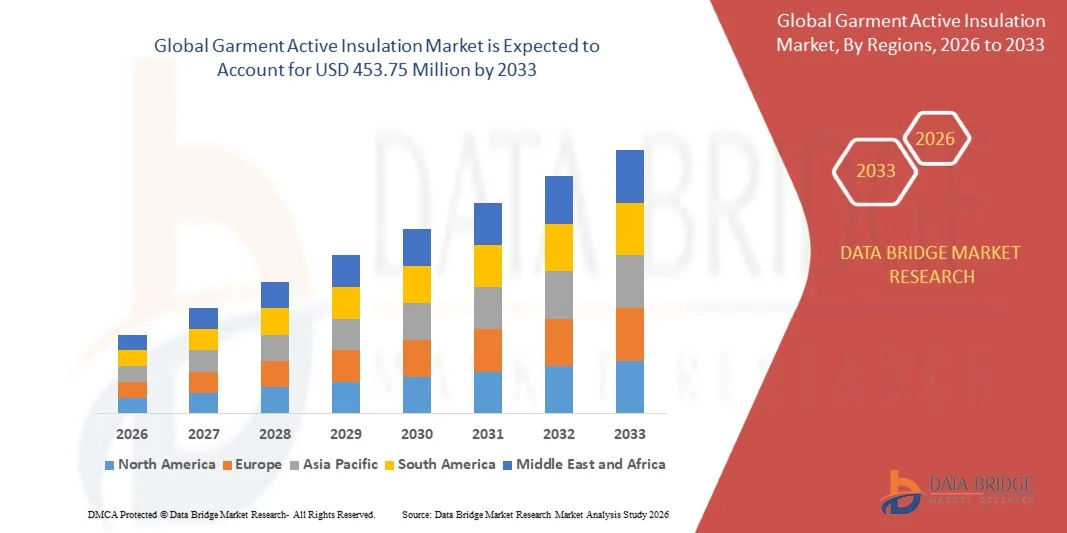
- As per Data Bridge Market Research analysis, the garment active insulation market was valued at USD 257.66 million in 2025 and is projected to reach USD 453.75 million by 2033, growing at a CAGR of 7.33% from 2026 to 2033.
- The market is experiencing steady growth driven by the rising participation in high-exertion outdoor and adventure sports, growing consumer demand for lightweight, breathable insulation that manages moisture during aerobic activity, and increasing adoption of active insulation technologies by both premium outdoor brands and mainstream apparel manufacturers.
- The growing consumer preference for versatile, multi-season garments capable of regulating body temperature during variable-intensity activity is compelling material science companies and apparel brands to invest in advanced active insulation technologies. Continuous filament and grid-structured insulation constructions are increasingly complementing traditional loose-fill synthetic insulation, offering improved air permeability and moisture-vapor transmission without sacrificing warmth retention during rest periods.
- The growing influence of outdoor lifestyle content on social media platforms is further raising consumer awareness of technical apparel performance attributes, driving increased willingness among mainstream consumers to invest in premium insulation technology previously reserved for core outdoor enthusiasts.
Market Size & Forecast
- Global Market Value (2025): USD 257.66 Million
- Expected Market Value (2033): USD 453.75 Million
- Forecast CAGR (2026–2033): 7.33%
- Leading Region in 2025: North America
- Fastest Growing Region: Asia-Pacific
What are the Major Takeaways of the Garment Active Insulation Market?
- North America dominated the global garment active insulation market with the largest revenue share of 36.84% in 2025, supported by strong outdoor recreation culture, high concentration of premium performance apparel brands, and significant consumer spending on technical outdoor gear.
- Asia-Pacific is expected to be the fastest-growing region at a CAGR of 9.6% from 2026 to 2033, fueled by rising disposable incomes, growing participation in outdoor and adventure sports, and expanding textile manufacturing capacity across China, Japan, and South Korea.
- The synthetic active insulation segment led the market with a 68.42% share in 2025, driven by its superior moisture management performance, faster drying time, and lower cost compared to natural down and hybrid insulation alternatives.
- The grid/fleece-backed insulation segment is the fastest-growing insulation type, projected to register a CAGR of 9.1%, reflecting rising demand for constructions that maximize breathability and air circulation during high-output aerobic activities.
- The outdoor & adventure apparel application segment dominated the application category with a 44.63% revenue share in 2025, led by strong consumer demand for technical jackets and midlayers suited to hiking, mountaineering, and backcountry activities.
- Specialty outdoor retailers accounted for 38.72% of the market share among distribution channels in 2025, preferred due to their knowledgeable staff and ability to demonstrate technical product performance to informed outdoor enthusiast consumers.
- The athletic & performance wear application segment is the fastest-growing category, with a CAGR of 9.8%, driven by rising consumer interest in cold-weather running, cycling, and cross-training apparel incorporating active insulation technology.
- The jackets garment type segment accounted for 52.17% of the market share in 2025, reflecting their status as the primary category for showcasing active insulation technology and offering the greatest consumer visibility for technical performance features.
- The men’s end-user segment held a 46.28% share in 2025, supported by historically higher participation rates in core outdoor and mountaineering activities among male consumers.
Report Scope and Garment Active Insulation Market Segmentation
|
Attributes |
Garment Active Insulation Key Market Insights |
|
Segments Covered |
|
|
Countries Covered |
North America
Europe
Asia-Pacific
Middle East and Africa
South America
|
|
Key Market Players |
|
|
Market Opportunities |
|
|
Value Added Data Infosets |
In addition to the insights on market scenarios such as market value, growth rate, segmentation, geographical coverage, and major players, the market reports curated by the Data Bridge Market Research also include in-depth expert analysis, geographically represented company-wise production and capacity, network layouts of distributors and partners, detailed and updated price trend analysis and deficit analysis of supply chain and demand. |
What is the Key Trend in the Garment Active Insulation Market?
- Material science companies are increasingly developing active insulation constructions that eliminate traditional inner and outer face fabrics entirely, bonding insulation fibers directly to a single lightweight shell to reduce overall garment weight and improve breathability.
- For instance, in March 2025, Polartec expanded its direct-bonded active insulation product line, offering apparel brands a lighter-weight construction option that reduces total garment layers while maintaining comparable thermal performance to traditional insulated garment constructions.
- Growing consumer and regulatory focus on sustainability is driving increased adoption of recycled polyester fibers within active insulation products, with several leading material suppliers transitioning significant portions of their product lines to recycled or bio-based fiber content.
- Apparel brands are increasingly collaborating directly with insulation material technology companies to co-develop proprietary, brand-exclusive active insulation constructions, differentiating their technical apparel offerings from competitors using more widely available generic insulation materials.
- For instance, in February 2025, Patagonia expanded its proprietary active insulation product line featuring a co-developed synthetic fiber construction optimized specifically for high-output alpine climbing and ski touring applications.
- Growing integration of active insulation technology into hybrid garment designs, which strategically combine different insulation types and densities across different body zones based on individual perspiration and heat-loss patterns, is enabling more precisely engineered thermal regulation performance.
- As outdoor brands, athletic apparel companies, and material science suppliers continue to prioritize breathability, weight reduction, and sustainability, the adoption of advanced garment active insulation technologies is expected to accelerate, reinforcing their role as a core differentiator in next-generation technical apparel design.
What are the Key Drivers of the Garment Active Insulation Market?
- The rapid growth of outdoor recreation participation, accelerated in recent years by increased consumer interest in hiking, trail running, and backcountry activities, has significantly increased demand for technical apparel capable of regulating body temperature across variable exertion levels.
- For instance, in April 2025, PrimaLoft expanded its active insulation manufacturing capacity to meet rising demand from both established outdoor brands and emerging performance apparel companies incorporating breathable synthetic insulation into new product lines.
- The growing athleisure and performance-lifestyle apparel trend is driving mainstream fashion and sportswear brands to incorporate active insulation technology into everyday casual wear, expanding the addressable market well beyond traditional core outdoor enthusiast consumers.
- For instance, in December 2024, Columbia Sportswear expanded its active insulation product range into its mainstream lifestyle apparel collections, targeting everyday consumers seeking technical warmth performance in casual outerwear designs.
- Rising global interest in winter and shoulder-season outdoor activities, supported by growing tourism to mountain and cold-weather destinations, is expanding the consumer base seeking technical insulated apparel capable of performing across diverse temperature and exertion conditions.
- With rising outdoor recreation participation, growing athleisure adoption, and continued material innovation prioritizing breathability and weight reduction, garment active insulation will remain a key growth category within the broader technical apparel and performance textiles industry.
Which Factors are Challenging the Growth of the Garment Active Insulation Market?
- Active insulation materials generally command higher production costs than conventional loose-fill synthetic insulation due to more complex manufacturing processes required for continuous filament and bonded constructions, creating pricing pressure for both material suppliers and finished apparel brands.
- These elevated production costs are often passed through to consumers in the form of higher retail price points, limiting broader mainstream adoption among price-sensitive apparel shoppers who may opt for more affordable conventional insulated garments.
- For instance, in 2025, Martini Sportswear expanded its product range featuring PrimaLoft® Active Evolve insulation, including several FW25 garments designed for active outdoor use. The positioning of these technically advanced active-insulation garments in the premium apparel segment illustrates how specialized insulation technologies can contribute to higher retail price points and potentially limit adoption among price-sensitive consumers.
- Supply chain dependency on specialized synthetic fiber production facilities capable of manufacturing continuous filament and bonded insulation constructions creates potential vulnerability to production disruptions, as fewer facilities worldwide possess the specialized equipment required compared to conventional loose-fill insulation manufacturing.
- The technical complexity of active insulation constructions requires specialized manufacturing equipment and quality control processes, creating barriers to entry for smaller apparel manufacturers and limiting the pace of broader industry-wide adoption despite growing consumer demand for the performance benefits these materials offer.
How is the Garment Active Insulation Market Segmented?
The garment active insulation market is segmented on the basis of material type, insulation type, application, garment type, end user, and distribution channel.
- By Material Type
On the basis of material type, the global garment active insulation market is segmented into synthetic active insulation, natural/hybrid insulation, and down-synthetic blends. The synthetic active insulation segment dominated the market with a 68.42% share in 2025, owing to its superior moisture management performance, faster drying time, and lower cost compared to natural down and hybrid insulation alternatives. These materials remain the preferred choice for high-exertion outdoor and athletic apparel requiring reliable performance in wet or humid conditions.
The down-synthetic blends segment is projected to register the fastest growth at a CAGR of 8.7% from 2026 to 2033, driven by rising consumer interest in products that combine down’s superior warmth-to-weight ratio with synthetic fiber’s moisture resilience, appealing to consumers seeking premium performance across a broader range of weather conditions.
- By Insulation Type
On the basis of insulation type, the global garment active insulation market is segmented into continuous filament insulation, staple fiber insulation, and grid/fleece-backed insulation. The continuous filament insulation segment led the market with a 47.86% share in 2025, supported by its durability, resistance to clumping after repeated washing, and consistent thermal performance over the garment’s usable lifespan.
The grid/fleece-backed insulation segment is expected to experience the fastest growth at a CAGR of 9.1% from 2026 to 2033, driven by rising demand for constructions that maximize breathability and air circulation during high-output aerobic activities, particularly among trail running and ski touring consumers.
- By Application
On the basis of application, the global garment active insulation market is segmented into outdoor & adventure apparel, athletic & performance wear, workwear, military & tactical apparel, and casual/lifestyle apparel. The outdoor & adventure apparel segment dominated the market with a share of 44.63% in 2025 due to strong consumer demand for technical jackets and midlayers suited to hiking, mountaineering, and backcountry activities. the continued growth of participation in outdoor recreation activities is reinforcing the dominance of this segment.
The athletic & performance wear segment is expected to witness the fastest CAGR of 9.8% from 2026 to 2033, driven by this growth is fueled by rising consumer interest in cold-weather running, cycling, and cross-training apparel incorporating active insulation technology to enable comfortable training across colder months.
- By Garment Type
On the basis of garment type, the global garment active insulation market is segmented into jackets, vests, base layers/midlayers, pants, and gloves & accessories. The jackets segment dominated the market with a share of 52.17% in 2025 due to their status as the primary garment category for showcasing active insulation technology, offering the largest surface area for insulation material application and the greatest consumer visibility for technical performance features.
The base layers/midlayers segment is expected to witness the fastest CAGR of 8.9% from 2026 to 2033, driven by rising consumer adoption of active insulation midlayers as versatile, standalone pieces that can be worn independently or combined with additional outer shell layers depending on weather conditions.
- By End User
On the basis of end user, the global garment active insulation market is segmented into men, women, and unisex/kids. The men’s segment dominated the market with a share of 46.28% in 2025 due to historically higher participation rates in core outdoor and mountaineering activities among male consumers, translating into stronger demand for technical insulated apparel. established product development pipelines from major outdoor brands targeting male consumers continue to reinforce this segment’s leading position.
The women’s segment is expected to witness the fastest CAGR of 9.3% from 2026 to 2033, driven by rising female participation in outdoor recreation and athletic activities, alongside growing brand investment in women’s-specific technical apparel designs offering improved fit and performance compared to historically unisex or male-pattern-adapted garments.
- By Distribution Channel
On the basis of distribution channel, the global garment active insulation market is segmented into specialty outdoor retailers, online retail, department stores, and brand-owned stores. The specialty outdoor retailers segment dominated the market with a share of 38.72% in 2025 due to their knowledgeable staff and ability to demonstrate technical product performance to informed outdoor enthusiast consumers. established relationships between specialty retailers and premium outdoor brands continue to reinforce this segment’s leading position.
The online retail segment is expected to witness the fastest CAGR of 10.4% from 2026 to 2033, driven by rising consumer comfort with purchasing technical apparel online, supported by detailed product specification content, video demonstrations, and flexible return policies that reduce the perceived risk of online technical gear purchases.
Which Region Holds the Largest Share of the Garment Active Insulation Market?
- North America dominated the garment active insulation market and accounted for the largest revenue share of 36.84% in 2025, supported by strong outdoor recreation culture, high concentration of premium performance apparel brands, and significant consumer spending on technical outdoor gear.
- The region also benefits from a well-established network of specialty outdoor retailers, strong brand loyalty toward domestic performance apparel companies, and continued innovation investment from leading material science suppliers headquartered in the region. Continued growth in outdoor participation rates continues to strengthen North America’s leadership position in the global market.
U.S. Garment Active Insulation Market Insight
The U.S. garment active insulation market holds the largest share within North America, driven by strong outdoor recreation culture, high concentration of premium technical apparel brands, and significant consumer spending on performance outerwear. Rising participation in trail running, ski touring, and backcountry activities is driving sustained demand for lightweight, breathable insulation technology. Additionally, continued material innovation investment by leading domestic insulation technology suppliers is reinforcing the country’s position as a global center for active insulation development.
Canada Garment Active Insulation Market Insight
Canada anchors strong regional leadership in North America’s garment active insulation market, fueled by robust consumer demand for high-performance winter sportswear and technical outerwear. The market responds directly to substantial cold-weather demands, rigorous public-sector gear requirements, and a surge in high-output backcountry touring. Driven by innovation, leading brands prioritize sustainable material science, shifting new product lines toward recycled polyester and plant-based fibers. This alignment ensures compliance with strict circular economy rules while delivering lightweight, adaptive thermal regulation suited for both extreme sub-zero wilderness conditions and modern urban settings.
Asia-Pacific Garment Active Insulation Market Insight
The Asia-Pacific garment active insulation market is expected to witness rapid growth, driven by rising disposable incomes, growing participation in outdoor and adventure sports, and expanding textile manufacturing capacity across countries such as China, Japan, and South Korea. Increasing consumer awareness of technical apparel performance benefits and rising middle-class spending on outdoor recreation activities are supporting regional market expansion. Additionally, the region’s dominant position in global technical textile and apparel manufacturing is accelerating both production capacity and domestic market adoption.
China Garment Active Insulation Market Insight
The China garment active insulation market is growing rapidly, driven by rising middle-class disposable incomes, increasing domestic outdoor recreation participation, and the country’s position as a global hub for technical textile manufacturing. Growing adoption of active insulation technology among both international and domestic apparel brands is significantly boosting market demand. In addition, rising domestic synthetic fiber production capabilities and increasing consumer interest in premium outdoor apparel are positioning China as one of the fastest-growing markets for garment active insulation globally.
Japan Garment Active Insulation Market Insight
The Japan garment active insulation market is witnessing consistent growth due to the country’s strong mountaineering and hiking culture, advanced technical textile manufacturing capabilities, and consumer preference for high-quality, performance-oriented outdoor apparel. Leading Japanese textile manufacturers continue to invest in proprietary synthetic fiber technologies for active insulation applications. Moreover, continued innovation in lightweight, compressible insulation materials is further contributing to market growth in Japan.
Which are the Top Companies in Garment Active Insulation Market?
The garment active insulation industry is primarily led by well-established companies, including:
- Polartec, LLC (U.S.)
- The North Face (VF Corporation) (U.S.)
- Arc'teryx (Amer Sports) (Canada)
- Mountain Hardwear (Columbia Sportswear) (U.S.)
- Toray Industries, Inc. (Japan)
- PrimaLoft, Inc. (U.S.)
- 3M Company (Thinsulate) (U.S.)
- Teijin Limited (Japan)
- Sympatex Technologies GmbH (Germany)
- Schoeller Textiles AG (Switzerland)
- The North Face (VF Corporation) (U.S.)
- Milliken & Company (U.S.)
- Ortovox Sportartikel GmbH (Germany)
- Mammut Sports Group AG (Switzerland)
- Patagonia, Inc. (U.S.)
- Rab Equipment Ltd. (U.K.)
- Vaude Sport GmbH & Co. KG (Germany)
- Invista (Koch Industries) (U.S.)
- Columbia Sportswear Company (U.S.)
- Toray Advanced Composites (Netherlands)
- Kolon Industries, Inc. (South Korea)
What are Latest Developments in Garment Active Insulation Market?
- In September 2025, PrimaLoft launched a new generation active insulation product featuring improved compressibility and increased recycled fiber content, targeting outdoor brands seeking sustainable, high-performance insulation for next-season technical apparel lines.
- In January 2025, Polartec expanded its manufacturing facility in Asia-Pacific to increase production capacity for its Alpha and Alpha Direct active insulation product lines, meeting rising regional demand from both international and domestic apparel brands.
- In November 2025, Patagonia introduced an updated Nano-Air product line featuring a next-generation recycled synthetic fiber construction, improving breathability performance while maintaining the brand’s continued commitment to environmental sustainability commitments.
- In November 2024, Toray Industries launched a new lightweight continuous filament insulation material designed specifically for high-output athletic apparel applications, expanding its technical textile portfolio for performance sportswear brands.
- In June 2023, Schoeller Textiles partnered with several European outdoor apparel brands to develop customized active insulation constructions optimized for alpine mountaineering conditions, demonstrating improved thermal regulation performance across variable exertion and weather scenarios during field testing.
- In August 2024, Teijin Limited expanded its recycled polyester active insulation fiber production capacity in response to growing brand demand for sustainable material options, strengthening its position within the technical textile supply chain for outdoor and athletic apparel manufacturers.

- Interactive Data Analysis Dashboard
- Company Analysis Dashboard for high growth potential opportunities
- Research Analyst Access for customization & queries
- Competitor Analysis with Interactive dashboard
- Latest News, Updates & Trend analysis
- Harness the Power of Benchmark Analysis for Comprehensive Competitor Tracking
Global Garment Active Insulation Market, Supply Chain Analysis and Ecosystem Framework
To support market growth and help clients navigate the impact of geopolitical shifts, DBMR has integrated in-depth supply chain analysis into its Global Garment Active Insulation Market research reports. This addition empowers clients to respond effectively to global changes affecting their industries. The supply chain analysis section includes detailed insights such as Global Garment Active Insulation Market consumption and production by country, price trend analysis, the impact of tariffs and geopolitical developments, and import and export trends by country and HSN code. It also highlights major suppliers with data on production capacity and company profiles, as well as key importers and exporters. In addition to research, DBMR offers specialized supply chain consulting services backed by over a decade of experience, providing solutions like supplier discovery, supplier risk assessment, price trend analysis, impact evaluation of inflation and trade route changes, and comprehensive market trend analysis.
Data collection and base year analysis are done using data collection modules with large sample sizes. The stage includes obtaining market information or related data through various sources and strategies. It includes examining and planning all the data acquired from the past in advance. It likewise envelops the examination of information inconsistencies seen across different information sources. The market data is analysed and estimated using market statistical and coherent models. Also, market share analysis and key trend analysis are the major success factors in the market report. To know more, please request an analyst call or drop down your inquiry.
The key research methodology used by DBMR research team is data triangulation which involves data mining, analysis of the impact of data variables on the market and primary (industry expert) validation. Data models include Vendor Positioning Grid, Market Time Line Analysis, Market Overview and Guide, Company Positioning Grid, Patent Analysis, Pricing Analysis, Company Market Share Analysis, Standards of Measurement, Global versus Regional and Vendor Share Analysis. To know more about the research methodology, drop in an inquiry to speak to our industry experts.
Data Bridge Market Research is a leader in advanced formative research. We take pride in servicing our existing and new customers with data and analysis that match and suits their goal. The report can be customized to include price trend analysis of target brands understanding the market for additional countries (ask for the list of countries), clinical trial results data, literature review, refurbished market and product base analysis. Market analysis of target competitors can be analyzed from technology-based analysis to market portfolio strategies. We can add as many competitors that you require data about in the format and data style you are looking for. Our team of analysts can also provide you data in crude raw excel files pivot tables (Fact book) or can assist you in creating presentations from the data sets available in the report.













