


What is the Gene Editing Manufacturing Services Market Size and Growth Rate?
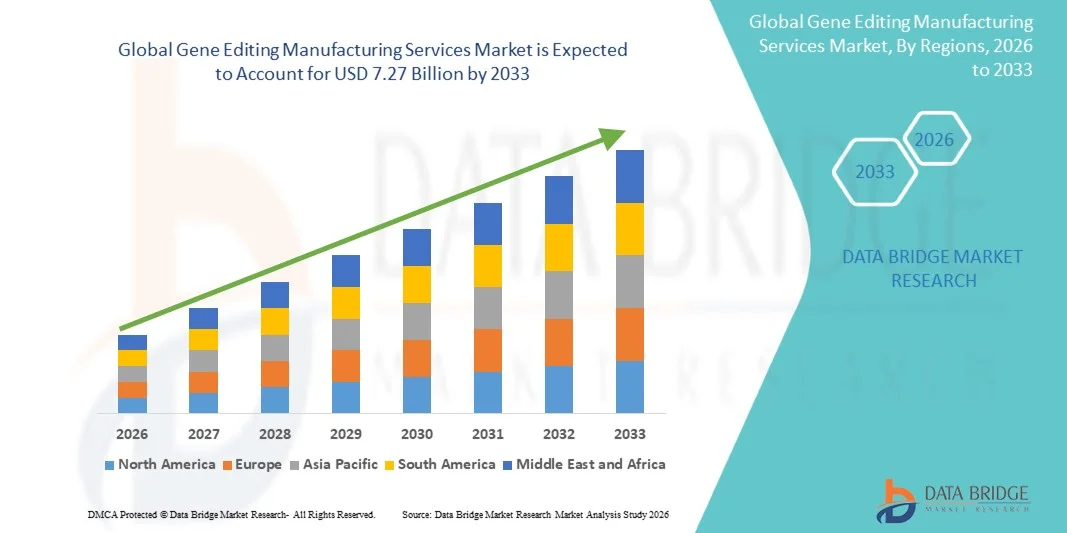
- As per Data Bridge Market Research analysis, the gene editing manufacturing services market was valued at USD 2.68 billion in 2025 and is projected to reach USD 7.27 billion by 2033, growing at a CAGR of 13.30% from 2026 to 2033.
- The market is experiencing consistent growth driven by the expanding clinical pipeline of CRISPR-based, base editing, and prime editing therapies, rising demand for GMP-grade guide RNAs, nucleases, editor mRNA, and plasmid DNA, and increasing outsourcing of development, manufacturing, and quality control to specialized providers across pharmaceutical, biotechnology, and academic sectors.
- The growing regulatory support for individualized and platform-based gene editing therapies, advances in lipid nanoparticle delivery and mRNA manufacturing, and the need to shorten timelines from design to clinic is supporting market adoption. Gene editing manufacturing services are being applied across CRISPR gene editing therapeutics, CRISPR lipid nanoparticle delivery, and gene therapy programs, offering developers GMP-quality components and integrated analytical support.
Market Size & Forecast
- Global Market Value (2025): USD 2.68 Billion
- Expected Market Value (2033): USD 7.27 Billion
- Forecast CAGR (2026–2033): 13.30%
- Leading Region in 2025: North America
- Fastest Growing Region: Asia Pacific
What are the Major Takeaways of the Gene Editing Manufacturing Services Market?
- North America dominated the gene editing manufacturing services market with the largest revenue share of 43.12% in 2025, supported by a strong concentration of gene editing developers, academic medical centers, and specialized manufacturers of guide RNA, mRNA, and plasmid DNA.
- Asia-Pacific is expected to be the fastest-growing region at a CAGR of 16.40% from 2026 to 2033, fueled by expanding gene editing research, growing biomanufacturing capacity, and increasing government support for advanced therapies.
- The guide RNA segment led the market with a 36.24% share in 2025, driven by its indispensable role in every CRISPR-based program and the need for custom, target-specific sequences.
- Editor mRNA is the fastest-growing product type, projected to register a CAGR of 15.92%, reflecting the shift toward in vivo editing delivered through lipid nanoparticles.
- The cGMP manufacturing segment dominated the service type category with a 54.31% revenue share in 2025, led by the need for clinical-grade components that meet regulatory documentation and quality standards.
- CRISPR-Cas9 accounted for 61.53% of the market share in 2025, preferred by its position as the most established editing platform with an approved therapy and a large clinical pipeline.
- The prime editing segment is the fastest-growing technology category, with a CAGR of 19.41%, driven by its ability to install precise changes without double-strand breaks.
Report Scope and Gene Editing Manufacturing Services Market Segmentation
|
Attributes |
Gene Editing Manufacturing Services Key Market Insights |
|
Segments Covered |
|
|
Countries Covered |
North America
Europe
Asia-Pacific
Middle East and Africa
South America
|
|
Key Market Players |
|
|
Market Opportunities |
|
|
Value Added Data Infosets |
In addition to the insights on market scenarios such as market value, growth rate, segmentation, geographical coverage, and major players, the market reports curated by the Data Bridge Market Research also include in-depth expert analysis, patient epidemiology, pipeline analysis, pricing analysis, and regulatory framework. |
What is the Key Trend in the Gene Editing Manufacturing Services Market?
- Gene editing manufacturing services are increasingly evolving from supply of research-grade reagents into integrated, GMP-oriented offerings that combine guide RNA, editor mRNA or protein, lipid nanoparticle formulation, analytical testing, and regulatory support under coordinated quality systems.
- For instance, in November 2025, according to the New England Journal of Medicine, FDA leaders Vinay Prasad and Martin Makary outlined a “plausible mechanism” pathway that would enable marketing approvals for individualized therapies, using the personalized base-editing treatment of an infant as an example, indicating a regulatory shift toward platform-style, patient-specific gene editing therapies
- Developers are increasingly seeking manufacturing partners that can deliver small, rapid, high-quality batches for individualized programs while retaining the ability to scale for larger patient populations.
- In vivo editing delivered as mRNA and guide RNA within lipid nanoparticles is shifting demand toward mRNA manufacturing, encapsulation, and aseptic fill-finish capabilities alongside traditional oligonucleotide and plasmid supply.
- For instance, in March 2026, according to the American Journal of Human Genetics, researchers reported initial proof-of-concept studies supporting a customizable prime editing platform for seven urea cycle disorders, together with a pre-IND discussion with the FDA about an umbrella-of-umbrellas clinical trial, demonstrating how platform designs are shaping manufacturing requirements
- As editing technologies, delivery systems, and regulatory frameworks continue to advance, gene editing manufacturing services are expected to expand from early clinical supply into repeatable platform manufacturing for rare and common diseases.
What are the Key Drivers of the Gene Editing Manufacturing Services Market?
- The rapid growth of gene editing clinical programs has significantly increased demand for GMP-grade guide RNAs, nucleases, editor mRNA, and plasmid DNA, as most developers lack internal capacity for these specialized processes.
- For instance, in May 2025, according to the Children’s Hospital of Philadelphia (CHOP), an infant with severe CPS1 deficiency was treated with a customized base-editing therapy delivered through lipid nanoparticles that was designed and manufactured within six months, with in-kind contributions from Acuitas Therapeutics, Integrated DNA Technologies, Aldevron, and Danaher, illustrating demand for rapid, specialized gene editing manufacturing.
- Pharmaceutical companies, biotechnology developers, and academic medical centers are increasingly partnering with specialized manufacturers to accelerate timelines and secure regulatory-ready starting materials.
- For instance, in January 2023, according to Agilent Technologies, the company announced an investment of approximately USD 725 million to double therapeutic nucleic acid manufacturing capacity at its Frederick, Colorado facility, adding two manufacturing lines to meet growing demand for siRNA, antisense, and CRISPR guide RNA molecules, with customer shipments expected to begin in 2026.
- With clinical-stage and commercial gene editing therapies requiring consistent quality and supply, specialized manufacturing services can support faster progression from preclinical research to clinical trials and commercialization.
What Factors Are Challenging the Growth of the Gene Editing Manufacturing Services Market?
- Gene editing manufacturing involves multiple specialized components, including guide RNA, editor mRNA or protein, plasmid DNA, and lipid nanoparticles, each requiring dedicated facilities, quality systems, and analytical methods, which increases cost and coordination complexity.
- For instance, in June 2026, according to Health Affairs, analysts noted that the FDA’s plausible mechanism draft guidance requires submission of new data for each new patient, and that a staged development approach cannot work when the first-in-human study is also the pivotal study, highlighting manufacturing and regulatory challenges for individualized gene editing products.
- Timelines for individualized therapies are extremely short, requiring release testing, safety studies, and documentation to be completed rapidly without compromising quality.
- Limited GMP capacity for specialized components, together with dependence on a small number of qualified suppliers, can create bottlenecks for developers advancing multiple programs.
- For instance, in May 2025, according to Aldevron, the company said the first personalized CRISPR therapy was made under exceptional circumstances and was not something the industry is built to do consistently, underscoring capacity and scalability constraints in bespoke gene editing manufacturing.
- The combination of multi-component manufacturing, compressed timelines, evolving regulatory expectations, and limited specialized capacity can constrain adoption among smaller developers and academic programs with limited budgets.
How is the Gene Editing Manufacturing Services Market Segmented?
The gene editing manufacturing services market is segmented on the basis of product type, service type, technology, and end user.
- By Product Type
On the basis of product type, the gene editing manufacturing services market is segmented into guide RNA, Cas nucleases and editor proteins, editor mRNA, plasmid DNA, and others. The guide RNA segment dominated the market with 36.24% share in 2025, supported by its indispensable role in every CRISPR-based program and the need for custom, patient- or target-specific sequences. GMP guide RNAs are manufactured as oligonucleotide active ingredients with strict control of purity, impurities, and sequence identity. Several providers have expanded oligonucleotide capacity and offer research, engineering-run, and cGMP grades that support progression from preclinical work to clinical trials, while analytical methods for impurity profiling remain a key requirement.
The editor mRNA segment is projected to register the fastest growth at a CAGR of 15.92% from 2026 to 2033, driven by the shift toward in vivo editing in which editor mRNA is delivered with guide RNA in lipid nanoparticles, offering transient expression and reduced off-target risk. Base and prime editors encoded as mRNA require high-integrity transcripts manufactured at cGMP with LNP encapsulation and fill-finish capability. Personalized and rare disease programs need rapid, small-batch production, and manufacturers are building flexible mRNA suites. Demand is also expected to rise as providers launch co-developed Cas9, base editor, and prime editor mRNA offerings.
- By Service Type
On the basis of service type, the gene editing manufacturing services market is segmented into process development, cGMP manufacturing, and analytical & quality control testing. The cGMP manufacturing segment dominated the service type category with 54.31% share in 2025, supported by the need for clinical-grade guide RNAs, nucleases, mRNA, and plasmids that meet regulatory documentation and quality standards. Developers progressing from preclinical to clinical studies must secure GMP starting materials and drug substance with traceability, release testing, and supply continuity. Limited internal capacity at most developers, together with the specialized facilities required for oligonucleotide, mRNA, and protein production, favors outsourcing.
The analytical & quality control testing segment is projected to register the fastest growth at a CAGR of 15.10% from 2026 to 2033, driven by the need to characterize identity, purity, potency, and impurity profiles of gene editing components and to assess off-target and safety risks. Regulatory guidance and draft frameworks for genome editing products emphasize manufacturing controls and quality attributes, increasing the scope of release panels. Complex formulations such as ribonucleoprotein complexes and LNP-encapsulated mRNA require specialized methods. Rapid timelines for individualized therapies also demand fast, validated testing, encouraging developers to engage specialized laboratories.
- By Technology
On the basis of technology, the gene editing manufacturing services market is segmented into CRISPR-Cas9, base editing, prime editing, and others. The CRISPR-Cas9 segment dominated the technology category with 61.53% share in 2025, supported by its position as the most established editing platform, with the first approved CRISPR-based therapy and a large clinical pipeline. Established supply chains for guide RNA, Cas9 protein, and Cas9 mRNA, including GMP-grade offerings, reduce development risk. Ex vivo programs for hematologic and immune cell therapies rely heavily on Cas9 reagents and ribonucleoprotein formats. Regulatory familiarity with Cas9-based products further supports continued demand for manufacturing services.
The prime editing segment is projected to register the fastest growth at a CAGR of 19.41% from 2026 to 2033, driven by its ability to install precise changes without double-strand breaks and growing preclinical-to-clinical translation, including platform concepts for multiple urea cycle disorders. Prime editors are large constructs requiring specialized mRNA and prime editing guide RNA manufacturing, creating demand for dedicated process development and analytics. Regulatory interest in platform approaches is encouraging developers to plan GMP supply early. As proof-of-concept data accumulate, demand for prime editing manufacturing services is expected to rise faster than for established platforms.
- By End User
On the basis of end user, the gene editing manufacturing services market is segmented into pharmaceutical & biotechnology companies, academic & research institutes, and others. The pharmaceutical & biotechnology companies segment dominated the end-user category with 68.72% share in 2025, supported by sponsor-led clinical programs requiring GMP components and drug product manufacturing. Companies increasingly use outsourced partners for guide RNA, mRNA, LNP formulation, and fill-finish to avoid capital-intensive facilities. Strategic collaborations between developers and providers shorten timelines, and platform designs reduce rework when switching targets. Pressure to reach clinical trials quickly encourages early engagement with manufacturers.
The academic & research institutes segment is projected to register the fastest growth at a CAGR of 14.97% from 2026 to 2033, driven by investigator-initiated trials and individualized therapy programs developed at academic medical centers. Such programs often rely on external manufacturers for GMP components because institutions lack production infrastructure. Collaborative arrangements between hospitals and manufacturers enabled the first personalized CRISPR therapy for an infant, and similar models are expected to expand. Public funding for genome editing consortia and rare disease programs further supports demand for outsourced manufacturing services.
Which Region Holds the Largest Share of the Gene Editing Manufacturing Services Market?
- North America dominated the gene editing manufacturing services market with the largest revenue share of 43.12% in 2025, supported by a strong concentration of gene editing developers, academic medical centers, and specialized manufacturers of guide RNA, mRNA, and plasmid DNA.
- The region also benefits from active regulatory frameworks for individualized and genome editing therapies, strong venture funding, and ongoing expansion of oligonucleotide and mRNA manufacturing capacity. Increasing use of outsourced GMP services for clinical-stage programs continues to strengthen North America’s position in the global market.
U.S. Gene Editing Manufacturing Services Market Insight
The U.S. gene editing manufacturing services market is witnessing strong growth due to the large number of gene editing developers, academic medical centers, and specialized manufacturers of guide RNA, mRNA, and plasmid DNA. The FDA’s draft frameworks for individualized and genome editing therapies, along with the first personalized CRISPR therapy delivered at U.S. institutions, are encouraging investment in flexible GMP capacity. In addition, expansion of oligonucleotide and mRNA manufacturing facilities and strong venture funding are accelerating adoption of gene editing manufacturing services.
Asia-Pacific Gene Editing Manufacturing Services Market Insight
The Asia-Pacific gene editing manufacturing services market is expected to witness rapid growth, driven by expanding gene editing research, growing biomanufacturing capacity, and increasing government support for advanced therapies across countries such as China, Japan, and South Korea. Rising numbers of CRISPR-based preclinical and clinical programs, together with development of local suppliers of oligonucleotides, mRNA, and plasmid DNA, are improving access to GMP-grade components. In addition, regional CDMOs are expanding capabilities to support multinational gene editing programs.
Japan Gene Editing Manufacturing Services Market Insight
The Japan gene editing manufacturing services market is witnessing consistent growth due to an advanced nucleic acid chemistry industry, strong academic research in genome editing, and a supportive regulatory framework for regenerative medicine. Pharmaceutical companies, research institutions, and specialized suppliers are increasingly investing in GMP-grade guide RNA, mRNA, and analytical capabilities. Moreover, emphasis on quality, precision, and reliability is contributing to steady growth of gene editing manufacturing services in Japan.
China Gene Editing Manufacturing Services Market Insight
The China gene editing manufacturing services market is growing rapidly, driven by a large gene editing research base, domestic manufacturers of oligonucleotides, mRNA, and plasmids, and a growing number of CRISPR-based clinical programs. Local CDMOs are building GMP capacity for gene-edited cell therapies and in vivo editing candidates. In addition, strong government support for biotechnology and increasing investment in advanced therapies are positioning China as a key growth market for gene editing manufacturing services across Asia-Pacific.
U.K. Gene Editing Manufacturing Services Market Insight
The U.K. gene editing manufacturing services market is experiencing steady growth, supported by strong academic genome editing research, an established cell and gene therapy manufacturing base, and active translational programs. CDMOs with viral vector, plasmid, and nucleic acid capabilities provide services to developers advancing editing programs toward the clinic. Furthermore, collaboration between universities, hospitals, and industry is supporting wider adoption of gene editing manufacturing services in the U.K.
Germany Gene Editing Manufacturing Services Market Insight
The Germany gene editing manufacturing services market is expanding steadily due to the country’s strong biopharmaceutical manufacturing base, established life science suppliers, and advanced analytical capabilities. Biotechnology companies, university hospitals, and research institutes are increasingly sourcing GMP-grade components and testing services for gene editing programs. Continuous advancements in mRNA, oligonucleotide, and delivery technologies, along with Germany’s emphasis on quality and regulatory compliance, are further driving growth of gene editing manufacturing services.
Which are the Top Companies in Gene Editing Manufacturing Services Market?
The gene editing manufacturing services industry is primarily led by well-established companies, including:
- Aldevron (U.S.)
- Integrated DNA Technologies, Inc. (U.S.)
- Synthego Corporation (U.S.)
- Agilent Technologies, Inc. (U.S.)
- TriLink BioTechnologies, LLC (U.S.)
- Charles River Laboratories International, Inc. (U.S.)
- Lonza Group AG (Switzerland)
- Biomay AG (Austria)
- Thermo Fisher Scientific Inc. (U.S.)
- Merck KGaA (Germany)
- Eurofins Scientific SE (Luxembourg)
- Catalent, Inc. (U.S.)
- Samsung Biologics Co., Ltd. (South Korea)
- WuXi AppTec Co., Ltd. (China)
- GenScript Biotech Corporation (China)
- Takara Bio Inc. (Japan)
- Minaris (U.S.)
- SK pharmteco (South Korea)
- Revvity, Inc. (U.S.)
- Danaher Corporation (U.S.)
What are Latest Developments in Gene Editing Manufacturing Services Market?
- In October 2026, Biomay and Synthego announced a non-exclusive collaboration to simplify access to gene-editing materials and cGMP manufacturing services across North America, combining Biomay’s mRNA, lipid nanoparticle formulation, aseptic fill-finish, plasmid DNA, and Cas9 production expertise with Synthego’s CRISPR solutions and single-guide RNA design and manufacturing capabilities.
- In September 2026, Integrated DNA Technologies and Aldevron launched new Cas9 mRNA solutions that combine IDT’s guide RNA design and analysis expertise with Aldevron’s mRNA manufacturing capabilities, supporting programs from early research through cGMP manufacturing. The launch is the first in a suite of co-developed offerings, with base and prime editors slated later in the year.
- In June 2026, the U.S. FDA published draft guidance on leveraging prior knowledge in the development of human gene therapy products incorporating genome editing, with a public comment period that closed on September 1, 2026, aimed at helping developers use existing data across related editing products and manufacturing platforms.
- In February 2026, the U.S. FDA issued draft guidance on the plausible mechanism framework for individualized therapies targeting genetic conditions with known biological causes, focusing primarily on genome-editing and RNA-based therapies and stating that manufacturing processes supporting an application must be appropriately validated.
- In December 2023, Charles River Laboratories announced that its Memphis facility was approved by the EMA to commercially manufacture Vertex’s CASGEVY, the world’s first gene-edited therapy, making it the first North American CDMO approved by the EMA to commercially manufacture an allogeneic cell therapy drug product.

- Interactive Data Analysis Dashboard
- Company Analysis Dashboard for high growth potential opportunities
- Research Analyst Access for customization & queries
- Competitor Analysis with Interactive dashboard
- Latest News, Updates & Trend analysis
- Harness the Power of Benchmark Analysis for Comprehensive Competitor Tracking
Data collection and base year analysis are done using data collection modules with large sample sizes. The stage includes obtaining market information or related data through various sources and strategies. It includes examining and planning all the data acquired from the past in advance. It likewise envelops the examination of information inconsistencies seen across different information sources. The market data is analysed and estimated using market statistical and coherent models. Also, market share analysis and key trend analysis are the major success factors in the market report. To know more, please request an analyst call or drop down your inquiry.
The key research methodology used by DBMR research team is data triangulation which involves data mining, analysis of the impact of data variables on the market and primary (industry expert) validation. Data models include Vendor Positioning Grid, Market Time Line Analysis, Market Overview and Guide, Company Positioning Grid, Patent Analysis, Pricing Analysis, Company Market Share Analysis, Standards of Measurement, Global versus Regional and Vendor Share Analysis. To know more about the research methodology, drop in an inquiry to speak to our industry experts.
Data Bridge Market Research is a leader in advanced formative research. We take pride in servicing our existing and new customers with data and analysis that match and suits their goal. The report can be customized to include price trend analysis of target brands understanding the market for additional countries (ask for the list of countries), clinical trial results data, literature review, refurbished market and product base analysis. Market analysis of target competitors can be analyzed from technology-based analysis to market portfolio strategies. We can add as many competitors that you require data about in the format and data style you are looking for. Our team of analysts can also provide you data in crude raw excel files pivot tables (Fact book) or can assist you in creating presentations from the data sets available in the report.













