


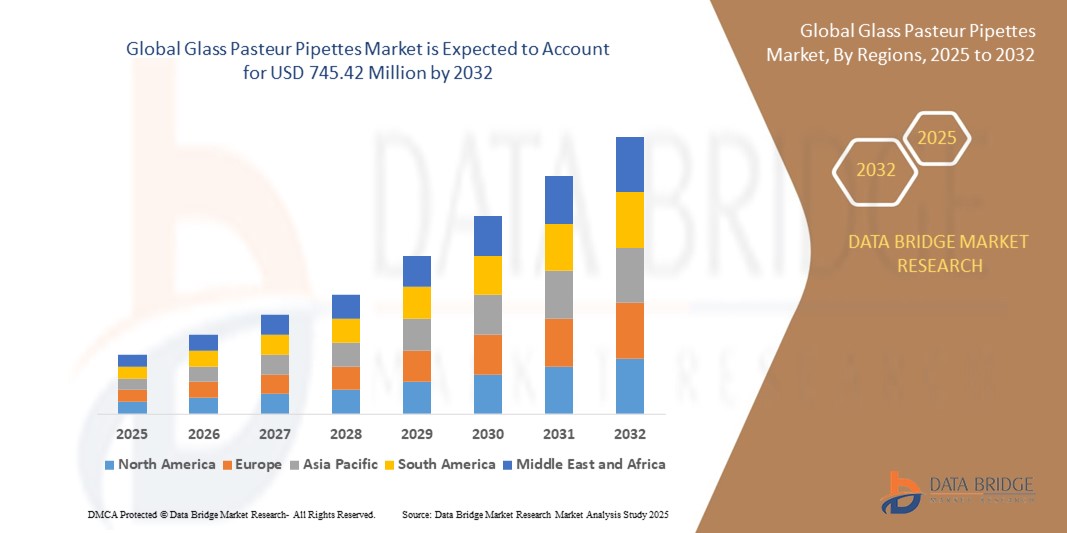
What is the Global Glass Pasteur Pipettes Market Size and Growth Rate?
- The global glass pasteur pipettes market size was valued at USD 520.17 million in 2024 and is expected to reach USD 745.42 million by 2032, at a CAGR of 4.60% during the forecast period
- The glass pasteur pipettes market is experiencing steady growth, driven by the increasing demand for precise liquid handling tools in various industries, including biotechnology, pharmaceuticals, and chemical research. The rising focus on laboratory safety and the need for contamination-free sample handling has boosted the adoption of glass Pasteur pipettes, which offer better chemical resistance and thermal stability compared to their plastic counterparts
- In addition, the growing number of research and development activities, particularly in the fields of life sciences and medical diagnostics, is further fueling market expansion
What are the Major Takeaways of Glass Pasteur Pipettes Market?
- The demand for accurate laboratory tools is on the rise, particularly in medical and chemical research, where precision is crucial. Glass pasteur pipettes are increasingly favored for their ability to provide precise liquid handling, which is essential for achieving reliable results in various laboratory procedures
- The heightened focus on accuracy in experiments and diagnostics has led to a growing preference for glass pipettes over plastic alternatives, as they offer better control and minimal risk of contamination. This trend is driving significant growth in the glass pasteur pipettes market, as researchers and scientists seek tools that can meet the stringent demands of modern laboratory environments
- North America dominated the glass pasteur pipettes market with the largest revenue share of 44.8% in 2024, driven by the region's advanced research infrastructure, strong pharmaceutical and biotechnology sectors, and increasing demand for precise laboratory tools
- Asia Pacific is projected to register the fastest CAGR of 14.6% from 2025 to 2032, fueled by rapid industrialization, growing investments in healthcare and research, and rising environmental awareness across countries such as China, India, Japan, and South Korea
- The Long Version segment dominated the market with the largest revenue share of 57.4% in 2024, owing to its high suitability for laboratory procedures that require precision in liquid handling and transferring small volumes of liquids over longer distances
Report Scope and Glass Pasteur Pipettes Market Segmentation
|
Attributes |
Glass Pasteur Pipettes Key Market Insights |
|
Segments Covered |
|
|
Countries Covered |
North America
Europe
Asia-Pacific
Middle East and Africa
South America
|
|
Key Market Players |
|
|
Market Opportunities |
|
|
Value Added Data Infosets |
In addition to the insights on market scenarios such as market value, growth rate, segmentation, geographical coverage, and major players, the market reports curated by the Data Bridge Market Research also include in-depth expert analysis, pricing analysis, brand share analysis, consumer survey, demography analysis, supply chain analysis, value chain analysis, raw material/consumables overview, vendor selection criteria, PESTLE Analysis, Porter Analysis, and regulatory framework. |
What is the Key Trend in the Glass Pasteur Pipettes Market?
“Growing Demand for Precision Laboratory Tools with Eco-Friendly and Reusable Features”
- A key emerging trend in the global glass pasteur pipettes market is the rising preference for precise, reusable, and environmentally sustainable laboratory consumables across research, pharmaceutical, and diagnostic sectors
- Laboratories are increasingly opting for glass Pasteur pipettes over disposable plastic alternatives, owing to their reusability, chemical resistance, and alignment with waste reduction initiatives
- For instance, in 2024, DWK Life Sciences expanded its glass pipette range to meet the demand for durable, high-precision liquid handling tools suitable for complex laboratory processes
- Glass pasteur pipettes are gaining popularity due to their ability to handle corrosive or volatile substances without contamination risks, making them ideal for biological, pharmaceutical, and chemical applications
- This trend aligns with global sustainability goals as laboratories seek to minimize plastic waste while maintaining high standards of safety, precision, and operational efficiency
- Manufacturers are also introducing improved designs with reinforced glass and ergonomic features, ensuring durability and ease of handling, further driving adoption across healthcare, academic, and research institutions worldwide
What are the Key Drivers of Glass Pasteur Pipettes Market?
- The increasing demand for accurate, contamination-free liquid transfer tools in medical diagnostics, pharmaceutical R&D, and chemical laboratories is a major factor driving the growth of the glass pasteur pipettes market
- For instance, in 2023, thermo fisher Scientific launched an advanced range of glass pipettes optimized for sterile laboratory environments, supporting precise sample handling in critical applications
- Glass Pasteur pipettes offer superior heat resistance, chemical compatibility, and reusability compared to plastic alternatives, making them essential in procedures requiring high-temperature sterilization or chemical stability
- The global emphasis on reducing laboratory plastic waste, coupled with stringent regulatory standards for laboratory consumables, is encouraging the adoption of glass-based alternatives
- Furthermore, the expanding biotechnology, pharmaceutical, and academic research sectors, along with increased investments in healthcare infrastructure, are fueling demand for reliable, eco-friendly laboratory tools
Which Factor is challenging the Growth of the Glass Pasteur Pipettes Market?
- One of the key challenges hindering broader adoption of glass pasteur pipettes is their fragility and higher breakage risk, particularly in fast-paced laboratory environments where handling errors can occur
- Glass pipettes, while durable under controlled use, are prone to damage if dropped, increasing operational costs and posing safety risks due to sharp fragments
- For instance, laboratory reports indicate concerns over handling glass pipettes in educational settings or high-volume laboratories, where plastic alternatives are often preferred for their durability
- In addition, the relatively higher upfront cost of high-quality glass Pasteur pipettes, especially those designed for specialized applications, can deter adoption among cost-sensitive institutions or smaller research facilities
- Supply chain fluctuations and limited availability in developing markets further constrain market expansion, emphasizing the need for affordable, durable, and widely accessible glass pipette solutions
- Overcoming these challenges through enhanced product designs, user training, and cost-competitive offerings will be critical for supporting long-term growth in the glass pasteur pipettes market
How is the Glass Pasteur Pipettes Market Segmented?
The market is segmented on the basis of product type, material, capacity, and application.
• By Product Type
On the basis of product type, the glass pasteur pipettes market is segmented into long version and short version. The long version segment dominated the market with the largest revenue share of 57.4% in 2024, owing to its high suitability for laboratory procedures that require precision in liquid handling and transferring small volumes of liquids over longer distances. The extended length offers greater control and minimizes contamination risks, making them preferred for research, diagnostics, and pharmaceutical applications.
The Short Version segment is projected to witness notable growth from 2025 to 2032, driven by increasing demand for compact, easy-to-handle pipettes suitable for space-constrained work environments, especially in medical laboratories and academic settings.
• By Material
On the basis of material, the market is segmented into Borosilicate Glass and Soda-Lime Glass. The Borosilicate Glass segment held the largest market revenue share of 66.8% in 2024, attributed to its excellent thermal resistance, chemical durability, and low coefficient of expansion. Borosilicate glass Pasteur pipettes are widely used in laboratories handling corrosive substances or high-temperature procedures, ensuring safety and precision.
The Soda-Lime Glass segment is expected to register significant growth from 2025 to 2032, supported by its cost-effectiveness and sufficient durability for general laboratory tasks, especially in educational institutions and low-risk environments.
• By Capacity
On the basis of capacity, the market is segmented into 1-10 ml, 10-15 ml, and 15-20 ml. The 1-10 ml segment dominated the market with the largest revenue share of 48.5% in 2024, driven by its widespread use in precise, small-volume laboratory tasks such as transferring reagents, solutions, and biological samples. Laboratories prefer this range for microscale applications where accuracy is critical.
The 15-20 ml segment is anticipated to witness the fastest growth from 2025 to 2032, fueled by the growing demand for higher-capacity Pasteur pipettes in procedures requiring larger liquid transfers without compromising precision, particularly in chemical and pharmaceutical industries.
• By Application
On the basis of application, the market is segmented into Microscale Column Chromatography, Microscale Distillation, Microscale Liquid Storage, and Medical Laboratory. The Medical Laboratory segment dominated the market with the largest revenue share of 39.2% in 2024, owing to the critical role of Glass Pasteur Pipettes in sample collection, transfer, and preparation in diagnostic labs, hospitals, and clinical research facilities. Their resistance to contamination and ease of sterilization make them essential in medical environments.
The Microscale Column Chromatography segment is projected to grow at the fastest CAGR from 2025 to 2032, supported by increased demand for precision tools in chemical analysis, separation processes, and research laboratories, where accurate liquid handling is crucial for experimental outcomes.
Which Region Holds the Largest Share of the Glass Pasteur Pipettes Market?
- North America dominated the glass pasteur pipettes market with the largest revenue share of 44.8% in 2024, driven by the region's advanced research infrastructure, strong pharmaceutical and biotechnology sectors, and increasing demand for precise laboratory tools
- The region’s emphasis on high-quality, contamination-free laboratory consumables, along with growing investments in healthcare and life sciences, is fueling the adoption of Glass Pasteur Pipettes across laboratories, research institutions, and academic settings
- Widespread usage in pharmaceutical research, clinical diagnostics, and medical testing, coupled with stringent laboratory safety regulations, has reinforced North America's position as the leading market for glass pasteur pipettes
U.S. Glass Pasteur Pipettes Market Insight
U.S. glass pasteur pipettes market captured the largest revenue share within North America in 2024, supported by robust demand from pharmaceutical companies, clinical laboratories, and research organizations. The country’s leadership in scientific innovation, coupled with the growing need for reliable, reusable laboratory equipment, continues to drive market growth. In addition, rising environmental awareness and efforts to reduce plastic waste in laboratories are further promoting the use of glass-based alternatives.
Canada Glass Pasteur Pipettes Market Insight
The Canada glass pasteur pipettes market is witnessing steady growth, driven by expanding healthcare infrastructure, increased focus on scientific research, and rising demand for sustainable laboratory consumables. Canadian laboratories and educational institutions are increasingly adopting glass pasteur pipettes for their durability, chemical resistance, and eco-friendly attributes, aligning with national sustainability goals and operational efficiency requirements.
Which Region is the Fastest Growing in the Glass Pasteur Pipettes Market?
Asia Pacific is projected to register the fastest CAGR of 14.6% from 2025 to 2032, fueled by rapid industrialization, growing investments in healthcare and research, and rising environmental awareness across countries such as China, India, Japan, and South Korea. The increasing demand for reusable, durable, and precise laboratory equipment, coupled with government-led sustainability initiatives, is accelerating market expansion across the region. Strong growth in pharmaceutical R&D, diagnostics, and biotechnology sectors, along with the availability of affordable, high-quality glass laboratory tools from regional manufacturers, is driving adoption across academic, research, and healthcare facilities.
China Glass Pasteur Pipettes Market Insight
The China glass pasteur pipettes market is expected to grow at a robust CAGR, driven by significant investments in scientific research, expanding pharmaceutical production, and government efforts to enhance laboratory safety and sustainability. China's large manufacturing base and growing emphasis on eco-friendly, reusable laboratory tools are contributing to strong market growth.
India Glass Pasteur Pipettes Market Insight
The India glass pasteur pipettes market is set to experience rapid growth, supported by expanding healthcare infrastructure, growing academic research, and increasing demand for reliable, sustainable laboratory consumables. Rising investments in life sciences, coupled with heightened awareness of plastic reduction and laboratory safety, are driving the adoption of glass pasteur pipettes across educational, research, and healthcare sectors.
Which are the Top Companies in Glass Pasteur Pipettes Market?
The glass pasteur pipettes industry is primarily led by well-established companies, including:
- Thermo Fisher Scientific Inc. (U.S.)
- BRAND GMBH + CO KG (Germany)
- Merck KGaA (Germany)
- DWK Life Sciences (Germany)
- Hilgenberg GmbH (Germany)
- Hirschmann Laborgeräte GmbH & Co. KG (Germany)
- Agar Scientific Ltd. (U.K.)
- Deltalab (Spain)

- Interactive Data Analysis Dashboard
- Company Analysis Dashboard for high growth potential opportunities
- Research Analyst Access for customization & queries
- Competitor Analysis with Interactive dashboard
- Latest News, Updates & Trend analysis
- Harness the Power of Benchmark Analysis for Comprehensive Competitor Tracking
Global Glass Pasteur Pipettes Market, Supply Chain Analysis and Ecosystem Framework
To support market growth and help clients navigate the impact of geopolitical shifts, DBMR has integrated in-depth supply chain analysis into its Global Glass Pasteur Pipettes Market research reports. This addition empowers clients to respond effectively to global changes affecting their industries. The supply chain analysis section includes detailed insights such as Global Glass Pasteur Pipettes Market consumption and production by country, price trend analysis, the impact of tariffs and geopolitical developments, and import and export trends by country and HSN code. It also highlights major suppliers with data on production capacity and company profiles, as well as key importers and exporters. In addition to research, DBMR offers specialized supply chain consulting services backed by over a decade of experience, providing solutions like supplier discovery, supplier risk assessment, price trend analysis, impact evaluation of inflation and trade route changes, and comprehensive market trend analysis.
Data collection and base year analysis are done using data collection modules with large sample sizes. The stage includes obtaining market information or related data through various sources and strategies. It includes examining and planning all the data acquired from the past in advance. It likewise envelops the examination of information inconsistencies seen across different information sources. The market data is analysed and estimated using market statistical and coherent models. Also, market share analysis and key trend analysis are the major success factors in the market report. To know more, please request an analyst call or drop down your inquiry.
The key research methodology used by DBMR research team is data triangulation which involves data mining, analysis of the impact of data variables on the market and primary (industry expert) validation. Data models include Vendor Positioning Grid, Market Time Line Analysis, Market Overview and Guide, Company Positioning Grid, Patent Analysis, Pricing Analysis, Company Market Share Analysis, Standards of Measurement, Global versus Regional and Vendor Share Analysis. To know more about the research methodology, drop in an inquiry to speak to our industry experts.
Data Bridge Market Research is a leader in advanced formative research. We take pride in servicing our existing and new customers with data and analysis that match and suits their goal. The report can be customized to include price trend analysis of target brands understanding the market for additional countries (ask for the list of countries), clinical trial results data, literature review, refurbished market and product base analysis. Market analysis of target competitors can be analyzed from technology-based analysis to market portfolio strategies. We can add as many competitors that you require data about in the format and data style you are looking for. Our team of analysts can also provide you data in crude raw excel files pivot tables (Fact book) or can assist you in creating presentations from the data sets available in the report.













