


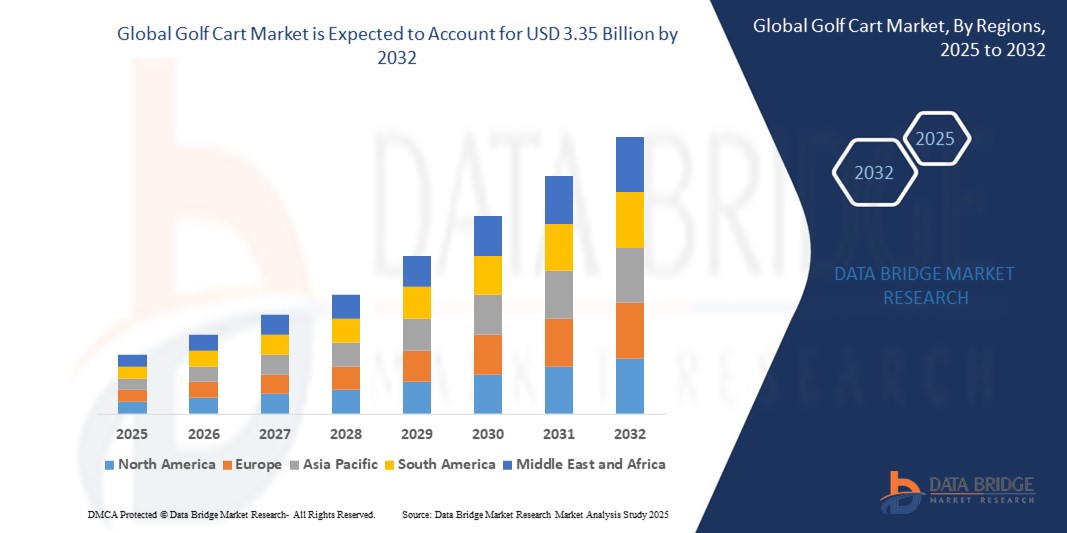
Golf Cart Market Size
- The global golf cart market was valued at USD 1.95 billion in 2024 and is expected to reach USD 3.35 billion by 2032
- During the forecast period of 2025 to 2032 the market is likely to grow at a CAGR of 7.00%, primarily driven by urbanization and smart city development
- This growth is driven by factors such as use in gated communities, campus mobility and first/last-mile transport
Golf Cart Market Analysis
- A golf cart is a low-speed vehicle, typically powered by electricity or gasoline, designed to transport golfers and their equipment across golf courses. Operating at speeds between 25 to 50 km/h, it is generally classified as an off-road or non-highway vehicle
- The market is experiencing notable growth driven by rising urbanization, the expansion of the tourism and hospitality sector, and increasing adoption in non-golf applications such as airports, campuses, and smart cities. The growing preference for eco-friendly and compact mobility solutions, especially in controlled environments, is further fueling demand for electric and solar-powered golf carts
- The golf cart market is evolving with a focus on sustainability, automation, and versatility. Manufacturers are increasingly investing in advanced cart models featuring enhanced battery efficiency, GPS integration, and smart mobility systems to meet the expectations of modern users in both private and public sectors
- For instance, leading companies such as Club Car and Yamaha Golf-Car Company are launching innovative electric golf carts with longer range, modular seating, and IoT-enabled fleet management systems to cater to resorts, gated communities, and corporate campuses
- The golf cart market is projected to witness steady expansion, supported by increased deployment in urban infrastructure, leisure destinations, and institutional facilities. Rising investments in smart city development, heightened focus on sustainable transportation, and the emergence of electric and solar-powered variants are expected to accelerate market growth in the coming years
Report Scope and Golf Cart Market Segmentation
|
Attributes |
Golf Cart Key Market Insights |
|
Segments Covered |
|
|
Countries Covered |
North America
Europe
Asia-Pacific
Middle East and Africa
South America
|
|
Key Market Players |
|
|
Market Opportunities |
|
|
Value Added Data Infosets |
In addition to the market insights such as market value, growth rate, market segments, geographical coverage, market players, and market scenario, the market report curated by the Data Bridge Market Research team includes in-depth expert analysis, import/export analysis, pricing analysis, production consumption analysis, and pestle analysis. |
Golf Cart Market Trends
“Rising Number of Golf Courses and Country Clubs”
- One prominent trend in the global golf cart market is the rising number of golf courses and country clubs
- This trend is driven by the expansion of golf tourism, increased investments in recreational infrastructure, and the growing popularity of golf as a leisure and professional sport, particularly in emerging economies. Golf cart demand is rising in tandem, as these facilities require efficient, low-speed transportation solutions for players and staff
- For instance, Club Car has partnered with several newly developed golf resorts in Southeast Asia to supply fleets of electric golf carts equipped with GPS tracking and energy-efficient features, catering to modern course management and sustainability goals
- The integration of golf courses within luxury real estate, resorts, and retirement communities is also contributing to the steady demand for golf carts, as on-site mobility becomes a valued amenity
- As golf continues to gain traction globally, manufacturers are focusing on innovation, comfort, and eco-friendly performance to meet the evolving requirements of golf facilities, ensuring continued growth in the golf cart market
Golf Cart Market Dynamics
Driver
“Rising Popularity of Golf as a Leisure Activity”
- The rising popularity of golf as a leisure activity is a key driver of growth in the global golf cart market. As more individuals across age groups take up golf for recreation, relaxation, and social engagement, the demand for golf carts is steadily increasing to support mobility and convenience on the course
- This shift is especially pronounced among affluent millennials and retirees, who are contributing to higher participation rates in golf due to its low-impact nature, outdoor setting, and association with lifestyle and wellness
- With more golf courses promoting accessibility and flexible membership options, there is a growing requirement for reliable, easy-to-operate golf carts that enhance the overall player experience while optimizing operational efficiency for clubs
- Features such as quiet electric drivetrains, GPS-enabled navigation, and ergonomic seating in modern golf carts are attracting both new players and long-time enthusiasts seeking comfort and performance during their game
- Manufacturers are responding by investing in advanced cart designs that emphasize energy efficiency, personalization, and low maintenance to meet evolving consumer expectations and course management needs
For instance,
- Yamaha Golf-Car Company offers Drive2 models with electronic fuel injection and QuieTech technology, appealing to eco-conscious users seeking smooth and quiet rides on the green
- Garia, known for its luxury golf carts, has collaborated with Mercedes-Benz Style to launch premium models that merge high-end design with golf utility, catering to upscale resorts and exclusive country clubs
- As recreational golf becomes more inclusive and lifestyle-oriented, the demand for golf carts is expected to grow across markets, driven by product innovation, expanding golf infrastructure, and the increasing role of golf as a leisure and lifestyle activity
Opportunity
“Diversification of Applications Beyond Golf Courses”
- The diversification of applications beyond golf courses presents a significant opportunity for growth in the global golf cart market. As user needs evolve, the demand for compact, low-speed electric vehicles is expanding into sectors such as hospitality, urban transport, healthcare, industrial operations, and gated residential communities
- Golf carts adapted for non-golf use such as shuttle services, cargo transport, internal facility mobility, and last-mile delivery, are gaining traction among operators seeking efficient, eco-friendly alternatives to traditional vehicles. Customization options including extended seating, cargo beds, solar roofs, and street-legal features are enhancing their utility in diverse environments
- The ability of manufacturers to deliver specialized golf carts with safety enhancements, GPS systems, and flexible configurations is driving adoption across commercial, tourism, and public infrastructure sectors, especially those focused on sustainability, cost-efficiency, and operational simplicity
For instance,
- Polaris GEM produces street-legal electric low-speed vehicles (LSVs) widely used in city campuses, airports, and universities for safe and sustainable internal mobility
- Marshell Electric Vehicles offer a wide portfolio of custom electric carts for hotels, sightseeing, and patrol use, addressing the growing demand for multifunctional electric mobility
- As sectors outside of golf recognize the practicality and efficiency of golf cart-style vehicles, investment in model diversification, localized customization, and compliance with road safety norms will accelerate. This expanding scope of applications is expected to become a major growth catalyst for the global golf cart market
Restraint/Challenge
“High Cost of Maintenance”
- The high cost of maintenance poses a significant challenge for the global golf cart market. As golf carts become more technologically advanced, with features such as lithium-ion battery, integrated navigation systems, and eco-friendly drivetrains, the complexity and cost of upkeep have increased
- Golf carts, especially those used in commercial or high-frequency environments such as resorts, golf courses, and gated communities, require routine servicing, battery replacements, and periodic component upgrades to maintain performance and safety. These ongoing expenses can burden operators, particularly those managing large fleets
- Smaller facilities or residential users often face limited access to specialized technicians, genuine replacement parts, or affordable service options, leading to delays in maintenance, reduced vehicle uptime, and potentially higher long-term operational costs
For instance,
- Independent cart rental businesses in tourist destinations often struggle with the cost of sourcing quality parts and trained technicians for multi-brand fleets, directly impacting profitability
- As innovation and customization drive prices upward, the market faces ongoing pressure to deliver affordable after-sales solutions, extended warranties, and cost-effective servicing models. Without scalable maintenance infrastructure or budget-friendly support programs, high upkeep costs may restrict market adoption, especially among smaller buyers and emerging regions
Golf Cart Market Scope
The market is segmented on the basis of product, use case, operation, ownership, application, seating capacity, and end-use vertical.
|
Segmentation |
Sub-Segmentation |
|
By Product |
|
|
By Use Case |
|
|
By Operation |
|
|
By Ownership
|
|
|
By Application |
|
|
By Seating Capacity |
|
|
By End-Use Vertical |
|
Golf Cart Market Regional Analysis
“North America is the Dominant Region in the Golf Cart Market”
- North America dominates the golf cart market, driven by the high concentration of golf courses, country clubs, and resorts across the U.S. and Canada. The sport’s well-established culture, combined with strong consumer spending and lifestyle preferences, significantly drives regional demand
- The U.S. holds a significant share due to its expansive golf infrastructure, favorable climate conditions for golf year-round in several states, and widespread adoption of golf carts for personal mobility in retirement communities and gated societies
- In addition to recreational use, the region’s growing use of golf carts for utility purposes in campuses, airports, and event venues supports steady market growth. The presence of leading manufacturers such as Textron, Polaris, and Club Car also ensures strong supply capabilities and continuous product innovation
- With advancements in electric and solar-powered golf carts, increasing adoption in non-golf sectors, and rising sustainability efforts, North America is expected to maintain its leading position in the global golf cart market throughout the forecast period
“Asia-Pacific is Projected to Register the Highest Growth Rate”
- The Asia-Pacific region is expected to witness the highest growth rate in the golf cart market, driven by increasing urbanization, infrastructure development, and a rising preference for eco-friendly transportation alternatives across densely populated countries such as China, India, and South Korea
- China and India are leading the regional expansion due to growing investments in smart cities, real estate, and tourism infrastructure where golf carts are used for internal transit, hospitality services, and gated community mobility
- The increasing demand for electric and solar-powered carts, supported by favorable government policies promoting clean energy vehicles, is accelerating adoption in both public and private sectors. Moreover, domestic manufacturers such as Suzhou Eagle, Marshell, and Speedways Electric are expanding their product portfolios to meet evolving local needs
- With rising disposable incomes, expanding middle-class populations, and broader applications of golf carts beyond sports, especially in commercial, industrial, and urban spaces—Asia-Pacific is set to emerge as the fastest-growing region in the golf cart market over the forecast period
Golf Cart Market Share
The market competitive landscape provides details by competitor. Details included are company overview, company financials, revenue generated, market potential, investment in research and development, new market initiatives, global presence, production sites and facilities, production capacities, company strengths and weaknesses, product launch, product width and breadth, application dominance. The above data points provided are only related to the companies' focus related to market.
The Major Market Leaders Operating in the Market Are:
- Garia (Denmark)
- Ingersoll Rand (Ireland
- JH Global Services, Inc. (U.S.)
- Maini Materials Movement Pvt. Ltd. (India)
- Suzhou Eagle Electric Vehicle Manufacturing Co., Ltd. (China)
- Textron Inc. (U.S.)
- Columbia Vehicle Group Inc. (U.S.)
- Xiamen Dalle New Energy Automobile Co., Ltd. (China)
- Yamaha Motor Corporation, USA (U.S.)
- Speedways Electric (India)
- Volmac Group (India)
- Marshell Green Power (China)
- Autopower (U.S.)
- Polaris Inc. (U.S.)
- Textron Inc. (U.S.)

- Interactive Data Analysis Dashboard
- Company Analysis Dashboard for high growth potential opportunities
- Research Analyst Access for customization & queries
- Competitor Analysis with Interactive dashboard
- Latest News, Updates & Trend analysis
- Harness the Power of Benchmark Analysis for Comprehensive Competitor Tracking
Data collection and base year analysis are done using data collection modules with large sample sizes. The stage includes obtaining market information or related data through various sources and strategies. It includes examining and planning all the data acquired from the past in advance. It likewise envelops the examination of information inconsistencies seen across different information sources. The market data is analysed and estimated using market statistical and coherent models. Also, market share analysis and key trend analysis are the major success factors in the market report. To know more, please request an analyst call or drop down your inquiry.
The key research methodology used by DBMR research team is data triangulation which involves data mining, analysis of the impact of data variables on the market and primary (industry expert) validation. Data models include Vendor Positioning Grid, Market Time Line Analysis, Market Overview and Guide, Company Positioning Grid, Patent Analysis, Pricing Analysis, Company Market Share Analysis, Standards of Measurement, Global versus Regional and Vendor Share Analysis. To know more about the research methodology, drop in an inquiry to speak to our industry experts.
Data Bridge Market Research is a leader in advanced formative research. We take pride in servicing our existing and new customers with data and analysis that match and suits their goal. The report can be customized to include price trend analysis of target brands understanding the market for additional countries (ask for the list of countries), clinical trial results data, literature review, refurbished market and product base analysis. Market analysis of target competitors can be analyzed from technology-based analysis to market portfolio strategies. We can add as many competitors that you require data about in the format and data style you are looking for. Our team of analysts can also provide you data in crude raw excel files pivot tables (Fact book) or can assist you in creating presentations from the data sets available in the report.













