


What is the GPU Rental Market Size and Growth Rate?
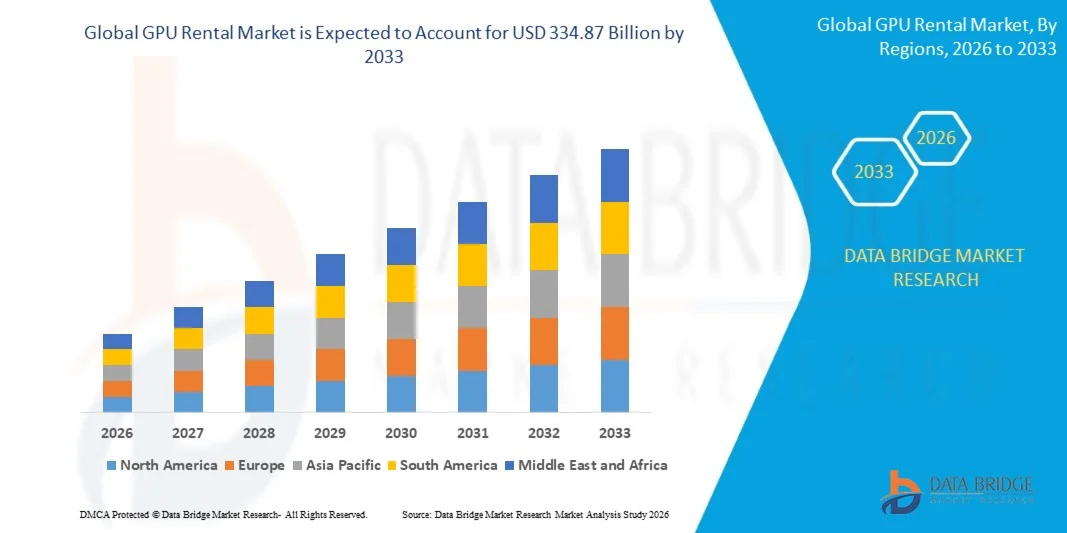
- As per Data Bridge Market Research analysis, the GPU rental market was valued at USD 39.81 billion in 2025 and is projected to reach USD 334.87 billion by 2033, growing at a CAGR of 30.50% from 2026 to 2033.
- The market is experiencing explosive growth driven by the unprecedented surge in demand for large language model training and generative AI inference workloads, chronic shortages of high-end data center GPU hardware constraining direct enterprise procurement, and rapid emergence of specialized GPU cloud providers offering more accessible and often more cost-effective alternatives to hyperscale cloud platforms.
- The growing recognition among enterprises and AI startups that renting GPU compute capacity avoids massive upfront capital expenditure, long hardware procurement lead times, and rapid technology obsolescence risk is compelling organizations of all sizes to shift AI infrastructure strategy toward flexible, consumption-based GPU access models. Specialized “neocloud” providers focused exclusively on GPU compute are increasingly complementing and, in many workloads, directly competing with traditional hyperscale cloud platforms, offering more competitive pricing and often faster access to the latest GPU generations.
- The rapid pace of GPU architecture innovation, with new generations offering substantial performance improvements released on an accelerating cadence, is further reinforcing the economic case for rental over ownership, as organizations can access the latest hardware without bearing the full cost and depreciation risk of frequent capital equipment refresh cycles.
Market Size & Forecast
- Global Market Value (2025): USD 39.81 Billion
- Expected Market Value (2033): USD 334.87 Billion
- Forecast CAGR (2026–2033): 30.50%
- Leading Region in 2025: North America
- Fastest Growing Region: Asia-Pacific
What are the Major Takeaways of the GPU Rental Market?
- North America dominated the global GPU rental market with the largest revenue share of 44.62% in 2025, supported by concentration of leading AI research labs, hyperscale cloud provider headquarters, and substantial venture capital investment fueling AI startup GPU compute demand.
- Asia-Pacific is expected to be the fastest-growing region at a CAGR of 34.8% from 2026 to 2033, fueled by rapidly expanding domestic AI development ecosystems, growing government investment in AI infrastructure, and increasing data center capacity build-out across China, India, Japan, and Singapore.
- The high-end/data center GPUs segment led the market with a 71.34% share in 2025, driven by overwhelming demand for the most powerful available accelerators to train and run increasingly large generative AI models efficiently.
- The AI inference application segment is the fastest-growing category, projected to register a CAGR of 34.2%, reflecting rapid proliferation of deployed generative AI applications requiring sustained, scalable compute capacity to serve growing user query volumes.
- The AI/ML model training application segment dominated the application category with a 48.73% revenue share in 2025, led by continued intensive compute demand from foundation model developers training progressively larger and more capable AI systems.
- On-demand/pay-as-you-go pricing accounted for 52.16% of the market share among pricing models in 2025, preferred for its flexibility in accommodating unpredictable and rapidly scaling AI workload compute requirements.
- The neoclouds provider type segment is the fastest-growing category, with a CAGR of 38.6%, driven by rapid emergence of specialized GPU-focused cloud providers securing large-scale GPU deployments and undercutting traditional hyperscaler pricing for AI-specific workloads.
- The public cloud deployment model segment accounted for 58.24% of the market share in 2025, reflecting its widespread accessibility and lower barrier to entry for organizations without existing data center infrastructure.
- The enterprises end-user segment held a 41.83% share in 2025, supported by widespread corporate adoption of generative AI applications requiring substantial ongoing compute capacity.
Report Scope and GPU Rental Market Segmentation
|
Attributes |
GPU Rental Key Market Insights |
|
Segments Covered |
|
|
Countries Covered |
North America
Europe
Asia-Pacific
Middle East and Africa
South America
|
|
Key Market Players |
|
|
Market Opportunities |
|
|
Value Added Data Infosets |
In addition to the insights on market scenarios such as market value, growth rate, segmentation, geographical coverage, and major players, the market reports curated by the Data Bridge Market Research also include in-depth expert analysis, geographically represented company-wise production and capacity, network layouts of distributors and partners, detailed and updated price trend analysis and deficit analysis of supply chain and demand. |
What is the Key Trend in the GPU Rental Market?
- GPU cloud providers are increasingly investing in next-generation GPU capacity and AI-specific infrastructure to meet rapidly growing demand for AI training and inference workloads.
- For instance, in February 2025, CoreWeave became the first cloud provider to make NVIDIA GB200 NVL72 instances generally available, providing customers access to rack-scale systems containing 72 NVIDIA Blackwell GPUs.
- Specialized GPU cloud providers are increasingly differentiating through purpose-built data centers with liquid cooling, high-density power, and high-speed networking, rather than relying solely on conventional cloud infrastructure.
- For instance, in April 2025, CoreWeave reported that most of its new data centers would use liquid cooling, enabling higher GPU density and supporting the thermal requirements of next-generation NVIDIA systems.
- GPU cloud providers are also focusing on GPU utilization and infrastructure efficiency through workload optimization, scheduling, and specialized software.
- For instance, in March 2025, CoreWeave reported achieving more than 50% Model FLOPS Utilization on NVIDIA Hopper GPUs, highlighting the growing focus on maximizing useful compute from rented GPU capacity.
- Providers are increasingly expanding their GPU portfolios across multiple generations of accelerators, allowing customers to select infrastructure according to workload performance, availability, and cost requirements.
- For instance, in January 2026, CoreWeave announced plans to deploy NVIDIA Vera Rubin systems, extending its cloud platform to another generation of NVIDIA accelerated-computing technology.
- As AI training and inference workloads continue to require large-scale accelerated computing, the GPU rental market is increasingly moving toward AI-optimized infrastructure, rapid access to next-generation GPUs, liquid cooling, high-performance networking, and improved utilization efficiency.
What are the Key Drivers of the GPU Rental Market?
- The unprecedented surge in demand for large language model training and generative AI application development has significantly increased enterprise and startup demand for scalable, on-demand access to high-end GPU compute capacity beyond what most organizations can economically procure and operate independently.
- For instance, in April 2025, Lambda expanded its GPU cloud infrastructure capacity significantly to meet surging demand from AI startups and enterprise customers seeking access to the latest generation data center GPUs for large-scale model training projects.
- The persistent global shortage of high-end data center GPUs relative to demand is driving organizations without direct manufacturer allocation access toward rental-based consumption models as the most practical pathway to securing necessary compute capacity within reasonable timeframes.
- For instance, in December 2024, Crusoe Energy Systems expanded its GPU cloud data center capacity in response to sustained enterprise demand exceeding available supply, highlighting the ongoing capacity-demand imbalance driving rental market growth.
- The growing proliferation of open-source and openly available AI models is lowering the barrier to AI application development for a much broader base of developers and smaller organizations, many of whom lack the capital or expertise to operate owned GPU infrastructure and therefore turn to rental-based compute access as their primary pathway to experimentation and deployment.
- With continued rapid advancement of AI model capabilities requiring ever-larger compute resources, persistent GPU hardware supply constraints, and growing enterprise preference for flexible consumption-based infrastructure models, the GPU rental market will remain one of the fastest-growing segments within the broader global technology infrastructure industry.
Which Factors are Challenging the Growth of the GPU Rental Market?
- GPU supply constraints remain a major challenge, as demand for advanced accelerators continues to exceed available supply, creating capacity shortages and potential pricing pressure for rental customers.
- For instance, in November 2024, NVIDIA highlighted supply constraints affecting deliveries of its latest AI processors amid strong demand.
- Power and grid limitations are restricting the expansion of GPU data-center capacity, as AI infrastructure requires substantial electricity and new grid connections can take considerable time. For instance, the IEA estimates that around 20% of planned data-center projects could face delays because of grid constraints.
- High capital and technology depreciation costs create financial pressure for GPU rental providers, which must continuously invest in GPUs, data centers, networking, cooling, and power infrastructure. Rapidly introduced GPU generations can also shorten hardware lifecycles and increase depreciation risks.
How is the GPU Rental Market Segmented?
The GPU rental market is segmented on the basis of GPU type, deployment model, pricing model, application, end user, and provider type.
- By GPU Type
On the basis of GPU type, the global GPU rental market is segmented into high-end/data center GPUs, mid-range GPUs, and consumer-grade GPUs. The high-end/data center GPUs segment dominated the market with a 71.34% share in 2025, owing to overwhelming demand for the most powerful available accelerators to train and run increasingly large generative AI models efficiently. These GPUs remain the preferred choice for enterprises and AI labs conducting large-scale model training and high-throughput inference workloads.
The mid-range GPUs segment is projected to register the fastest growth at a CAGR of 32.7% from 2026 to 2033, driven by rising demand from smaller AI startups, academic researchers, and developers for cost-effective compute capacity suitable for model fine-tuning, smaller-scale training, and inference workloads that do not require flagship accelerator hardware.
- By Deployment Model
On the basis of deployment model, the global GPU rental market is segmented into public cloud, private cloud, and hybrid cloud. The public cloud segment led the market with a 58.24% share in 2025, supported by its widespread accessibility, elastic scalability, and lower barrier to entry for organizations without existing data center infrastructure or long-term capacity commitments.
The hybrid cloud segment is expected to experience the fastest growth at a CAGR of 33.9% from 2026 to 2033, driven by rising enterprise interest in combining owned on-premises GPU infrastructure for baseline workloads with rented cloud GPU capacity for burst demand, optimizing both cost efficiency and capacity flexibility.
- By Pricing Model
On the basis of pricing model, the global GPU rental market is segmented into on-demand/pay-as-you-go, reserved/committed instances, and spot instances. The on-demand/pay-as-you-go segment dominated the market with a share of 52.16% in 2025 due to its flexibility in accommodating unpredictable and rapidly scaling AI workload compute requirements without long-term financial commitment. the widespread preference among AI startups and research teams for flexible, low-commitment access continues to reinforce this segment’s leading position.
The reserved/committed instances segment is expected to witness the fastest CAGR of 31.8% from 2026 to 2033, driven by this growth is fueled by growing enterprise preference for securing guaranteed GPU capacity access and more predictable pricing through longer-term commitments, particularly for mission-critical, continuously running AI training and inference workloads.
- By Application
On the basis of application, the global GPU rental market is segmented into AI/ML model training, AI inference, high-performance computing & scientific computing, rendering & visual effects, cryptocurrency mining, and cloud gaming. The AI/ML model training segment dominated the market with a share of 48.73% in 2025 due to continued intensive compute demand from foundation model developers training progressively larger and more capable AI systems. the ongoing race among AI companies to develop increasingly capable models is reinforcing the dominance of this segment.
The AI inference segment is expected to witness the fastest CAGR of 34.2% from 2026 to 2033, driven by rapid proliferation of deployed generative AI applications requiring sustained, scalable compute capacity to serve growing user query volumes across consumer and enterprise AI products.
- By End User
On the basis of end user, the global GPU rental market is segmented into enterprises, AI/ML startups, research institutions & academia, government & defense, and individual developers. The enterprises segment dominated the market with a share of 41.83% in 2025 due to widespread corporate adoption of generative AI applications requiring substantial ongoing compute capacity for both internal tool development and customer-facing AI product deployment. the widespread enterprise AI adoption across nearly every industry vertical is reinforcing this segment’s leading position.
The AI/ML startups segment is expected to witness the fastest CAGR of 35.7% from 2026 to 2033, driven by continued strong venture capital investment flowing into AI startups that rely heavily on rented GPU compute rather than capital-intensive direct hardware ownership to fund model development and deployment.
- By Provider Type
On the basis of provider type, the global GPU rental market is segmented into hyperscale cloud providers, specialized GPU cloud providers, and neoclouds. The hyperscale cloud providers segment dominated the market with a share of 54.72% in 2025 due to their extensive existing infrastructure, broad geographic coverage, and established enterprise customer relationships spanning far beyond GPU compute alone. established enterprise procurement relationships and integrated cloud service ecosystems continue to reinforce this segment’s leading position.
The neoclouds segment is expected to witness the fastest CAGR of 38.6% from 2026 to 2033, driven by rapid emergence of specialized GPU-focused cloud providers securing large-scale GPU deployments and undercutting traditional hyperscaler pricing for AI-specific workloads, attracting significant venture and infrastructure financing to fund rapid capacity expansion.
Which Region Holds the Largest Share of the GPU Rental Market?
- North America dominated the GPU rental market and accounted for the largest revenue share of 44.62% in 2025, supported by concentration of leading AI research labs, hyperscale cloud provider headquarters, and substantial venture capital investment fueling AI startup GPU compute demand.
- The region also benefits from a dense concentration of foundation model developers, well-established data center infrastructure, and significant capital availability supporting rapid GPU cloud provider infrastructure expansion. Continued leadership in frontier AI model development continues to strengthen North America’s leadership position in the global market.
U.S. GPU Rental Market Insight
The U.S. GPU rental market holds the largest share within North America, driven by concentration of leading AI research labs and foundation model developers, extensive hyperscale and specialized GPU cloud provider infrastructure, and substantial venture capital investment fueling AI startup compute demand. Rising enterprise generative AI adoption and continued frontier AI model development are further supporting robust market growth. Additionally, significant infrastructure investment by both established hyperscalers and emerging neocloud providers is reinforcing the country’s position as the global center of GPU rental market activity.
Canada GPU Rental Market Insight
Canada’s GPU rental market is expanding as AI startups, enterprises, research institutions, and technology companies seek flexible access to high-performance computing without large upfront hardware investments. Demand is supported by generative AI, machine learning, cloud computing, and advanced data analytics. Providers are increasingly offering NVIDIA-based GPU instances, high-speed networking, and scalable infrastructure. Canada’s strong AI research ecosystem and growing data-center investments create opportunities, while electricity costs, GPU availability, infrastructure constraints, and intense competition remain key challenges.
Asia-Pacific GPU Rental Market Insight
The Asia-Pacific GPU rental market is expected to witness rapid growth, driven by rapidly expanding domestic AI development ecosystems, growing government investment in AI infrastructure, and increasing data center capacity build-out across the region. Rising enterprise generative AI adoption and growing venture capital investment in regional AI startups are supporting market expansion. Additionally, the growing presence of both international and domestic GPU cloud providers establishing regional data center capacity is accelerating market adoption across the region.
India GPU Rental Market Insight
The India GPU rental market is witnessing robust growth, driven by rapidly expanding domestic AI startup ecosystem, growing government investment in national AI compute infrastructure initiatives, and increasing enterprise generative AI adoption across the technology and services sectors. Growing availability of both international and domestic GPU cloud providers is supporting market expansion. Additionally, rising government focus on building sovereign AI compute capacity is further accelerating market adoption across the country.
Japan GPU Rental Market Insight
The Japan GPU rental market is witnessing steady growth, driven by increasing enterprise generative AI adoption, growing government investment in national AI computing infrastructure, and rising demand from domestic technology companies developing AI applications. Japanese enterprises across technology, automotive, and manufacturing sectors continue to adopt GPU rental services to accelerate AI initiative deployment without heavy capital investment. Continued government support for AI infrastructure development is further contributing to market growth in Japan.
Which are the Top Companies in GPU Rental Market?
The GPU rental industry is primarily led by well-established companies, including:
- NVIDIA Corporation (U.S.)
- Amazon Web Services, Inc. (U.S.)
- Microsoft Corporation (U.S.)
- Google LLC (U.S.)
- CoreWeave, Inc. (U.S.)
- Lambda, Inc. (U.S.)
- Oracle Corporation (U.S.)
- Paperspace (DigitalOcean, Inc.) (U.S.)
- RunPod Inc. (U.S.)
- Vast.ai Inc. (U.S.)
- Crusoe Energy Systems Inc. (U.S.)
- Together AI, Inc. (U.S.)
- Fluidstack Ltd. (U.K.)
- Nebius Group N.V. (Netherlands)
- Voltage Park (U.S.)
- TensorDock, Inc. (U.S.)
- Genesis Cloud GmbH (Germany)
- Alibaba Cloud (Alibaba Group) (China)
- Tencent Cloud (Tencent Holdings) (China)
- IBM Corporation (U.S.)
What are Latest Developments in GPU Rental Market?
- In September 2025, CoreWeave announced a major expansion of its data center capacity with new facilities dedicated to next-generation GPU deployment, aiming to significantly increase available compute capacity for enterprise AI training and inference customers.
- In January 2025, Lambda secured additional infrastructure financing to expand its GPU cloud capacity, targeting increased availability of high-end data center GPUs for AI startups and enterprise research teams.
- In November 2025, Nebius Group expanded its European GPU cloud data center footprint, adding new capacity specifically designed to serve growing enterprise AI demand across the European Union amid rising data sovereignty considerations.
- In November 2024, Crusoe Energy Systems announced a major data center expansion powered increasingly by renewable and stranded energy sources, targeting sustainability-conscious enterprise customers seeking lower-carbon GPU compute options.
- In June 2023, Together AI partnered with several open-source AI model developers to provide subsidized GPU cloud access for research and community model training projects, demonstrating the company’s positioning within the broader open AI research ecosystem.
- In August 2024, Vast.ai expanded its decentralized GPU marketplace platform, connecting individual and smaller data center GPU owners with AI developers seeking cost-effective compute access, broadening the diversity of available GPU rental supply sources.

- Interactive Data Analysis Dashboard
- Company Analysis Dashboard for high growth potential opportunities
- Research Analyst Access for customization & queries
- Competitor Analysis with Interactive dashboard
- Latest News, Updates & Trend analysis
- Harness the Power of Benchmark Analysis for Comprehensive Competitor Tracking
Global Gpu Rental Market, Supply Chain Analysis and Ecosystem Framework
To support market growth and help clients navigate the impact of geopolitical shifts, DBMR has integrated in-depth supply chain analysis into its Global Gpu Rental Market research reports. This addition empowers clients to respond effectively to global changes affecting their industries. The supply chain analysis section includes detailed insights such as Global Gpu Rental Market consumption and production by country, price trend analysis, the impact of tariffs and geopolitical developments, and import and export trends by country and HSN code. It also highlights major suppliers with data on production capacity and company profiles, as well as key importers and exporters. In addition to research, DBMR offers specialized supply chain consulting services backed by over a decade of experience, providing solutions like supplier discovery, supplier risk assessment, price trend analysis, impact evaluation of inflation and trade route changes, and comprehensive market trend analysis.
Data collection and base year analysis are done using data collection modules with large sample sizes. The stage includes obtaining market information or related data through various sources and strategies. It includes examining and planning all the data acquired from the past in advance. It likewise envelops the examination of information inconsistencies seen across different information sources. The market data is analysed and estimated using market statistical and coherent models. Also, market share analysis and key trend analysis are the major success factors in the market report. To know more, please request an analyst call or drop down your inquiry.
The key research methodology used by DBMR research team is data triangulation which involves data mining, analysis of the impact of data variables on the market and primary (industry expert) validation. Data models include Vendor Positioning Grid, Market Time Line Analysis, Market Overview and Guide, Company Positioning Grid, Patent Analysis, Pricing Analysis, Company Market Share Analysis, Standards of Measurement, Global versus Regional and Vendor Share Analysis. To know more about the research methodology, drop in an inquiry to speak to our industry experts.
Data Bridge Market Research is a leader in advanced formative research. We take pride in servicing our existing and new customers with data and analysis that match and suits their goal. The report can be customized to include price trend analysis of target brands understanding the market for additional countries (ask for the list of countries), clinical trial results data, literature review, refurbished market and product base analysis. Market analysis of target competitors can be analyzed from technology-based analysis to market portfolio strategies. We can add as many competitors that you require data about in the format and data style you are looking for. Our team of analysts can also provide you data in crude raw excel files pivot tables (Fact book) or can assist you in creating presentations from the data sets available in the report.













