


What is the GS1 Digital Link for Food Packaging Market Size and Growth Rate?
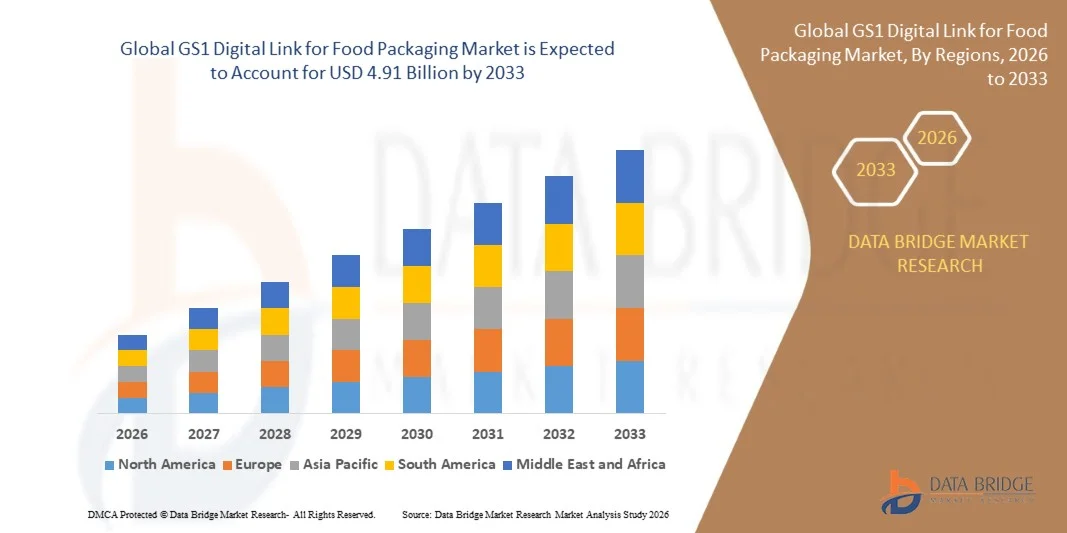
- As per Data Bridge Market Research analysis, the GS1 digital link for food packaging market was valued at USD 2.13 billion in 2025 and is projected to reach USD 6.42 billion by 2033, growing at a CAGR of 14.80% from 2026 to 2033.
- The market is experiencing significant momentum driven by increasing consumer demand for transparency and detailed product information, stringent global food safety regulations, enhanced traceability across the supply chain, and the rising adoption of smart packaging solutions.
- The growing need for food traceability and supply chain visibility, combined with increasing regulatory requirements and the food industry's digital transformation, is compelling food manufacturers and retailers to adopt GS1 digital link solutions. The technology enables packaging to connect consumers and supply chain stakeholders with product origin, nutritional facts, allergen information, recall status, sustainability data, and other digital information, supporting transparency, compliance, and consumer engagement.
Market Size & Forecast
- Global Market Value (2025): USD 2.13 Billion
- Expected Market Value (2033): USD 6.42 Billion
- Forecast CAGR (2026–2033): 14.80%
- Leading Region in 2025: North America
- Fastest Growing Region: Asia Pacific
What are the Major Takeaways of the GS1 Digital Link for Food Packaging Market?
- North America dominated the GS1 digital link for food packaging market with the largest revenue share of 38.7% in 2025, supported by the region’s mature food industry, early adoption of digital technologies, and stringent regulatory frameworks requiring enhanced traceability and food safety.
- Asia-Pacific is expected to be the fastest-growing region at a CAGR of 29.1% from 2026 to 2033, fueled by rising middle class, increasing urbanization, growing demand for packaged and processed foods, and significant investments in digital infrastructure and smart packaging technologies.
- The software segment led the market with a 45% share in 2025, driven by its central role in creating, managing, and updating GS1 digital link URLs and digital product content across the food value chain.
- Services are the fastest-growing component type, projected to register a CAGR of 16.2%, reflecting the surge in demand for implementation, consulting, system integration, and technical support.
- The processed food segment dominated the application category with a 32% revenue share in 2025, led by rising demand for transparency, ingredient disclosure, nutritional information, and product traceability across packaged food categories.
- On-premise accounted for 58% of the market share in 2025, preferred by large food manufacturers and multinational brands continued relying on internally managed systems for sensitive product data and enterprise integration.
- The consumer information segment is the fastest-growing information category, with a CAGR of 16.8%, driven by brands increasingly use digital packaging to strengthen customer engagement.
Report Scope and GS1 Digital Link for Food Packaging Market Segmentation
|
Attributes |
GS1 Digital Link for Food Packaging Key Market Insights |
|
Segments Covered |
|
|
Countries Covered |
North America
Europe
Asia-Pacific
Middle East and Africa
South America
|
|
Key Market Players |
|
|
Market Opportunities |
|
|
Value Added Data Infosets |
In addition to the insights on market scenarios such as market value, growth rate, segmentation, geographical coverage, and major players, the market reports curated by the Data Bridge Market Research also include import export analysis, production capacity overview, production consumption analysis, price trend analysis, climate change scenario, supply chain analysis, value chain analysis, raw material/consumables overview, vendor selection criteria, PESTLE Analysis, Porter Analysis, and regulatory framework. |
What is the Key Trend in the GS1 Digital Link for Food Packaging Market?
- Food brands are increasingly adopting GS1 digital link-enabled QR codes to transform packaging into digital touchpoints that provide consumers with product information, nutritional details, traceability data, sustainability information, and promotional content through a single scan.
- For instance, in May 2026, Mondelēz Italia began piloting QR Codes powered by GS1 on selected Oro Saiwa products, using GS1 digital link to connect product identity with batch and expiry information and provide consumers with product, sustainability, and disposal information.
- The transition toward 2D barcodes under GS1 Sunrise 2027 is accelerating the integration of GS1 digital link into food packaging, allowing the same QR code to support retail checkout functions while connecting consumers to web-based product information.
- GS1 digital link enables brands to update digital content without changing the QR code printed on packaging, allowing information such as promotions, product usage guidance, and sustainability details to be modified throughout the product lifecycle.
- Food manufacturers are increasingly using connected packaging to improve traceability, transparency, and consumer engagement, while supply-chain stakeholders can use the same identifier to access product and logistics information.
- For instance, in June 2024, GS1 Hong Kong reported the use of 1QR, based on the GS1 digital link standard, by food businesses to connect consumers with product information and promotions through QR-code scanning. The June 2024 GS1 Hong Kong publication also highlighted the broader industry transition toward QR Codes with GS1 standards.
- As retailers prepare for the global transition toward 2D barcode scanning by 2027, food-packaging manufacturers and brands are increasingly preparing their packaging, data systems, and retail infrastructure for GS1 Digital Link adoption
What are the Key Drivers of the GS1 Digital Link for Food Packaging Market?
- The growing demand for food traceability and supply-chain transparency is significantly increasing the adoption of GS1 digital link, as the technology connects product identifiers with online information and enables stakeholders to access detailed product and traceability data.
- For instance, in October 2024, Carrefour expanded the use of QR Codes powered by GS1 across its private-label wine products, providing consumers with ingredients, nutritional values, and recycling information while improving inventory management and product traceability
- Increasing consumer expectations for authentic, detailed, and accessible product information are encouraging food companies to adopt QR-based digital packaging solutions that provide information beyond what can fit on conventional packaging labels.
- Regulatory requirements related to food safety, product identification, expiry information, and traceability are further supporting adoption as businesses seek more efficient ways to connect physical products with structured digital information.
- Retailers and manufacturers are also adopting 2D barcode technologies to improve price lookup, product identification, expiry-date management, and consumer engagement through a single data carrier.
- For instance, in May 2026, Swapp! used QR Codes powered by GS1 on reusable food packaging, with each code containing a GS1 digital link to enable individual-container traceability and return tracking; its pilot saved 2,100 containers and reduced emissions by more than 128 kg.
- With the food industry increasingly shifting toward connected, data-rich packaging, GS1 Digital Link is expected to remain an important technology for improving traceability, regulatory compliance, supply-chain efficiency, and consumer engagement.
Which Factors are Challenging the Growth of the GS1 Digital Link for Food Packaging Market?
- The transition from traditional 1D barcodes to GS1 digital link-enabled 2D barcodes requires investment in compatible scanners, software systems, data infrastructure, packaging processes, and digital platforms, increasing implementation complexity for food companies.
- For instance, in December 2024, GS1 confirmed that only the latest or recently upgraded camera-based scanners were generally capable of reading QR Codes and Data Matrix barcodes using GS1 digital link URI syntax, highlighting the need for retail scanner upgrades and limiting immediate adoption across existing point-of-sale infrastructure
- Smaller food manufacturers and businesses with limited digital infrastructure may face difficulties integrating GS1 digital link with existing enterprise resource planning, inventory, production, and supply-chain systems.
- Retail adoption also remains a challenge because not all retail systems currently support the scanning and processing of 2D barcodes, requiring companies to maintain traditional 1D barcodes during the transition period.
- Effective implementation requires accurate product data, reliable digital destinations, and coordinated systems across manufacturers, retailers, distributors, and other supply-chain participants.
- For instance, in January 2025, GS1 stated that the cost of transitioning to 2D barcodes varies according to business size, technology, and sector, with implementation potentially requiring changes to existing processes and technology infrastructure, creating a financial and operational barrier particularly for smaller food businesses.
- The need for technology upgrades, data synchronization, supply-chain coordination, and dual-barcode implementation during the transition can increase costs and operational complexity, particularly for smaller food-packaging companies and retailers.
How is the GS1 Digital Link for Food Packaging Market Segmented?
The GS1 digital link for food packaging market is segmented on the basis of component, application, deployment mode, information, and end-user.
- By Component
On the basis of component, the GS1 digital link for food packaging market is segmented into software, hardware, and services. The software segment dominated the market with an estimated 45% share in 2025, driven by its central role in creating, managing, and updating GS1 Digital Link URLs and digital product content across the food value chain. Software platforms enable manufacturers to connect physical packaging with dynamic web-based information without changing printed QR codes. They support product information management, traceability, recall communication, and consumer engagement through a single digital infrastructure. Increasing adoption of cloud-based product data management and compliance solutions is further strengthening demand. Food companies also rely on software for integrating GS1 standards with enterprise resource planning and inventory systems. Its scalability, flexibility, and recurring-service model continue to make software the largest component segment.
The services segment is projected to witness the fastest growth at an estimated CAGR of 16.2% from 2026 to 2033, supported by increasing demand for implementation, consulting, system integration, and technical support. Organizations adopting GS1 Digital Link often require assistance in integrating digital links with existing packaging workflows and supply-chain systems. Growing migration toward 2D barcode implementation under GS1 Sunrise 2027 is creating additional demand for deployment and training services. Companies are also investing in ongoing maintenance, analytics, and digital-content management to maximize consumer engagement. Rising adoption among small and medium-sized food manufacturers is further expanding the addressable service market. Increasing digital transformation across the food industry continues to accelerate demand for specialized implementation expertise.
- By Application
On the basis of application, the GS1 digital link for food packaging market is segmented into fresh food, processed food, beverages, dairy products, confectionery, and others. The processed food segment dominated the market with an estimated 32% share in 2025, owing to rising demand for transparency, ingredient disclosure, nutritional information, and product traceability across packaged food categories. Manufacturers are increasingly using GS1 digital link to provide consumers with detailed product information through QR-enabled packaging. The segment also benefits from strict labeling regulations and growing demand for digital product information. Packaged food brands frequently update promotional content, allergen information, and sustainability messaging using dynamic digital links. Expanding retail adoption of connected packaging further strengthens growth. Strong consumer preference for convenient packaged foods continues to reinforce the segment’s leadership.
The beverages segment is expected to witness the fastest growth at an estimated CAGR of 16.0% from 2026 to 2033, driven by increasing adoption of connected packaging across beverage brands. Beverage companies are using GS1 digital link to provide ingredient information, recycling guidance, promotional campaigns, and product authentication through smartphone scanning. Premium beverage brands are also leveraging QR-enabled packaging to strengthen customer engagement and brand storytelling. Regulatory requirements related to nutritional labeling and sustainability are further encouraging adoption. The segment benefits from high packaging volumes and frequent marketing campaigns that require dynamic digital updates. Growing consumer interaction with mobile-enabled packaging continues to support rapid expansion.
- By Deployment Mode
On the basis of deployment mode, the GS1 digital link for food packaging market is segmented into on-premises and cloud. The on-premises segment dominated the market with an estimated 58% share in 2025, as large food manufacturers and multinational brands continued relying on internally managed systems for sensitive product data and enterprise integration. On-premises deployment offers greater control over product databases, security policies, and regulatory compliance requirements. Companies with established IT infrastructure often prefer direct integration with manufacturing, inventory, and supply-chain management systems. It also supports customized workflows for large-scale packaging operations. Existing enterprise investments have contributed to its continued adoption across major food companies. Strong emphasis on operational control and data governance continues to sustain this segment’s leadership.
The cloud segment is projected to register the fastest growth at an estimated CAGR of 17.1% from 2026 to 2033, supported by scalability, lower implementation costs, and simplified management of digital product information. Cloud-based platforms enable manufacturers to update consumer-facing content instantly without replacing printed packaging. They also improve collaboration across manufacturers, retailers, and distributors through centralized data access. Small and medium-sized food companies are increasingly adopting cloud solutions because they reduce infrastructure investments. Integration with analytics, consumer engagement tools, and remote management capabilities further enhances adoption. Growing digital transformation initiatives across the food industry continue to accelerate cloud deployment.
- By Information
On the basis of information, the GS1 digital link for food packaging market is segmented into product information, traceability information, recall status, supply chain information, consumer information, and usage information. The traceability information segment dominated the market with an estimated 35% share in 2025, as food manufacturers increasingly prioritized end-to-end visibility across production, distribution, and retail operations. GS1 digital link enables products to connect with batch details, origin information, and supply-chain records through a single digital identifier. Growing regulatory focus on food safety and faster recall management has strengthened adoption. Consumers are also demanding greater transparency regarding sourcing and product authenticity. Retailers benefit from improved inventory management and product verification capabilities. Increasing emphasis on resilient food supply chains continues to reinforce this segment’s dominance.
The consumer information segment is expected to witness the fastest growth at an estimated CAGR of 16.8% from 2026 to 2033, as brands increasingly use digital packaging to strengthen customer engagement. Companies are providing nutritional information, ingredient details, sustainability messaging, promotional campaigns, and product usage guidance through a single QR-enabled experience. Consumers increasingly expect immediate access to trusted product information using smartphones. Dynamic digital content allows brands to update information without changing printed packaging. Marketing teams are also using digital links to deliver personalized campaigns and loyalty experiences. The growing role of connected packaging in enhancing consumer interaction continues to accelerate expansion.
- By End-User
On the basis of end-user, the GS1 digital link for food packaging market is segmented into food manufacturers, retailers, distributors, logistics providers, and others. The food manufacturers segment dominated the market with an estimated 42% share in 2025, because manufacturers are the primary adopters responsible for embedding GS1 digital link into product packaging. They use the technology to improve traceability, regulatory compliance, recall communication, and consumer engagement across packaged food products. Manufacturers also integrate digital links with enterprise systems to manage product information more efficiently. Growing investment in smart packaging and digital transformation initiatives is strengthening adoption. Connected packaging helps brands provide richer consumer experiences while improving operational efficiency. The segment remains the largest because manufacturers control packaging design and product data management at scale.
The retailers segment is projected to witness the fastest growth at an estimated CAGR of 17.0% from 2026 to 2033, driven by increasing adoption of 2D barcode scanning, enhanced inventory management, and improved consumer-facing digital experiences. Retailers are preparing their checkout infrastructure for GS1 Sunrise 2027 while expanding support for QR-enabled product information. Digital links also help retailers improve product authentication, expiry-date management, and customer engagement. Integration with loyalty programs and personalized marketing campaigns further supports adoption. Retailers benefit from greater operational efficiency and better visibility across product inventories. The continued modernization of retail scanning infrastructure is expected to accelerate growth throughout the forecast period.
Which Region Holds the Largest Share of the GS1 Digital Link for Food Packaging Market?
- North America dominated the GS1 digital link for food packaging market with the largest revenue share of 38.7% in 2025, supported by the region’s mature food industry, early adoption of digital technologies, and stringent regulatory frameworks requiring enhanced traceability and food safety.
- The region also benefits from strong adoption of GS1 standards for food safety, traceability, and supply-chain management, particularly in the U.S. and Canada. GS1 notes that its North American activities include collaboration with government agencies and industry stakeholders on food safety and product traceability, including work related to the U.S. Food and Drug Administration’s Food Safety Modernization Act (FSMA). GS1 digital link further allows a GTIN to serve as a gateway to product and traceability information, supporting more connected supply chains.
U.S. GS1 Digital Link for Food Packaging Market Insight
The U.S. GS1 digital link for food packaging market is witnessing strong growth due to increasing adoption of 2D barcodes, food traceability solutions, and digital product-information systems across the food industry. U.S. government agencies recognize GS1 standards for applications including food safety, product identification, and supply-chain management, creating a supportive environment for digital identification technologies. GS1 also works with U.S. agencies on food-safety and supply-chain initiatives, strengthening the use of standardized product data. In addition, QR Codes with GS1 digital link can connect food packaging with ingredients, allergens, nutrition, sustainability information, and other consumer-facing content. The country's established retail infrastructure and high smartphone usage further support consumer-facing QR-code applications.
Asia-Pacific GS1 Digital Link for Food Packaging Market Insight
The Asia-Pacific GS1 digital link for food packaging market is expected to witness rapid growth, driven by expanding food traceability initiatives, increasing digitalization, and rising adoption of QR Codes powered by GS1 across countries such as China, India, and South Korea. China has been particularly active in promoting next-generation barcodes for food traceability and transparency. In May 2022, Zhejiang Province launched the Zhejiang Food Traceability Chain, designed to progressively implement next-generation barcodes for millions of products and improve food-company traceability. The system uses QR Codes powered by GS1 on pre-packaged food and edible agricultural products, allowing businesses, regulators, and consumers to access product information. Growing government support for digital food-safety systems and increasingly connected supply chains is therefore strengthening regional adoption.
Japan GS1 Digital Link for Food Packaging Market Insight
The Japan GS1 digital link for food packaging market is witnessing consistent growth due to increasing adoption of QR-based product information, traceability technologies, and digitally connected packaging. Japanese food and beverage companies are increasingly using standardized digital identification to provide consumers with more detailed information beyond conventional packaging labels. The country's technologically advanced retail ecosystem and strong consumer familiarity with QR-code scanning provide favorable conditions for GS1 digital link applications. GS1 digital link enables a single QR code to connect packaging with product details, traceability information, nutritional data, and other online content. The transition toward next-generation 2D barcodes also provides Japanese food manufacturers with opportunities to combine retail and consumer-facing functions within a single data carrier.
China GS1 Digital Link for Food Packaging Market Insight
The China GS1 digital link for food packaging market is growing rapidly, driven by government-backed food traceability programs, increasing adoption of next-generation barcodes, and growing requirements for food-safety transparency. In May 2022, Zhejiang AMR launched the Zhejiang Food Traceability Chain, with GS1 China supporting food companies in implementing GS1 standards and providing traceability technical support. The system uses QR Codes powered by GS1 to label pre-packaged food and edible agricultural products, while supply-chain movements are recorded in a centralized database. During the Asian Games, the system was also used for real-time, end-to-end traceability, with QR Codes containing GTINs, batch or serial numbers, and GS1 digital link information. Increasing government support, food-safety requirements, and digital infrastructure development are positioning China as one of the leading Asian markets for GS1-based food traceability
U.K. GS1 Digital Link for Food Packaging Market Insight
The U.K. GS1 digital link for food packaging market is experiencing steady growth, supported by increasing interest in 2D barcodes, product traceability, and digitally accessible consumer information. Food manufacturers and retailers are preparing for the wider adoption of next-generation barcodes that can connect physical products with online information. GS1 digital link allows a single QR code to provide access to product details, traceability information, recalls, nutritional information, and brand content. This capability is particularly relevant for food brands seeking to provide changing promotional, sustainability, and product information. Continued modernization of retail scanning systems and preparation for the global 2D-barcode transition are supporting market development in the U.K.
Germany GS1 Digital Link for Food Packaging Market Insight
The Germany GS1 digital link for food packaging market is expanding steadily due to the country's strong food manufacturing and retail sectors, advanced digital infrastructure, and increasing emphasis on traceability and sustainable packaging. German food manufacturers can use GS1 digital link-enabled QR Codes to connect packaging with product information, nutritional details, sustainability information, and usage guidance. Increasing European emphasis on product transparency and digitalization is encouraging food companies to strengthen their product-data infrastructure. GS1 digital link also enables one barcode to serve consumer-facing, retail, and supply-chain requirements, potentially reducing the need for multiple data carriers on packaging. These capabilities support continued adoption of connected packaging technologies across Germany's food ecosystem.
Which are the Top Companies in GS1 Digital Link for Food Packaging Market?
The GS1 digital link for food packaging industry is primarily led by well-established companies, including:
- Avery Dennison Corporation (U.S.)
- Zebra Technologies Corp. (U.S.)
- SATO Corporation (Japan)
- Honeywell International Inc. (U.S.)
- Datalogic S.p.A. (Italy)
- Seagull Scientific, LLC (U.S.)
- Impinj, Inc. (U.S.)
- NXP Semiconductors. (Netherlands)
- CCL Industries Inc. (Canada)
- Checkpoint Systems, Inc. (U.S.)
- DMRC LLC (U.S.)
- TOPPAN Inc. (Japan)
- UPM (Finland)
- Identiv, Inc. (U.S.)
- Scantrust SA (Switzerland)
- Wiliot Ltd. (Israel)
- Loftware, Inc. (U.S.)
- Kezzler (Norway)
- Tetra Pak International SA (Switzerland)
- Nestlé (Switzerland)
What are Latest Developments in GS1 Digital Link for Food Packaging Market?
- In May 2026, Polish start-up Swapp! implemented QR Codes powered by GS1 on reusable food packaging. Each QR code contains a GS1 digital link that enables individual reusable containers to be tracked and returned. The pilot saved 2,100 containers and reduced emissions by more than 128 kg, demonstrating the application of GS1 Digital Link to reusable food packaging.
- In June 2025, GS1 published new guidance on migrating to a single GS1-compliant 2D barcode for retailer private-label and in-store-labelled products, highlighting the use of QR Codes with GS1 digital link URIs for consumer-facing digital experiences. The guidance specifically identifies fresh foods and short-shelf-life products as important opportunities because 2D barcodes can carry additional information such as best-before dates, expiry dates, batch/lot codes, and serial numbers.
- In April 2025, GS1 released version 1.6.0 of the GS1 digital link URI Syntax standard, updating the technical specification for GS1 digital link URIs used in QR Codes, Data Matrix codes, and other data carriers. The update strengthens the technical foundation for connecting products and packaging to online information and services, supporting applications such as product information, traceability, recalls, and consumer engagement.
- In June 2024, more than 25 major companies from the retail, consumer-goods, and marketplace sectors signed a global joint statement supporting QR Codes with GS1 standards. The initiative included companies such as Carrefour and major brand owners and called for widespread adoption of next-generation barcodes by 2027.
- In October 2023, the Hangzhou Asian Games used QR Codes powered by GS1 as part of the Zhejiang Food Traceability Chain. Pre-packaged food and edible agricultural products were labelled with GS1-powered QR codes to support food-safety supervision and traceability throughout the supply chain during the Games.

- Interactive Data Analysis Dashboard
- Company Analysis Dashboard for high growth potential opportunities
- Research Analyst Access for customization & queries
- Competitor Analysis with Interactive dashboard
- Latest News, Updates & Trend analysis
- Harness the Power of Benchmark Analysis for Comprehensive Competitor Tracking
Global Gs1 Digital Link For Food Packaging Market, Supply Chain Analysis and Ecosystem Framework
To support market growth and help clients navigate the impact of geopolitical shifts, DBMR has integrated in-depth supply chain analysis into its Global Gs1 Digital Link For Food Packaging Market research reports. This addition empowers clients to respond effectively to global changes affecting their industries. The supply chain analysis section includes detailed insights such as Global Gs1 Digital Link For Food Packaging Market consumption and production by country, price trend analysis, the impact of tariffs and geopolitical developments, and import and export trends by country and HSN code. It also highlights major suppliers with data on production capacity and company profiles, as well as key importers and exporters. In addition to research, DBMR offers specialized supply chain consulting services backed by over a decade of experience, providing solutions like supplier discovery, supplier risk assessment, price trend analysis, impact evaluation of inflation and trade route changes, and comprehensive market trend analysis.
Data collection and base year analysis are done using data collection modules with large sample sizes. The stage includes obtaining market information or related data through various sources and strategies. It includes examining and planning all the data acquired from the past in advance. It likewise envelops the examination of information inconsistencies seen across different information sources. The market data is analysed and estimated using market statistical and coherent models. Also, market share analysis and key trend analysis are the major success factors in the market report. To know more, please request an analyst call or drop down your inquiry.
The key research methodology used by DBMR research team is data triangulation which involves data mining, analysis of the impact of data variables on the market and primary (industry expert) validation. Data models include Vendor Positioning Grid, Market Time Line Analysis, Market Overview and Guide, Company Positioning Grid, Patent Analysis, Pricing Analysis, Company Market Share Analysis, Standards of Measurement, Global versus Regional and Vendor Share Analysis. To know more about the research methodology, drop in an inquiry to speak to our industry experts.
Data Bridge Market Research is a leader in advanced formative research. We take pride in servicing our existing and new customers with data and analysis that match and suits their goal. The report can be customized to include price trend analysis of target brands understanding the market for additional countries (ask for the list of countries), clinical trial results data, literature review, refurbished market and product base analysis. Market analysis of target competitors can be analyzed from technology-based analysis to market portfolio strategies. We can add as many competitors that you require data about in the format and data style you are looking for. Our team of analysts can also provide you data in crude raw excel files pivot tables (Fact book) or can assist you in creating presentations from the data sets available in the report.













