


Halal Ingredients for Food and Beverage Market Overview
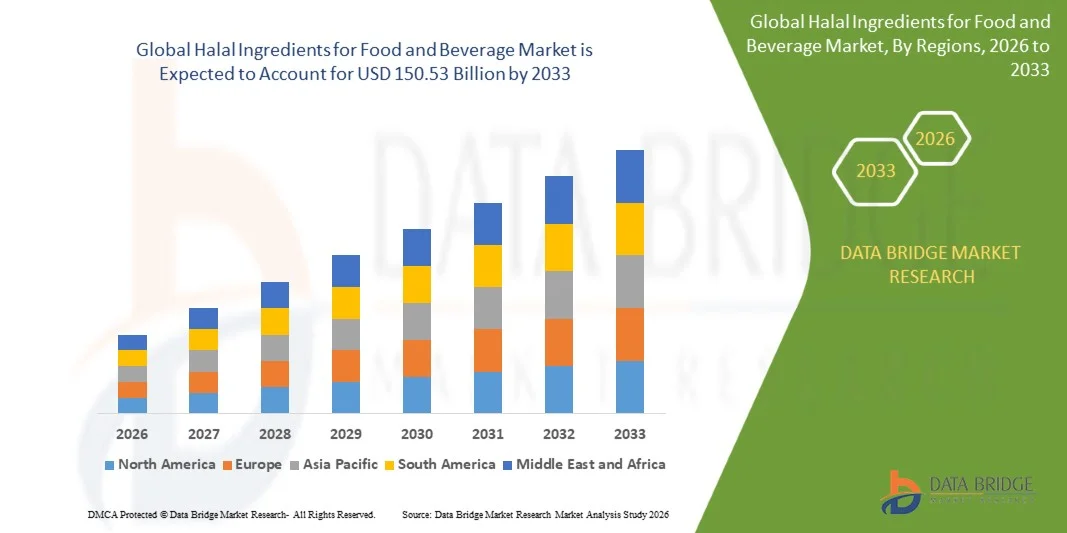
The Halal Ingredients for Food and Beverage Market was valued at USD 93.03 Billion in 2025 and is projected to reach USD 150.53 Billion by 2033, growing at a CAGR of 6.20% from 2026 to 2033. The market is experiencing consistent growth driven by rising demand for halal-certified processed foods, increasing global Muslim population, and growing preference for clean-label, safe, and ethically sourced food ingredients. Expanding applications of halal ingredients across bakery, beverages, convenience foods, and meat and poultry products are further supporting market growth across both developed and emerging economies.
The increasing focus on food safety, traceability, and regulatory compliance in halal certification, combined with rapid growth in packaged and functional food consumption, is encouraging manufacturers to adopt halal-certified emulsifiers, starches, flavors, and proteins. Strong expansion of modern retail channels, globalization of halal food trade, and rising penetration of multinational food companies in halal markets are further accelerating demand for certified ingredients across the global food and beverage industry.
Key Market Trends & Insights
- Asia-Pacific dominated the Halal Ingredients for Food and Beverage Market with the largest revenue share of 55.5% in 2025, supported by a large Muslim population base, strong food processing industry, and extensive consumption of halal-certified packaged and convenience foods
- The starches segment led the market with a 41% share in 2025, driven by extensive usage in halal-certified processed foods, bakery formulations, and ready-to-eat products where texture and stability enhancement are essential
- North America is expected to be the fastest-growing region at a CAGR of 7.81% from 2026 to 2033, fueled by rising demand for halal-certified processed foods, functional beverages, and clean-label ingredients
- Meat and poultry products are the fastest-growing application type, projected to register a CAGR of 14% from 2026 to 2033, supported by increasing global demand for halal-certified protein sources and strict compliance requirements in meat processing and supply chains
- The beverage products segment dominated the application category with a 38% revenue share in 2025, led by rising consumption of halal-certified functional drinks, juices, and dairy-based beverages across Muslim-majority regions and expanding export demand
- The enzymes segment is the fastest-growing ingredient type category, with a CAGR of 13.5% from 2026 to 2033, driven by increasing use in improving food processing efficiency and product quality within halal-certified manufacturing systems
Market Size & Forecast
- Global Market Value (2025): USD 93.03 Billion
- Expected Market Value (2033): USD 150.53 Billion
- Forecast CAGR (2026–2033): 6.20%
- Leading Region in 2025: Asia-Pacific
- Fastest Growing Region: North America
Report Scope and Halal Ingredients for Food and Beverage Market Segmentation
|
Attributes |
Halal Ingredients for Food and Beverage Key Market Insights |
|
Segments Covered |
|
|
Countries Covered |
North America · U.S. · Canada · Mexico Europe · Germany · France · U.K. · Netherlands · Switzerland · Belgium · Russia · Italy · Spain · Turkey · Rest of Europe Asia-Pacific · China · Japan · India · South Korea · Singapore · Malaysia · Australia · Thailand · Indonesia · Philippines · Rest of Asia-Pacific Middle East and Africa · Saudi Arabia · U.A.E. · South Africa · Egypt · Israel · Rest of Middle East and Africa South America · Brazil · Argentina · Rest of South America |
|
Key Market Players |
· DSM (Netherlands) · ADM (U.S.) · Kerry Group (Ireland) · Solvay (Belgium) · Barentz (Netherlands) · Cargill, Incorporated (U.S.) · BASF SE (Germany) · PureCircle (Malaysia) · Nestlé India Ltd. (India) · BRF Global (Brazil) · Al Islami Foods (U.A.E.) · American Foods Group, LLC (U.S.) · Midamar Corporation (U.S.) · Carrefour (France) · Saffron Road (U.S.) · One World Halal (U.S.) · Allanasons Pvt Ltd (India) · QL Foods Sdn Bhd (Malaysia) · NEMA Food Distribution, Inc. (U.S.) · NAMET (Turkey) · Kawan Food Manufacturing Sdn Bhd (Malaysia) |
|
Market Opportunities |
· Expansion of Plant-Based and Alternative Protein Halal Ingredients · Growth in Halal-Compliant Convenience and Packaged Food Products · Increasing Adoption of Halal Ingredients in Non-Muslim Majority Markets |
|
Value Added Data Infosets |
In addition to the insights on market scenarios such as market value, growth rate, segmentation, geographical coverage, and major players, the market reports curated by the Data Bridge Market Research also include in-depth expert analysis, pricing analysis, brand share analysis, consumer survey, demography analysis, supply chain analysis, value chain analysis, raw material/consumables overview, vendor selection criteria, PESTLE Analysis, Porter Analysis, and regulatory framework. |
Halal Ingredients for Food and Beverage Market Trends
Trend: Increasing Demand for Clean-Label and Halal-Certified Functional Ingredients
The Halal Ingredients for Food and Beverage Market is witnessing a strong shift toward clean-label, transparent, and halal-certified functional ingredients as consumers demand safer and more ethically compliant food products. Food manufacturers are increasingly reformulating products using halal-certified emulsifiers, starches, flavors, and protein-based ingredients to meet both religious compliance and health-oriented consumption trends. This shift is particularly strong in processed foods, beverages, and bakery applications where ingredient transparency and certification credibility are becoming key purchasing factors.
Companies such as Nestlé, through its halal-certified product lines in Malaysia and Indonesia, and Cargill, with its expanding halal-compliant ingredient portfolio across Asia-Pacific, are actively strengthening clean-label and halal-integrated formulations to meet rising global demand for certified functional food ingredients.
Halal Ingredients for Food and Beverage Market Dynamics
Key Market Driver: Rising Global Muslim Population and Expanding Halal Food Consumption Base
The steady growth of the global Muslim population, combined with increasing urbanization and rising disposable income across emerging economies, is significantly driving demand for halal-certified food and beverage ingredients. This expanding consumer base is increasing consumption of packaged foods, beverages, and convenience products that require certified halal emulsifiers, sweeteners, and stabilizers. Governments in countries such as Indonesia and Malaysia are also strengthening halal certification frameworks, further supporting market penetration.
Companies such as QL Foods Sdn Bhd and BRF Global are expanding halal-certified production and export operations to meet rising demand across Asia-Pacific, the Middle East, and European halal food markets, reinforcing large-scale consumption growth.
Key Restraint/Challenge: Complexity in Global Halal Certification Standards
A major challenge in the Halal Ingredients for Food and Beverage market is the lack of uniform global halal certification standards, which creates compliance complexity for multinational food manufacturers. Different certification bodies across regions apply varying requirements for ingredient sourcing, processing methods, and supply chain verification, increasing operational and documentation burdens. This fragmentation slows down product approvals and limits seamless cross-border trade of halal-certified ingredients.
For instance, global ingredient suppliers such as DSM and BASF must manage multiple certification systems across Southeast Asia, the Middle East, and Europe, leading to increased compliance costs and extended time-to-market for halal-compliant formulations.
Key Market Opportunity: Expansion of Plant-Based and Alternative Protein Halal Ingredients
The growing shift toward plant-based diets and alternative protein consumption is creating strong opportunities for halal-certified ingredient manufacturers. Demand for halal-compliant plant proteins, fermentation-based enzymes, and functional bio-ingredients is increasing across beverages, nutritional supplements, and meat alternatives. This trend is supported by rising health awareness and sustainability-focused consumption patterns among younger populations in both Muslim-majority and non-Muslim markets.
Companies such as ADM and Kerry Group are actively investing in plant-based halal protein systems and functional ingredient innovations, enabling broader adoption of alternative proteins in halal-certified food and beverage applications across global markets.
Halal Ingredients for Food and Beverage Market Scope
The halal ingredients for food and beverage market is segmented on the basis of ingredient type and application.
- By Ingredient Type
On the basis of ingredient type, the Halal Ingredients for Food and Beverage Market is segmented into flavors, hydrocolloids, starches, sweeteners, acidulants, emulsifiers, enzymes, colors, protein, antioxidants, preservatives, and others. The Starches segment dominated the market with the largest share of 41% in 2025, supported by extensive usage in halal-certified processed foods, bakery formulations, and ready-to-eat products where texture and stability enhancement are essential. Strong demand from large-scale food manufacturers across Asia-Pacific and the Middle East reinforces its leading position. Widespread availability of halal-compliant plant-based starch sources further strengthens adoption across multiple applications. Continuous expansion of processed halal food production sustains its market dominance.
The Enzymes segment is projected to register the fastest growth at a CAGR of 13.5% from 2026 to 2033, driven by increasing use in improving food processing efficiency and product quality within halal-certified manufacturing systems. Rising demand for clean-label and high-performance processing aids is encouraging broader enzyme adoption across bakery, dairy alternatives, and beverage formulations. Technological advancements in microbial and plant-derived halal enzymes are expanding application scope. Growing regulatory alignment for halal-certified processing inputs across global supply chains further accelerates segment expansion.
- By Application
On the basis of application, the Halal Ingredients for Food and Beverage Market is segmented into convenience food products, bakery products, beverage products, meat and poultry products, confectionary products, and others. The Beverage Products segment dominated the market with the largest share of 38% in 2025, driven by rising consumption of halal-certified functional drinks, juices, and dairy-based beverages across Muslim-majority regions and expanding export demand. Strong product innovation in fortified and flavored beverages enhances ingredient utilization across emulsifiers, sweeteners, and stabilizers. Expanding retail penetration and branded halal beverage offerings further reinforce segment leadership. Continuous demand for safe and certified hydration products sustains its dominant position.
The Meat and Poultry Products segment is projected to register the fastest growth at a CAGR of 14% from 2026 to 2033, driven by increasing global demand for halal-certified protein sources and strict compliance requirements in meat processing and supply chains. Rising urbanization and income growth across emerging economies are strengthening consumption of processed and packaged halal meat products. Advancements in halal slaughtering certification systems and traceability technologies are improving consumer trust and adoption. Expanding international trade of halal meat across Asia-Pacific, the Middle East, and parts of Europe further accelerates segment growth.
Halal Ingredients for Food and Beverage Market Regional Analysis
Asia-Pacific dominated the halal ingredients for food and beverage market and accounted for the largest revenue share of 55.5% in 2025, supported by a large Muslim population base, strong food processing industry, and extensive consumption of halal-certified packaged and convenience foods. The region benefits from well-established halal certification frameworks across key economies, expanding export capabilities, and cost-efficient ingredient manufacturing. Rising demand for clean-label, safe, and traceable food ingredients across processed foods, beverages, and bakery applications is accelerating regional market expansion. Strong growth in modern retail and quick-service restaurants further reinforces regional dominance in halal ingredient consumption.
China Halal Ingredients for Food and Beverage Market Insight
China held a significant share in the Asia-Pacific Halal Ingredients for Food and Beverage market in 2025, supported by large-scale food manufacturing capacity and increasing production of halal-certified processed foods for domestic consumption and export markets. The country’s expanding supply chain infrastructure enables efficient sourcing of starches, flavors, and emulsifiers used in halal formulations. Rising demand from urban Muslim populations and growing exports to Southeast Asia and the Middle East are strengthening market penetration. In addition, increasing investment in halal-certified production facilities is enhancing China’s role in global halal ingredient supply chains.
India Halal Ingredients for Food and Beverage Market Insight
India is witnessing the fastest growth in the Asia-Pacific region with a CAGR of 13.2% from 2026 to 2033, driven by rising demand for halal-certified processed foods, beverages, and packaged bakery products. Expanding food processing industries and increasing export-oriented halal production are supporting strong ingredient consumption growth. Growing awareness of halal compliance among manufacturers and rising penetration of organized retail channels are further accelerating adoption. In addition, increasing demand for plant-based and clean-label ingredients is strengthening long-term halal ingredient market expansion across the country.
Europe Halal Ingredients for Food and Beverage Market Insight
The Europe Halal Ingredients for Food and Beverage market is expanding steadily, supported by increasing Muslim population, rising demand for multicultural food products, and strong growth in clean-label and ethically sourced ingredients. Food manufacturers are increasingly incorporating halal-certified emulsifiers, starches, and flavors to serve both Muslim consumers and broader health-conscious populations. Growing demand from bakery, confectionery, and ready-to-eat segments is further contributing to regional expansion. In addition, strict food safety regulations and growing imports of certified halal ingredients are strengthening market development across Europe.
Germany Halal Ingredients for Food and Beverage Market Insight
Germany accounted for the largest share in the Europe Halal Ingredients for Food and Beverage market in 2025, driven by strong demand from food processing industries and a large urban Muslim population. The country’s advanced manufacturing infrastructure supports widespread use of halal-certified ingredients in bakery, meat processing, and packaged food products. Rising consumer preference for ethically sourced and clean-label foods is further boosting demand for halal-compliant formulations. In addition, strong retail distribution networks and increasing product diversification in ethnic and functional foods are reinforcing Germany’s leading position.
U.K. Halal Ingredients for Food and Beverage Market Insight
The U.K. market is growing steadily, supported by increasing demand for halal-certified bakery products, ready meals, beverages, and confectionery items. A growing multicultural population and rising awareness of halal food authenticity are driving ingredient adoption across mainstream food manufacturers. Expansion of retail chains offering halal-certified packaged foods is further supporting market growth. In addition, increasing use of halal ingredients in premium and organic food categories is strengthening overall market penetration in the country.
North America Halal Ingredients for Food and Beverage Market Insight
North America is projected to grow at the fastest CAGR of 7.81% from 2026 to 2033, driven by rising demand for halal-certified processed foods, functional beverages, and clean-label ingredients. Increasing Muslim population and strong consumer preference for ethically sourced and traceable food products are supporting market expansion. Food manufacturers are increasingly incorporating halal-compliant emulsifiers, sweeteners, and proteins across packaged food categories. In addition, growing retail availability and expansion of halal-certified product lines in mainstream supermarkets are accelerating regional growth.
U.S. Halal Ingredients for Food and Beverage Market Insight
The U.S. accounted for the largest share in the North America Halal Ingredients for Food and Beverage market in 2025, supported by strong demand from processed food, beverage, and foodservice industries. The country benefits from a well-developed halal certification ecosystem and increasing adoption of halal-certified ingredients across mainstream food brands. Rising consumer preference for clean-label, natural, and ethically sourced ingredients is further strengthening market growth. In addition, expanding availability of halal-certified packaged foods across retail and e-commerce channels is reinforcing the U.S. leadership position in the regional market.
Halal Ingredients for Food and Beverage Market Share
The halal ingredients for food and beverage industry is primarily led by well-established companies, including:
- DSM (Netherlands)
- ADM (U.S.)
- Kerry Group (Ireland)
- Solvay (Belgium)
- Barentz (Netherlands)
- Cargill, Incorporated (U.S.)
- BASF SE (Germany)
- PureCircle (Malaysia)
- Nestlé India Ltd. (India)
- BRF Global (Brazil)
- Al Islami Foods (U.A.E.)
- American Foods Group, LLC (U.S.)
- Midamar Corporation (U.S.)
- Carrefour (France)
- Saffron Road (U.S.)
- One World Halal (U.S.)
- Allanasons Pvt Ltd (India)
- QL Foods Sdn Bhd (Malaysia)
- NEMA Food Distribution, Inc. (U.S.)
- NAMET (Turkey)
- Kawan Food Manufacturing Sdn Bhd (Malaysia)
Latest Developments in Halal Ingredients for Food and Beverage Market
- In February 2025, Archer Daniels Midland (ADM) expanded its halal ingredient operations by opening a large-scale facility in the Lagos Free Trade Zone, strengthening regional production and distribution capabilities for nutrition and carbohydrate-based ingredients. This development significantly enhances the availability of halal-certified food ingredients across West Africa, reducing import dependency and improving supply chain resilience for food and beverage manufacturers. It also supports faster fulfillment of growing regional demand for processed foods, beverages, and functional nutrition products. In addition, the facility strengthens ADM’s competitive position in emerging halal markets by improving cost efficiency and local market responsiveness
- In August 2024, Cargill expanded its halal-certified manufacturing footprint in Southeast Asia with the launch of new production capabilities focused on blending and processing food ingredients for applications such as confectionery, bakery, and packaged foods. This expansion improves regional supply stability and supports increasing demand for halal-compliant emulsifiers, stabilizers, and specialty food ingredients. It also enables faster innovation cycles for manufacturers developing clean-label and halal-certified product formulations. Furthermore, it strengthens Cargill’s integration within Asia-Pacific halal food supply chains, where consumption of processed foods continues to rise rapidly
- In 2024, DSM introduced a new portfolio of plant-based halal-certified protein and functional ingredients designed for use in beverages, nutritional supplements, and fortified food products. This development supports the growing shift toward alternative protein sources while ensuring compliance with halal certification standards. It enhances formulation flexibility for food manufacturers targeting health-conscious and ethically driven consumers. In addition, it strengthens the adoption of sustainable ingredient solutions across global halal food and beverage markets, particularly in sports nutrition and functional beverage categories
- In 2024, Barentz established a dedicated halal ingredient distribution hub in Dubai to streamline the export and global supply of specialty halal-certified food ingredients. This initiative improves logistics efficiency and enables faster distribution to key halal-consuming regions including the Middle East, Africa, and Southeast Asia. It also enhances accessibility of specialty emulsifiers, flavors, and functional ingredients for food manufacturers operating in multiple international markets. Furthermore, it reinforces Dubai’s strategic position as a global halal trade and distribution center, supporting cross-border ingredient trade expansion
- In 2023, BASF expanded its halal certification coverage across a wide portfolio of specialty food and functional ingredients, enabling broader use across bakery, beverage, and processed food applications. This development improves ingredient accessibility for manufacturers seeking certified halal raw materials while reducing regulatory and compliance barriers. It also supports increased formulation flexibility for companies operating in both Muslim-majority and global mainstream markets. In addition, it accelerates the integration of halal-compliant ingredients into large-scale food production systems, strengthening BASF’s position in the global ingredients industry

- Interactive Data Analysis Dashboard
- Company Analysis Dashboard for high growth potential opportunities
- Research Analyst Access for customization & queries
- Competitor Analysis with Interactive dashboard
- Latest News, Updates & Trend analysis
- Harness the Power of Benchmark Analysis for Comprehensive Competitor Tracking
Global Halal Ingredients For Food And Beverage Market, Supply Chain Analysis and Ecosystem Framework
To support market growth and help clients navigate the impact of geopolitical shifts, DBMR has integrated in-depth supply chain analysis into its Global Halal Ingredients For Food And Beverage Market research reports. This addition empowers clients to respond effectively to global changes affecting their industries. The supply chain analysis section includes detailed insights such as Global Halal Ingredients For Food And Beverage Market consumption and production by country, price trend analysis, the impact of tariffs and geopolitical developments, and import and export trends by country and HSN code. It also highlights major suppliers with data on production capacity and company profiles, as well as key importers and exporters. In addition to research, DBMR offers specialized supply chain consulting services backed by over a decade of experience, providing solutions like supplier discovery, supplier risk assessment, price trend analysis, impact evaluation of inflation and trade route changes, and comprehensive market trend analysis.
Data collection and base year analysis are done using data collection modules with large sample sizes. The stage includes obtaining market information or related data through various sources and strategies. It includes examining and planning all the data acquired from the past in advance. It likewise envelops the examination of information inconsistencies seen across different information sources. The market data is analysed and estimated using market statistical and coherent models. Also, market share analysis and key trend analysis are the major success factors in the market report. To know more, please request an analyst call or drop down your inquiry.
The key research methodology used by DBMR research team is data triangulation which involves data mining, analysis of the impact of data variables on the market and primary (industry expert) validation. Data models include Vendor Positioning Grid, Market Time Line Analysis, Market Overview and Guide, Company Positioning Grid, Patent Analysis, Pricing Analysis, Company Market Share Analysis, Standards of Measurement, Global versus Regional and Vendor Share Analysis. To know more about the research methodology, drop in an inquiry to speak to our industry experts.
Data Bridge Market Research is a leader in advanced formative research. We take pride in servicing our existing and new customers with data and analysis that match and suits their goal. The report can be customized to include price trend analysis of target brands understanding the market for additional countries (ask for the list of countries), clinical trial results data, literature review, refurbished market and product base analysis. Market analysis of target competitors can be analyzed from technology-based analysis to market portfolio strategies. We can add as many competitors that you require data about in the format and data style you are looking for. Our team of analysts can also provide you data in crude raw excel files pivot tables (Fact book) or can assist you in creating presentations from the data sets available in the report.













