


Hemiballismus Treatment Market Size
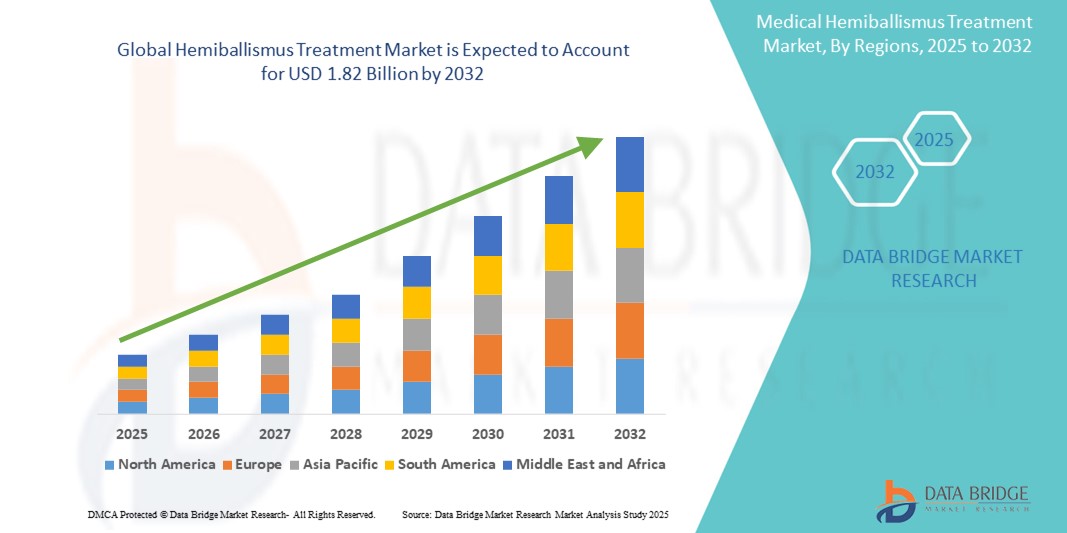
- The global hemiballismus treatment market size was valued at USD 1.27 billion in 2024 and is expected to reach USD 1.82 billion by 2032, at a CAGR of 4.60% during the forecast period
- The market growth is largely fueled by the increasing prevalence of neurological disorders, rising awareness of rare movement disorders, and advancements in neuroimaging and diagnostic tools, leading to improved detection and management of hemiballismus across healthcare settings
- Furthermore, growing demand for minimally invasive treatment options, development of targeted pharmacological therapies, and rising investment in neurological research and clinical trials are establishing hemiballismus treatment solutions as a critical component in managing hyperkinetic movement disorders. These converging factors are accelerating the uptake of Hemiballismus Treatment solutions, thereby significantly boosting the industry's growth
Hemiballismus Treatment Market Analysis
- Hemiballismus treatments, involving pharmacological therapies, deep brain stimulation, and supportive neurological care, are increasingly vital components of modern neurotherapeutic strategies due to their potential to manage severe, involuntary movement symptoms in both acute and chronic neurological settings
- The escalating demand for hemiballismus treatment is primarily fueled by the increasing incidence of stroke-related complications, growing awareness about rare movement disorders, and a rising preference for non-invasive and precision-targeted therapies, including dopamine antagonists and neuromodulation techniques
- North America dominated the hemiballismus treatment Market with the largest revenue share of 41.3% in 2024, characterized by advanced healthcare infrastructure, high healthcare spending, and strong research funding in neurology. The U.S. has experienced substantial growth in hemiballismus treatment procedures, particularly within academic medical centers and specialized movement disorder clinics, driven by innovations in neuropharmacology and surgical neuromodulation
- Asia-Pacific is expected to be the fastest-growing region in the hemiballismus treatment market during the forecast period due to increasing access to specialized neurological care, growing stroke incidence, and rising healthcare investments in countries such as China, India, and South Korea
- The therapy segment dominated the hemiballismus treatment market with a market share of 46.7% in 2024, driven by its established role in first-line treatment using antipsychotic medications and dopamine-depleting agents, as well as ongoing research into novel neuroinhibitory drug formulations
Report Scope and Hemiballismus Treatment Market Segmentation
|
Attributes |
Hemiballismus Treatment Key Market Insights |
|
Segments Covered |
|
|
Countries Covered |
North America
Europe
Asia-Pacific
Middle East and Africa
South America
|
|
Key Market Players |
|
|
Market Opportunities |
|
|
Value Added Data Infosets |
In addition to the insights on market scenarios such as market value, growth rate, segmentation, geographical coverage, and major players, the market reports curated by the Data Bridge Market Research also include in-depth expert analysis, pricing analysis, brand share analysis, consumer survey, demography analysis, supply chain analysis, value chain analysis, raw material/consumables overview, vendor selection criteria, PESTLE Analysis, Porter Analysis, and regulatory framework. |
Hemiballismus Treatment Market Trends
“Increasing Adoption of Targeted Neurological Therapies and Advanced Drug Delivery Systems”
- A significant and accelerating trend in the global hemiballismus treatment market is the increasing focus on targeted neurological therapies, including the use of antipsychotics, dopamine-depleting agents, and GABAergic medications. These therapeutic approaches are designed to better modulate the basal ganglia circuits involved in hemiballismus, offering symptom relief and reducing side effects associated with non-specific treatments
- For instance, tetrabenazine and related VMAT2 inhibitors are being increasingly adopted due to their effectiveness in controlling involuntary movements by depleting monoamines at the synapse level. Similarly, the use of antipsychotic drugs such as haloperidol and risperidone is becoming more refined with personalized dosage regimens based on patient-specific responses
- Recent developments in extended-release formulations and transdermal delivery methods are also improving patient compliance and minimizing adverse effects, especially for elderly patients who are more susceptible to movement disorders such as hemiballismus
- The market is witnessing the introduction of novel drug delivery mechanisms that enhance CNS penetration while reducing systemic toxicity. These innovations are particularly beneficial in managing complex motor symptoms that require continuous modulation of neurotransmitter levels
- Moreover, increasing clinical trials and R&D investments into rare hyperkinetic movement disorders are contributing to the diversification of treatment options. Several biotech and pharmaceutical firms are exploring repurposed CNS drugs and novel neuroprotective compounds specifically for movement disorders
- The demand for effective, minimally invasive, and long-term treatment strategies is growing rapidly across both developed and emerging markets, as healthcare systems prioritize better neurological care and rehabilitation outcomes. This evolving trend is expected to significantly shape the future landscape of the Hemiballismus Treatment market
Hemiballismus Treatment Market Dynamics
Driver
“Growing Need Due to Rising Awareness and Advancements in Neurological Care”
- The increasing prevalence of movement disorders, particularly those associated with aging populations and neurodegenerative diseases, has heightened the demand for effective Hemiballismus treatment solutions globally. Growing awareness among patients and healthcare professionals is accelerating the diagnosis and clinical management of rare hyperkinetic disorders such as Hemiballismus
- For instance, in April 2024, researchers at a leading U.S. neurology institute initiated a multi-center study to evaluate novel therapeutic approaches for Hemiballismus, with an emphasis on precision medicine and neuromodulation. Such initiatives by research and healthcare institutions are expected to drive Hemiballismus Treatment industry growth in the forecast period
- As clinical understanding of basal ganglia dysfunction improves, healthcare providers are increasingly incorporating targeted pharmacological regimens, physiotherapy, and deep brain stimulation (DBS) into treatment protocols. These advancements offer a compelling upgrade over earlier symptomatic treatments that lacked long-term efficacy
- Furthermore, the increasing availability of neurologists, expanding access to specialized movement disorder clinics, and the development of multidisciplinary care models are making Hemiballismus treatment more accessible. These factors, combined with patient-centric approaches and improved insurance coverage in many regions, are contributing to rising adoption
- The convenience of minimally invasive DBS procedures, improved antipsychotic drug formulations, and growing public health initiatives for rare disease management are also playing a key role in boosting the Hemiballismus Treatment market. The trend toward personalized neurology care and the rising visibility of rare disorders through advocacy groups are further contributing to market growth
Restraint/Challenge
“Lack of Approved Drugs and High Treatment Costs”
- The limited availability of Hemiballismus-specific treatments poses a significant challenge to the broader market. Most treatment regimens currently involve the off-label use of antipsychotics or dopamine-depleting agents, which may not be optimized for long-term use or tailored for this rare condition
- For instance, high-profile reports from neurological conferences continue to highlight the gap in FDA-approved drugs specifically indicated for Hemiballismus, which can make clinicians hesitant to prescribe long-term pharmacological treatments
- Addressing these concerns requires continued R&D, clinical trial investments, and regulatory focus to facilitate orphan drug development. While drug repurposing is underway, the absence of standardized treatment guidelines remains a major hurdle
- In addition, the relatively high cost of interventions such as DBS or prolonged inpatient neurorehabilitation can be a barrier to adoption, particularly in developing economies. Even when available, these treatments are often limited to tertiary care centers and may not be widely reimbursed by public or private insurers
- While ongoing innovation and awareness campaigns are helping, overcoming these barriers through targeted funding, affordable healthcare access, and regulatory support for rare neurological diseases will be critical to ensure equitable growth in the hemiballismus treatment market
Hemiballismus Treatment Market Scope
The hemiballismus treatment market is segmented on the basis of type, cause, treatment, drug type, end user, and distribution channel.
• By Type
On the basis of type, the hemiballismus treatment market is segmented into acute hemiballismus and hemichorea disorder. The acute hemiballismus segment dominated the market with the largest revenue share of 62.4% in 2024, owing to the sudden onset of symptoms requiring immediate intervention.
The hemichorea disorder segment is expected to register the fastest CAGR of 8.1% from 2025 to 2032, driven by increased diagnosis of complex movement disorders and access to improved neurology services.
• By Cause
On the basis of cause, the hemiballismus treatment market is segmented into stroke, non-ketotic hyperglycemia, and others. The stroke segment held the largest revenue share of 54.7% in 2024, as stroke remains a leading neurological cause of hemiballismus.
The non-ketotic hyperglycemia segment is projected to grow at the fastest CAGR of 9.2% from 2025 to 2032, due to rising global diabetes prevalence and improved metabolic disorder screening.
• By Treatment
On the basis of treatment, the hemiballismus treatment market is segmented into drug, therapy, and surgery. The therapy segment dominated the Market with a market share of 46.7% in 2024, driven by its established role in first-line treatment using antipsychotic medications and dopamine-depleting agents, as well as ongoing research into novel neuroinhibitory drug formulations
The surgery segment is expected to witness the fastest CAGR of 10.4% from 2025 to 2032, owing to its success in drug-resistant cases.
• By Drug Type
On the basis of drug type, the hemiballismus treatment market is segmented into branded and generic. The generic segment dominated with a market share of 73.5% in 2024, as low-cost formulations are widely accessible and commonly prescribed.
The branded segment is anticipated to expand at a fastest CAGR of 7.8% from 2025 to 2032, with innovation in CNS-targeting drugs contributing to segment growth.
• By End User
On the basis of end user, the hemiballismus treatment market is segmented into hospitals, ambulatory surgical centers, home healthcare, and others. The hospitals segment held the largest share of 58.2% in 2024, due to availability of advanced diagnostic and treatment infrastructure.
The ambulatory surgical centers segment is projected to grow at the highest CAGR of 9.6% during the forecast period, driven by the shift toward outpatient procedures such as DBS.
• By Distribution Channel
On the basis of distribution channel, the hemiballismus treatment market is segmented into direct tender, hospital pharmacy, retail pharmacy, online pharmacy, and others. The hospital pharmacy segment led the market with a share of 46.3% in 2024, supported by institutional drug procurement and inpatient administration.
The online pharmacy segment is expected to post the fastest CAGR of 10.1% from 2025 to 2032, as digital health platforms and e-prescriptions gain momentum.
Hemiballismus Treatment Market Regional Analysis
- North America dominated the hemiballismus treatment market with the largest revenue share of 41.3% in 2024, driven by a robust healthcare infrastructure, increasing awareness of neurological disorders, and growing investments in movement disorder research
- The region benefits from early diagnosis capabilities, access to cutting-edge treatments including deep brain stimulation (DBS), and strong pharmaceutical and medical device pipelines.
- In addition, favorable reimbursement policies and ongoing clinical trials for rare movement disorders contribute significantly to regional growth
U.S. Hemiballismus Treatment Market Insight
The U.S. hemiballismus treatment market accounted for 82.05% of the North American share in 2024, supported by the availability of specialized neurologists, increasing prevalence of stroke-related disorders, and high treatment adoption rates. The U.S. is also a leading center for ongoing DBS technology advancements and clinical research collaborations aimed at managing hyperkinetic movement disorders such as hemiballismus.
Europe Hemiballismus Treatment Market Insight
The Europe hemiballismus treatment market accounted for 28.6% of global revenue in 2024 and is projected to grow at a CAGR of 7.9% from 2025 to 2032, driven by improved diagnostic capabilities and expanding access to neurological care. Countries such as Germany, France, and the U.K. are investing in advanced neurology departments and increasing participation in international research trials, particularly for rare and underdiagnosed movement disorders.
U.K. Hemiballismus Treatment Market Insight
The U.K. hemiballismus treatment market is expected to witness a CAGR of 8.3% over the forecast period, driven by the National Health Service’s (NHS) focus on neurological care pathways and growing public awareness campaigns related to involuntary movement disorders.
Germany Hemiballismus Treatment Market Insight
The Germany hemiballismus treatment market is projected to expand at a CAGR of 8.1%, supported by the country’s leadership in medical device innovation, including minimally invasive surgical tools used in treating hyperkinetic conditions, and an emphasis on personalized medicine.
Asia-Pacific Hemiballismus Treatment Market Insight
The Asia-Pacific hemiballismus treatment market is poised to grow at the fastest CAGR of 10.2% from 2025 to 2032, with a 2024 revenue share of 18.7%, fueled by growing investments in healthcare, increased stroke incidence, and expanding access to specialized neurology care. The rising geriatric population in countries such as China, Japan, and India—combined with higher rates of diabetes and cerebrovascular complications—further drives demand for hemiballismus treatment.
Japan Hemiballismus Treatment Market Insight
The Japan hemiballismus treatment market is forecast to grow steadily with a CAGR of 9.8%, driven by advanced healthcare technologies, government funding for neurological disease management, and widespread use of digital health monitoring tools among the elderly.
China Hemiballismus Treatment Market Insight
The China hemiballismus treatment market accounted for the largest revenue share within Asia-Pacific in 2024, reflecting 45.5% of the APAC regional total, owing to its rapidly improving neurology care infrastructure, urban hospital upgrades, and the availability of both domestic and imported treatment options.
Hemiballismus Treatment Market Share
The hemiballismus treatment industry is primarily led by well-established companies, including:
- Teva Pharmaceutical Industries Ltd. (Israel)
- Neurolixis (U.S.)
- Neurocrine Biosciences, Inc. (U.S.)

- Interactive Data Analysis Dashboard
- Company Analysis Dashboard for high growth potential opportunities
- Research Analyst Access for customization & queries
- Competitor Analysis with Interactive dashboard
- Latest News, Updates & Trend analysis
- Harness the Power of Benchmark Analysis for Comprehensive Competitor Tracking
Data collection and base year analysis are done using data collection modules with large sample sizes. The stage includes obtaining market information or related data through various sources and strategies. It includes examining and planning all the data acquired from the past in advance. It likewise envelops the examination of information inconsistencies seen across different information sources. The market data is analysed and estimated using market statistical and coherent models. Also, market share analysis and key trend analysis are the major success factors in the market report. To know more, please request an analyst call or drop down your inquiry.
The key research methodology used by DBMR research team is data triangulation which involves data mining, analysis of the impact of data variables on the market and primary (industry expert) validation. Data models include Vendor Positioning Grid, Market Time Line Analysis, Market Overview and Guide, Company Positioning Grid, Patent Analysis, Pricing Analysis, Company Market Share Analysis, Standards of Measurement, Global versus Regional and Vendor Share Analysis. To know more about the research methodology, drop in an inquiry to speak to our industry experts.
Data Bridge Market Research is a leader in advanced formative research. We take pride in servicing our existing and new customers with data and analysis that match and suits their goal. The report can be customized to include price trend analysis of target brands understanding the market for additional countries (ask for the list of countries), clinical trial results data, literature review, refurbished market and product base analysis. Market analysis of target competitors can be analyzed from technology-based analysis to market portfolio strategies. We can add as many competitors that you require data about in the format and data style you are looking for. Our team of analysts can also provide you data in crude raw excel files pivot tables (Fact book) or can assist you in creating presentations from the data sets available in the report.












