What is the Hemispherical Resonating Gyroscopes Market Size and Growth Rate?
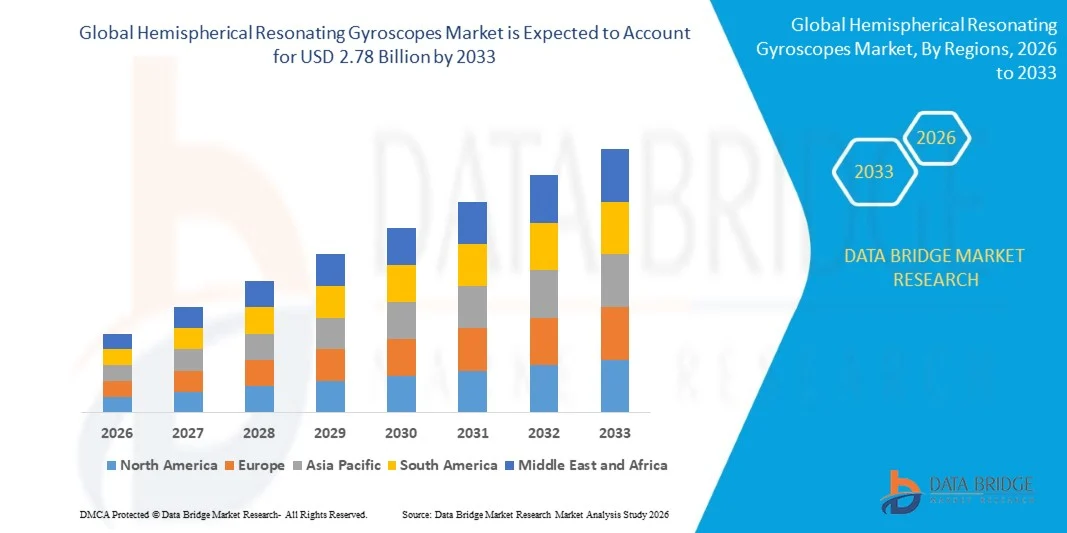
- As per Data Bridge Market Research analysis, the hemispherical resonating gyroscopes market was valued at USD 1.73 Billion in 2025 and is projected to reach USD 2.78 Billion by 2033, growing at a CAGR of 6.10% from 2026 to 2033.
- The market is experiencing steady growth driven by rising demand for satellite-independent navigation, expanding defense and aerospace modernization programs, increasing deployment of unmanned systems, and wider adoption of high-performance inertial sensors across space, marine, industrial, and electronics applications.
- The increasing reliance on resilient positioning, navigation, and timing, combined with growing integration of gyroscope technology into aircraft, missiles, satellites, and autonomous platforms, is supporting market adoption. Hemispherical resonating gyroscopes are being applied across high-performance inertial sensing systems, aerospace and defense navigation, remotely operated vehicles, and portable electronics, offering a maintenance-free solid-state sensor with no moving parts for precise measurement of angular rate and rotation.
Market Size & Forecast
- Global Market Value (2025): USD 1.73 Billion
- Expected Market Value (2033): USD 2.78 Billion
- Forecast CAGR (2026–2033): 6.10%
- Leading Region in 2025: North America
- Fastest Growing Region: Asia Pacific
What are the Major Takeaways of the Hemispherical Resonating Gyroscopes Market?
- North America dominated the hemispherical resonating gyroscopes market with the largest revenue share of 36.45% in 2025, supported by sustained defense navigation spending, the presence of established inertial sensor manufacturers, and early adoption of satellite-resilient navigation across aerospace, space, and unmanned platforms.
- Asia-Pacific is expected to be the fastest-growing region at a CAGR of 7.78% from 2026 to 2033, fueled by rising defense budgets, expanding electronics manufacturing, and rapid deployment of unmanned and handheld systems.
- The 1 axis segment led the dimension category with a 44.85% share in 2025, driven by the use of single-axis resonators as building blocks of triaxial inertial measurement units and navigation systems.
- 3 axis is the fastest-growing dimension, projected to register a CAGR of 7.65%, reflecting demand for compact multi-axis sensing in navigation, stabilization, and robotics.
- The high-end application segment dominated the application category with a 63.20% revenue share in 2025, led by defense, aerospace, space, and remotely operated vehicles requiring navigation-grade accuracy.
- The low-end application segment is the fastest-growing application category, with a CAGR of 7.40%, driven by wearables, internet of things, automotive, railway, and structural health monitoring uses.
- The market is projected to add approximately USD 1,051.95 million in incremental revenue between 2025 and 2033, expanding at 1.6 times its 2025 size.
Report Scope and Hemispherical Resonating Gyroscopes Market Segmentation
|
Attributes |
Hemispherical Resonating Gyroscopes Key Market Insights |
|
Segments Covered |
|
|
Countries Covered |
North America
Europe
Asia-Pacific
Middle East and Africa
South America
|
|
Key Market Players |
|
|
Market Opportunities |
|
|
Value Added Data Infosets |
In addition to the insights on market scenarios such as market value, growth rate, segmentation, geographical coverage, and major players, the market reports curated by the Data Bridge Market Research also include in-depth expert analysis, geographically represented company-wise production and capacity, network layouts of distributors and partners, detailed and updated price trend analysis and deficit analysis of supply chain and demand. |
What is the Key Trend in the Hemispherical Resonating Gyroscopes Market?
- Hemispherical resonating gyroscopes are increasingly moving from niche, high-cost spaceflight sensors toward scalable, mass-produced navigation components, as manufacturers industrialize resonator production, miniaturize sensor heads, and integrate digital electronics for use in aircraft, land vehicles, drones, and satellites.
- For instance, in June 2025, according to Middle East Technical University (METU), a doctoral study reported that a cost-effective aluminum hemispherical resonator gyroscope prototype achieved an angular random walk of 3.39 × 10⁻³ °/√h and a bias instability of 3.35 × 10⁻² °/h, demonstrating that navigation-grade accuracy can be approached at a fraction of the cost of traditional quartz sensors.
- Resilience to jamming and spoofing is becoming a primary design criterion, with navigation systems built around solid-state gyroscopes increasingly specified to maintain accurate trajectories when satellite signals are degraded, denied, or manipulated.
- Miniaturization is also expanding the addressable market, as scaled-down resonators bring navigation-grade performance to smaller satellites, tactical munitions, unmanned vehicles, and compact inertial measurement units.
- For instance, in February 2025, according to Micromachines (MDPI), researchers analyzing a hemispherical resonator with a midplane radius of 10 mm showed that structural parameters directly influence the thermoelastic damping quality factor and the minimum frequency difference from interference modes, which determine operating accuracy and lifespan, highlighting continued optimization of resonator geometry.
- As resonator materials, precision machining, digital control electronics, and hybrid satellite-inertial architectures continue to advance, hemispherical resonating gyroscopes are expected to expand beyond defense and space into commercial aviation, eVTOL aircraft, autonomous vehicles, marine systems, and industrial stabilization.
What are the Key Drivers of the Hemispherical Resonating Gyroscopes Market?
- Rising dependence on navigation that does not rely on satellite signals is increasing demand for high-precision inertial sensors, as aircraft, ships, missiles, and ground vehicles need to maintain accurate position and heading during jamming, spoofing, or outage events.
- For instance, in April 2026, according to the Stockholm International Peace Research Institute (SIPRI), world military expenditure reached USD 2,887 billion in 2025, an increase of 2.9% in real terms over 2024, while spending in Europe rose by 14% to USD 864 billion, expanding procurement of navigation, guidance, and targeting systems built around advanced gyroscopes.
- Growth in unmanned aerial, ground, and underwater vehicles, along with satellite constellations and next-generation aircraft, is widening the application base for compact, long-life, maintenance-free solid-state gyroscopes with no moving parts.
- For instance, in April 2026, according to SIPRI, India increased its military spending by 8.9% to USD 92.1 billion, Germany raised expenditure by 24% to USD 114 billion, and Japan increased spending by 9.7% to USD 62.2 billion in 2025, supporting regional demand for precision inertial navigation across Asia-Pacific and Europe.
- The expansion of consumer and industrial electronics, robotics, internet of things, wearable devices, and structural health monitoring is gradually creating demand for lower-cost variants, supporting volume growth alongside the established defense and aerospace base.
What Factors Are Challenging the Growth of the Hemispherical Resonating Gyroscopes Market?
- Hemispherical resonating gyroscopes require ultra-pure fused quartz or specialty-alloy resonators, ultra-precise machining, thin-film coating, vacuum encapsulation, and sophisticated control electronics, resulting in long production cycles, high capital requirements, and limited manufacturing scale.
- For instance, in January 2025, according to Sensors (MDPI), researchers studying energy dissipation in a hemispherical resonator gyroscope reported that the quality factor is mainly affected by material damping, surface loss, thermoelastic damping, and anchoring loss, and that assembly of the resonator onto the gyroscope head introduces further dissipation, highlighting the difficulty of preserving resonator performance in production.
- These requirements restrict the number of qualified suppliers, create supply-chain concentration, and keep unit prices high relative to MEMS and fiber optic alternatives, limiting adoption in cost-sensitive commercial applications.
- Performance depends on tightly controlled resonator symmetry, as small mass defects, machining errors, or surface imperfections can degrade the quality factor and frequency split, increasing calibration effort, rejection rates, and testing time.
- For instance, in August 2025, according to Applied Sciences (MDPI), researchers investigating the first four harmonic components of mass defects in hemispherical resonators found that such defects affect the quality factor and frequency split, which are critical to gyroscope performance, underscoring the technology’s sensitivity to manufacturing imperfections.
- Export controls, defense-procurement regulations, and long qualification cycles for aerospace and military programs can further delay commercialization, while competition from fiber optic, ring laser, and advancing MEMS gyroscopes constrains pricing in mid-range applications.
How is the Hemispherical Resonating Gyroscopes Market Segmented?
The hemispherical resonating gyroscopes market is segmented on the basis of dimension and application.
- By Dimension
On the basis of dimension, the hemispherical resonating gyroscopes market is segmented into 1 axis, 2 axis, and 3 axis. The 1 axis segment dominated the market with 44.85% share in 2025, supported by the use of single-axis resonators as the core sensing element in triaxial inertial measurement units, strategic navigation systems, and spacecraft attitude references. Single-axis devices offer high precision, simple integration, and flexibility to be combined into multi-gyro architectures tailored to each platform. Their long operating life and absence of wear components make them attractive for platforms that demand years of maintenance-free operation. Established qualification records in aerospace and defense programs further strengthen demand.
The 3 axis segment is projected to register the fastest growth at a CAGR of 7.65% from 2026 to 2033, driven by increasing demand for compact, integrated sensing units that reduce size, weight, power consumption, and assembly complexity. Three-axis devices are particularly suited to unmanned vehicles, small satellites, robotics, and portable navigation devices where space is limited. Advances in micro-fabrication and digital signal processing are improving the performance of multi-axis designs while lowering unit costs. Growing adoption of compact inertial measurement units in autonomous systems and wearable electronics is expected to create additional opportunities. The 2 axis segment is expected to grow steadily, supported by stabilization and tracking systems.
- By Application
On the basis of application, the hemispherical resonating gyroscopes market is segmented into low-end application and high-end application. The high-end application segment dominated the market with 63.20% share in 2025, supported by extensive use in defense, aerospace, remotely operated vehicles, industrial stabilization, and medical equipment where navigation-grade accuracy and reliability are essential. Military aircraft, missiles, spacecraft, commercial aircraft, and unmanned underwater, aerial, and ground vehicles rely on these sensors to maintain precise orientation without satellite signals. Long-term government programs, multi-year supply contracts, and rising investment in resilient navigation continue to support revenue stability in this segment.
The low-end application segment is projected to register the fastest growth at a CAGR of 7.40% from 2026 to 2033, driven by increasing use of gyroscopes in transportation, consumer electronics, and emerging internet of things deployments. Applications include automotive and railway systems, smartphones, tablets, laptops, wearable devices, portable navigation devices, digital cameras, automation, and structural health monitoring. Declining sensor costs, improved integration with other motion sensors, and the rising number of connected devices are widening adoption. Growing demand for image stabilization, virtual reality, and robotics is expected to further support volume growth, particularly in Asia-Pacific manufacturing hubs.
Which Region Holds the Largest Share of the Hemispherical Resonating Gyroscopes Market?
- North America dominated the hemispherical resonating gyroscopes market with the largest revenue share of 36.45% in 2025, supported by sustained defense navigation spending, the presence of established inertial sensor manufacturers, and early adoption of satellite-resilient navigation across aerospace, space, and unmanned platforms.
- The region also benefits from stringent government safety regulations, strong research and development funding, and a mature supply chain for precision sensors. Rising investment in hypersonic systems, space missions, and unmanned platforms continues to strengthen North America’s position, with the regional market expected to reach approximately USD 949.30 million by 2033.
U.S. Hemispherical Resonating Gyroscopes Market Insight
The U.S. hemispherical resonating gyroscopes market is witnessing strong growth due to rising investment in resilient navigation, space exploration, missile modernization, and unmanned systems. The country’s mature aerospace and defense ecosystem, along with the presence of leading inertial sensor developers and long-term government procurement programs, is driving demand for high-precision gyroscopes. In addition, growing emphasis on navigation in satellite-denied environments, hypersonic programs, and commercial space missions is accelerating adoption across military and commercial platforms.
Asia-Pacific Hemispherical Resonating Gyroscopes Market Insight
The Asia-Pacific hemispherical resonating gyroscopes market is expected to witness rapid growth, expanding at a CAGR of 7.78% from 2026 to 2033, driven by rising defense budgets, growing electronics manufacturing, and high penetration of gyroscopes in handheld devices across countries such as China, India, and Japan. Increasing deployment of unmanned vehicles, satellite programs, and smart transportation systems is supporting regional expansion. The region’s share is expected to rise from 27.35% in 2025 to 31.01% by 2033.
Japan Hemispherical Resonating Gyroscopes Market Insight
The Japan hemispherical resonating gyroscopes market is witnessing consistent growth due to rising defense spending, strong precision-electronics capabilities, and active space and robotics programs. Domestic sensor and electronics manufacturers are advancing compact, reliable gyroscopes for automotive, industrial, and consumer applications, while government investment in surveillance, maritime, and space systems supports demand for high-end inertial navigation. Strong emphasis on quality, durability, and miniaturization is further contributing to market growth in Japan.
China Hemispherical Resonating Gyroscopes Market Insight
The China hemispherical resonating gyroscopes market is growing rapidly, driven by large-scale defense modernization, expanding satellite and aerospace programs, and strong domestic electronics manufacturing. Local research institutions and manufacturers are investing in resonator design, precision machining, and domestic supply chains to reduce import dependence. Growing use of unmanned vehicles, intelligent transportation, and robotics is further boosting demand, positioning China as a key growth market for gyroscope solutions across Asia-Pacific.
U.K. Hemispherical Resonating Gyroscopes Market Insight
The U.K. hemispherical resonating gyroscopes market is experiencing steady growth, supported by sustained defense modernization, active space and unmanned-systems programs, and the presence of established inertial sensor developers. Procurement of navigation systems for military aircraft, naval vessels, and autonomous platforms is increasing demand for high-performance gyroscopes. Furthermore, collaboration between industry, research institutions, and allied defense programs is supporting wider adoption of resilient navigation technologies in the U.K.
Germany Hemispherical Resonating Gyroscopes Market Insight
The Germany hemispherical resonating gyroscopes market is expanding steadily due to the country’s strong industrial base, advanced sensor manufacturing ecosystem, and sharply higher defense spending. Aerospace, automotive, and industrial automation companies are increasingly utilizing high-precision gyroscopes for navigation, stabilization, and testing applications. Continuous advancements in sensor technology, along with Germany’s focus on precision engineering and sovereign defense capabilities, are further driving market growth in the country.
Which are the Top Companies in Hemispherical Resonating Gyroscopes Market?
The hemispherical resonating gyroscopes industry is primarily led by well-established companies, including:
- Safran Electronics & Defense (France)
- Northrop Grumman Corporation (U.S.)
- Analog Devices, Inc. (U.S.)
- STMicroelectronics (Switzerland)
- Murata Manufacturing Co., Ltd. (Japan)
- TDK Corporation (Japan)
- Bosch Sensortec GmbH (Germany)
- Seiko Epson Corp. (Japan)
- Texas Instruments Incorporated (U.S.)
- Panasonic Corporation (Japan)
- Moog Inc. (U.S.)
- Silicon Sensing Systems Limited (U.K.)
- Safran Colibrys SA (Switzerland)
- KIONIX, Inc. (U.S.)
- MEMSIC Inc. (U.S.)
- Gladiator Technologies (U.S.)
- VectorNav Technologies, LLC (U.S.)
- DYTRAN INSTRUMENTS INCORPORATED (U.S.)
- ASC GmbH (Germany)
- SHENZHEN RION TECHNOLOGY CO., LTD (China)
What are Latest Developments in Hemispherical Resonating Gyroscopes Market?
- In October 2026, Safran Electronics & Defense announced that its SkyNaute inertial navigation system, built around its patented hemispherical resonator gyroscope, will equip the Airbus A220, marking the system’s debut in commercial aviation and bringing resistance to jamming and spoofing from military aircraft, helicopters, and drones to commercial air transport.
- In July 2026, Safran was reported to be supplying inertial navigation for Eve’s eVTOL aircraft, with two SkyNaute units fitted to each aircraft using hemispherical resonant gyroscope technology to maintain navigation accuracy when satellite signals are degraded or unavailable.
- In June 2026, Safran Electronics & Defense announced a EUR 120 million investment to expand and modernize its Montluçon site in France, tripling annual hemispherical resonator gyroscope production capacity from 10,000 to 30,000 units by 2032 and supporting the creation of new jobs, as part of a EUR 1.4 billion global capacity expansion plan approved in 2025.
- In May 2026, Northrop Grumman introduced the LR-450, a compact and lightweight positioning and navigation system for space missions that uses milli-hemispherical resonating gyroscopes, scaled-down versions of the HRGs in its spacecraft inertial reference unit, building on a technology that has logged more than 70 million hours in orbit.
- In February 2026, Safran Electronics & Defense announced the delivery of its 2,500th Geonyx inertial navigation system at Enforce Tac in Nuremberg, Germany, a system based on its HRG Crystal technology designed for navigation, targeting, and artillery pointing in satellite-denied environments.
- Interactive Data Analysis Dashboard
- Company Analysis Dashboard for high growth potential opportunities
- Research Analyst Access for customization & queries
- Competitor Analysis with Interactive dashboard
- Latest News, Updates & Trend analysis
- Harness the Power of Benchmark Analysis for Comprehensive Competitor Tracking
Global Hemispherical Resonating Gyroscopes Market, Supply Chain Analysis and Ecosystem Framework
To support market growth and help clients navigate the impact of geopolitical shifts, DBMR has integrated in-depth supply chain analysis into its Global Hemispherical Resonating Gyroscopes Market research reports. This addition empowers clients to respond effectively to global changes affecting their industries. The supply chain analysis section includes detailed insights such as Global Hemispherical Resonating Gyroscopes Market consumption and production by country, price trend analysis, the impact of tariffs and geopolitical developments, and import and export trends by country and HSN code. It also highlights major suppliers with data on production capacity and company profiles, as well as key importers and exporters. In addition to research, DBMR offers specialized supply chain consulting services backed by over a decade of experience, providing solutions like supplier discovery, supplier risk assessment, price trend analysis, impact evaluation of inflation and trade route changes, and comprehensive market trend analysis.
Data collection and base year analysis are done using data collection modules with large sample sizes. The stage includes obtaining market information or related data through various sources and strategies. It includes examining and planning all the data acquired from the past in advance. It likewise envelops the examination of information inconsistencies seen across different information sources. The market data is analysed and estimated using market statistical and coherent models. Also, market share analysis and key trend analysis are the major success factors in the market report. To know more, please request an analyst call or drop down your inquiry.
The key research methodology used by DBMR research team is data triangulation which involves data mining, analysis of the impact of data variables on the market and primary (industry expert) validation. Data models include Vendor Positioning Grid, Market Time Line Analysis, Market Overview and Guide, Company Positioning Grid, Patent Analysis, Pricing Analysis, Company Market Share Analysis, Standards of Measurement, Global versus Regional and Vendor Share Analysis. To know more about the research methodology, drop in an inquiry to speak to our industry experts.
Data Bridge Market Research is a leader in advanced formative research. We take pride in servicing our existing and new customers with data and analysis that match and suits their goal. The report can be customized to include price trend analysis of target brands understanding the market for additional countries (ask for the list of countries), clinical trial results data, literature review, refurbished market and product base analysis. Market analysis of target competitors can be analyzed from technology-based analysis to market portfolio strategies. We can add as many competitors that you require data about in the format and data style you are looking for. Our team of analysts can also provide you data in crude raw excel files pivot tables (Fact book) or can assist you in creating presentations from the data sets available in the report.