


What is the Remotely Operated Vehicle Market Size and Growth Rate?
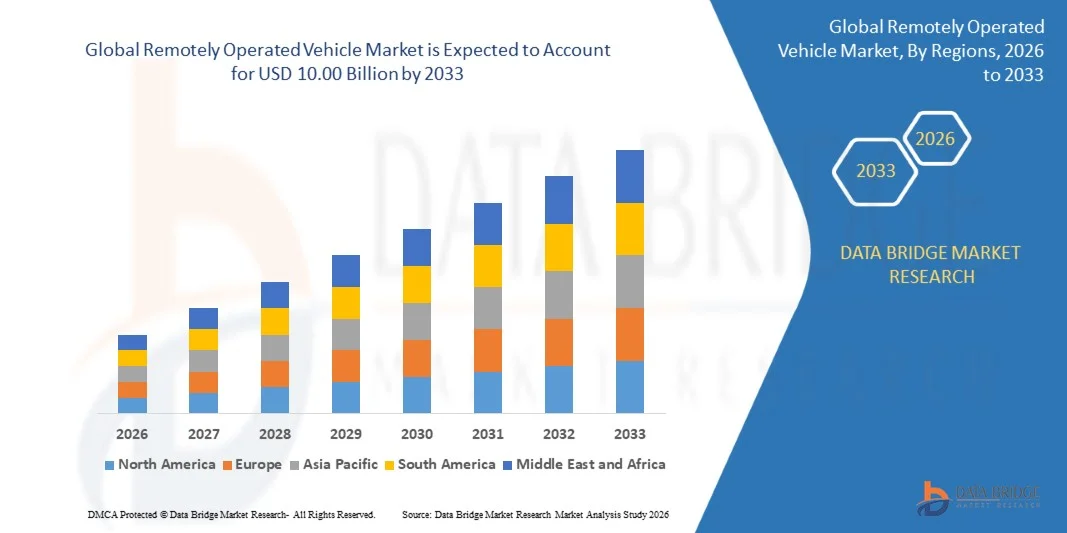
- As per Data Bridge Market Research analysis, the remotely operated vehicle market was valued at USD 4.34 billion in 2025 and is projected to reach USD 10.00 billion by 2033, growing at a CAGR of 11.01% from 2026 to 2033.
- The market is experiencing consistent growth driven by rising demand for remotely controlled vehicles in subsea services, oil and gas exploration, defense and military research, scientific research, and exploration of challenging or uncharted environments.
- The increasing need for safer and more efficient underwater inspection and exploration, combined with growing applications of remote-controlled manipulators, cameras, and advanced control systems, is encouraging oil and gas companies, defense organizations, and research institutions to adopt remotely operated vehicles. These systems enable operators to perform complex tasks and gather information in hazardous or inaccessible environments while reducing direct human exposure to operational risks.
Market Size & Forecast
- Global Market Value (2025): USD 4.34 Billion
- Expected Market Value (2033): USD 10.00 Billion
- Forecast CAGR (2026–2033): 11.01%
- Leading Region in 2025: North America
- Fastest Growing Region: Asia Pacific
What are the Major Takeaways of the Remotely Operated Vehicle Market?
- North America dominated the remotely operated vehicle market with the largest revenue share of 34.5% in 2025, supported by extensive offshore oil and gas activities, advanced subsea infrastructure, and strong defense applications.
- Asia-Pacific is expected to be the fastest-growing region at a CAGR of 11.0% from 2026 to 2033, fueled by expanding offshore exploration, deepwater field development, rising defense investments, and increasing adoption of subsea technologies.
- The electronics & control systems segment led the market with a 35% share in 2025, driven by the increasing integration of advanced control units, sensors, navigation systems, communication interfaces, and monitoring technologies.
- Camera & lighting systems are the fastest-growing system corporation type, projected to register a CAGR of 12.0%, reflecting the surge in demand for high-resolution underwater imaging and improved visibility during subsea operations.
- The electric ROV segment dominated the propulsion category with a 55.5% revenue share in 2025, led by increasing preference for efficient, precise, and environmentally compatible propulsion technologies.
- Work class vehicle accounted for 44.6% of the market share in 2025, preferred by extensive use in deepwater oil and gas operations, subsea construction, inspection, maintenance, and intervention.
- The military & defence segment is the fastest-growing industry category, with a CAGR of 8.6%, driven by increasing requirements for underwater surveillance, reconnaissance, search and rescue, mine detection, and maritime security.
Report Scope and Remotely Operated Vehicle Market Segmentation
|
Attributes |
Remotely Operated Vehicle Key Market Insights |
|
Segments Covered |
|
|
Countries Covered |
North America
Europe
Asia-Pacific
Middle East and Africa
South America
|
|
Key Market Players |
|
|
Market Opportunities |
|
|
Value Added Data Infosets |
In addition to the market insights such as market value, growth rate, market segments, geographical coverage, market players, and market scenario, the market report curated by the Data Bridge Market Research team includes in-depth expert analysis, import/export analysis, pricing analysis, production consumption analysis, and pestle analysis. |
What is the Key Trend in the Remotely Operated Vehicle Market?
- Remotely operated vehicle operations are increasingly shifting toward remote and uncrewed subsea operations, with ROVs being integrated with uncrewed surface vessels, shore-based control centers, and advanced electric systems to reduce offshore personnel exposure and improve operational efficiency.
- For instance, in February 2025, Fugro mobilized its Fugro Vaquita uncrewed surface vessel and Blue Volta electric ROV for a 330-day Petrobras campaign, enabling 100% remote subsea inspections from shore at depths of up to 250 meters without offshore personnel.
- Integration of remote-control, autonomous navigation, and real-time communications is enabling operators to perform subsea inspection, maintenance, and survey activities with fewer personnel and reduced dependence on conventional crewed support vessels.
- Offshore wind developers are increasingly adopting compact ROVs for in-water surveys, turbine foundation inspections, subsea cable monitoring, and other maintenance activities, expanding ROV applications beyond traditional oil and gas operations.
- For instance, in April 2025, Louis Dreyfus Armateurs and MaDfly deployed an ROV at the Hornsea 2 offshore wind farm, completing an in-water survey in open-sea conditions with swells of up to two meters while the vessel remained operational.
- As offshore energy operators increasingly prioritize uncrewed operations, lower personnel exposure, and faster subsea inspection, the integration of ROVs with remote-control systems and uncrewed vessels is expected to accelerate, reinforcing remote robotics as a core component of next-generation offshore operations.
What are the Key Drivers of the Remotely Operated Vehicle Market?
- The expansion of offshore oil and gas exploration, deepwater production, and subsea infrastructure has significantly increased demand for ROVs capable of inspection, maintenance, repair, construction, and intervention activities in hazardous underwater environments.
- For instance, in August 2025, Oceaneering secured approximately USD 180 million in subsea robotics contracts from Petrobras, covering work-class ROV services, specialized tooling, surveys, inspection, maintenance, repair, decommissioning, FPSO hook-ups, and mooring inspections offshore Brazil.
- Offshore operators are increasingly integrating ROVs into subsea asset integrity and inspection programs because remotely controlled systems can operate at depths and in conditions where conventional diver-based operations are more difficult and hazardous.
- For instance, in September 2025, Fugro secured two three-year contracts to deploy FCV 3000 ROV systems for deepwater exploration in Brazil's Campos Basin and Equatorial Margin, with subsea equipment inspections and interventions forming part of the scope.
- With offshore exploration, subsea infrastructure development, and deepwater asset maintenance continuing to require reliable robotic intervention, ROVs will remain essential for improving operational safety, extending inspection capabilities, and supporting complex underwater activities.
What Factors are Challenging the Growth of the Remotely Operated Vehicle Market?
- Advanced work-class ROV systems require substantial capital investment because deployment involves the vehicle, launch and recovery equipment, specialized tooling, control systems, support vessels, and highly trained offshore personnel.
- For instance, in April 2026, Boskalis announced an investment of GBP 40 million in ROVs and its new Remote Operations Center in Aberdeen, following an 18-month development program, demonstrating the substantial capital required to establish advanced ROV and remote-operation capabilities.
- These high acquisition and operating costs can limit adoption among smaller subsea service providers and organizations with restricted capital budgets, particularly when projects require dedicated vessels and specialized ROV infrastructure.
- The financial burden is further increased by fleet upgrades, vessel mobilization, equipment maintenance, and specialist training requirements, while the availability of experienced ROV personnel can also constrain deployment capacity.
- For instance, in September 2025, Reach Subsea announced USD 62.4 million investment in two remotely operated uncrewed surface vessels, with the vessels designed to support remote ROV operations and subsea surveys, highlighting the substantial capital requirements associated with deploying integrated remote subsea systems.
- The combination of high equipment expenditure, vessel-related operating costs, maintenance requirements, and skilled-labor needs continues to create a significant cost barrier, particularly for smaller operators, potentially slowing wider adoption of sophisticated ROV systems despite increasing demand for subsea robotics.
How is the Remotely Operated Vehicle Market Segmented?
The remotely operated vehicle market is segmented on the basis of system component, propulsion, vehicle type, and industry.
- By System Component
On the basis of system component, the remotely operated vehicle market is segmented into electronics & control systems, frame & propulsion, camera & lighting systems, and others. The electronics & control systems segment dominated the market with 35.0% share in 2025, owing to the increasing integration of control units, sensors, navigation systems, communication interfaces, and monitoring technologies. These systems enable operators to control ROV movement and monitor underwater conditions with greater precision. They also facilitate the transmission and processing of video, sensor, and operational data from subsea environments. Increasing deployment of ROVs for deepwater inspection and intervention is strengthening demand for sophisticated electronic architectures. Integration of digital controls and high-bandwidth communication is further improving operational efficiency.
The camera & lighting systems segment is projected to register the fastest growth at CAGR of 12.0% during forecast period, driven by increasing demand for high-resolution underwater imaging and improved visibility during subsea operations. Advanced cameras enable operators to inspect pipelines, offshore structures, vessels, and underwater equipment in real time. Improvements in LED lighting are enhancing visibility in deep, dark, and turbid underwater environments. Increasing use of high-definition and low-light imaging is further improving inspection accuracy. Offshore energy, marine research, defense, and infrastructure applications are expanding demand for advanced visual systems. Integration of cameras with digital data transmission and monitoring platforms is also supporting segment development.
- By Propulsion
On the basis of propulsion, the remotely operated vehicle market is segmented into electric ROV, mechanical ROV, and hybrid ROV. The electric ROV segment dominated the market with a 55.5% share in 2025, supported by increasing preference for efficient, precise, and environmentally compatible propulsion technologies. Electric propulsion provides responsive thrust control and is suitable for a wide range of inspection and survey missions. These systems also reduce dependence on hydraulic fluids, supporting deployment in environmentally sensitive marine environments. Advances in electric thrusters, batteries, and power-management technologies are improving operational capabilities. Offshore wind, marine infrastructure, research, and inspection applications are creating additional demand for electric ROV platforms.
The hybrid ROV segment is projected to register the fastest growth at CAGR of 15.0% during forecast period, driven by increasing demand for longer endurance and greater operational flexibility. Hybrid systems combine different propulsion and energy technologies to address the requirements of complex subsea missions. They can provide efficient operation while supporting higher-power activities when required. Increasing demand for resident ROVs and extended underwater missions is supporting development of hybrid architectures. Offshore energy, defense, and scientific research applications are creating additional demand for flexible propulsion platforms. Hybrid technology can also improve mission flexibility where conventional propulsion systems face power or endurance limitations.
- By Vehicle Type
On the basis of vehicle type, the remotely operated vehicle market is segmented into observation vehicle, work class vehicle, and towed & bottom-crawling vehicle. The work class vehicle segment dominated the market with a 44.6% share in 2025, driven by extensive use in deepwater oil and gas operations, subsea construction, inspection, maintenance, and intervention. Work-class ROVs provide high power, substantial payload capacity, and sophisticated manipulator systems for demanding underwater activities. They can carry specialized tooling required for pipeline intervention, drilling support, and subsea construction. Their ability to operate at substantial depths reduces the need for direct human exposure to hazardous underwater environments. Growing deepwater exploration and subsea asset maintenance are sustaining demand for these systems.
The observation vehicle segment is projected to witness the fastest growth at CAGR of 11.2% during forecast period, reflecting increasing demand for compact and versatile ROVs used in inspection, monitoring, research, and survey applications. Observation vehicles are generally easier to deploy than large work-class systems and can operate from comparatively smaller vessels. Their applications include underwater infrastructure inspection, marine research, aquaculture monitoring, environmental surveys, and ship-hull inspection. Increasing demand for frequent visual inspections is creating additional deployment opportunities for lightweight ROV platforms. Advances in cameras, sensors, navigation, and real-time data transmission are improving their capabilities.
- By Industry
On the basis of industry, the remotely operated vehicle market is segmented into oil & gas application, military & defence, scientific research, and others. The oil & gas application segment dominated the market with a 47.3% share in 2025, supported by extensive ROV deployment across offshore exploration, drilling support, subsea inspection, pipeline monitoring, maintenance, and intervention. ROVs are essential for inspecting and servicing subsea infrastructure where diver-based operations can be hazardous or impractical. Increasing deepwater and ultra-deepwater activities are creating sustained requirements for high-capability work-class vehicles. Aging offshore assets also require regular inspection and maintenance to preserve operational integrity. Oil and gas operators continue to use ROVs for construction, repair, decommissioning, and field-development activities.
The military & defence segment is projected to register the fastest growth at CAGR of 8.6% during forecast period, driven by increasing requirements for underwater surveillance, reconnaissance, search and rescue, mine detection, and maritime security. Defense organizations are deploying ROVs to conduct underwater missions while reducing personnel exposure to hazardous environments. Advanced cameras, sonar, navigation systems, and manipulators are improving their suitability for complex defense operations. Growing maritime security requirements are encouraging investment in underwater inspection and surveillance capabilities. ROVs are also used for inspection of naval vessels, harbors, ballast tanks, and underwater infrastructure.
Which Region Holds the Largest Share of the Remotely Operated Vehicle Market?
- North America dominated the remotely operated vehicle market with the largest revenue share of 34.5% in 2025, supported by extensive offshore oil and gas activities, advanced subsea infrastructure, and strong defense applications
- The region also benefits from established offshore energy activities in the U.S. Gulf of Mexico, increasing deployment of ROVs for subsea inspection and intervention, and growing adoption across defense, offshore wind, and marine research applications. Continued investment in deepwater projects and advanced underwater robotics is expected to strengthen North America's leading position in the global market.
U.S. Remotely Operated Vehicle Market Insight
The U.S. remotely operated vehicle market is witnessing steady growth due to extensive offshore oil and gas activities, advanced subsea infrastructure, and increasing deployment of ROVs for inspection, maintenance, repair, and intervention operations. The country’s established offshore energy ecosystem, particularly in the Gulf of Mexico, along with the presence of major subsea technology and service providers, is driving demand for work-class and observation-class ROVs. In addition, growing investments in offshore wind, defense, marine research, and underwater infrastructure are expanding ROV applications. The replacement and upgrading of existing ROV fleets is also supporting continued market development.
Asia-Pacific Remotely Operated Vehicle Market Insight
The Asia-Pacific remotely operated vehicle market is expected to witness rapid growth, driven by expanding offshore energy activities, deepwater project development, and increasing demand for subsea inspection and maintenance across countries such as China, Japan, India, and Australia. Rising investments in maritime security, underwater infrastructure, offshore wind, and scientific exploration are supporting regional adoption. China accounted for 46.3% of the Asia-Pacific ROV market in 2025, reflecting its extensive offshore energy activities and investments in underwater technologies. Increasing demand for remotely operated systems across oil and gas, defense, and marine research is further strengthening regional market expansion.
Japan Remotely Operated Vehicle Market Insight
The Japan remotely operated vehicle market is witnessing consistent growth due to increasing demand for underwater infrastructure inspection, marine resource development, offshore renewable energy, and scientific research. ROVs are already used for infrastructure maintenance and seabed surveys in shallow waters, while growing offshore wind development is creating additional requirements for underwater inspection technologies. Japan’s labor shortages and focus on cost-effective marine operations are also encouraging greater adoption of robotic underwater systems. Government and research institutions are investing in underwater robotics, seafloor-resource exploration, and marine renewable-energy technologies. These developments are supporting continued demand for advanced ROV and subsea robotic solutions.
China Remotely Operated Vehicle Market Insight
The China remotely operated vehicle market is growing rapidly, driven by expanding offshore energy exploration, subsea infrastructure development, maritime security, and underwater robotics research. China accounted for 33.04% of the Asia-Pacific AUV & ROV market in 2025, supported by its established offshore energy sector, maritime engineering capabilities, and extensive subsea operations ecosystem. Increasing adoption of remotely operated and autonomous underwater technologies across defense, marine research, and commercial applications is further supporting market demand. Investments in offshore infrastructure and advanced underwater inspection technologies are expanding the use of ROVs. Growing requirements for monitoring, maintenance, and subsea intervention are expected to continue supporting China's market development.
U.K. Remotely Operated Vehicle Market Insight
The U.K. remotely operated vehicle market is experiencing steady growth, supported by established offshore oil and gas operations, expanding offshore wind projects, and increasing requirements for subsea inspection and maintenance. ROVs are extensively used across offshore energy and underwater infrastructure activities, including inspection, repair, maintenance, and subsea engineering services. The country's growing offshore wind sector is creating additional demand for ROV-based seabed surveys and asset-integrity services. For instance, in April 2025, GEOxyz secured a multi-year agreement with ScottishPower Renewables for subsea operations and maintenance services at the East Anglia Hub, including ROV and geophysical seabed survey services. These developments are strengthening the role of ROV technology across the U.K.'s offshore energy sector.
Germany Remotely Operated Vehicle Market Insight
The Germany remotely operated vehicle market is expanding steadily due to growing offshore wind development, subsea infrastructure inspection, and underwater maintenance requirements. The country's offshore renewable-energy sector is creating recurring demand for ROVs to inspect turbine foundations, subsea cables, and other underwater infrastructure. Increasing requirements for commercial ROV inspections and critical subsea infrastructure surveillance are further supporting adoption. Germany's strong engineering capabilities and focus on electrification and efficient underwater technologies are also encouraging the development of advanced ROV solutions. In addition, defense, marine research, and industrial underwater inspection applications are broadening the country's ROV demand beyond offshore energy.
Which are the Top Companies in Remotely Operated Vehicle Market?
The remotely operated vehicle industry is primarily led by well-established companies, including:
- Oceaneering International, Inc. (U.S.)
- TechnipFMC plc (U.K.)
- Subsea 7 S.A. (U.K.)
- Fugro N.V. (Netherlands)
- DOF Group ASA (Norway)
- Saipem S.p.A. (Italy)
- Helix Energy Solutions Group, Inc. (U.S.)
- Forum Energy Technologies, Inc. (U.S.)
- Saab AB (Sweden)
- Kongsberg Maritime AS (Norway)
- DeepOcean AS (Norway)
- Deep Trekker Inc. (Canada)
- Blue Robotics Inc. (U.S.)
- SEAMOR Marine Ltd. (Canada)
- Nauticus Robotics, Inc. (U.S.)
- Outland Technology, Inc. (U.S.)
- IKM Subsea AS (Norway)
- MacArtney A/S (Denmark)
- Rovco Ltd (U.K.)
- Seatools B.V. (Netherlands)
What are Latest Developments in Remotely Operated Vehicle Market?
- In August 2025, Oceaneering announced that its Brazilian subsidiary, Marine Production Systems do Brasil, had been awarded multiple Subsea Robotics contracts by Petrobras with an anticipated aggregate value of approximately USD 180 million. The contracts cover work-class remotely operated vehicle (ROV) services, specialized tooling, survey services, subsea inspection, maintenance and repair, decommissioning, FPSO hook-ups, mooring inspections, and pile installations across offshore Brazil. The development strengthens Oceaneering’s ROV presence in Brazil and demonstrates continued deployment of subsea robotics for complex offshore energy operations.
- In February 2024, Oceaneering announced the successful completion of its first onshore piloting of a remotely operated vehicle from its Onshore Remote Operations Center in Macaé, Brazil. Conducted in collaboration with Petrobras, the operation used secure offshore connectivity and low-latency communications to remotely control a heavy work-class ROV from shore for inspection and intervention activities. The milestone demonstrated the growing integration of remote operations with ROV technology to reduce offshore personnel exposure while improving operational efficiency and specialized subsea service delivery.
- In April 2023, Fugro successfully completed the world’s first fully remote inspection of offshore wind farm assets using its Blue Essence uncrewed surface vessel together with the Blue Volta electric remotely operated vehicle. Conducted at the Aberdeen offshore wind farm in the North Sea, the system enabled the ROV to be remotely launched, recovered, and operated from Fugro’s Remote Operations Centre in Aberdeen. The development demonstrated the expanding use of ROV technology beyond traditional oil and gas applications into offshore wind inspection and maintenance.
- In January 2022, TechnipFMC announced the successful completion of proof-of-concept trials for remote piloting of its UHD 18 remotely operated vehicle from shore. The trials connected a pilot in Aberdeen with an ROV operating hundreds of miles away off the coast of Norway using satellite communications and video streaming technology. The demonstration tested ROV flight control, subsea equipment inspection, waypoint navigation, target collection, and low-latency video and audio transmission, highlighting the development of remote ROV operations and vessel digitalization.
- In December 2021, Oceaneering announced the successful completion of the first onshore remote piloting of a remotely operated vehicle in the U.K. sector for bp. The operation was conducted from Oceaneering’s Onshore Remote Operations Center in Stavanger, Norway, while the ROV supported drilling operations at bp’s Clair Ridge facility west of Shetland. The project established a cross-border model for remote ROV operations and demonstrated how secure offshore connectivity could enable subsea activities to be controlled from shore while reducing personnel exposure and the environmental footprint of offshore work.

- Interactive Data Analysis Dashboard
- Company Analysis Dashboard for high growth potential opportunities
- Research Analyst Access for customization & queries
- Competitor Analysis with Interactive dashboard
- Latest News, Updates & Trend analysis
- Harness the Power of Benchmark Analysis for Comprehensive Competitor Tracking
Data collection and base year analysis are done using data collection modules with large sample sizes. The stage includes obtaining market information or related data through various sources and strategies. It includes examining and planning all the data acquired from the past in advance. It likewise envelops the examination of information inconsistencies seen across different information sources. The market data is analysed and estimated using market statistical and coherent models. Also, market share analysis and key trend analysis are the major success factors in the market report. To know more, please request an analyst call or drop down your inquiry.
The key research methodology used by DBMR research team is data triangulation which involves data mining, analysis of the impact of data variables on the market and primary (industry expert) validation. Data models include Vendor Positioning Grid, Market Time Line Analysis, Market Overview and Guide, Company Positioning Grid, Patent Analysis, Pricing Analysis, Company Market Share Analysis, Standards of Measurement, Global versus Regional and Vendor Share Analysis. To know more about the research methodology, drop in an inquiry to speak to our industry experts.
Data Bridge Market Research is a leader in advanced formative research. We take pride in servicing our existing and new customers with data and analysis that match and suits their goal. The report can be customized to include price trend analysis of target brands understanding the market for additional countries (ask for the list of countries), clinical trial results data, literature review, refurbished market and product base analysis. Market analysis of target competitors can be analyzed from technology-based analysis to market portfolio strategies. We can add as many competitors that you require data about in the format and data style you are looking for. Our team of analysts can also provide you data in crude raw excel files pivot tables (Fact book) or can assist you in creating presentations from the data sets available in the report.













