


Hemp-Derived Cannabidiol Market Size
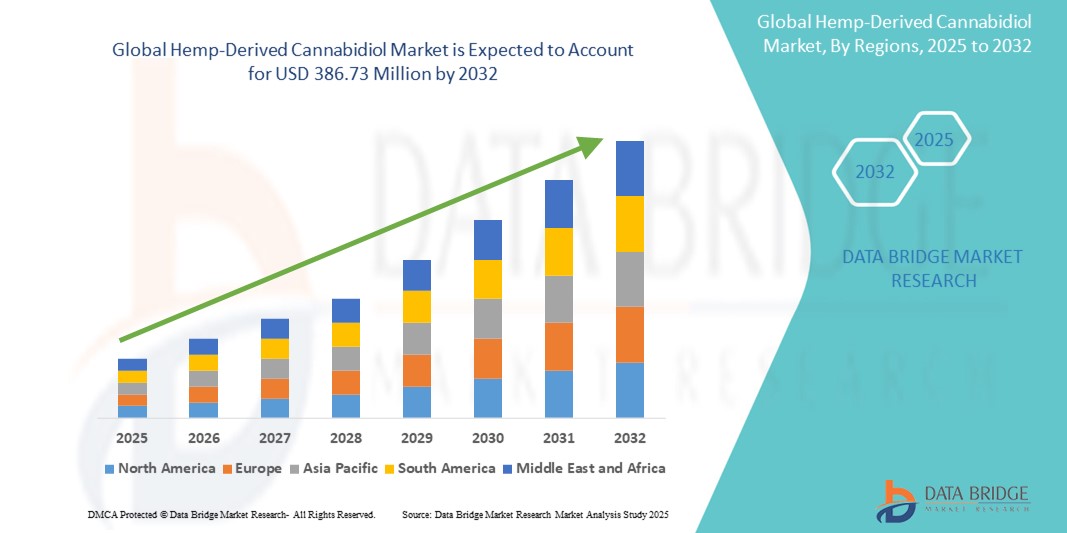
- The global hemp-derived cannabidiol market size was valued at USD 221.74 million in 2024 and is expected to reach USD 386.73 million by 2032, at a CAGR of 7.20% during the forecast period
- The market growth is largely fueled by the increasing awareness of the therapeutic benefits of hemp-derived cannabidiol (CBD) in managing conditions such as chronic pain, anxiety, epilepsy, and inflammation, leading to widespread product innovation and medical research across the globe
- Furthermore, rising demand for non-psychoactive, plant-based health and wellness solutions and the legalization of hemp cultivation in several countries are establishing hemp-derived cannabidiol solutions as a mainstream health product. These converging factors are accelerating the uptake of hemp-derived cannabidiol solutions, thereby significantly boosting the industry's growth
Hemp-Derived Cannabidiol Market Analysis
- The Hemp-Derived Cannabidiol Market is experiencing substantial growth due to rising public awareness of its therapeutic potential, expanding legalization across various countries, and increasing demand for natural alternatives to conventional pharmaceuticals. Key applications include pain management, anxiety reduction, neuroprotection, and anti-inflammatory effects
- Government initiatives supporting the use of cannabidiol in medical settings, combined with ongoing research into its efficacy across conditions such as epilepsy, arthritis, and insomnia, are driving wider acceptance and product innovation in the market
- North America dominated the hemp-derived cannabidiol market with the largest revenue share of 39.6% in 2024, supported by progressive regulatory frameworks in the U.S. and Canada, growing consumer preference for wellness products, and a well-established retail and e-commerce infrastructure. The U.S. remains the market leader due to robust product availability, brand awareness, and significant investments in R&D and marketing by domestic players
- Asia-Pacific is expected to be the fastest-growing region in the hemp-derived cannabidiol market during the forecast period, owing to changing regulatory stances, increasing mental health awareness, and a growing aging population. Countries such as Japan, China, and Australia are witnessing surging demand for CBD-based therapeutic and cosmetic products, supported by cross-border e-commerce and global brand penetration
- The CBD hemp oil segment dominated the hemp-derived cannabidiol market with a market share of 45.2% in 2024, driven by its widespread use across nutraceuticals, personal care products, and therapeutic formulations. The surge in demand is largely attributed to its anti-inflammatory and neuroprotective properties, making it a preferred choice in both wellness and clinical applications
Report Scope and Hemp-Derived Cannabidiol Market Segmentation
|
Attributes |
Hemp-Derived Cannabidiol Key Market Insights |
|
Segments Covered |
|
|
Countries Covered |
North America
Europe
Asia-Pacific
Middle East and Africa
South America
|
|
Key Market Players |
|
|
Market Opportunities |
|
|
Value Added Data Infosets |
In addition to the insights on market scenarios such as market value, growth rate, segmentation, geographical coverage, and major players, the market reports curated by the Data Bridge Market Research also include in-depth expert analysis, pricing analysis, brand share analysis, consumer survey, demography analysis, supply chain analysis, value chain analysis, raw material/consumables overview, vendor selection criteria, PESTLE Analysis, Porter Analysis, and regulatory framework. |
Hemp-Derived Cannabidiol Market Trends
“Increased Use in Wellness and Therapeutics”
- A key trend in the hemp-derived cannabidiol market is the growing integration of CBD into health and wellness products, including skincare, dietary supplements, and functional beverages. This shift is supported by increasing consumer awareness of cannabidiol's potential benefits for anxiety, sleep disorders, inflammation, and chronic pain.
- For instance, several cosmetics and personal care brands across Europe and North America are incorporating hemp-derived CBD in anti-aging and anti-inflammatory product lines, aiming to capture the clean-label and natural ingredients market.
- In addition, ongoing scientific studies are improving public understanding of CBD’s therapeutic value, particularly in conditions such as epilepsy (e.g., Lennox-Gastaut syndrome), which is encouraging the development of targeted formulations and regulatory approvals.
- The market is also witnessing innovations in delivery methods—such as water-soluble CBD, nanoemulsions, and transdermal patches—aimed at enhancing bioavailability and user convenience, supporting broader mainstream acceptance.
- The legalization and decriminalization of cannabis-derived products across major markets including the U.S., Canada, Germany, and Thailand are creating favorable regulatory landscapes, accelerating product innovation, and enabling large-scale commercial distribution of CBD-based products
- Rising consumer interest in plant-based and holistic health remedies is driving demand for full-spectrum and broad-spectrum hemp-derived cannabidiol formulations, perceived as offering enhanced "entourage effects" due to the presence of multiple cannabinoids and terpenes
- E-commerce channels are playing a pivotal role in the growth of the CBD industry, enabling direct-to-consumer strategies and allowing brands to expand their global footprint with minimal infrastructure investment
- Partnerships between CBD product manufacturers and pharmaceutical, food & beverage, and cosmetic companies are increasing, as established players seek to enter or expand their presence in the growing CBD market through strategic collaborations and co-branded offerings
- Increasing investment in clinical research and pharmacological studies is providing credibility and scientific backing for CBD efficacy, helping to overcome consumer skepticism and positioning CBD products as evidence-based alternatives in the medical and wellness space
- In addition, consumer demand for transparency and safety is encouraging companies to adopt third-party lab testing, clear labeling, and sustainable sourcing
Hemp-Derived Cannabidiol Market Dynamics
Driver
“Rising Legalization and Consumer Demand for Plant-Based Alternatives”
- One of the primary growth drivers of the Hemp-Derived Cannabidiol Market is the increasing legalization of hemp and CBD products across major economies, including the U.S., Canada, U.K., Germany, and several Asia-Pacific countries
- For instance, the U.S. Farm Bill of 2018 legalized hemp cultivation, dramatically expanding the industrial and medicinal hemp market. Similarly, in Europe, the European Commission's reclassification of CBD as a novel food has opened new product pathways
- Growing consumer preference for plant-based and natural health remedies, especially among Millennials and Gen Z, is fueling demand for CBD-infused products in both medical and wellness sectors
- Furthermore, the rise in mental health awareness and the search for alternatives to synthetic pharmaceuticals have led to increased interest in hemp-derived CBD for anxiety, depression, and sleep issues, expanding the market’s potential
Restraint/Challenge
“Regulatory Uncertainty and Product Quality Concerns”
- A major challenge in the hemp-derived cannabidiol market is the lack of consistent regulatory frameworks across countries and even within regions, which creates uncertainty for manufacturers and retailers
- For instance, while CBD is federally legal in the U.S., state-level laws vary widely in terms of permissible concentrations and sale channels. In Europe, some countries treat CBD as a narcotic, while others allow over-the-counter sales
- In addition, product mislabeling, contamination risks, and inconsistent CBD content in over-the-counter formulations have raised quality concerns among consumers and regulators alike
- According to various lab tests and studies, many commercially available CBD products fail to meet labeling claims, reducing consumer trust and prompting stricter oversight
- To address this, companies are investing in third-party lab testing, transparent labeling, and Good Manufacturing Practice (GMP) certifications to assure quality and build consumer confidence
- Without harmonized regulations and stricter quality controls, market growth could be limited by consumer hesitancy and enforcement actions from authorities
Hemp-Derived Cannabidiol Market Scope
The hemp-derived cannabidiol market is segmented on the basis of type, product type, application, end-users, and distribution channel.
- By Type
On the basis of type, the hemp-derived cannabidiol market is segmented into hemp fiber, hemp seed, hemp seed Oil, and CBD Hemp Oil. CBD Hemp Oil held the largest market revenue share of 45.2% in 2024, driven by its widespread use across nutraceuticals, personal care products, and therapeutic formulations. The surge in demand is largely attributed to its anti-inflammatory and neuroprotective properties.
Hemp Fiber is expected to witness the fastest CAGR from 2025 to 2032, fueled by its increasing use in textiles, construction materials, and bioplastics, particularly in eco-conscious markets.
- By Product Type
On the basis of product type, the hemp-derived cannabidiol market is segmented into Hemp-derived CBD Distillate, Hemp-derived CBD Isolate, Hemp-derived CBD Terpenes, and others. Hemp-derived CBD Isolate dominated the market with a revenue share of 38.6% in 2024, as it offers the highest purity of cannabidiol without THC content, making it a preferred choice in regulated therapeutic and cosmetic products.
Hemp-derived CBD Distillate is anticipated to grow at the fastest CAGR from 2025 to 2032, due to its full-spectrum properties and higher effectiveness in holistic wellness applications.
- By Application
On the basis of application, the hemp-derived cannabidiol market is segmented into nutraceuticals, atopic dermatitis, seizure, anxiety, high cholesterol, and others. Nutraceuticals accounted for the largest share of 33.1% in 2024, owing to the rising trend of functional wellness and preventive healthcare. CBD’s incorporation into supplements, beverages, and edibles continues to expand.
Seizure treatment applications is expected to witness the fastest CAGR from 2025 to 2032, due to increasing clinical support and the successful use of CBD in conditions like Lennox-Gastaut and Dravet syndrome.
- By End-Users
On the basis of end-users, the hemp-derived cannabidiol market is segmented into clinics, hospitals, and others. Hospitals led the segment with a market share of 61.9% in 2024, due to advanced infrastructure, patient trust, and access to prescription-based cannabinoid therapeutics for chronic conditions.
Clinics is expected to witness the fastest CAGR from 2025 to 2032, due to the increasing number of specialized cannabinoid-focused treatment centers and their role in patient education and monitoring.
- By Distribution Channel
On the basis of distribution channel, the hemp-derived cannabidiol market is segmented into hospital pharmacy, retail pharmacy, and online pharmacy. Hospital Pharmacies held the largest market revenue share of 54.7% in 2024, supported by regulated dispensing of prescription CBD medications and chronic disease management protocols.
Online Pharmacies are projected to witness the highest CAGR due to the rising popularity of e-commerce, ease of product comparison, discreet purchasing, and broader access in underserved geographies.
Hemp-Derived Cannabidiol Market Regional Analysis
- North America dominated the hemp-derived cannabidiol market with the largest revenue share of 39.6% in 2024, driven by the increasing burden of co-infections with Hepatitis B virus (HBV), advanced healthcare infrastructure, and strong emphasis on early diagnosis and treatment
- The region benefits from wide access to interferon-based therapies and newly approved antiviral agents, with growing adoption of diagnostic screening in high-risk populations
- Government-supported hepatitis elimination programs and clinical research collaborations are further supporting regional market expansion
U.S. Hemp-Derived Cannabidiol Market Insight
The U.S. hemp-derived cannabidiol market captured the largest revenue share of 71.05% within North America in 2024, driven by proactive screening programs, high healthcare spending, and FDA approvals of innovative Hemp-Derived Cannabidiol drugs. Increasing awareness about chronic liver diseases, availability of specialized hepatology centers, and a large population of HBV-infected individuals fuel demand. The market is expected to grow steadily, supported by national health policies, access to clinical trials, and continued innovation in diagnostic and therapeutic approaches.
Europe Hemp-Derived Cannabidiol Market Insight
The Europe hemp-derived cannabidiol market is projected to expand at a considerable CAGR from 2025 to 2032, owing to rising prevalence of Hepatitis B and D co-infections in Eastern and Southern Europe. Europe accounted for a market share of 24.7% in 2024, with Germany, the U.K., France, and Italy leading in the adoption of screening protocols and treatment guidelines. Efforts by the European Association for the Study of the Liver (EASL) and local health authorities are fostering increased disease awareness and access to therapies.
U.K. Hemp-Derived Cannabidiol Market Insight
The U.K. hemp-derived cannabidiol market accounted for 17.9% of the European market share in 2024, fueled by NHS-backed screening programs, rising liver disease cases, and availability of HDV-targeted therapies. Market growth is further supported by public health initiatives aimed at reducing transmission, along with academic and pharmaceutical research partnerships.
Germany Hemp-Derived Cannabidiol Market Insight
The Germany hemp-derived cannabidiol market captured 21.6% of Europe’s market share in 2024, supported by high healthcare investment, advanced diagnostic capabilities, and a robust framework for treating viral hepatitis. National strategies focusing on early diagnosis and increasing clinical trial participation are further contributing to the country's market leadership.
Asia-Pacific Hemp-Derived Cannabidiol Market Insight
The Asia-Pacific hemp-derived cannabidiol market is poised to grow at the fastest CAGR of 19.7% from 2025 to 2032, driven by the high HBV prevalence in countries like China, India, and Southeast Asia. The region accounted for a market share of 22.3% in 2024, with governments increasingly integrating HDV screening into HBV management programs. Improved healthcare access, growing awareness campaigns, and international collaborations are accelerating market penetration.
Japan Hemp-Derived Cannabidiol Market Insight
The Japan hemp-derived cannabidiol market held a market share of 16.4% in Asia-Pacific in 2024, supported by early adoption of innovative treatments and strong emphasis on liver health in national healthcare policy Rising prevalence of chronic HBV and aging population dynamics are fueling demand for regular liver screenings and targeted antivirals.
China Hemp-Derived Cannabidiol Market Insight
The China hemp-derived cannabidiol market accounted for the largest share in the Asia-Pacific region at 43.2% in 2024, due to its large HBV-infected population, government-backed hepatitis control programs, and expanding diagnostic and treatment access. The “Healthy China 2030” initiative, local pharmaceutical manufacturing, and large-scale screening campaigns are key factors driving rapid market growth.
Hemp-Derived Cannabidiol Market Share
The hemp-derived cannabidiol industry is primarily led by well-established companies, including:
- Groff North America Hemplex (U.S.)
- Biophore (India)
- Johnson Matthey (U.K.)
- Curia Inc. (U.S.)
- Wavelength (U.S.)
- Noramco (U.S.)
- Purisys (U.S.)
- Xi'an Tian Guangyuan Biotech Co., Ltd. (China)
- Agno Pharma (U.S.)
Latest Developments in Global Hemp-Derived Cannabidiol Market
- In August 2021, L Catterton and Crown Laboratories announced the acquisition of StriVectin, reflecting a growing trend of major investments in skincare companies. This move could potentially influence the hemp-derived cannabidiol (CBD) market as skincare products often incorporate CBD for its purported benefits. With a focus on expanding skincare portfolios, this acquisition might lead to increased competition and innovation within the CBD skincare sector
- In June 2021, Biomérieux launched the REVEAL Rapid AST system in Europe, highlighting the importance of rapid diagnostic solutions in healthcare. While not directly related to hemp-derived CBD, advancements in diagnostic technology can indirectly impact the CBD market by promoting health awareness and facilitating better patient outcomes. Enhanced diagnostic capabilities could potentially drive demand for CBD products as consumers seek holistic wellness solutions
- In April 2021, Jordana Brewster collaborated with Clearblue for the Real Talk with Conceivinghood Campaign, shedding light on fertility issues. While fertility awareness may not directly intersect with the CBD market, campaigns promoting women's health and wellness align with the ethos of the CBD industry, which often emphasizes holistic approaches to well-being. Such collaborations contribute to a broader cultural conversation around health and wellness, potentially increasing interest in CBD products among health-conscious consumers

- Interactive Data Analysis Dashboard
- Company Analysis Dashboard for high growth potential opportunities
- Research Analyst Access for customization & queries
- Competitor Analysis with Interactive dashboard
- Latest News, Updates & Trend analysis
- Harness the Power of Benchmark Analysis for Comprehensive Competitor Tracking
Data collection and base year analysis are done using data collection modules with large sample sizes. The stage includes obtaining market information or related data through various sources and strategies. It includes examining and planning all the data acquired from the past in advance. It likewise envelops the examination of information inconsistencies seen across different information sources. The market data is analysed and estimated using market statistical and coherent models. Also, market share analysis and key trend analysis are the major success factors in the market report. To know more, please request an analyst call or drop down your inquiry.
The key research methodology used by DBMR research team is data triangulation which involves data mining, analysis of the impact of data variables on the market and primary (industry expert) validation. Data models include Vendor Positioning Grid, Market Time Line Analysis, Market Overview and Guide, Company Positioning Grid, Patent Analysis, Pricing Analysis, Company Market Share Analysis, Standards of Measurement, Global versus Regional and Vendor Share Analysis. To know more about the research methodology, drop in an inquiry to speak to our industry experts.
Data Bridge Market Research is a leader in advanced formative research. We take pride in servicing our existing and new customers with data and analysis that match and suits their goal. The report can be customized to include price trend analysis of target brands understanding the market for additional countries (ask for the list of countries), clinical trial results data, literature review, refurbished market and product base analysis. Market analysis of target competitors can be analyzed from technology-based analysis to market portfolio strategies. We can add as many competitors that you require data about in the format and data style you are looking for. Our team of analysts can also provide you data in crude raw excel files pivot tables (Fact book) or can assist you in creating presentations from the data sets available in the report.












