


What is the Hereditary Cancer Testing Market Size and Overview?
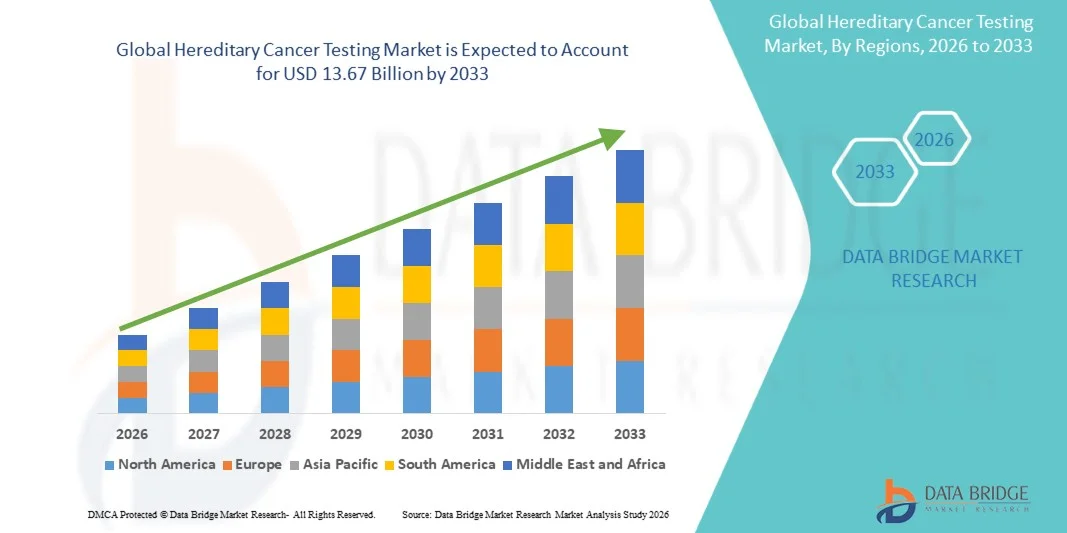
As per Data Bridge Market Research Analysis the Hereditary Cancer Testing Market was valued at USD 5.18 billion in 2025 and is projected to reach USD 13.67 billion by 2033, growing at a CAGR of 12.9% from 2026 to 2033. The market is witnessing strong growth driven by increasing prevalence of hereditary cancers, rising awareness of genetic predisposition testing, and expanding adoption of next-generation sequencing (NGS) and multigene panel testing across clinical settings.
The growing burden of cancers such as breast, ovarian, colorectal, and prostate cancer, along with expanding family history–based screening recommendations, is significantly boosting demand for early and preventive genetic diagnostics. In addition, advancements in genomic technologies, declining sequencing costs, and integration of AI-based interpretation tools are improving test accuracy and accessibility. Supportive government initiatives for precision medicine, coupled with expanding reimbursement coverage in developed markets, are further accelerating clinical adoption of hereditary cancer testing worldwide.
Market Size & Forecast
- Global Market Value (2025): USD 5.18 Billion
- Expected Market Value (2033): USD 13.67 Billion
- Forecast CAGR (2026–2033): 12.9%
- Leading Region in 2025: North America
- Fastest Growing Region: Asia Pacific
Key Market Trends & Insights
- North America dominated the Hereditary Cancer Testing Market with the largest revenue share of 48.62% in 2025, supported by high awareness of genetic testing, strong healthcare infrastructure, and widespread adoption of NGS-based diagnostics.
- The Multi Panel Set segment led the market with a 63.8% share in 2025, driven by its ability to analyze multiple cancer susceptibility genes simultaneously in a single workflow.
- Asia-Pacific is expected to be the fastest-growing region at a CAGR of 14.9% from 2026 to 2033, fueled by rising cancer prevalence, improving genomic testing accessibility, and expanding precision medicine initiatives in countries such as China, India, and Japan.
- Single Site Genetic Test are the fastest-growing test type, projected to register a CAGR of 8.7%, reflecting the surge in demand for targeted mutation testing in families with known genetic variants.
- The Lab Tests segment dominated the diagnosis type category with a 71.4% revenue share in 2025, led by its central role in molecular diagnostics and genomic sequencing workflows
- Sequencing accounted for 58.9% of the market, preferred by the widespread adoption of next-generation sequencing (NGS) for comprehensive genomic profiling
- The Lynch Syndrome segment is the fastest-growing disease type category, with a CAGR of 9.3%, driven by increasing colorectal cancer screening initiatives and universal tumor testing programs.
Report Scope and Hereditary Cancer Testing Market Segmentation
|
Attributes |
Hereditary Cancer Testing Key Market Insights |
|
Segments Covered |
|
|
Countries Covered |
North America
Europe
Asia-Pacific
Middle East and Africa
South America
|
|
Key Market Players |
|
|
Market Opportunities |
|
|
Value Added Data Infosets |
In addition to the insights on market scenarios such as market value, growth rate, segmentation, geographical coverage, and major players, the market reports curated by the Data Bridge Market Research also include in-depth expert analysis, patient epidemiology, pipeline analysis, pricing analysis, and regulatory framework. |
What is the Key Trend in the Hereditary Cancer Testing Market?
Trend: Expansion of Population-Based Genetic Screening Programs
Healthcare systems and government bodies are increasingly shifting from selective, symptom-based testing to large-scale population genetic screening programs aimed at identifying hereditary cancer risk at an early stage. This transformation is being driven by the rising burden of cancers with strong genetic links, such as breast, ovarian, colorectal, and prostate cancers, where early detection significantly improves survival outcomes. The integration of next-generation sequencing (NGS), automated variant classification, and AI-assisted genomic interpretation is enabling high-throughput screening with improved accuracy and reduced turnaround time. For instance, national genomic health initiatives in countries such as the United Kingdom and Finland are actively expanding hereditary cancer screening under precision medicine programs, aiming to integrate genetic risk assessment into routine healthcare pathways for early intervention and long-term cancer prevention.
Hereditary Cancer Testing Market Dynamics
Key Market Driver: Rising Adoption of Precision Oncology and Preventive Diagnostics
The growing global shift toward precision oncology is a major driver accelerating the demand for hereditary cancer testing, as healthcare providers increasingly focus on identifying germline mutations that contribute to cancer susceptibility. Unlike traditional diagnostics that focus on disease detection after onset, hereditary testing enables risk prediction and preventive intervention, allowing clinicians to design personalized monitoring and treatment strategies. This is particularly important in cancers such as BRCA-related breast and ovarian cancers and Lynch syndrome-associated colorectal cancer, where early identification significantly reduces mortality risk. For instance, leading oncology centers in the United States and Germany have incorporated hereditary risk assessment into routine cancer care pathways, ensuring that high-risk patients undergo genetic testing alongside diagnostic and treatment planning processes.
Key Restraint/Challenge: High Cost and Limited Accessibility in Emerging Markets
A significant challenge in the hereditary cancer testing market is the high cost associated with advanced genomic technologies, including next-generation sequencing platforms, bioinformatics infrastructure, and skilled genetic counseling services. These cost barriers make comprehensive hereditary testing less accessible in low- and middle-income countries, where healthcare systems often prioritize acute and infectious disease management over preventive genomic screening. In addition, limited insurance reimbursement policies for genetic testing further restrict adoption, particularly in developing regions where out-of-pocket healthcare expenditure remains high. The shortage of trained genetic counselors and specialized molecular diagnostic laboratories also limits the ability to deliver accurate interpretation and follow-up care after testing.
For instance, hospitals in parts of South Asia and Sub-Saharan Africa continue to depend on BRCA-only testing or outsourced laboratory services due to affordability constraints and limited local genomic infrastructure, delaying broader adoption of preventive cancer genetics.
Key Market Opportunity: Expansion of Decentralized, Preventive, and AI-Enabled Genetic Testing Ecosystems
A major opportunity in the Hereditary Cancer Testing Market lies in the rapid expansion of decentralized and digitally enabled genetic testing ecosystems that improve accessibility, affordability, and turnaround time for patients. The traditional model of hospital-based genetic testing is gradually shifting toward hybrid care pathways that combine at-home sample collection, tele-genetics consultations, and cloud-based genomic analysis platforms. This evolution is significantly expanding the addressable patient pool by reducing dependency on large tertiary care centers and specialized oncology institutions. At the same time, the growing integration of artificial intelligence and machine learning into genomic interpretation is creating new opportunities to enhance variant classification accuracy, reduce manual workload, and shorten diagnostic timelines. AI-powered tools are increasingly being used to interpret complex multigene panel data, identify rare pathogenic variants, and support clinical decision-making in hereditary cancer risk assessment.
How is the Hereditary Cancer Testing Market Segmented?
The hereditary cancer testing market is segmented on the basis of test type, diagnosis type, technology, disease type, end user, and distribution channel.
- By Test Type
On the basis of test type, the Hereditary Cancer Testing Market is segmented into multi panel set and single site genetic test. The Multi Panel Set segment dominated the market with a 63.8% share in 2025 due to its ability to analyze multiple cancer susceptibility genes simultaneously in a single workflow. This approach significantly improves diagnostic efficiency and supports comprehensive risk profiling for hereditary cancers such as breast, ovarian, and colorectal cancers. It is widely adopted in precision oncology programs across hospitals and diagnostic laboratories. Increasing reliance on next-generation sequencing (NGS) platforms is further strengthening its dominance. Physicians prefer multi-panel testing for its higher clinical yield compared to single-gene approaches. Rising adoption of personalized medicine and genomic screening programs continues to reinforce segment leadership.
The Single Site Genetic Test segment is expected to register the fastest growth at a CAGR of 8.7% during the forecast period due to increasing demand for targeted mutation testing in families with known genetic variants. It is primarily used for cascade screening of relatives of affected individuals. Lower cost, faster turnaround time, and operational simplicity make it highly suitable for follow-up genetic confirmation. Expanding genetic counseling services and hereditary cancer awareness programs are accelerating adoption. Increasing use in preventive healthcare frameworks is further supporting growth. Physician-driven recommendations for familial mutation testing continue to strengthen demand globally.
- By Diagnosis Type
On the basis of diagnosis type, the Hereditary Cancer Testing Market is segmented into biopsy, imaging, and lab tests. The Lab Tests segment dominated the market with a 71.4% share in 2025 owing to its central role in molecular diagnostics and genomic sequencing workflows. Laboratory-based testing remains the gold standard for hereditary cancer detection due to its high accuracy and reproducibility. Advanced genomic laboratories with high-throughput sequencing platforms are widely deployed in hospitals and diagnostic centers. Increasing investments in molecular diagnostic infrastructure are further strengthening segment dominance. Integration of automation and bioinformatics tools is improving efficiency and scalability. Strong reliance on lab-based oncology workflows continues to reinforce its leadership position.
The Imaging segment is expected to register the fastest growth at a CAGR of 9.1% during the forecast period due to increasing integration of advanced imaging modalities with genetic risk assessment. Technologies such as MRI, CT, and PET are increasingly used for surveillance of high-risk hereditary cancer populations. AI-driven imaging analytics are improving early detection and risk stratification accuracy. Hybrid diagnostic approaches combining imaging and genomics are gaining strong clinical acceptance. Expanding screening programs for genetically predisposed individuals are further supporting adoption. Continuous advancements in imaging resolution and functional imaging techniques are driving rapid growth.
- By Technology
On the basis of technology, the Hereditary Cancer Testing Market is segmented into sequencing, polymerase chain reaction (PCR), and microarray. The Sequencing segment dominated the market with a 58.9% share in 2025 due to widespread adoption of next-generation sequencing (NGS) for comprehensive genomic profiling. Sequencing enables simultaneous detection of multiple cancer-associated mutations, making it the most efficient diagnostic approach. Declining sequencing costs and improved throughput are accelerating global adoption. Pharmaceutical companies and research institutions heavily rely on sequencing for oncology research and precision medicine development. Continuous advancements in sequencing platforms and bioinformatics are further reinforcing market leadership.
The PCR segment is expected to register the fastest growth at a CAGR of 8.4% during the forecast period due to its affordability, speed, and simplicity in detecting known genetic mutations. Real-time PCR advancements are enhancing sensitivity and diagnostic accuracy. It is widely used in decentralized laboratories and routine screening applications. Increasing demand for rapid and cost-effective genetic testing is driving adoption. Expanding use in emerging economies and point-of-care settings is further accelerating growth.
- By Disease Type
On the basis of disease type, the Hereditary Cancer Testing Market is segmented into Hereditary Breast & Ovarian Cancer Syndrome, Cowden Syndrome, Lynch Syndrome, Hereditary Leukemia and Hematologic Malignancies Syndromes, Familial Adenomatous Polyposis (FAP), Li-Fraumeni Syndrome, Von Hippel-Lindau Disease, and Multiple Endocrine Neoplasias (MEN) Syndromes. The Hereditary Breast & Ovarian Cancer Syndrome segment dominated the market with a 34.7% share in 2025 due to the high prevalence of BRCA1 and BRCA2 mutations globally. Strong clinical guidelines and widespread screening recommendations significantly drive testing uptake. Preventive oncology programs and targeted therapy advancements further reinforce demand. Family history-based screening remains a key driver. Expanding precision medicine initiatives continue to strengthen its dominant position.
The Lynch Syndrome segment is expected to register the fastest growth at a CAGR of 9.3% during the forecast period due to increasing colorectal cancer screening initiatives and universal tumor testing programs. Rising physician awareness of mismatch repair gene mutations is improving diagnosis rates. Expanding use of multi-gene panel testing is enhancing detection efficiency. Improved reimbursement coverage in developed healthcare systems is further supporting adoption. Growing integration of genomic testing into routine cancer care is accelerating segment expansion.
- By End User
On the basis of end user, the Hereditary Cancer Testing Market is segmented into hospitals, clinics, laboratories, radiology centers, diagnostic centers, and others. The Hospitals segment dominated the market with a 45.6% share in 2025 due to strong integration of oncology services with advanced genetic testing infrastructure. Hospitals serve as primary centers for cancer diagnosis, treatment planning, and genetic counseling. High patient inflow and multidisciplinary oncology teams support large testing volumes. Government funding and reimbursement support further strengthen adoption. Increasing use of precision medicine in hospital-based oncology care reinforces market leadership.
The Diagnostic Centers segment is expected to register the fastest growth at a CAGR of 9.0% during the forecast period due to rising demand for specialized genetic testing services. Independent diagnostic chains are expanding rapidly across global markets. Outsourcing of testing services from hospitals is significantly boosting demand. These centers offer faster turnaround times and cost-effective testing solutions. Adoption of advanced sequencing and molecular diagnostic technologies is increasing across standalone facilities. Growing consumer preference for accessible and affordable testing services is driving rapid expansion.
- By Distribution Channel
On the basis of distribution channel, the Hereditary Cancer Testing Market is segmented into direct tender and retail sales. The Direct Tender segment dominated the market with a 68.5% share in 2025 due to bulk procurement by hospitals, government health systems, and large diagnostic networks. This model ensures cost efficiency, standardized supply chains, and long-term contractual agreements with manufacturers. National screening programs and public healthcare initiatives heavily rely on direct procurement systems. Strong institutional partnerships further reinforce segment dominance.
The Retail Sales segment is expected to register the fastest growth at a CAGR of 10.2% during the forecast period due to increasing adoption of direct-to-consumer genetic testing kits. Rising awareness of hereditary cancer risk is driving consumer-led testing demand. E-commerce and digital health platforms are expanding accessibility globally. Improved at-home sample collection technologies are enhancing convenience. Growing trust in privacy-protected genetic testing services is further accelerating adoption. Increasing focus on preventive healthcare continues to support strong growth momentum.
Which Region Holds the Largest Share of the Hereditary Cancer Testing Market?
North America dominated the Hereditary Cancer Testing Market with the largest revenue share of 48.62% in 2025, supported by high awareness of genetic testing, strong healthcare infrastructure, and widespread adoption of NGS-based diagnostics. The region benefits from well-established cancer screening programs, favorable reimbursement policies, and high awareness of genetic predisposition to cancers among patients and healthcare providers. Increasing integration of precision medicine into oncology care, along with widespread availability of multi-gene panel testing, further strengthens market growth. Continuous investments in genomic research and expanding use of preventive genetic testing in clinical practice continue to reinforce North America’s leadership position in the global market.
U.S. Hereditary Cancer Testing Market Insight
The U.S. hereditary cancer testing market is witnessing strong growth due to high prevalence of cancer, advanced genomic testing infrastructure, and widespread adoption of precision oncology practices. Strong presence of leading diagnostic laboratories and biotechnology companies is accelerating access to multi-gene panel testing and next-generation sequencing technologies. Favorable reimbursement policies and well-established genetic counseling services are further supporting market expansion. Increasing awareness of BRCA and Lynch syndrome-related cancers is driving preventive screening uptake. In addition, growing integration of hereditary cancer testing into routine oncology workflows and expanding use in personalized treatment decision-making continue to strengthen market demand across the country.
Europe Hereditary Cancer Testing Market Insight
The Europe hereditary cancer testing market remains a major contributor to global revenue, driven by strong healthcare systems, government-supported cancer screening programs, and rising adoption of advanced genomic diagnostics. Widespread implementation of preventive oncology initiatives and structured genetic testing guidelines is supporting market growth across the region. Increasing use of multi-gene panels and next-generation sequencing platforms in hospitals and diagnostic centers is enhancing early cancer risk detection. Strong regulatory frameworks promoting patient safety and data quality are further strengthening market reliability. In addition, growing focus on precision medicine and expanding research collaborations continue to support sustained adoption of hereditary cancer testing across Europe.
U.K. Hereditary Cancer Testing Market Insight
The U.K. hereditary cancer testing market is experiencing steady growth, supported by the National Health Service (NHS) cancer screening programs and increasing integration of genomic medicine into public healthcare. Rising adoption of multi-gene panel testing for hereditary breast, ovarian, and colorectal cancers is improving early detection rates. Expanding access to genetic counseling services is further enhancing patient awareness and testing uptake. Investments in genomic research through national initiatives are strengthening diagnostic capabilities. Moreover, increasing use of next-generation sequencing technologies and structured referral pathways within oncology care are contributing to improved efficiency and accessibility of hereditary cancer testing services in the country.
Germany Hereditary Cancer Testing Market Insight
The Germany hereditary cancer testing market is expanding steadily due to strong clinical research infrastructure, advanced diagnostic laboratories, and high adoption of molecular genetic testing technologies. The country’s well-established healthcare system supports widespread use of hereditary cancer screening in oncology and preventive care settings. Increasing application of next-generation sequencing and bioinformatics-driven diagnostics is improving mutation detection accuracy. Strong focus on early cancer detection and preventive healthcare is driving demand across hospitals and specialized diagnostic centers. In addition, growing investment in precision medicine and continuous innovation in genomic technologies are further accelerating market growth in Germany.
Asia-Pacific Hereditary Cancer Testing Market Insight
The Asia-Pacific hereditary cancer testing market is expected to witness rapid growth, driven by rising cancer burden, improving healthcare infrastructure, and increasing awareness of genetic testing benefits. Expanding adoption of next-generation sequencing and multi-gene panel testing across hospitals and diagnostic laboratories is significantly boosting market demand. Government initiatives promoting early cancer detection and preventive healthcare are further supporting regional growth. Increasing investments in genomic research and biotechnology development are strengthening diagnostic capabilities. In addition, growing presence of international diagnostic companies and rising affordability of testing solutions are accelerating market expansion across emerging economies in the region.
Japan Hereditary Cancer Testing Market Insight
The Japan hereditary cancer testing market is witnessing consistent growth due to strong healthcare infrastructure, advanced diagnostic technologies, and increasing focus on precision medicine. High adoption of genomic testing in oncology care is improving early detection of hereditary cancer syndromes. Expanding use of next-generation sequencing platforms in hospitals and research institutions is further strengthening diagnostic accuracy. Government support for genomic medicine initiatives and structured cancer screening programs is also contributing to market development. In addition, increasing awareness among physicians and patients regarding genetic risk factors is driving steady adoption of hereditary cancer testing services in the country.
China Hereditary Cancer Testing Market Insight
The China hereditary cancer testing market is growing rapidly, driven by rising cancer incidence, expanding healthcare infrastructure, and increasing government focus on early disease detection. Rapid adoption of AI-enabled genomic platforms and next-generation sequencing technologies is significantly enhancing testing capabilities. Growing investments in precision medicine and biotechnology research are further strengthening the diagnostic ecosystem. Expanding awareness of hereditary cancer risks among urban populations is boosting demand for preventive genetic testing. In addition, increasing availability of cost-effective testing solutions and strong expansion of private diagnostic chains are positioning China as one of the fastest-growing markets globally.
Which are the Top Companies in Hereditary Cancer Testing Market?
The hereditary cancer testing industry is primarily led by well-established companies, including:
- Myriad Genetics (U.S.)
- Natera, Inc. (U.S.)
- Illumina, Inc. (U.S.)
- Guardant Health, Inc. (U.S.)
- Quest Diagnostics Incorporated (U.S.)
- Labcorp (U.S.)
- Fulgent Genetics, Inc. (U.S.)
- Roche Holding AG (Switzerland)
- Thermo Fisher Scientific Inc. (U.S.)
- QIAGEN (Germany)
- Agilent Technologies, Inc. (U.S.)
- Bio-Rad Laboratories, Inc. (U.S.)
- BGI Genomics Co., Ltd. (China)
- SOPHiA GENETICS SA (Switzerland)
- Veracyte, Inc. (U.S.)
- Personalis, Inc. (U.S.)
- Tempus AI, Inc. (U.S.)
- Twist Bioscience Corporation (U.S.)
- 10x Genomics, Inc. (U.S.)
- GeneDx Holdings Corp. (U.S.)
What are Latest Developments in Hereditary Cancer Testing Market?
- In July 2024, Labcorp announced the acquisition of select assets of Invitae, a major provider of hereditary cancer and genetic testing services, to strengthen its position in advanced diagnostics and precision oncology. The acquisition enhances Labcorp’s genetic testing portfolio, particularly in oncology, rare diseases, and hereditary cancer risk assessment. It also ensures continued access to key Invitae hereditary cancer testing services for patients and providers. This development reflects ongoing consolidation in the genetic testing industry to expand scale and service capabilities
- In January 2023, Illumina announced the launch of its NovaSeq X Series, a next-generation sequencing platform designed to significantly improve genomic throughput and reduce sequencing costs. The system strengthens large-scale genomic applications, including hereditary cancer testing and multi-gene panel analysis. It enables faster and more accurate detection of cancer-associated genetic mutations in clinical and research settings. This launch supports the rapid expansion of precision medicine and population-scale genetic screening
- In June 2023, the National Comprehensive Cancer Network (NCCN) updated its clinical practice guidelines to expand recommendations for hereditary cancer genetic testing. The updated guidelines broaden eligibility for testing in cancers such as breast, ovarian, colorectal, and Lynch syndrome-related cancers. It increases the use of multi-gene panel testing for individuals with personal or family cancer history. This update significantly expands the patient population eligible for genetic screening and preventive oncology services
- In September 2022, GRAIL announced expanded availability of its Galleri multi-cancer early detection test across the United States for clinical use. The test uses advanced genomic sequencing and machine learning to detect cancer signals from a single blood sample. It supports early detection across multiple cancer types, complementing hereditary cancer risk assessment strategies. This expansion enhances adoption of liquid biopsy and genomic-based diagnostic approaches
- In October 2021, Natera expanded adoption of its Empower Hereditary Cancer Test, broadening access to genetic screening for hereditary cancer risk assessment. The test analyzes multiple genes associated with inherited cancer syndromes, including breast, ovarian, colorectal, and endometrial cancers. It supports early identification of high-risk individuals for preventive care and treatment planning. This expansion reflects growing demand for multi-gene panel testing in clinical oncology practice

- Interactive Data Analysis Dashboard
- Company Analysis Dashboard for high growth potential opportunities
- Research Analyst Access for customization & queries
- Competitor Analysis with Interactive dashboard
- Latest News, Updates & Trend analysis
- Harness the Power of Benchmark Analysis for Comprehensive Competitor Tracking
Data collection and base year analysis are done using data collection modules with large sample sizes. The stage includes obtaining market information or related data through various sources and strategies. It includes examining and planning all the data acquired from the past in advance. It likewise envelops the examination of information inconsistencies seen across different information sources. The market data is analysed and estimated using market statistical and coherent models. Also, market share analysis and key trend analysis are the major success factors in the market report. To know more, please request an analyst call or drop down your inquiry.
The key research methodology used by DBMR research team is data triangulation which involves data mining, analysis of the impact of data variables on the market and primary (industry expert) validation. Data models include Vendor Positioning Grid, Market Time Line Analysis, Market Overview and Guide, Company Positioning Grid, Patent Analysis, Pricing Analysis, Company Market Share Analysis, Standards of Measurement, Global versus Regional and Vendor Share Analysis. To know more about the research methodology, drop in an inquiry to speak to our industry experts.
Data Bridge Market Research is a leader in advanced formative research. We take pride in servicing our existing and new customers with data and analysis that match and suits their goal. The report can be customized to include price trend analysis of target brands understanding the market for additional countries (ask for the list of countries), clinical trial results data, literature review, refurbished market and product base analysis. Market analysis of target competitors can be analyzed from technology-based analysis to market portfolio strategies. We can add as many competitors that you require data about in the format and data style you are looking for. Our team of analysts can also provide you data in crude raw excel files pivot tables (Fact book) or can assist you in creating presentations from the data sets available in the report.













