


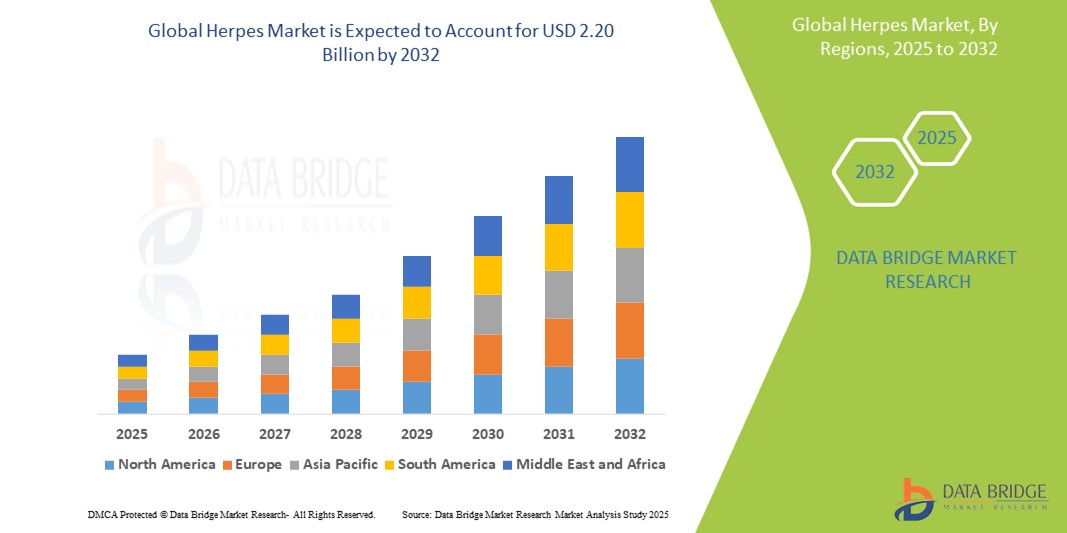
Herpes Market Size
- The global herpes market size was valued at USD 1.32 billion in 2024 and is expected to reach USD 2.20 billion by 2032, at a CAGR of 6.6% during the forecast period
- The market growth is largely fueled by the high and increasing global prevalence of Herpes Simplex Virus (HSV-1 and HSV-2) and Herpes Zoster, coupled with significant advancements in diagnostic methods and antiviral therapies. This is leading to earlier detection and more effective management of symptoms and outbreaks
- Furthermore, rising patient and healthcare provider demand for effective, long-term management solutions, reduction of outbreak frequency, and improved transmission prevention strategies is establishing advanced antiviral medications and potential prophylactic vaccines as crucial components of modern herpes care. These converging factors are accelerating the uptake of Herpes solutions, thereby significantly boosting the industry's growth
Herpes Market Analysis
- Herpes treatment options, encompassing antiviral drugs and supportive therapies, have become essential components of managing herpes simplex virus (HSV) infections globally. These therapies are increasingly sought after due to rising prevalence, recurrent outbreaks, and the long-term nature of the infection, which often requires lifelong management in both genital and oral herpes cases
- The growing demand for herpes treatment is primarily fueled by the rising incidence of HSV infections worldwide, increased awareness about sexually transmitted diseases (STDs), improved access to diagnostic tools, and the expanding availability of novel treatment formulations, including extended-release antivirals and topical therapies
- North America dominated the herpes treatment market, capturing the largest revenue share of 42.6% in 2024, owing to high disease prevalence, early availability of branded antiviral drugs, increased awareness and screening, and the presence of major pharmaceutical companies such as GlaxoSmithKline and Pfizer
- Asia-Pacific is projected to be the fastest-growing region in the herpes treatment market, with a CAGR of 7.9% from 2025 to 2032, driven by increasing STD awareness campaigns, growing population, rising healthcare expenditure, and improving diagnostic capabilities in countries such as China, India, and Japan
- The herpes simplex segment dominated the herpes treatment market with a market share of 68.5% in 2024. This is due to its higher prevalence worldwide and the chronic nature of infections requiring ongoing treatment and management, compared to Herpes Zoster which generally affects older populations
Report Scope and Herpes Market Segmentation
|
Attributes |
Herpes Key Market Insights |
|
Segments Covered |
|
|
Countries Covered |
North America
Europe
Asia-Pacific
Middle East and Africa
South America
|
|
Key Market Players |
|
|
Market Opportunities |
|
|
Value Added Data Infosets |
In addition to the insights on market scenarios such as market value, growth rate, segmentation, geographical coverage, and major players, the market reports curated by the Data Bridge Market Research also include in-depth expert analysis, pricing analysis, brand share analysis, consumer survey, demography analysis, supply chain analysis, value chain analysis, raw material/consumables overview, vendor selection criteria, PESTLE Analysis, Porter Analysis, and regulatory framework. |
Herpes Market Trends
“Growing Demand for Personalized and Convenient Herpes Treatment Solutions”
- A major and rapidly expanding trend in the global herpes treatment market is the shift toward personalized treatment regimens and greater patient-centric care models. This trend is transforming how patients manage herpes simplex virus (HSV) infections, emphasizing ease of access, convenience, and adaptability to individual patient needs
- For instance, several pharmaceutical companies are introducing long-acting antiviral therapies and once-daily dosage formulations to improve patient compliance and reduce recurrence. In addition, telehealth platforms such as Nurx and Lemonaid Health now offer discreet online consultations and direct-to-door prescription services, enhancing privacy and convenience for users
- Innovations in topical drug delivery—such as nanotechnology-based creams and fast-absorbing patches—are also allowing for more targeted relief of symptoms, minimizing systemic side effects while providing rapid comfort. Products such as Docosanol (Abreva) and new bioadhesive gels are increasingly being tailored for over-the-counter access
- The expansion of ePharmacy platforms further facilitates easy and timely access to medications, especially in remote or underdeveloped regions. This digital convenience is encouraging more individuals to proactively manage their condition, thereby improving outcomes and reducing viral transmission
- Companies such as GlaxoSmithKline, Cipla, and Sun Pharma are actively investing in research and development of next-generation herpes therapies, including combination drugs and therapeutic vaccines, to meet the growing expectations of informed, tech-savvy consumers seeking faster and more discreet solutions
- The demand for flexible, user-friendly herpes treatments is surging across both developed and developing regions, underscoring the industry's ongoing shift toward innovation, accessibility, and personalized healthcare experiences
Herpes Market Dynamics
Driver
“Expanding Treatment Landscape and Advancements in Antiviral Research”
- The herpes treatment market is witnessing substantial expansion due to the rising global prevalence of herpes simplex virus (HSV-1 and HSV-2) infections and the continuous development of advanced therapeutic options. The increasing awareness among patients regarding early diagnosis and long-term management is contributing significantly to the demand for both prescription and over-the-counter antiviral treatments
- For instance, companies such as GlaxoSmithKline, Cipla, and Emcure Pharmaceuticals are actively investing in R&D for novel antiviral drugs, extended-release formulations, and therapeutic vaccines. These innovations aim to not only reduce outbreak frequency and severity but also potentially target latent virus reservoirs
- The shift toward personalized and long-term suppressive therapy is enabling patients to better manage symptoms, avoid transmission, and improve quality of life. This is especially critical for immunocompromised populations and those suffering from recurrent outbreaks
- In addition, the rise of telehealth platforms and ePharmacy services is expanding treatment access, particularly in underserved and remote regions. These digital healthcare solutions offer privacy and convenience, making them highly appealing to patients reluctant to seek in-person consultation for sexually transmitted infections
- The increasing inclusion of herpes treatments in public health programs and awareness campaigns by governments and non-profit organizations is also playing a crucial role in reducing stigma and encouraging testing and treatment. Educational initiatives have led to a surge in diagnosis rates, fueling demand for effective therapeutic interventions
- As the herpes virus continues to affect millions worldwide, the market is poised for long-term growth driven by unmet clinical needs, technological innovation in drug delivery, and expanding access to antiviral therapies across all demographics and geographies
Restraint/Challenge
“Stigma, Limited Curative Options, and Drug Resistance”
- A major challenge restraining the growth of the herpes treatment market is the persistent social stigma surrounding sexually transmitted infections, particularly herpes. This stigma discourages individuals from seeking timely medical help, testing, or treatment, leading to underdiagnosis and underreporting, especially in conservative societies and low-resource settings
- Furthermore, despite decades of research, there is still no permanent cure for herpes. Current treatments primarily focus on symptom suppression and outbreak management rather than virus eradication. This limitation significantly impacts patient expectations and reduces the motivation for long-term adherence to antiviral regimens
- The increasing use of antiviral medications, such as acyclovir, valacyclovir, and famciclovir, has also led to growing concerns over antiviral resistance, particularly among immunocompromised patients and those undergoing prolonged treatment. Resistance limits the effectiveness of standard therapies and necessitates the development of newer, more potent drugs, which can be costlier and have limited availability
- In addition, stringent regulatory frameworks and the high cost and complexity of clinical trials for herpes vaccine and novel drug development pose challenges for pharmaceutical companies. These barriers can delay the launch of innovative products and restrict the entry of smaller players into the market
- Lastly, the limited healthcare access and awareness in certain developing regions further hinder market penetration. Lack of routine screening programs, cultural taboos, and insufficient government initiatives continue to slow progress in early diagnosis and widespread treatment adoption
Herpes Market Scope
The herpes treatment market is segmented into seven notable segments based on virus type, product, drug type, age group, route of administration, distribution channel, and end users.
- By Virus Type
On the basis of virus type, the herpes treatment market is segmented into Herpes simplex and herpes zoster. The herpes simplex segment dominated the market in 2024 with 68.5% of the global revenue share. This dominance is primarily attributed to the high global prevalence of both HSV-1 and HSV-2 strains, with recurring episodes necessitating long-term management. Moreover, increasing awareness and diagnostic efforts are contributing to early detection and sustained treatment regimens.
The herpes zoster segment is projected to register the fastest CAGR of 6.8% during 2025–2032, driven by the rising incidence of shingles, particularly among elderly populations and immunocompromised individuals. Growing vaccine awareness, improved diagnostics, and better access to healthcare facilities in emerging markets further support this growth.
- By Product
On the basis of product, the herpes treatment market is segmented into acyclovir, docosanol, valacyclovir, famciclovir, and others. The acyclovir segment dominated the market with the largest revenue share of 38.1% in 2024, owing to its widespread availability, affordability, and proven clinical efficacy. Acyclovir remains the gold standard for managing both initial and recurring herpes episodes, with high adoption in both oral and topical forms.
The valacyclovir segment is anticipated to witness the fastest CAGR of 7.3% from 2025 to 2032, due to its improved pharmacokinetic profile and simplified dosing regimen compared to acyclovir. It is particularly favored for suppressive therapy in patients with frequent outbreaks.
- By Drug Type
On the basis of drug type, the market is segmented into prescription drugs and over-the-counter drugs. The prescription drug segment led the market with a revenue share of 71.6% in 2024, as most antiviral therapies require physician oversight for diagnosis and long-term management. The need for tailored treatment regimens and monitoring of recurrent infections supports this dominance.
The over-the-counter drug segment is projected to grow at a CAGR of 6.2% from 2025 to 2032, driven by the increasing availability of topical antivirals, consumer inclination toward self-care, and the convenience of online purchasing platforms.
- By Age Group
On the basis of age group, the herpes treatment market is segmented into adult and pediatrics. The adult segment held the largest market share of 85.9% in 2024, driven by higher rates of HSV-1 and HSV-2 transmission in sexually active populations. Adults also show higher diagnosis and treatment rates due to more frequent screenings and increased health awareness.
The pediatrics segment is expected to grow at a CAGR of 5.1% from 2025 to 2032, propelled by congenital herpes infections and early-age symptom onset. Growing pediatric antiviral approvals and expanding access to healthcare in emerging regions further contribute to this trend.
- By Route of Administration
On the basis of route of administration, the market is segmented into topical, oral, and parenteral. The oral segment accounted for the largest revenue share of 54.3% in 2024, supported by its systemic therapeutic effect, ease of use, and suitability for both episodic and long-term suppressive therapy.
The parenteral segment is anticipated to register a CAGR of 6.6% from 2025 to 2032, largely driven by its use in severe or hospitalized cases such as neonatal herpes or immunocompromised patients, where rapid drug delivery is critical.
- By Distribution Channel
On the basis of distribution channel, the market is segmented into hospital pharmacies, retail pharmacies, drug stores, online pharmacies, and others. Retail Pharmacies held the largest market share at 40.2% in 2024, due to the wide availability of herpes medications and strong consumer reliance on local pharmacy outlets for prescription fulfillment. These pharmacies offer patient counseling and contribute significantly to medication adherence.
Online pharmacies are expected to register the highest CAGR of 8.1% from 2025 to 2032, fueled by the rising trend of digital healthcare, discreet delivery preferences, and growing demand for convenience. Online platforms also play a crucial role in underserved or remote areas with limited access to physical pharmacies.
- By End Users
By end users, the herpes market is segmented into specialty clinics and others. Specialty clinics accounted for a market-leading share of 58.7% in 2024, driven by the chronic and recurrent nature of herpes that necessitates specialist intervention and personalized care plans. These clinics also offer advanced diagnostic and therapeutic services, making them the preferred destination for patients with complex cases.
The others segment is anticipated to grow at a CAGR of 5.4% from 2025 to 2032, supported by the global expansion of digital healthcare platforms and improved access to herpes management services beyond urban centers.
Herpes Market Regional Analysis
- North America dominates the herpes treatment market with the largest revenue share of 42.6% in 2024, driven by a high prevalence of both herpes simplex and herpes zoster infections, advanced healthcare infrastructure, and strong awareness regarding sexually transmitted diseases and antiviral therapies
- The region benefits from a well-established reimbursement framework and widespread availability of prescription-based antiviral medications. Increased investment in clinical research and the presence of key pharmaceutical companies also play a vital role in accelerating treatment adoption
- Moreover, frequent public health campaigns by organizations such as the CDC and growing usage of digital health tools for diagnosis and management continue to promote early detection and timely treatment, bolstering market growth across the U.S. and Canada
U.S. Herpes Treatment Market Insight
The U.S. herpes treatment market held the largest revenue share within North America, accounting for 70.2% in 2024. This dominance is driven by a high prevalence of herpes simplex and herpes zoster infections, advanced healthcare infrastructure, strong awareness of sexually transmitted diseases and antiviral therapies, the presence of key pharmaceutical companies, and ongoing research and development activities.
Europe Herpes Treatment Market Insight
The Europe herpes treatment represents the second-largest market for herpes treatments globally, with a projected compound annual growth rate (CAGR) of 3.45% over the forecast period. The market's growth is fueled by stringent security regulations, increasing awareness of sexually transmitted infections, and the escalating need for enhanced healthcare services. Countries such as Germany, the U.K., France, Spain, and Italy are primary revenue generators in the region, benefiting from favorable patient demographics and high awareness of advanced treatment options for STIs.
U.K. Herpes Treatment Market Insight
The U.K. herpes treatment market is anticipated to grow at a noteworthy CAGR from 2025 to 2032 This growth is fueled by the escalating trend of home automation in healthcare, a desire for heightened security and convenience in treatment options, and concerns regarding the increasing prevalence of herpes infections. The U.K.'s robust e-commerce and retail infrastructure also contributes to the market's expansion by facilitating easy access to antiviral medications.
Germany Herpes Treatment Market Insight
The Germany's herpes treatment market is expected to expand at a considerable CAGR during the forecast period from 2025 to 2032 This growth is driven by increasing awareness of digital health solutions, demand for technologically advanced and eco-conscious treatments, and the country's well-developed healthcare infrastructure. Germany's emphasis on innovation and sustainability promotes the adoption of advanced herpes treatments, particularly in residential and commercial healthcare settings.
Asia-Pacific Herpes Treatment Market Insight
The Asia-Pacific herpes treatment market is poised to grow at the fastest CAGR of 7.9% during the forecast period of 2025 to 2032. This rapid growth is driven by increasing urbanization, rising disposable incomes, and technological advancements in countries such as China, Japan, and India. The region's growing inclination towards smart healthcare solutions, supported by government initiatives promoting digitalization, is driving the adoption of advanced herpes treatments. Furthermore, as APAC emerges as a manufacturing hub for herpes treatment components and systems, the affordability and accessibility of these treatments are expanding to a wider consumer base.
Japan Herpes Treatment Market Insight
The Japan herpes treatment market is gaining momentum due to the country’s high-tech culture, rapid urbanization, and demand for convenience in healthcare solutions. The Japanese market places a significant emphasis on security and the adoption of advanced treatments, driven by the increasing number of smart healthcare facilities and connected medical devices. The integration of herpes treatments with other Internet of Things (IoT) devices, such as home security cameras and lighting systems, is fueling growth. Moreover, Japan's aging population is such as ly to spur demand for easier-to-use, secure access solutions in both residential and commercial healthcare sectors.
China Herpes Treatment Market Insight
The China herpes treatment market accounted for the largest market revenue share in the Asia-Pacific region in 2024, attributed to the country's expanding middle class, rapid urbanization, and high rates of technological adoption. China stands as one of the largest markets for smart healthcare devices, and advanced herpes treatments are becoming increasingly popular in residential, commercial, and rental properties. The push towards smart cities and the availability of affordable herpes treatment options, alongside strong domestic manufacturers, are key factors propelling the market in China.
Herpes Market Share
The Herpes industry is primarily led by well-established companies, including:
- Abbott (U.S.)
- Apotex, Inc. (Canada)
- Avet Pharmaceuticals, Inc. (U.S.)
- Bausch Health Companies, Inc. (Canada)
- Cipla (India)
- Dr. Reddy’s Laboratories Ltd. (India)
- Fresenius Kabi AG (Germany)
- GSK plc (U.K.)
- Glenmark Pharmaceuticals Ltd. (India)
- Maruho Co., Ltd. (Japan)
- Pfizer Inc. (U.S.)
- Sun Pharmaceutical Industries Ltd. (India)
- Teva Pharmaceutical Industries Ltd. (Israel)
- Zydus Pharmaceuticals, Inc. (India)
- Recordati Industria Chimica e Farmaceutica S.p.A. (Italy)
- Aurobindo Pharma Limited (India)
- Amneal Pharmaceuticals LLC (U.S.)
- Slavia Pharm S.R.L. (Romania)
- Blistex, Inc. (U.S.)
Latest Developments in Global Herpes Market
- In April 2025, Assembly Biosciences presented promising data for ABI‑5366, a long‑acting HSV helicase‑primase inhibitor, at the ESCMID Global conference. Interim Phase 1a/1b results showed favorable safety, pharmacokinetics (with ~20-day half-life), and strong activity against both HSV‑1 and HSV‑2—supporting potential once‑weekly or monthly oral dosing
- In May 2025, Moderna’s mRNA‑1608 HSV‑2 vaccine candidate completed enrollment in its Phase 1/2 trial. This mRNA vaccine, targeting both HSV‑1 and HSV‑2, is designed to elicit robust neutralizing antibody and T-cell responses; the study is expected to deliver full data by April 2025
- In April 2025, OpenPR’s analysis of the herpes simplex drug pipeline noted innovative therapies such as PRITELIVIR (AIC‑316), mRNA‑1608, and BNT163, with PRITELIVIR expected to launch in the U.S. by 2026 and the U.K./Japan by 2027

- Interactive Data Analysis Dashboard
- Company Analysis Dashboard for high growth potential opportunities
- Research Analyst Access for customization & queries
- Competitor Analysis with Interactive dashboard
- Latest News, Updates & Trend analysis
- Harness the Power of Benchmark Analysis for Comprehensive Competitor Tracking
Data collection and base year analysis are done using data collection modules with large sample sizes. The stage includes obtaining market information or related data through various sources and strategies. It includes examining and planning all the data acquired from the past in advance. It likewise envelops the examination of information inconsistencies seen across different information sources. The market data is analysed and estimated using market statistical and coherent models. Also, market share analysis and key trend analysis are the major success factors in the market report. To know more, please request an analyst call or drop down your inquiry.
The key research methodology used by DBMR research team is data triangulation which involves data mining, analysis of the impact of data variables on the market and primary (industry expert) validation. Data models include Vendor Positioning Grid, Market Time Line Analysis, Market Overview and Guide, Company Positioning Grid, Patent Analysis, Pricing Analysis, Company Market Share Analysis, Standards of Measurement, Global versus Regional and Vendor Share Analysis. To know more about the research methodology, drop in an inquiry to speak to our industry experts.
Data Bridge Market Research is a leader in advanced formative research. We take pride in servicing our existing and new customers with data and analysis that match and suits their goal. The report can be customized to include price trend analysis of target brands understanding the market for additional countries (ask for the list of countries), clinical trial results data, literature review, refurbished market and product base analysis. Market analysis of target competitors can be analyzed from technology-based analysis to market portfolio strategies. We can add as many competitors that you require data about in the format and data style you are looking for. Our team of analysts can also provide you data in crude raw excel files pivot tables (Fact book) or can assist you in creating presentations from the data sets available in the report.













