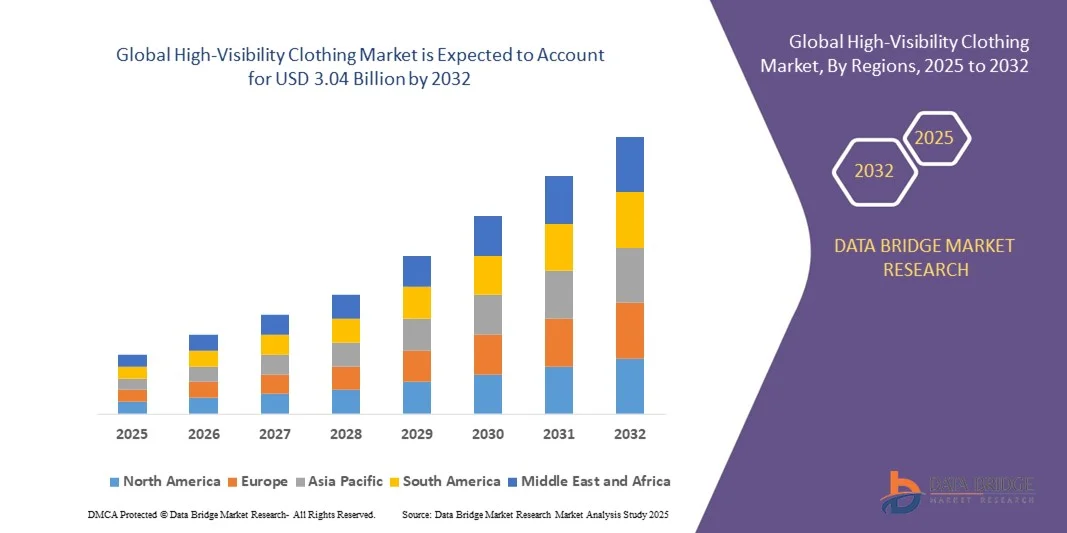
What is the Global High-Visibility Clothing Market Size and Growth Rate?
- The global high-visibility clothing market size was valued at USD 1.90 billion in 2024 and is expected to reach USD 3.04 billion by 2032, at a CAGR of 6.00% during the forecast period
- The increasing demand for high visibility clothing in a working environment which is heavily trafficked thus is one of the primary factors driving the high-visibility clothing market growth rate
- Moreover, the rapidly increasing awareness regarding the road safety for school going children, this trend has attracted the investor sentiment where manufacturers are designing innovative bag covers and jackets at reasonably priced prices which are also fueling the growth of the high-visibility clothing market
What are the Major Takeaways of High-Visibility Clothing Market?
- The market is largely driven by the ever-expanding construction industry which is one of the stable revenue streams for manufacturers. Also, the rising disposable incomes and rapidly increasing population are also highly impacting the growth of the high-visibility clothing market
- While, the various companies in the high visibility clothing market are rising their production capabilities to manufacture tapes that offer visibility during both day and night-time which is also one of the major factors driving the growth of the high-visibility clothing market
- In 2024, Asia-Pacific dominated the high-visibility clothing market, capturing the largest revenue share of 36.87%, driven by rapid industrialization, infrastructure development, and the rising adoption of safety standards across construction, transportation, and manufacturing sectors
- The North America high-visibility clothing market is expected to grow at the fastest CAGR of 7.54% during 2025–2032, supported by the rising adoption of stringent workplace safety regulations and technologically advanced PPE solutions
- The Safety Vest segment dominated the market with the largest revenue share of 38.5% in 2024, owing to its essential role in providing high visibility for workers across construction, transportation, and public safety sectors
Report Scope and High-Visibility Clothing Market Segmentation
|
Attributes |
High-Visibility Clothing Key Market Insights |
|
Segments Covered |
|
|
Countries Covered |
North America
Europe
Asia-Pacific
Middle East and Africa
South America
|
|
Key Market Players |
|
|
Market Opportunities |
|
|
Value Added Data Infosets |
In addition to the insights on market scenarios such as market value, growth rate, segmentation, geographical coverage, and major players, the market reports curated by the Data Bridge Market Research also include in-depth expert analysis, pricing analysis, brand share analysis, consumer survey, demography analysis, supply chain analysis, value chain analysis, raw material/consumables overview, vendor selection criteria, PESTLE Analysis, Porter Analysis, and regulatory framework. |
What is the Key Trend in the High-Visibility Clothing Market?
Integration of Smart Technology and Advanced Safety Features
- A prominent and accelerating trend in the global high-visibility clothing market is the incorporation of smart technologies, such as wearable sensors, connectivity modules, and real-time monitoring capabilities, into traditional high-visibility garments. This integration is significantly enhancing worker safety, operational efficiency, and convenience across industrial, construction, and logistics environments
- For instance, some smart vests and jackets now include integrated GPS trackers, temperature sensors, and motion detectors, allowing supervisors to monitor worker location and safety status remotely. Similarly, smart helmets with Bluetooth communication enable instant alerts in case of falls or hazardous conditions, providing a comprehensive high-visibility and safety solution
- AI-enabled high-visibility clothing allows for predictive safety features, such as detecting fatigue, monitoring heart rate, or alerting workers of dangerous proximity to heavy machinery. This ensures proactive safety management and reduces workplace incidents
- The integration of high-visibility clothing with connected platforms facilitates centralized monitoring of workforce safety in real-time. Through cloud-based dashboards, managers can track exposure times, location, and compliance with safety protocols, creating a unified safety management system
- This trend towards intelligent, connected, and proactive safety apparel is transforming expectations in occupational health and safety. Consequently, companies such as Ansell and Honeywell are developing high-visibility clothing embedded with sensors, alerts, and connectivity options to enhance worker protection
- The growing demand for smart high-visibility clothing is driven by the need for enhanced safety, operational efficiency, and compliance with stricter industrial safety regulations across multiple sectors
What are the Key Drivers of High-Visibility Clothing Market?
- The increasing emphasis on worker safety regulations and government mandates for personal protective equipment (PPE) is a significant driver for the growing adoption of high-visibility clothing
- For instance, in 2024, Honeywell International launched a line of smart high-visibility vests integrated with temperature and location sensors to meet OSHA and EU safety standards, setting a benchmark for compliance-driven adoption
- Growing awareness of workplace hazards and the rising incidence of industrial accidents have compelled organizations to invest in advanced high-visibility clothing that goes beyond traditional fluorescent colors. These garments now offer reflective properties, embedded sensors, and ergonomic designs for maximum safety
- The increasing deployment of wearable technology in industrial and construction sectors is also accelerating market growth. Companies are integrating connected PPE into broader IoT-based safety systems, ensuring workers are protected and operations remain efficient
- Enhanced convenience features, such as remote monitoring, automated alerts, and ergonomic designs, are propelling the adoption of high-visibility clothing across construction, logistics, utilities, and transportation sectors. The demand for smart, multifunctional garments that provide both visibility and safety intelligence is rising steadily
Which Factor is Challenging the Growth of the High-Visibility Clothing Market?
- High production costs associated with smart high-visibility garments pose a challenge for widespread adoption, particularly in developing regions and among small and medium enterprises. Advanced features such as embedded sensors, connectivity modules, and AI-driven monitoring increase the price compared to conventional PPE
- Concerns regarding data privacy and cybersecurity of connected high-visibility clothing also limit adoption. These garments collect sensitive information such as worker location, biometric data, and activity patterns, which require robust encryption and secure platforms to ensure compliance with privacy regulations
- Limited awareness among small-scale companies and construction contractors about the benefits of smart PPE further hampers growth. While large enterprises increasingly adopt intelligent high-visibility clothing, smaller organizations may rely on traditional garments due to budget constraints
- Despite these challenges, advances in material technology, decreasing sensor costs, and growing regulatory pressure are encouraging manufacturers to develop more affordable and reliable high-visibility clothing options. In addition, ongoing training and education for organizations on the safety and operational benefits of smart PPE will drive sustained market growth
How is the High-Visibility Clothing Market Segmented?
The market is segmented on the basis of product type, category, end use, and distribution channel.
- By Product
On the basis of product, the high-visibility clothing market is segmented into Safety Vests, T-shirts, Pants, Jackets, Hats, Rainwear, and Others. The Safety Vest segment dominated the market with the largest revenue share of 38.5% in 2024, owing to its essential role in providing high visibility for workers across construction, transportation, and public safety sectors. Safety vests are lightweight, easy to wear over existing uniforms, and often integrated with reflective strips and smart sensors, enhancing both comfort and protection.
The Jackets segment is expected to witness the fastest growth at a CAGR of 22% from 2025 to 2032, driven by rising adoption in colder climates, outdoor industrial work, and emergency response operations. Jackets offer additional insulation and durability, making them ideal for prolonged outdoor exposure, while technological enhancements, such as integrated sensors and communication modules, are further boosting demand.
- By Category
On the basis of category, the high-visibility clothing market is segmented into Type O, Type R, and Type P. The Type R segment accounted for the largest market revenue share of 42% in 2024, primarily due to its comprehensive protection features for roadway and construction workers. Type R garments meet stringent regulatory standards and offer both visibility and reflectivity to ensure safety in high-traffic areas.
The Type P segment is anticipated to witness the fastest CAGR of 20.5% from 2025 to 2032, driven by increased use in public safety, oil and gas, and industrial applications where higher protection standards are required. Enhanced materials, ergonomic designs, and reflective technologies are encouraging enterprises to adopt Type P garments to reduce workplace accidents and improve operational safety compliance.
- By End-Use
On the basis of end-use, the high-visibility clothing market is segmented into Construction, Transportation and Warehousing, Oil and Gas, Public Safety, Industrial Manufacturing, Mining, and Others. The Construction segment dominated the market with a 36% revenue share in 2024, fueled by mandatory PPE regulations, high risk of accidents, and ongoing infrastructure development projects globally. Workers in construction sites rely heavily on high-visibility apparel to reduce accident risks and comply with safety norms.
The Oil and Gas segment is expected to witness the fastest CAGR of 21% from 2025 to 2032, due to the harsh and hazardous work environments in offshore and onshore sites, where enhanced protective clothing with reflective and fire-resistant properties is critical. The growing adoption of smart fabrics and integrated safety features is further boosting growth in this end-use category.
- By Distribution Channel
On the basis of distribution channel, the high-visibility clothing market is segmented into Online and Offline. The Offline segment held the largest revenue share of 55% in 2024, supported by industrial suppliers, PPE distributors, and retail networks where buyers can physically inspect and select garments based on quality and compliance certifications. Offline channels remain crucial for bulk orders by large construction, transportation, and industrial companies.
The Online segment is projected to witness the fastest CAGR of 23% from 2025 to 2032, driven by increasing digital adoption, e-commerce penetration, and the convenience of direct-to-consumer and corporate bulk purchases. Online platforms also allow easy customization, quick delivery, and access to a wider variety of products, fueling rapid growth in the digital segment.
- By Product Type
On the basis of product type, the high-visibility clothing market is segmented into Durable and Disposable. The Durable segment dominated the market with a 62% revenue share in 2024, attributed to long-lasting garments used in construction, transportation, and industrial sectors. These garments are designed to withstand extreme conditions, repeated washing, and prolonged usage, ensuring safety over extended periods.
The Disposable segment is expected to witness the fastest CAGR of 19% from 2025 to 2032, fueled by adoption in temporary worksites, emergency response situations, and short-term industrial projects where cost-effective, single-use high-visibility garments are preferred. Lightweight designs, regulatory compliance, and low environmental impact are supporting the growth of disposable high-visibility clothing.
Which Region Holds the Largest Share of the High-Visibility Clothing Market?
- In 2024, Asia-Pacific dominated the high-visibility clothing market, capturing the largest revenue share of 36.87%, driven by rapid industrialization, infrastructure development, and the rising adoption of safety standards across construction, transportation, and manufacturing sectors
- Consumers and organizations in the region highly value durable, reflective, and technologically enhanced high-visibility clothings that ensure workplace safety and compliance with government regulations
- This widespread adoption is further supported by a large labor force, growing awareness of occupational safety, and increasing government initiatives promoting industrial safety, establishing high-visibility clothings as an essential PPE solution across residential, commercial, and industrial applications
China High-Visibility Clothing Market Insight
In 2024, China accounted for the largest revenue share within Asia-Pacific, fueled by extensive urbanization, industrial growth, and the implementation of strict occupational safety laws. Chinese companies are increasingly integrating advanced features such as flame resistance, high-reflectivity strips, and smart wearable sensors into High-Visibility Clothings. The push towards smart factories and automation, along with the availability of cost-effective domestic manufacturing, is accelerating adoption across construction, logistics, and public safety sectors.
Japan High-Visibility Clothing Market Insight
The Japan high-visibility clothing market is witnessing steady growth due to the country’s emphasis on worker safety, technological innovation, and compliance with industrial safety standards. Rapid urbanization and aging workforce demographics are driving demand for ergonomically designed and highly visible garments. Integration with IoT-enabled sensors and smart wearables is fueling adoption in construction, manufacturing, and public safety sectors. Japan’s focus on quality, durability, and innovation ensures sustained market expansion.
Which Region is the Fastest Growing Region in the High-Visibility Clothing Market?
The North America high-visibility clothing market is expected to grow at the fastest CAGR of 7.54% during 2025–2032, supported by the rising adoption of stringent workplace safety regulations and technologically advanced PPE solutions. U.S. organizations are increasingly prioritizing occupational health and safety by investing in smart, durable, and reflective garments that improve visibility and compliance with OSHA standards. The growth is further fueled by awareness campaigns, government incentives for safety improvements, and the integration of High-Visibility Clothings with smart wearable devices that monitor employee location, exposure, and movement in real-time.
U.S. High-Visibility Clothing Market Insight
The U.S. market captured the largest share within North America at 81% in 2024, driven by the adoption of advanced, high-quality garments across construction, transportation, oil and gas, and public safety sectors. Companies are increasingly focusing on integrating smart fabrics, flame resistance, and reflective technology into High-Visibility Clothings. The growing emphasis on worker safety, regulatory compliance, and adoption of innovative PPE solutions is expected to sustain robust market growth during the forecast period.
Which are the Top Companies in High-Visibility Clothing Market?
The high-visibility clothing industry is primarily led by well-established companies, including:
- Ansell Ltd. (Australia)
- Honeywell International Inc. (U.S.)
- Lakeland Inc (U.S.)
- 3M Company (U.S.)
- PIP (U.S.)
- UniFirst Corporation (U.S.)
- NASCO Industries, Inc. (U.S.)
- ASATEX AG (Germany)
- Bulwark (U.S.)
- Xinxiang Qiming Reflective Material Co., Ltd (China)
- Ballyclare International (U.K.)
- JB International (U.K.)
- KERMEL (France)
- Safety Smart Gear (U.S.)
- ZhongKe Reflective Material Co., Ltd (China)
- Chandramukhi Impex Ltd. (India)
- Anbu Safety Industrial Co., Ltd (India)
- OccuNomix International LLC (U.S.)
- True North Gear (U.S.)
What are the Recent Developments in Global High-Visibility Clothing Market?
- In March 2024, F.A.S.T., a British Columbia-based safety clothing company, launched a new line of high-visibility personal protective equipment (PPE) designed specifically for women, including vests, coveralls, bomber-style jackets, and hoodies, tailored to fit women’s bodies instead of downsizing men’s patterns, with two-piece coveralls improving functionality such as easier washroom access, thereby enhancing safety and comfort for female workers
- In October 2023, Arco partnered with Stuff4Life, a polyester recycling start-up, to introduce a new range of high-visibility clothing, including t-shirts, polo shirts, waistcoats, sweatshirts, fleeces, softshells, and overcoats, all made from 100% Global Recycled Standard (GRS) certified polyester, promoting sustainability while maintaining safety and performance standards in the workplace
- In September 2023, Ballyclare obtained planning approval for a £90m+ housing development in Ballyclare, encompassing 300 residential units, retail and service areas, a community hub, playgrounds, and medical/fitness facilities, which is expected to create 70 to 80 construction jobs and significantly improve local services, boosting the regional economy
- In August 2023, Ansell launched a new line of eco-friendly gloves made from sustainable materials to meet the rising demand for environmentally responsible PPE solutions, supporting both worker safety and corporate sustainability initiatives

- Interactive Data Analysis Dashboard
- Company Analysis Dashboard for high growth potential opportunities
- Research Analyst Access for customization & queries
- Competitor Analysis with Interactive dashboard
- Latest News, Updates & Trend analysis
- Harness the Power of Benchmark Analysis for Comprehensive Competitor Tracking
Data collection and base year analysis are done using data collection modules with large sample sizes. The stage includes obtaining market information or related data through various sources and strategies. It includes examining and planning all the data acquired from the past in advance. It likewise envelops the examination of information inconsistencies seen across different information sources. The market data is analysed and estimated using market statistical and coherent models. Also, market share analysis and key trend analysis are the major success factors in the market report. To know more, please request an analyst call or drop down your inquiry.
The key research methodology used by DBMR research team is data triangulation which involves data mining, analysis of the impact of data variables on the market and primary (industry expert) validation. Data models include Vendor Positioning Grid, Market Time Line Analysis, Market Overview and Guide, Company Positioning Grid, Patent Analysis, Pricing Analysis, Company Market Share Analysis, Standards of Measurement, Global versus Regional and Vendor Share Analysis. To know more about the research methodology, drop in an inquiry to speak to our industry experts.
Data Bridge Market Research is a leader in advanced formative research. We take pride in servicing our existing and new customers with data and analysis that match and suits their goal. The report can be customized to include price trend analysis of target brands understanding the market for additional countries (ask for the list of countries), clinical trial results data, literature review, refurbished market and product base analysis. Market analysis of target competitors can be analyzed from technology-based analysis to market portfolio strategies. We can add as many competitors that you require data about in the format and data style you are looking for. Our team of analysts can also provide you data in crude raw excel files pivot tables (Fact book) or can assist you in creating presentations from the data sets available in the report.