


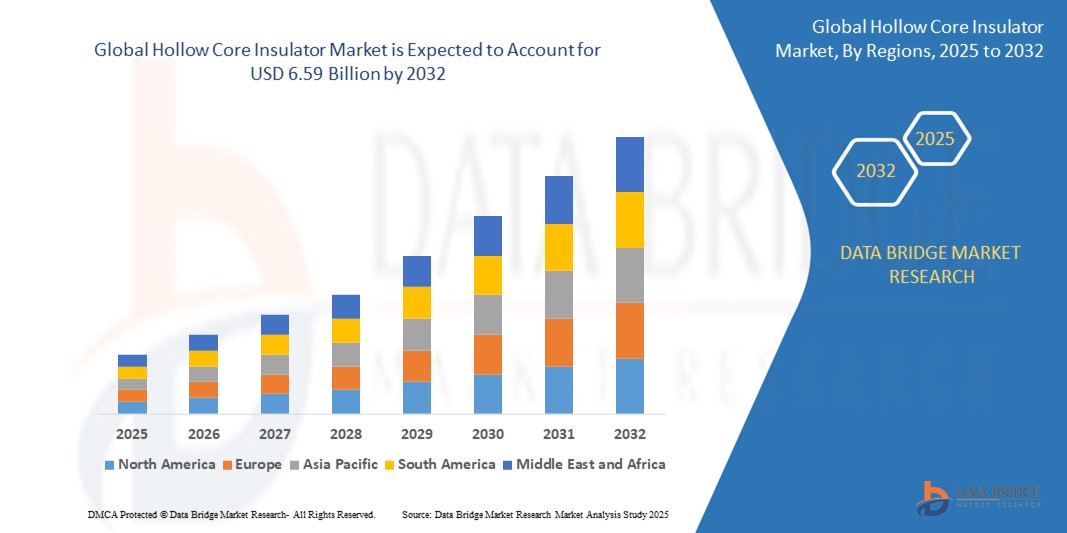
What is the Global Hollow Core Insulator Market Size and Growth Rate?
- The global hollow core insulator market size was valued at USD 4.50 billion in 2024 and is expected to reach USD 6.59 billion by 2032, at a CAGR of 4.90% during the forecast period
- Market expansion is largely driven by increased investments in electrical transmission infrastructure and rapid industrialization across developing regions
- In addition, the growing need for reliable, high-voltage insulation in smart grids, substations, and power utilities is strengthening the adoption of hollow core insulators worldwide
What are the Major Takeaways of Hollow Core Insulator Market?
- Hollow Core Insulators, known for their excellent mechanical strength and weather resistance, are essential for high-voltage applications in electrical transmission and distribution networks
- Rising demand is fueled by the modernization of power grids, an increasing number of renewable energy projects, and the need for compact, lightweight insulation solutions
- The market is witnessing accelerated growth due to a shift toward ceramic and composite materials, which offer superior performance in harsh environmental conditions
- Asia-Pacific dominated the Hollow Core Insulator market with the largest revenue share of 42.7% in 2024, driven by the extensive deployment of high-voltage transmission infrastructure, grid modernization projects, and rising energy demand across fast-growing economies
- North America is projected to grow at the fastest CAGR of 21.3% from 2025 to 2032, fueled by the modernization of electric grids and the replacement of aging infrastructure. Growing investments in renewable energy projects and high-voltage transmission lines, especially in the U.S. and Canada, are driving the adoption of high-performance insulators
- The 300–600 KV segment held the largest market revenue share of 46.5% in 2024, driven by widespread deployment in high-voltage transmission lines and substations
Report Scope and Hollow Core Insulator Market Segmentation
|
Attributes |
Hollow Core Insulator Key Market Insights |
|
Segments Covered |
|
|
Countries Covered |
North America
Europe
Asia-Pacific
Middle East and Africa
South America
|
|
Key Market Players |
|
|
Market Opportunities |
|
|
Value Added Data Infosets |
In addition to the insights on market scenarios such as market value, growth rate, segmentation, geographical coverage, and major players, the market reports curated by the Data Bridge Market Research also include in-depth expert analysis, pricing analysis, brand share analysis, consumer survey, demography analysis, supply chain analysis, value chain analysis, raw material/consumables overview, vendor selection criteria, PESTLE Analysis, Porter Analysis, and regulatory framework. |
What is the Key Trend in the Hollow Core Insulator Market?
“Advanced Material Innovation and Design Efficiency”
- A prominent and accelerating trend in the global hollow core insulator market is the shift toward advanced materials such as silicone rubber and hybrid composites, which offer superior mechanical strength, hydrophobicity, and long-term weather resistance compared to traditional porcelain
- These modern materials are enabling the development of lighter, more compact insulators that are easier to install and maintain, making them ideal for high-voltage transmission applications in remote or challenging environments
- For instance, manufacturers such as NGK Insulators and PPC Insulators have introduced high-performance composite hollow core insulators that exhibit improved resistance to pollution, ultraviolet radiation, and mechanical stress, significantly extending service life and reliability
- The use of finite element analysis (FEA) and other digital simulation tools is allowing engineers to optimize insulator geometry for better stress distribution, improving safety and reducing the such as of mechanical failure
- In addition, modular design innovations allow for customization based on voltage class and environmental exposure, making hollow core insulators more adaptable to a variety of grid configurations
- This trend is redefining expectations in terms of performance, longevity, and maintenance efficiency, especially as grid modernization and renewable integration demand more durable and adaptable insulation solutions
What are the Key Drivers of Hollow Core Insulator Market?
- Growing investments in power transmission and distribution infrastructure, especially in emerging economies, are significantly driving the demand for hollow core insulators
- For instance, in April 2024, GE Grid Solutions announced an upgrade project across Southeast Asia's transmission grid, including the deployment of advanced hollow core insulators for better system stability and reduced maintenance
- The global transition towards renewable energy sources such as wind and solar requires the development of high-voltage transmission lines, where hollow core insulators are critical for insulation and mechanical support
- In addition, the expansion of smart grids and substation automation is pushing utilities to adopt high-reliability insulators capable of withstanding environmental and electrical stresses over long operational periods
- The increasing demand for compact, lightweight, and pollution-resistant solutions in areas with harsh environmental conditions is also driving the shift from ceramic to composite hollow core insulators, accelerating adoption across multiple regions
Which Factor is challenging the Growth of the Hollow Core Insulator Market?
- One of the primary challenges facing the market is material degradation and long-term reliability concerns in highly polluted or high-humidity regions, particularly when using lower-grade composites
- For instance, failure reports in certain installations across coastal regions have raised concerns about surface tracking, erosion, and flashover risks, particularly in areas with limited maintenance access
- While composites offer several advantages, they can also suffer from hydrophobicity loss over time and may require more stringent quality control during manufacturing to prevent early aging or structural failure
- Furthermore, high upfront costs of premium-grade composite insulators compared to traditional porcelain options can deter adoption, especially in cost-sensitive markets
- The lack of standardization across global markets regarding testing protocols and performance benchmarks also complicates procurement decisions, particularly for utility operators in developing regions
- Overcoming these challenges will require investment in material R&D, improved global standards, and education on long-term cost savings and performance benefits to encourage broader adoption
How is the Hollow Core Insulator Market Segmented?
The market is segmented on the basis of voltage rating, shed material type, shed design, product type, and application.
• By Voltage Rating
On the basis of Voltage Rating, the Hollow Core Insulator market is segmented into Below 300 KV, 300–600 KV, and Above 600 KV. The 300–600 KV segment held the largest market revenue share of 46.5% in 2024, driven by widespread deployment in high-voltage transmission lines and substations. These insulators strike a balance between voltage capacity and physical size, making them suitable for a majority of modern grid applications, especially in emerging economies upgrading to higher-capacity networks.
The Above 600 KV segment is projected to witness the fastest growth from 2025 to 2032, fueled by the expansion of ultra-high-voltage (UHV) transmission projects globally. As energy demand rises and renewable power must be transmitted over long distances, this voltage class is gaining strategic importance, especially in countries such as China and India.
• By Shed Material Type
On the basis of shed material, the market is segmented into High Temperature Vulcanizing (HTV) Silicon Rubber and Liquid Silicon Rubber (LSR). The HTV Silicon Rubber segment dominated the market with a revenue share of 59.1% in 2024, owing to its excellent mechanical strength, resistance to UV degradation, and hydrophobic recovery properties. HTV materials are preferred for outdoor and polluted environments where long-term reliability is crucial.
The Liquid Silicon Rubber segment is anticipated to grow at the highest CAGR from 2025 to 2032, driven by its superior flexibility, automation-friendly processing, and high consistency in mass production, making it ideal for cost-effective manufacturing of precision-shaped insulators.
• By Shed Design
On the basis of shed design, The Hollow Core Insulator market is segmented into Plain Shed, Alternating Shed, Single Rib Shed, Double Rib Shed, and Super Deep Rib Shed. In 2024, the Alternating Shed design led the market with a revenue share of 33.8%, as it provides optimal performance in polluted and coastal environments by improving creepage distance and minimizing contamination buildup.
The Super Deep Rib Shed segment is expected to grow at the fastest CAGR during 2025 to 2032, driven by increasing demand in highly polluted regions where additional creepage distance and surface self-cleaning properties are critical for preventing flashover and prolonging service life.
• By Product Type
On the basis of product type, the market is classified into Ceramic and Composite insulators. The Composite segment held the dominant share of 57.6% in 2024, owing to its lightweight properties, better resistance to vandalism, and superior hydrophobic behavior. Composites are increasingly preferred for modern transmission applications due to their ease of handling and installation.
The Ceramic segment continues to grow steadily, particularly in regions with established grid infrastructure and a preference for long-proven insulator technologies. It is expected to maintain strong demand in legacy systems and high-temperature environments.
• By Application
On the basis of application, the market is segmented into Instrument Transformers, Circuit Breakers, Surge Arresters, Bushings, Switchgear, Station Post, and Cable Termination. The Instrument Transformers segment held the largest market share of 25.4% in 2024, driven by its essential role in voltage measurement and protection in high-voltage transmission systems.
The Surge Arresters segment is projected to witness the fastest growth during 2025 to 2032, as grid operators prioritize over-voltage protection amidst increasing load variability and lightning strike risks. Hollow core insulators are integral in enhancing reliability and safety in surge arresting equipment across both urban and remote installations.
Which Region Holds the Largest Share of the Hollow Core Insulator Market?
- Asia-Pacific dominated the Hollow Core Insulator market with the largest revenue share of 42.7% in 2024, driven by the extensive deployment of high-voltage transmission infrastructure, grid modernization projects, and rising energy demand across fast-growing economies
- Countries such as China, India, and Japan are investing heavily in power grid expansion, renewable integration, and electrification, fueling demand for hollow core insulators
- Government support for infrastructure development and high-voltage transmission corridors, especially for solar and wind energy projects, further boosts regional adoption
- A robust manufacturing ecosystem, growing domestic demand, and technological advancements in composite insulator production have solidified Asia-Pacific’s market leadership
China Hollow Core Insulator Market Insight
China hollow core insulator market accounted for majority of the Asia Pacific market revenue in 2024, fueled by a robust expansion of ultra-high-voltage (UHV) transmission networks and increasing renewable energy integration. Major grid expansion projects, coupled with domestic production dominance, enable fast deployment of cost-effective, high-performance insulators. In addition, the country’s push for energy efficiency and reduced transmission losses continues to drive adoption across new and existing substations.
India Hollow Core Insulator Market Insight
India hollow core insulator market is expected to grow at a notable CAGR during the forecast period, propelled by expanding power distribution infrastructure in rural and urban areas. Government programs such as Deendayal Upadhyaya Gram Jyoti Yojana (DDUGJY) and Revamped Distribution Sector Scheme (RDSS) are strengthening transmission reliability, creating substantial demand for advanced insulators. The growing focus on renewable energy and cross-regional grid connectivity also supports market expansion.
Japan Hollow Core Insulator Market Insight
Japan hollow core insulator market is projected to experience steady growth, driven by ongoing upgrades to aging power infrastructure and heightened attention to grid resilience in disaster-prone areas. Japan’s emphasis on compact and efficient power systems, along with high standards for reliability and safety, increases the demand for advanced hollow core insulators, particularly in densely populated urban regions and coastal installations.
Which Region is the Fastest Growing in the Hollow Core Insulator Market?
North America is projected to grow at the fastest CAGR of 21.3% from 2025 to 2032, fueled by the modernization of electric grids and the replacement of aging infrastructure. Growing investments in renewable energy projects and high-voltage transmission lines, especially in the U.S. and Canada, are driving the adoption of high-performance insulators. Regulatory mandates for grid reliability, coupled with increased climate-related disruptions, have prompted utilities to deploy durable and weather-resistant hollow core insulators across transmission networks.
U.S. Hollow Core Insulator Market Insight
U.S. hollow core insulator market dominated the North American market in 2024, supported by large-scale infrastructure upgrades and resilient grid development projects. The integration of wind and solar energy into long-distance transmission networks increases the need for high-voltage insulators. Utility providers prioritize hollow core solutions for their superior mechanical strength and contamination resistance, particularly in wildfire-prone and coastal zones.
Canada Hollow Core Insulator Market Insight
Canada hollow core insulator market is anticipated to grow at a robust CAGR during the forecast period, driven by ongoing transmission line expansions across remote regions and cross-border energy trading with the U.S. Canada’s emphasis on clean energy generation and decarbonization further encourages deployment of reliable, maintenance-free insulators suited for extreme environmental conditions.
Which are the Top Companies in Hollow Core Insulator Market?
The hollow core insulator industry is primarily led by well-established companies, including:
- PPC Austria Holding GmbH (Austria)
- CTC INSULATOR (Turkey)
- Modern Insulators Ltd. (India)
- PFISTERER Holding AG (Germany)
- Jiangsu Shenma Electric Power Co., Ltd (China)
- Maschinenfabrik Reinhausen GmbH (Germany)
- SAVER S.p.A (Italy)
- Nanjing Electric (Group)Co.,Ltd. (China)
- NGK INSULATORS, LTD (Japan)
- ZPE ZAPEL S.A (Poland)
- Zhengzhou Orient Power Co., Ltd (China)
- SANDIAN ELECTRIC (China)
- Aditya Birla Insulators (India)
- MacLean-Fogg (U.S.)
- Global Insulator Group LLC (U.S.)
- Royalinsulator (Turkey)
- Hitachi ABB Power Grids (Switzerland)
- Fujian Ruisen New Materials Co., Ltd. (China)
- Dalian Hivolt Power System Co., Ltd. (China)
- Newell & Hindustan Urban Infrastructure Ltd. (India)
What are the Recent Developments in Global Hollow Core Insulator Market?
- In August 2021, Hitachi ABB Power Grids had announced a step for a sustainable energy future and entering the transmission voltage level with its Econi eco-efficient high-voltage portfolio. EconiQ is the company's eco-efficient portfolio for sustainability, where products, services, and solutions are proven to deliver exceptional environmental performance. With that, the company had manufactured the first commercially available alternative to SF6 for gas-insulated switchgear with circuit breakers for power transmission networks, thereby reducing environmental effects significantly.

- Interactive Data Analysis Dashboard
- Company Analysis Dashboard for high growth potential opportunities
- Research Analyst Access for customization & queries
- Competitor Analysis with Interactive dashboard
- Latest News, Updates & Trend analysis
- Harness the Power of Benchmark Analysis for Comprehensive Competitor Tracking
Data collection and base year analysis are done using data collection modules with large sample sizes. The stage includes obtaining market information or related data through various sources and strategies. It includes examining and planning all the data acquired from the past in advance. It likewise envelops the examination of information inconsistencies seen across different information sources. The market data is analysed and estimated using market statistical and coherent models. Also, market share analysis and key trend analysis are the major success factors in the market report. To know more, please request an analyst call or drop down your inquiry.
The key research methodology used by DBMR research team is data triangulation which involves data mining, analysis of the impact of data variables on the market and primary (industry expert) validation. Data models include Vendor Positioning Grid, Market Time Line Analysis, Market Overview and Guide, Company Positioning Grid, Patent Analysis, Pricing Analysis, Company Market Share Analysis, Standards of Measurement, Global versus Regional and Vendor Share Analysis. To know more about the research methodology, drop in an inquiry to speak to our industry experts.
Data Bridge Market Research is a leader in advanced formative research. We take pride in servicing our existing and new customers with data and analysis that match and suits their goal. The report can be customized to include price trend analysis of target brands understanding the market for additional countries (ask for the list of countries), clinical trial results data, literature review, refurbished market and product base analysis. Market analysis of target competitors can be analyzed from technology-based analysis to market portfolio strategies. We can add as many competitors that you require data about in the format and data style you are looking for. Our team of analysts can also provide you data in crude raw excel files pivot tables (Fact book) or can assist you in creating presentations from the data sets available in the report.













