


Home/Self Testing Market Overview
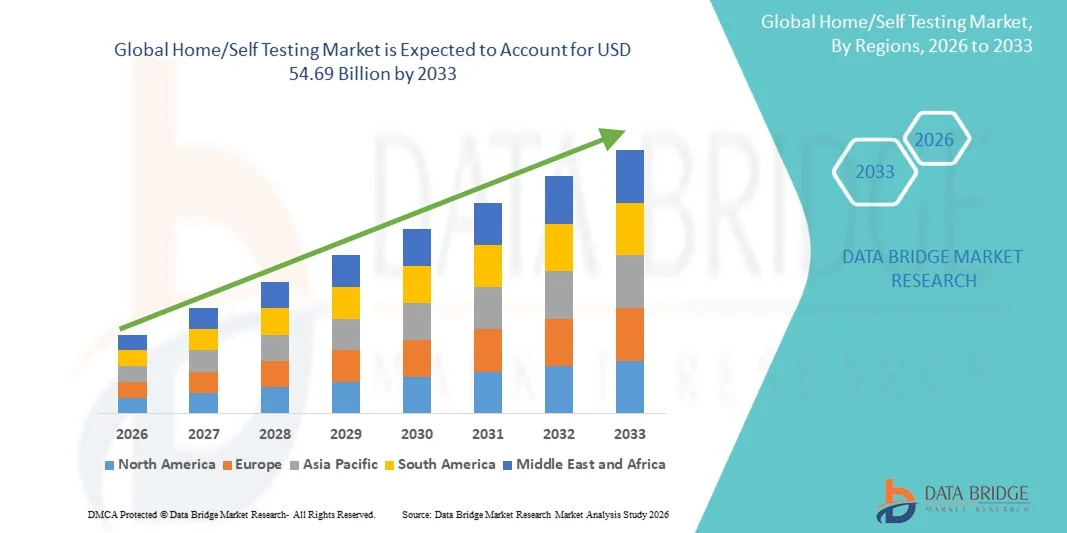
The Home/Self Testing Market was valued at USD 28.06 billion in 2025 and is projected to reach USD 54.69 billion by 2033, growing at a CAGR of 8.70% from 2026 to 2033. The market is witnessing strong growth driven by increasing consumer preference for convenient healthcare solutions, rising awareness of preventive health monitoring, and continuous advancements in diagnostic technologies. The expanding availability of rapid, user-friendly test kits for infectious diseases, chronic conditions, fertility, and wellness assessment is further accelerating market adoption.
The growing burden of chronic and infectious diseases worldwide, coupled with increasing healthcare costs and the need for early disease detection, is encouraging individuals to utilize home-based diagnostic solutions. Regulatory support for over-the-counter testing products and the integration of digital health platforms with self-testing devices are enhancing accessibility and patient engagement. In addition, innovations in connected diagnostics, smartphone-enabled testing, and AI-powered result interpretation are transforming home/self testing into a reliable, cost-effective, and convenient alternative to traditional laboratory-based diagnostics.
Key Market Trends & Insights
- North America dominated the Home/Self Testing Market with the largest revenue share of 38.46% in 2025, supported by high consumer awareness, widespread availability of over-the-counter diagnostic kits, and strong adoption of digital health solutions.
- The Diagnostic Kits segment led the market with a 46.28% share in 2025, driven by their broad availability, ease of use, and extensive adoption for infectious disease, pregnancy, fertility, and chronic disease testing.
- Asia-Pacific is expected to be the fastest-growing region at a CAGR of 8.1% from 2026 to 2033, fueled by expanding healthcare access, growing health-conscious populations, and increasing penetration of self-diagnostic products across China, India, and Southeast Asia.
- Diagnostic Devices are the fastest-growing product type, projected to register a CAGR of 8.6%, reflecting the surge in adoption of digital health technologies and connected monitoring solutions.
- The Disposable segment dominated the usage category with a 68.74% revenue share in 2025, led by widespread use of single-use testing products for pregnancy detection, infectious disease screening, and rapid diagnostics.
- Urine accounted for 61.33% of the market, preferred by its extensive use in pregnancy tests, fertility monitoring, diabetes screening, and various diagnostic applications.
- The Digital Monitoring Instrument segment is the fastest-growing form type category, with a CAGR of 9.1%, driven by the rising adoption of connected and technology-enabled healthcare solutions.
Market Size & Forecast
- Global Market Value (2025): USD 28.06 Billion
- Expected Market Value (2033): USD 54.69 Billion
- Forecast CAGR (2026–2033): 8.70%
- Leading Region in 2025: North America
- Fastest Growing Region: Asia Pacific
Report Scope and Home/Self Testing Market Segmentation
|
Attributes |
Home/Self Testing Key Market Insights |
|
Segments Covered |
|
|
Countries Covered |
North America · U.S. · Canada · Mexico Europe · Germany · France · U.K. · Netherlands · Switzerland · Belgium · Russia · Italy · Spain · Turkey · Rest of Europe Asia-Pacific · China · Japan · India · South Korea · Singapore · Malaysia · Australia · Thailand · Indonesia · Philippines · Rest of Asia-Pacific Middle East and Africa · Saudi Arabia · U.A.E. · South Africa · Egypt · Israel · Rest of Middle East and Africa South America · Brazil · Argentina · Rest of South America |
|
Key Market Players |
· Abbott (U.S.) · F. Hoffmann-La Roche Ltd (Switzerland) · Siemens Healthineers AG (Germany) · QuidelOrtho Corporation (U.S.) · OraSure Technologies, Inc. (U.S.) · BD (U.S.) · Danaher (U.S.) · EKF Diagnostics Holdings plc (U.K.) · ACON Laboratories, Inc. (U.S.) · Nova Biomedical Corporation (U.S.) · Trinity Biotech plc (Ireland) · bioLytical Laboratories Inc. (Canada) · LetsGetChecked (Ireland) · Everly Health, Inc. (U.S.) · iHealth Labs Inc. (U.S.) · SD BIOSENSOR, Inc. (South Korea) · ARKRAY, Inc. (Japan) · PHC Holdings Corporation (Japan) · OraQuick (U.S.) · Bionime Corporation (Taiwan) |
|
Market Opportunities |
· Expansion of multi-disease home testing platforms · Growing adoption of smartphone-connected self-testing solutions · Increasing demand for home-based diagnostics in emerging markets |
|
Value Added Data Infosets |
In addition to the insights on market scenarios such as market value, growth rate, segmentation, geographical coverage, and major players, the market reports curated by the Data Bridge Market Research also include in-depth expert analysis, patient epidemiology, pipeline analysis, pricing analysis, and regulatory framework. |
Home/Self Testing Market Trends
Trend: Growth in Digital and Connected Home Diagnostics
Consumers are increasingly adopting connected home/self testing solutions to monitor health conditions, detect diseases, and track wellness indicators without visiting healthcare facilities. The integration of smartphone applications and cloud-based platforms enables seamless result interpretation, data storage, and remote consultation with healthcare professionals. Manufacturers are similarly leveraging digital technologies to enhance user experience through intuitive interfaces and personalized health insights, while AI-powered analytics create smarter diagnostic ecosystems that closely support proactive health management and continuous monitoring.
For instance, in January 2025, Everlywell expanded its digital health ecosystem by enhancing connectivity between at-home testing services and telehealth consultations, reflecting the growing trend toward integrated and connected diagnostic experiences.
Home/Self Testing Market Dynamics
Key Market Driver: Rising Demand for Early Disease Detection and Preventive Healthcare
The increasing focus on preventive healthcare and early disease detection has created substantial demand for home/self testing products that enable individuals to monitor health conditions conveniently and independently. Healthcare providers, diagnostic companies, and public health organizations are promoting self-testing as a core component of disease management strategies, reducing healthcare burdens, accelerating diagnosis timelines, and improving patient engagement. The growing prevalence of chronic diseases and heightened consumer awareness of personal health are further strengthening adoption across global markets. For instance, in March 2024, Abbott expanded access to consumer-focused diagnostic solutions designed to support early detection and routine health monitoring, highlighting the growing role of self-testing in preventive care.
Key Restraint/Challenge: Concerns Regarding Accuracy and Interpretation of Results
A significant restraint in the Home/Self Testing Market is the concern surrounding test accuracy, result interpretation, and user compliance. Modern self-testing products require clear instructions, reliable performance, and proper sample collection to ensure dependable outcomes. The challenge extends to false-positive or false-negative results, limited clinical oversight, and varying levels of health literacy, making adoption difficult for certain consumer groups and healthcare systems. Regulatory scrutiny and quality assurance requirements further increase complexity for manufacturers seeking broad market acceptance.
For instance, ongoing regulatory reviews by agencies such as the U.S. Food and Drug Administration continue to emphasize validation standards and labeling requirements for over-the-counter diagnostic products, reflecting the broader challenge of ensuring reliable consumer use.
Key Market Opportunity: Expansion of Multiplex and AI-Enabled Self-Testing Platforms
The expansion of multiplex and AI-enabled home/self testing platforms presents a significant market opportunity. AI-powered solutions can support automated result interpretation, provide personalized health recommendations, and enable continuous monitoring through connected healthcare ecosystems. The development of multi-condition testing kits and digitally integrated diagnostic platforms is further democratizing access to advanced healthcare, opening growth opportunities across underserved populations and rapidly developing healthcare markets in Asia-Pacific, Latin America, and the Middle East. For instance, in 2024, Roche Diagnostics continued advancing digital diagnostic capabilities and connected health solutions, demonstrating the industry's focus on intelligent and scalable self-testing technologies.
Home/Self Testing Market Scope
The home/self testing market is segmented on the basis of product type, usage, sample type, form type, application, and distribution channel.
- By Product Type
On the basis of product type, the Home/Self Testing Market is segmented into diagnostic kits, diagnostic devices, and diagnostic strips. The Diagnostic Kits segment dominated the market with a 46.28% share in 2025, owing to their broad availability, ease of use, and extensive adoption for infectious disease, pregnancy, fertility, and chronic disease testing. These kits provide rapid results without requiring specialized equipment or professional assistance. Their affordability and convenience make them highly accessible across both developed and emerging markets. Continuous innovation in test sensitivity and accuracy is further strengthening adoption. Growing consumer awareness regarding preventive healthcare is also increasing demand. The segment continues to benefit from expanding over-the-counter product availability and regulatory approvals worldwide.
The Diagnostic Devices segment is projected to register the fastest growth at a CAGR of 8.6% from 2026 to 2033, driven by increasing adoption of digital health technologies and connected monitoring solutions. These devices provide enhanced accuracy, automated result interpretation, and long-term health tracking capabilities. Integration with smartphones and telehealth platforms is significantly improving patient engagement and disease management. Rising prevalence of chronic diseases is creating strong demand for home-based monitoring devices. Continuous advancements in biosensors and wireless connectivity are accelerating innovation. Growing preference for personalized healthcare solutions is further supporting segment expansion.
- By Usage
On the basis of usage, the Home/Self Testing Market is segmented into disposable and reusable. The Disposable segment dominated the market with a 68.74% share in 2025, driven by widespread use of single-use testing products for pregnancy detection, infectious disease screening, and rapid diagnostics. These products minimize contamination risks and eliminate the need for cleaning or maintenance. Their convenience and ease of disposal make them highly preferred among consumers. Healthcare authorities also favor disposable products due to improved safety and infection control. Large-scale manufacturing has enabled competitive pricing and broad accessibility. Increasing demand for rapid and reliable home diagnostics continues to support market leadership.
The Reusable segment is expected to witness the fastest growth at a CAGR of 8.2% from 2026 to 2033, owing to growing consumer interest in long-term health monitoring and cost-efficient testing solutions. Reusable devices provide continuous monitoring capabilities and reduce recurring product expenses. Advances in digital diagnostics and sensor technologies are improving performance and usability. Integration with health applications allows users to track trends and share data with healthcare providers. Increasing prevalence of chronic conditions requiring routine monitoring is further driving demand. Sustainability concerns are also encouraging adoption of reusable healthcare products.
- By Sample Type
On the basis of sample type, the Home/Self Testing Market is segmented into saliva and urine. The Urine segment dominated the market with a 61.33% share in 2025, owing to its extensive use in pregnancy tests, fertility monitoring, diabetes screening, and various diagnostic applications. Urine collection is simple, non-invasive, and familiar to most consumers. The availability of numerous validated urine-based tests has strengthened market penetration. High reliability and ease of sample collection support widespread adoption. Manufacturers continue to develop advanced urine-based diagnostic products for broader health applications. The segment remains a cornerstone of the home testing industry due to its practicality and accessibility.
The Saliva segment is projected to be the fastest-growing during the forecast period at a CAGR of 8.9% from 2026 to 2033, driven by increasing demand for non-invasive and user-friendly diagnostic solutions. Saliva collection eliminates discomfort associated with traditional sample collection methods. Advances in molecular diagnostics are enabling saliva-based detection of infectious diseases and other health conditions. Growing consumer preference for convenient testing procedures is accelerating adoption. Research investments are expanding the range of saliva-based applications. Increasing use in personalized healthcare and wellness testing is further contributing to segment growth.
- By Form Type
On the basis of form type, the Home/Self Testing Market is segmented into cassette, strip, midstream, digital monitoring instrument, test panel, cup, and dip card. The Strip segment dominated the market with a 34.57% share in 2025 due to its affordability, simplicity, and widespread use across glucose monitoring, pregnancy testing, and infectious disease detection. Test strips are easy to manufacture and distribute, supporting broad market availability. Their compact design enhances portability and convenience for users. Healthcare consumers value their rapid result delivery and straightforward interpretation. Continuous improvements in strip-based diagnostic technologies are increasing testing accuracy. Strong demand across both developed and emerging markets sustains segment leadership.
The Digital Monitoring Instrument segment is expected to register the fastest growth at a CAGR of 9.1% from 2026 to 2033, driven by the rising adoption of connected and technology-enabled healthcare solutions. These instruments provide accurate readings, automated data recording, and real-time monitoring capabilities. Integration with mobile applications enhances user engagement and health management. Growing demand for chronic disease monitoring is significantly supporting adoption. Technological advancements are improving usability, reliability, and diagnostic performance. Increasing focus on digital healthcare transformation continues to create strong growth opportunities.
- By Application
On the basis of application, the Home/Self Testing Market is segmented into cholesterol and triglycerides tests, diabetes and glucose tests, and others. The Diabetes and Glucose Tests segment dominated the market with a 39.86% share in 2025, driven by the growing global prevalence of diabetes and the need for routine self-monitoring. These tests play a critical role in disease management and treatment optimization. Patients increasingly rely on home-based glucose monitoring to improve health outcomes and reduce hospital visits. Continuous technological advancements have enhanced testing accuracy and convenience. Healthcare providers actively encourage regular monitoring to prevent complications. The large patient population worldwide continues to support the segment’s dominant position.
The Cholesterol and Triglycerides Tests segment is projected to witness the fastest growth at a CAGR of 8.4% from 2026 to 2033, supported by rising awareness of cardiovascular health and preventive healthcare practices. Consumers are increasingly seeking convenient methods to monitor lipid levels at home. Growing incidence of lifestyle-related disorders is encouraging routine screening. Advances in portable diagnostic technologies are improving accessibility and accuracy. Preventive health initiatives by governments and healthcare organizations are supporting adoption. Increasing emphasis on early detection of cardiovascular risk factors is further accelerating growth.
- By Distribution Channel
On the basis of distribution channel, the Home/Self Testing Market is segmented into retail pharmacies, drug store, supermarket/hypermarket, and online pharmacies. The Retail Pharmacies segment dominated the market with a 52.37% share in 2025 owing to strong consumer trust, professional guidance, and broad availability of self-testing products. These outlets provide convenient access to a wide range of diagnostic solutions. Pharmacists often assist consumers in selecting appropriate products and understanding usage instructions. Established distribution networks ensure consistent product availability. Retail pharmacies also benefit from strong healthcare partnerships and consumer confidence. Their accessibility continues to support leadership within the market.
The Online Pharmacies segment is anticipated to be the fastest-growing at a CAGR of 9.3% from 2026 to 2033, driven by increasing e-commerce penetration and consumer preference for convenient purchasing options. Online platforms offer extensive product choices, competitive pricing, and home delivery services. Digital healthcare adoption is encouraging consumers to purchase diagnostic products through online channels. The availability of product information and customer reviews supports informed decision-making. Expanding internet access and smartphone usage are further accelerating growth. Growing demand for discreet and contactless healthcare purchasing experiences continues to strengthen the segment.
Home/Self Testing Market Regional Analysis
North America dominated the Home/Self Testing Market with the largest revenue share of 38.46% in 2025, supported by high consumer awareness, widespread availability of over-the-counter diagnostic kits, and strong adoption of digital health solutions. The region also benefits from favorable regulatory frameworks, high adoption of digital health technologies, and growing demand for convenient at-home disease monitoring and preventive healthcare solutions. Increasing prevalence of chronic diseases, expanding use of connected diagnostic devices, and rising consumer preference for self-managed healthcare continue to drive market growth. Continuous innovation in rapid testing technologies and integration with telehealth platforms further strengthen North America’s leadership position in the global market.
U.S. Home/Self Testing Market Insight
The U.S. home/self testing market is witnessing strong growth due to rising consumer awareness regarding preventive healthcare, increasing prevalence of chronic diseases, and expanding adoption of at-home diagnostic technologies. The country’s advanced healthcare infrastructure, along with growing use of digital health platforms and connected diagnostic devices, is driving demand across disease screening, wellness monitoring, and chronic condition management applications. In addition, increasing emphasis on early disease detection and reducing healthcare costs is accelerating adoption of home/self testing products among consumers and healthcare providers.
Europe Home/Self Testing Market Insight
The Europe home/self testing market remains a major contributor to global revenue, driven by strong healthcare systems, growing health consciousness, and high demand for convenient diagnostic solutions. The widespread use of self-testing products for disease screening, pregnancy monitoring, and chronic disease management is supporting market expansion across the region. Increasing investments in digital healthcare technologies, coupled with favorable regulatory frameworks and rising focus on preventive care, continue to enhance the adoption of home/self testing solutions throughout Europe.
U.K. Home/Self Testing Market Insight
The U.K. home/self testing market is experiencing steady growth, supported by rising adoption of self-care practices, expanding availability of over-the-counter diagnostic products, and increasing demand for convenient healthcare solutions. Growing investments in digital health infrastructure and rising consumer preference for rapid and accessible testing options are contributing to market growth. Furthermore, integration of mobile health applications, connected devices, and telehealth services is improving diagnostic accessibility and patient engagement, positioning the U.K. as a key innovation hub in the home/self testing industry.
Germany Home/Self Testing Market Insight
The Germany home/self testing market is expanding steadily due to the country’s strong healthcare infrastructure, advanced diagnostic capabilities, and increasing adoption of innovative self-testing technologies. Healthcare providers, diagnostic companies, and consumers are increasingly utilizing home testing products for disease monitoring, preventive screening, and wellness assessment activities. Continuous advancements in digital diagnostics, connected health platforms, and rapid testing technologies, along with strong government focus on preventive healthcare and innovation, are further driving market growth in Germany.
Asia-Pacific Home/Self Testing Market Insight
The Asia-Pacific home/self testing market is expected to witness rapid growth, driven by increasing healthcare awareness, expanding access to diagnostic services, and rising investments in healthcare infrastructure across countries such as China, India, and Japan. Growing focus on preventive healthcare, rising adoption of digital health technologies, and increasing demand for affordable and convenient testing solutions are supporting regional market expansion. In addition, the growing prevalence of chronic diseases and improving availability of self-testing products are accelerating market adoption across both urban and rural populations.
Japan Home/Self Testing Market Insight
The Japan home/self testing market is witnessing consistent growth due to rising investments in healthcare innovation, increasing demand for preventive diagnostics, and growing awareness regarding personal health management. Healthcare organizations, diagnostic manufacturers, and consumers are increasingly adopting advanced self-testing solutions for disease detection, routine monitoring, and wellness assessment purposes. Moreover, increasing integration of digital health technologies and the country’s focus on efficient and accessible healthcare services are further contributing to market growth.
China Home/Self Testing Market Insight
The China home/self testing market is growing rapidly, driven by increasing healthcare expenditure, expanding access to diagnostic technologies, and rising government focus on preventive healthcare initiatives. Growing adoption of digital and connected diagnostic solutions across consumer healthcare and disease monitoring applications is significantly boosting market demand. In addition, rising investments in healthcare innovation, increasing awareness regarding early disease detection, and rapid technological advancements are positioning China as one of the fastest-growing markets for home/self testing globally.
Home/Self Testing Market Share
The home/self testing industry is primarily led by well-established companies, including:
- Abbott (U.S.)
- Hoffmann-La Roche Ltd (Switzerland)
- Siemens Healthineers AG (Germany)
- QuidelOrtho Corporation (U.S.)
- OraSure Technologies, Inc. (U.S.)
- BD (U.S.)
- Danaher (U.S.)
- EKF Diagnostics Holdings plc (U.K.)
- ACON Laboratories, Inc. (U.S.)
- Nova Biomedical Corporation (U.S.)
- Trinity Biotech plc (Ireland)
- bioLytical Laboratories Inc. (Canada)
- LetsGetChecked (Ireland)
- Everly Health, Inc. (U.S.)
- iHealth Labs Inc. (U.S.)
- SD BIOSENSOR, Inc. (South Korea)
- ARKRAY, Inc. (Japan)
- PHC Holdings Corporation (Japan)
- OraQuick (U.S.)
- Bionime Corporation (Taiwan)
Latest Developments in Home/Self Testing Market
- In August 2024, NOWDiagnostics received U.S. FDA approval for the first over-the-counter at-home syphilis test in the United States. The test delivers results in approximately 15 minutes using a fingerstick blood sample, expanding consumer access to sexually transmitted infection (STI) screening. The approval represents a significant advancement in decentralized diagnostics and supports broader public health efforts to improve early detection and treatment of syphilis
- In May 2024, Sherlock Biosciences announced the initiation of a clinical study evaluating its over-the-counter rapid self-test for chlamydia and gonorrhea, with commercialization targeted for 2025. The test is designed to provide results within 30 minutes from samples collected at home, improving accessibility and convenience for STI screening. This development highlights the growing expansion of home testing beyond traditional infectious disease applications
- In June 2023, Cue Health received FDA marketing authorization for its Cue COVID-19 Molecular Test, becoming the first at-home over-the-counter COVID-19 test to receive authorization through the traditional premarket review process rather than emergency authorization. The milestone strengthened confidence in home molecular diagnostics and demonstrated the transition of self-testing technologies into mainstream healthcare
- In February 2023, Lucira Health obtained FDA Emergency Use Authorization for the first over-the-counter at-home test capable of detecting and differentiating both Influenza A/B and COVID-19 from a single nasal swab sample. The test provides results in about 30 minutes and marked a major breakthrough in multiplex home diagnostics, enabling consumers to distinguish between common respiratory infections without visiting a healthcare facility
- In March 2021, Cue Health received FDA Emergency Use Authorization for the first molecular non-prescription at-home COVID-19 test. The test enabled consumers to perform highly sensitive molecular testing outside traditional laboratory settings, helping expand access to reliable diagnostics during the pandemic. This authorization accelerated the adoption of advanced home testing technologies and laid the foundation for the modern self-testing market

- Interactive Data Analysis Dashboard
- Company Analysis Dashboard for high growth potential opportunities
- Research Analyst Access for customization & queries
- Competitor Analysis with Interactive dashboard
- Latest News, Updates & Trend analysis
- Harness the Power of Benchmark Analysis for Comprehensive Competitor Tracking
Data collection and base year analysis are done using data collection modules with large sample sizes. The stage includes obtaining market information or related data through various sources and strategies. It includes examining and planning all the data acquired from the past in advance. It likewise envelops the examination of information inconsistencies seen across different information sources. The market data is analysed and estimated using market statistical and coherent models. Also, market share analysis and key trend analysis are the major success factors in the market report. To know more, please request an analyst call or drop down your inquiry.
The key research methodology used by DBMR research team is data triangulation which involves data mining, analysis of the impact of data variables on the market and primary (industry expert) validation. Data models include Vendor Positioning Grid, Market Time Line Analysis, Market Overview and Guide, Company Positioning Grid, Patent Analysis, Pricing Analysis, Company Market Share Analysis, Standards of Measurement, Global versus Regional and Vendor Share Analysis. To know more about the research methodology, drop in an inquiry to speak to our industry experts.
Data Bridge Market Research is a leader in advanced formative research. We take pride in servicing our existing and new customers with data and analysis that match and suits their goal. The report can be customized to include price trend analysis of target brands understanding the market for additional countries (ask for the list of countries), clinical trial results data, literature review, refurbished market and product base analysis. Market analysis of target competitors can be analyzed from technology-based analysis to market portfolio strategies. We can add as many competitors that you require data about in the format and data style you are looking for. Our team of analysts can also provide you data in crude raw excel files pivot tables (Fact book) or can assist you in creating presentations from the data sets available in the report.













