


What is the Home Spirometer Market Size and Growth Rate?
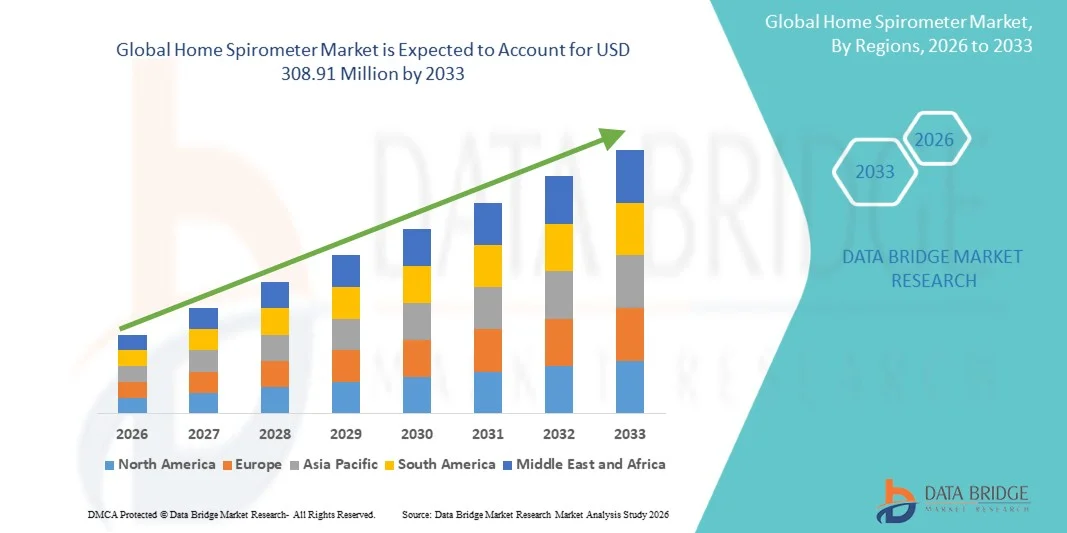
- As per Data Bridge Market Research analysis, the home spirometer market was valued at USD 153.90 million in 2025 and is projected to reach USD 308.91 million by 2033, growing at a CAGR of 9.10% from 2026 to 2033.
- The market is experiencing steady growth driven by the rising adoption of home-based respiratory monitoring, increasing prevalence of chronic obstructive pulmonary disease (COPD) and asthma, and the expanding integration of telehealth and remote patient monitoring into routine respiratory care.
- The growing burden of chronic respiratory diseases, combined with increasing preference for remote patient management and home healthcare, is encouraging healthcare providers to adopt connected home spirometers for continuous lung function assessment. Handheld and Bluetooth/Wi-Fi-enabled spirometers are increasingly replacing conventional clinic-only monitoring by enabling real-time data sharing with clinicians, improving disease management while reducing hospital visits and supporting telehealth-based care pathways.
Market Size & Forecast
- Global Market Value (2025): USD 153.90 Million
- Expected Market Value (2033): USD 308.91 Million
- Forecast CAGR (2026–2033): 9.10%
- Leading Region in 2025: North America
- Fastest Growing Region: Asia Pacific
What are the Major Takeaways of the Home Spirometer Market?
- North America dominated the home spirometer market with the largest revenue share of 40.26% in 2025, supported by a mature telehealth ecosystem, high prevalence of chronic respiratory diseases, and widespread adoption of home-based respiratory monitoring.
- Asia-Pacific is expected to be the fastest-growing region at a CAGR of 10.52% from 2026 to 2033, fueled by the rising burden of respiratory diseases, expanding healthcare digitalization, and increasing adoption of portable respiratory monitoring devices.
- The handheld spirometers segment led the market with a 57.84% share in 2025, driven by their established clinical validation, compact design, portability, and suitability for individual home-based lung function monitoring.
- Portable wireless spirometers are the fastest-growing product type, projected to register a CAGR of 8.21%, reflecting the surge in demand for connected healthcare solutions and remote respiratory monitoring.
- The flow-based spirometers segment dominated the technology category with a 54.63% revenue share in 2025, led by their widespread adoption for measuring airflow during pulmonary function testing.
- Chronic obstructive pulmonary disease (COPD) accounted for 40.42% of the market share in 2025, preferred by the increasing global burden of COPD and the need for continuous lung function monitoring.
- The asthma segment is the fastest-growing application category, with a CAGR of 9%, driven by increasing demand for continuous respiratory monitoring and personalized asthma management.
Report Scope and Home Spirometer Market Segmentation
|
Attributes |
Home Spirometer Key Market Insights |
|
Segments Covered |
|
|
Countries Covered |
North America
Europe
Asia-Pacific
Middle East and Africa
South America
|
|
Key Market Players |
|
|
Market Opportunities |
|
|
Value Added Data Infosets |
In addition to the insights on market scenarios such as market value, growth rate, segmentation, geographical coverage, and major players, the market reports curated by the Data Bridge Market Research also include in-depth expert analysis, patient epidemiology, pipeline analysis, pricing analysis, and regulatory framework. |
What is the Key Trend in the Home Spirometer Market?
- Connected home spirometry integrated with telehealth platforms is increasingly transforming respiratory disease management by enabling continuous remote lung function monitoring, digital data sharing, and timely clinical intervention.
- For instance, in June 2023, researchers at the University of California, San Francisco implemented a digital health intervention using Bluetooth-enabled home spirometers integrated with electronic health records, demonstrating reliable remote monitoring and high patient engagement among lung transplant recipients.
- Bluetooth-enabled spirometers allow healthcare providers to access real-time pulmonary function data, improving disease monitoring, treatment adjustments, and long-term patient engagement outside traditional clinical settings.
- Healthcare systems are increasingly incorporating digital home spirometry into chronic respiratory care pathways to reduce unnecessary hospital visits while supporting personalized and value-based healthcare delivery.
- For instance, in January 2025, a multicenter observational study published in the Journal of Medical Internet Research evaluated the implementation of home spirometry with a remote monitoring platform across five Dutch cystic fibrosis centers, demonstrating its integration into routine respiratory care while highlighting the importance of structured remote-care strategies to improve long-term patient uptake.
- As healthcare providers continue expanding telemedicine and remote patient monitoring programs, adoption of connected home spirometers is expected to accelerate, reinforcing digital respiratory monitoring as a core component of chronic pulmonary disease management.
What are the Key Drivers of the Home Spirometer Market?
- The rising global prevalence of chronic obstructive pulmonary disease, asthma, cystic fibrosis, and other chronic respiratory disorders is significantly increasing demand for home spirometers supporting continuous lung function assessment.
- For instance, in July 2025, an article published in the Journal of Cystic Fibrosis reported that high-quality home spirometry measurements, after adjustment for clinical stability and antibiotic use, provided lung function levels and trends closely comparable to hospital spirometry, supporting the broader adoption of remote pulmonary monitoring in clinical practice
- Healthcare providers and respiratory specialists are increasingly integrating home spirometry into disease management programs to improve early detection of lung function decline and reduce avoidable hospital admissions.
- For instance, in April 2024, an article published in Spring Nature demonstrated that remotely monitored home spirometry and pulse oximetry were feasible and well accepted among patients with interstitial lung disease, supporting the expansion of telehealth-enabled respiratory monitoring in routine clinical care.
- With healthcare systems increasingly prioritizing remote patient monitoring and digital respiratory care, home spirometers will remain essential tools for long-term management of chronic pulmonary diseases and telehealth-enabled clinical services.
Which Factors are Challenging the Growth of the Home Spirometer Market?
- Accurate home spirometry depends heavily on correct patient technique, consistent adherence, and regular device usage, creating challenges in obtaining reliable longitudinal pulmonary function measurements.
- For instance, in March 2024, an article published in JMIR mHealth and uHealth reported that patient engagement in mobile health home spirometry programs was affected by device-related difficulties, communication gaps, limited understanding of monitoring purpose, and challenges in using digital platforms, highlighting adherence and usability barriers for remote respiratory monitoring adoption.
- Home spirometry programs frequently experience declining patient adherence over time, reducing the effectiveness of continuous remote monitoring and long-term disease management strategies.
- For instance, in January 2025, a multicenter observational study published in the Journal of Medical Internet Research reported that 54.2% of people with cystic fibrosis discontinued home spirometry within one year of initiation despite access to a remote monitoring platform, highlighting long-term patient adherence as a key challenge for home spirometry adoption.
- Variability in unsupervised testing quality and limited patient training can reduce measurement consistency compared with supervised clinical spirometry, particularly during routine home use.
- The continued need for patient education, standardized testing protocols, and sustained engagement remains a significant barrier to widespread adoption, particularly for long-term respiratory disease monitoring outside clinical environments.
How is the Home Spirometer Market Segmented?
The home spirometer market is segmented on the basis of product type, technology, application, end user, and distribution channel.
- By Product Type
On the basis of product type, the home spirometer market is segmented into handheld spirometers, portable wireless spirometers, and smartphone-connected spirometers. The handheld spirometers segment dominated the market with a 57.84% share in 2025, owing to their established clinical validation, compact design, portability, and suitability for individual home-based lung function monitoring. These devices are widely used for measuring important pulmonary parameters such as forced vital capacity (FVC) and forced expiratory volume in one second (FEV1) among patients suffering from chronic respiratory diseases. Handheld spirometers have gained strong acceptance due to their affordability, simple operation, and widespread availability through healthcare providers and respiratory care programs. Their long history of clinical use has supported physician confidence and patient adoption. Increasing prevalence of COPD and asthma is further strengthening demand for these devices in homecare environments. However, limited connectivity features compared with advanced digital spirometry solutions may restrict adoption among users seeking real-time remote monitoring capabilities.
The portable wireless spirometers segment is projected to register the fastest growth with a CAGR of 8.21% from 2026 to 2033, driven by increasing demand for connected healthcare solutions and remote respiratory monitoring. These devices enable wireless transmission of lung function data through Bluetooth and other digital platforms, allowing healthcare providers to monitor patients remotely. Growing adoption of telehealth and remote patient monitoring programs is encouraging hospitals and clinicians to integrate wireless spirometry into chronic disease management. Advancements in smartphone connectivity, cloud-based data storage, and digital health applications are improving patient engagement and monitoring efficiency. The shift toward home-based healthcare models has further accelerated demand for connected respiratory devices
- By Technology
On the basis of technology, the home spirometer market is segmented into flow-based spirometers and connected and digital spirometry, and others. The flow-based spirometers segment dominated the market with a 54.63% share in 2025, supported by their widespread adoption for measuring airflow during pulmonary function testing. Flow-based technology provides reliable assessment of respiratory parameters and is extensively used for monitoring COPD, asthma, and other obstructive respiratory conditions. These devices are preferred due to their compact structure, ease of use, and suitability for home monitoring applications. Established clinical acceptance and availability of validated measurement techniques continue to support segment leadership. Increasing demand for portable respiratory diagnostic devices is further contributing to adoption. However, maintaining measurement accuracy requires proper patient technique and regular calibration.
The connected and digital spirometry technology segment is projected to register the fastest growth with a CAGR of 8.9% from 2026 to 2033, driven by increasing integration of Bluetooth connectivity, smartphone applications, and cloud-based healthcare platforms. Connected spirometers enable automatic transmission of lung function data to healthcare providers, supporting remote diagnosis and continuous monitoring. Rising adoption of telemedicine platforms and digital respiratory care models is accelerating demand for advanced technologies. These solutions improve patient engagement by providing real-time feedback and personalized disease management. Increasing investments in smart medical devices and remote monitoring infrastructure are further supporting adoption.
- By Application
On the basis of application, the home spirometer market is segmented into chronic obstructive pulmonary disease (COPD), asthma, cystic fibrosis, pulmonary fibrosis, and others. The chronic obstructive pulmonary disease (COPD) segment dominated the market with a 40.42% share in 2025, driven by the increasing global burden of COPD and the need for continuous lung function monitoring. Spirometry remains an essential diagnostic and monitoring tool for evaluating disease severity, tracking progression, and managing treatment outcomes in COPD patients. Home spirometers enable patients to monitor respiratory changes without frequent hospital visits, improving convenience and supporting early intervention. Growing healthcare emphasis on reducing COPD-related hospitalizations is encouraging adoption of home monitoring solutions. Increasing aging population and rising prevalence of smoking-related respiratory disorders are further supporting demand.
The asthma segment is projected to register the fastest growth with a CAGR of 9% from 2026 to 2033, supported by increasing demand for continuous respiratory monitoring and personalized asthma management. Home spirometry enables patients and healthcare providers to track lung function changes and evaluate treatment effectiveness. Growing adoption of digital asthma management platforms is increasing integration of spirometers with smartphone applications and telehealth solutions. Rising awareness regarding early detection of asthma exacerbations is further supporting demand. Healthcare providers are increasingly using remote monitoring approaches to improve disease control and reduce emergency visits.
- By End User
On the basis of end user, the home spirometer market is segmented into homecare settings, hospitals & clinics, ambulatory surgical centers, and others. The homecare settings segment dominated the market with 45% market share in 2025, supported by increasing preference for remote patient monitoring and decentralized healthcare delivery models. Home spirometers allow patients with chronic respiratory disorders to perform regular lung function assessments from their residences. The segment is benefiting from growing adoption of telehealth services and home-based disease management programs. Healthcare providers are increasingly recommending home monitoring solutions to improve patient convenience and reduce healthcare costs. Rising demand among elderly populations and patients requiring long-term respiratory monitoring is strengthening adoption. However, maintaining patient compliance and ensuring accurate self-testing remain important barriers.
The hospitals & clinics segment is projected to witness significant growth with a CAGR of 7.8% from 2026 to 2033, driven by increasing integration of home spirometry data into clinical workflows. Hospitals are adopting connected spirometry solutions to remotely monitor discharged patients and manage chronic respiratory diseases more effectively. Clinicians use home-generated lung function data to adjust treatment plans and identify early deterioration. Increasing focus on reducing hospital readmissions is encouraging healthcare facilities to adopt remote monitoring programs. Expansion of digital healthcare infrastructure is supporting adoption among hospitals and clinics.
- By Distribution Channel
On the basis of distribution channel, the home spirometer market is segmented into hospital pharmacies and others. The hospital pharmacies segment dominated the market with a 41.57% share in 2025, supported by physician recommendations, institutional purchasing, and integration with respiratory care services. Patients commonly obtain home spirometers through hospitals where healthcare professionals provide device training and usage guidance. Hospital pharmacies offer reliable access to medically approved respiratory monitoring devices and strengthen patient confidence. Increasing adoption of hospital-based remote monitoring programs is supporting demand through this channel. The segment benefits from established healthcare distribution networks and professional recommendations.
The online pharmacies and e-commerce segment is projected to register the fastest growth with a CAGR of 9.76% from 2026 to 2033, driven by increasing digital healthcare adoption and consumer preference for convenient medical device purchasing. Online platforms provide wider product availability, easier comparison of device specifications, and direct access to home healthcare equipment. Growing internet penetration and expansion of e-commerce healthcare services are supporting adoption through online channels. Manufacturers are increasingly using digital sales strategies to reach patients directly.
Which Region Holds the Largest Share of the Home Spirometer Market?
- North America dominated the home spirometer market with the largest revenue share of 40.26% in 2025, supported by a mature telehealth ecosystem, high prevalence of chronic respiratory diseases, and widespread adoption of home-based respiratory monitoring.
- The region also benefits from strong adoption of connected respiratory devices, favorable reimbursement frameworks, and the presence of leading medical device manufacturers offering advanced home spirometry solutions. Increasing focus on digital healthcare, decentralized care models, and continuous monitoring of COPD, asthma, and other pulmonary conditions continues to strengthen North America’s leadership position in the global market.
U.S. Home Spirometer Market Insight
The U.S. home spirometer market is witnessing strong growth due to the increasing prevalence of chronic respiratory diseases, expanding adoption of remote patient monitoring, and growing integration of digital health technologies into respiratory care. The country’s advanced healthcare infrastructure, strong presence of respiratory device manufacturers, and increasing use of connected spirometry solutions are driving demand across COPD, asthma, cystic fibrosis, and pulmonary monitoring applications. In addition, the growing emphasis on reducing hospital visits through home-based care models is accelerating adoption of home spirometers across healthcare systems. According to the Centers for Disease Control and Prevention (CDC), approximately 16 million Americans have been diagnosed with COPD, creating significant demand for continuous lung function monitoring solutions such as home spirometers.
Asia-Pacific Home Spirometer Market Insight
The Asia-Pacific home spirometer market is expected to witness rapid growth, driven by the rising burden of respiratory diseases, expanding healthcare digitalization, and increasing adoption of telemedicine solutions across countries such as China, India, and Japan. Growing awareness regarding early respiratory disease detection, improving healthcare infrastructure, and rising demand for affordable home monitoring devices are supporting regional market expansion. Additionally, increasing government initiatives for digital healthcare and remote patient monitoring are accelerating adoption of home spirometry across emerging economies. According to the World Health Organization (WHO), chronic respiratory diseases remain a major health burden in the Western Pacific and Southeast Asia regions, increasing the need for accessible respiratory monitoring technologies.
Japan Home Spirometer Market Insight
The Japan home spirometer market is witnessing consistent growth due to rising demand for elderly respiratory care, advanced healthcare technologies, and remote monitoring solutions. The country’s aging population, high healthcare technology adoption, and focus on preventive healthcare are encouraging the use of portable respiratory monitoring devices in homecare settings. Healthcare providers and research institutions are increasingly adopting digital spirometry solutions to support chronic respiratory disease management and reduce hospital dependency. According to Japan’s Ministry of Health, Labour and Welfare, people aged 65 years and above accounted for approximately 29% of Japan’s population in 2024, increasing the need for long-term respiratory monitoring solutions.
China Home Spirometer Market Insight
The China home spirometer market is growing rapidly, driven by increasing respiratory disease prevalence, expanding healthcare access, and rising adoption of digital healthcare solutions. Growing awareness regarding COPD management, increasing availability of portable medical devices, and government initiatives supporting smart healthcare are significantly boosting market demand. In addition, rising investments in telemedicine infrastructure and increasing use of remote monitoring platforms are positioning China as one of the fastest-growing markets for home spirometry globally. According to a study published in The Lancet Respiratory Medicine, China has one of the world’s largest COPD patient populations, with more than 100 million adults affected by COPD, creating substantial demand for lung function monitoring technologies.
U.K. Home Spirometer Market Insight
The U.K. home spirometer market is experiencing steady growth, supported by increasing adoption of remote respiratory monitoring programs, expansion of digital healthcare services, and rising demand for patient-centered care models. The country’s strong National Health Service (NHS) infrastructure and focus on reducing healthcare pressure through remote monitoring are contributing to wider adoption of home spirometry solutions. Furthermore, increasing use of connected medical devices and telehealth platforms is improving respiratory disease management efficiency across primary and specialist care settings. According to NHS England, virtual wards and remote monitoring pathways are being expanded to support patients outside hospitals, creating opportunities for connected respiratory monitoring technologies.
Germany Home Spirometer Market Insight
The Germany home spirometer market is expanding steadily due to the country’s advanced healthcare infrastructure, increasing adoption of digital health solutions, and growing focus on chronic respiratory disease management. Hospitals, respiratory specialists, and homecare providers are increasingly integrating remote monitoring technologies to improve patient outcomes and reduce healthcare costs. Continuous advancements in connected medical devices, telemedicine adoption, and Germany’s strong medical technology sector are further supporting market growth. According to the German Federal Ministry of Health, Germany’s Digital Healthcare Act (Digitale-Versorgung-Gesetz) has supported the integration of digital health applications into healthcare delivery, strengthening adoption of digital monitoring solutions.
Which are the Top Companies in Home Spirometer Market?
The home spirometer industry is primarily led by well-established companies, including:
- NuvoAir (Sweden)
- Medical International Research S.p.A. (Italy)
- Aluna Technologies Inc. (U.S.)
- Monitored Therapeutics Inc. (U.S.)
- Vyaire Medical, Inc. (U.S.)
- COSMED Srl (Italy)
- ndd Medical Technologies (Switzerland)
- SCHILLER AG (Switzerland)
- MGC Diagnostics Corporation (U.S.)
- CareFusion Corporation (U.S.)
- FUKUDA SANGYO CO., LTD. (Japan)
- CHEST M.I., Inc. (Japan)
- Vitalograph Ltd (U.K.)
- Geratherm Medical AG (Germany)
- GANSHORN Medizin Electronic GmbH (Germany)
- ZEPHYRx (U.S.)
- Uscom Limited (Australia)
- Hillrom Holdings, Inc. (U.S.)
What are Latest Developments in Home Spirometer Market?
- In May 2025, ActiGraph and ZEPHYRx announced a strategic partnership to expand remote respiratory monitoring capabilities for clinical research and decentralized trials. The collaboration integrates ZEPHYRx’s respiratory platform, which supports at-home spirometry testing and collection of pulmonary function parameters such as forced vital capacity (FVC) and forced expiratory volume (FEV₁), with ActiGraph’s digital health platform. This partnership enables researchers to collect high-quality respiratory data remotely, supporting broader adoption of connected home spirometry technologies in clinical studies and patient monitoring programs.
- In May 2025, Huma announced the acquisition of Aluna, a connected respiratory care company specializing in intelligent remote monitoring and management of respiratory diseases. The acquisition strengthens Huma’s digital health ecosystem by integrating Aluna’s home spirometry and respiratory monitoring capabilities into its healthcare platform. The strategic move aims to improve access to remote respiratory care, enhance chronic disease management, and expand digital monitoring solutions for conditions such as asthma and other respiratory disorders.
- In February 2025, MedM and CMI Health announced a partnership to integrate CMI Health’s SpiroLink spirometer with the MedM health data management platform. The collaboration combines CMI Health’s connected spirometry technology with MedM’s digital health ecosystem, enabling users to track respiratory health information through connected applications. The partnership supports easier monitoring of lung function data and reflects the growing integration of smartphone-connected spirometers with digital healthcare platforms for remote respiratory management.
- In January 2024, NuvoAir Medical announced that its Air Next Spirometer received FDA 510(k) clearance for in-home use as a full spirometer, enabling patients with respiratory conditions such as COPD and asthma to perform clinical-grade lung function testing remotely. The Air Next Spirometer integrates with NuvoAir’s digital respiratory care platform, allowing healthcare providers to monitor lung function data and support continuous disease management outside traditional clinical settings. This regulatory clearance strengthened the adoption of connected home spirometry solutions for remote respiratory care.
- In August 2022, Uscom submitted regulatory documentation for its SpiroSonic AIR spirometer, a Bluetooth-enabled respiratory monitoring device designed to transfer spirometry data through a mobile application for use across clinical and home settings. The device development reflects the increasing demand for wireless spirometry solutions that enable digital data transmission and remote monitoring of lung function. The integration of smartphone connectivity supports broader adoption of home-based pulmonary assessment technologies.

- Interactive Data Analysis Dashboard
- Company Analysis Dashboard for high growth potential opportunities
- Research Analyst Access for customization & queries
- Competitor Analysis with Interactive dashboard
- Latest News, Updates & Trend analysis
- Harness the Power of Benchmark Analysis for Comprehensive Competitor Tracking
Data collection and base year analysis are done using data collection modules with large sample sizes. The stage includes obtaining market information or related data through various sources and strategies. It includes examining and planning all the data acquired from the past in advance. It likewise envelops the examination of information inconsistencies seen across different information sources. The market data is analysed and estimated using market statistical and coherent models. Also, market share analysis and key trend analysis are the major success factors in the market report. To know more, please request an analyst call or drop down your inquiry.
The key research methodology used by DBMR research team is data triangulation which involves data mining, analysis of the impact of data variables on the market and primary (industry expert) validation. Data models include Vendor Positioning Grid, Market Time Line Analysis, Market Overview and Guide, Company Positioning Grid, Patent Analysis, Pricing Analysis, Company Market Share Analysis, Standards of Measurement, Global versus Regional and Vendor Share Analysis. To know more about the research methodology, drop in an inquiry to speak to our industry experts.
Data Bridge Market Research is a leader in advanced formative research. We take pride in servicing our existing and new customers with data and analysis that match and suits their goal. The report can be customized to include price trend analysis of target brands understanding the market for additional countries (ask for the list of countries), clinical trial results data, literature review, refurbished market and product base analysis. Market analysis of target competitors can be analyzed from technology-based analysis to market portfolio strategies. We can add as many competitors that you require data about in the format and data style you are looking for. Our team of analysts can also provide you data in crude raw excel files pivot tables (Fact book) or can assist you in creating presentations from the data sets available in the report.













