


Hospital Asset Management Market Size
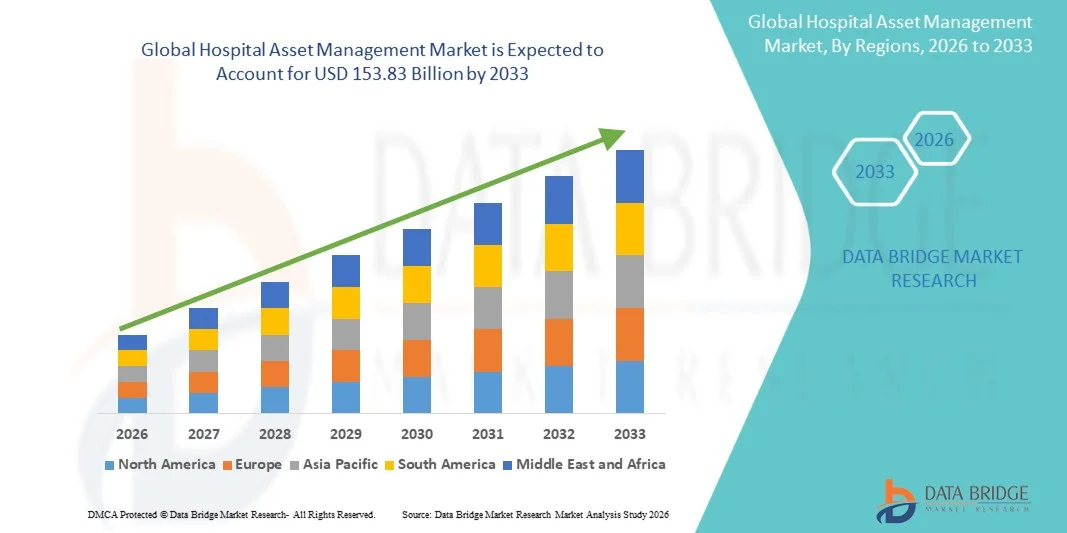
- As per Data Bridge Market Research Analysis the global hospital asset management market size was valued at USD 31.14 billion in 2025 and is expected to reach USD 153.83 billion by 2033, at a CAGR of 22.10% during the forecast period
- The market growth is largely fueled by the increasing need for efficient tracking and management of medical equipment, along with the growing adoption of digital healthcare infrastructure, leading to improved operational efficiency and cost optimization across hospitals and healthcare facilities
- Furthermore, rising demand for real-time asset visibility, integration of technologies such as RFID, IoT, and cloud-based platforms, and the need to reduce equipment loss and enhance patient care are establishing hospital asset management solutions as essential components of modern healthcare systems. These converging factors are accelerating the uptake of hospital asset management solutions, thereby significantly boosting the industry's growth
Market Size & Forecast
- Global Market Value (2025): USD 31.14 billion in 2025
- Expected Market Value (2033): USD 153.83 billion by 2033
- Forecast CAGR (2026–2033): 22.10%
Hospital Asset Management Market Analysis
- Hospital asset management solutions, including RFID tracking systems, real-time location systems (RTLS), and asset tracking software, are increasingly vital components of modern healthcare facilities due to their ability to improve equipment utilization, reduce losses, and enhance operational efficiency
- The escalating demand for hospital asset management solutions is primarily fueled by the growing need for cost control in healthcare, increasing adoption of digital health technologies, and rising focus on improving patient care and workflow efficiency
- North America dominated the hospital asset management market with the largest revenue share of 39.4% in 2025, characterized by advanced healthcare infrastructure, early adoption of asset tracking technologies, and strong presence of key market players, with the U.S. experiencing substantial growth driven by increasing investments in healthcare IT and automation
- Asia-Pacific is expected to be the fastest growing region in the hospital asset management market during the forecast period due to expanding healthcare infrastructure, increasing hospital digitization, rising patient volumes, and growing investments in smart healthcare solutions across emerging economies
- The Real-Time Location Systems (RTLS) segment dominated the largest market revenue share of 41.6% in 2025, driven by its ability to provide real-time tracking of medical equipment, patients, and staff within hospital environments
Report Scope and Hospital Asset Management Market Segmentation
|
Attributes |
Hospital Asset Management Key Market Insights |
|
Segments Covered |
|
|
Countries Covered |
North America · U.S. · Canada · Mexico Europe · Germany · France · U.K. · Netherlands · Switzerland · Belgium · Russia · Italy · Spain · Turkey · Rest of Europe Asia-Pacific · China · Japan · India · South Korea · Singapore · Malaysia · Australia · Thailand · Indonesia · Philippines · Rest of Asia-Pacific Middle East and Africa · Saudi Arabia · U.A.E. · South Africa · Egypt · Israel · Rest of Middle East and Africa South America · Brazil · Argentina · Rest of South America |
|
Key Market Players |
· Stanley Healthcare (U.S.) · Zebra Technologies Corporation (U.S.) · GE HealthCare Technologies Inc. (U.S.) · Cisco Systems, Inc. (U.S.) · Honeywell International Inc. (U.S.) · Siemens Healthineers AG (Germany) · IBM Corporation (U.S.) · CenTrak, Inc. (U.S.) · ThingMagic (Impinj, Inc.) (U.S.) · Awarepoint Corporation (U.S.) · Aruba Networks (Hewlett Packard Enterprise) (U.S.) · Axcess International, Inc. (U.S.) · Sonitor Technologies (U.S.) · Midmark Corporation (U.S.) · Ekahau, Inc. (U.S.) · Identec Solutions AG (Austria) · Ubisense Group plc (U.K.) · Alien Technology, LLC (U.S.) · GAO RFID Inc. (Canada) · Trimble Inc. (U.S.) |
|
Market Opportunities |
· Integration of IoT and Real-Time Analytics · Expansion of Smart Hospitals and Digital Healthcare Infrastructure |
|
Value Added Data Infosets |
In addition to the insights on market scenarios such as market value, growth rate, segmentation, geographical coverage, and major players, the market reports curated by the Data Bridge Market Research also include in-depth expert analysis, patient epidemiology, pipeline analysis, pricing analysis, and regulatory framework. |
Hospital Asset Management Market Trends
“Increasing Adoption of Real-Time Tracking and IoT-Enabled Asset Monitoring”
- A significant and accelerating trend in the global Hospital Asset Management market is the growing adoption of real-time tracking technologies such as RFID, Bluetooth Low Energy (BLE), and IoT-enabled systems to monitor and manage critical medical equipment efficiently. These technologies are transforming how hospitals track high-value assets, reduce losses, and optimize utilization
- For instance, many large hospitals are deploying RFID-based tracking systems to monitor the location and usage of infusion pumps, wheelchairs, and ventilators, enabling staff to quickly locate equipment and reduce delays in patient care
- The integration of IoT with asset management platforms allows continuous monitoring of equipment status, including usage patterns, maintenance needs, and availability, improving operational efficiency
- In addition, real-time data analytics helps healthcare providers identify underutilized assets, reduce unnecessary procurement, and improve cost management
- The rising need for automation in hospital operations, especially in large healthcare facilities, is further accelerating the adoption of these advanced tracking solutions
- This trend is significantly enhancing workflow efficiency, minimizing equipment downtime, and improving overall patient care delivery
Hospital Asset Management Market Dynamics
Driver
“Rising Need for Operational Efficiency and Cost Optimization in Healthcare Facilities”
-
The increasing pressure on healthcare systems to improve operational efficiency while reducing costs is a major driver for the Hospital Asset Management market. Hospitals are increasingly focusing on optimizing asset utilization to minimize wastage and improve return on investment
-
For instance, hospitals are implementing centralized asset management systems that provide real-time visibility into equipment usage, helping administrators reduce redundant purchases and streamline inventory management
- The growing volume of patients and the rising demand for advanced medical devices are pushing healthcare providers to adopt efficient asset tracking solutions to ensure timely availability of equipment
- Furthermore, the need to comply with regulatory standards related to equipment maintenance and patient safety is encouraging hospitals to adopt automated asset management systems
- Digital transformation initiatives in healthcare, including the adoption of electronic health records and connected medical devices, are also supporting the integration of asset management platforms
- The ability to reduce equipment loss, prevent theft, and enhance staff productivity is further contributing to the increasing adoption of these systems across hospitals globally
- In addition, improved asset visibility helps in better emergency preparedness, ensuring that critical equipment is readily available during high-demand situations such as pandemics or emergencies
Restraint/Challenge
“High Implementation Costs and Integration Complexities with Existing Systems”
-
One of the key challenges in the Hospital Asset Management market is the high initial investment required for implementing advanced tracking technologies, including RFID infrastructure, sensors, and software platforms. This can be a barrier, particularly for small and mid-sized healthcare facilities
- For instance, deploying a hospital-wide RFID system involves significant costs related to hardware installation, system integration, and staff training, which may limit adoption in resource-constrained settings
- In addition, integrating new asset management solutions with existing hospital IT infrastructure, such as legacy systems and electronic medical records, can be complex and time-consuming
- Data interoperability issues between different systems may hinder seamless communication and reduce the effectiveness of asset tracking solutions
- Concerns related to data security and patient privacy also pose challenges, as these systems handle sensitive operational and sometimes patient-related data
- Limited technical expertise and resistance to adopting new technologies among healthcare staff can further slow down implementation
- Ongoing maintenance costs, including software updates and system upgrades, add to the total cost of ownership, making it essential for vendors to develop more cost-effective and scalable solutions
Hospital Asset Management Market Scope
The market is segmented on the basis of product, application, and end-user.
-
By Product
On the basis of product, the Hospital Asset Management market is segmented into Real-Time Location Systems (RTLS), Radio-Frequency Identification (RFID), Ultrasound, and Infrared. The Real-Time Location Systems (RTLS) segment dominated the largest market revenue share of 41.6% in 2025, driven by its ability to provide real-time tracking of medical equipment, patients, and staff within hospital environments. RTLS solutions are widely adopted due to their high accuracy, automation capabilities, and ability to reduce equipment loss and operational inefficiencies. Hospitals increasingly rely on RTLS to enhance workflow optimization, improve patient safety, and ensure better utilization of high-value assets such as ventilators and infusion pumps. The integration of RTLS with hospital information systems and IoT-based platforms further strengthens its adoption. In addition , the rising burden on healthcare infrastructure and the need for digital transformation are boosting demand. Government initiatives promoting smart hospitals and connected healthcare ecosystems also support segment growth. RTLS helps in minimizing delays in patient care and improves response times in emergencies. Its scalability and ability to integrate with cloud-based systems make it a preferred solution. Increasing investments in healthcare IT infrastructure continue to drive this segment’s dominance.
The Radio-Frequency Identification (RFID) segment is anticipated to witness the fastest growth rate with a CAGR of 22.4% from 2026 to 2033, fueled by its cost-effectiveness and widespread applicability in asset tracking and inventory management. RFID technology enables automated identification and tracking of assets using tags and readers, significantly reducing manual errors and labor costs. Hospitals are increasingly adopting RFID for tracking pharmaceuticals, surgical instruments, and consumables. The technology enhances supply chain visibility and helps prevent theft or misplacement of critical assets. RFID also supports compliance with regulatory standards by maintaining accurate records. Its ease of deployment and compatibility with existing hospital systems contribute to its rapid adoption. Growing awareness about inventory optimization and cost reduction strategies is accelerating demand. In addition , advancements in RFID technology, including passive and active tags, are improving efficiency. The rising focus on operational efficiency and digitization in healthcare facilities further drives this segment’s growth trajectory.
-
By Application
On the basis of application, the Hospital Asset Management market is segmented into Patient Management, Staff Management, Instrument Management, and Supply Chain Management. The Instrument Management segment dominated the largest market revenue share of 38.9% in 2025, driven by the increasing need to track and manage high-value medical equipment across healthcare facilities. Hospitals face significant challenges related to equipment misplacement, underutilization, and maintenance scheduling, which has led to higher adoption of asset management solutions in this segment. Effective instrument management ensures optimal utilization of devices such as MRI machines, infusion pumps, and surgical tools. It also helps in reducing operational costs and improving patient care delivery. The integration of advanced tracking technologies enhances visibility and accountability of assets. Hospitals are focusing on preventive maintenance and lifecycle management of equipment, further driving demand. The segment also benefits from increasing healthcare expenditure and infrastructure expansion. In addition , improved compliance with safety and regulatory standards contributes to its dominance. Rising demand for automation in hospital operations further supports growth.
The Supply Chain Management segment is expected to witness the fastest CAGR of 23.1% from 2026 to 2033, driven by the growing need for efficient inventory control and logistics management in healthcare facilities. Hospitals are increasingly adopting asset management solutions to streamline procurement, storage, and distribution of medical supplies. Efficient supply chain management reduces wastage, prevents stockouts, and ensures timely availability of essential items. The adoption of digital technologies such as IoT and AI is enhancing supply chain visibility and forecasting capabilities. Increasing pressure to reduce healthcare costs is also driving adoption. The segment benefits from the rising complexity of hospital supply chains and the need for real-time tracking. Automation in inventory management significantly improves operational efficiency. Furthermore, the growth of large hospital networks and centralized procurement systems accelerates demand. The focus on improving patient outcomes through better resource availability further fuels this segment’s expansion.
-
By End-User
On the basis of end-user, the Hospital Asset Management market is segmented into Hospitals and Clinics, Pharmaceutical Companies, Biotechnology Companies, and Others. The Hospitals and Clinics segment accounted for the largest market revenue share of 52.7% in 2025, driven by the high volume of assets and the need for efficient management in these settings. Hospitals require robust asset tracking systems to manage a wide range of equipment, from critical care devices to routine medical tools. The increasing adoption of digital healthcare solutions and smart hospital initiatives significantly contributes to this segment’s dominance. Hospitals are focusing on improving operational efficiency, reducing costs, and enhancing patient care quality. Asset management systems help minimize equipment downtime and improve utilization rates. The rising patient population and increasing demand for healthcare services further drive adoption. In addition , regulatory requirements for asset tracking and maintenance support market growth. Integration with electronic health records (EHRs) enhances functionality and usability. Growing investments in healthcare infrastructure also boost demand in this segment.
The Pharmaceutical Companies segment is projected to witness the fastest CAGR of 21.6% from 2026 to 2033, driven by the increasing need for efficient tracking of research equipment, drug inventories, and logistics. Pharmaceutical firms are adopting asset management solutions to enhance operational efficiency and ensure regulatory compliance. The growing complexity of drug development processes requires precise tracking of assets and materials. Asset management systems help reduce losses and improve productivity in research and manufacturing facilities. Increasing investments in R&D activities further support segment growth. The adoption of advanced technologies such as RFID and IoT is enhancing asset visibility. In addition , the need for real-time data and analytics is driving demand. Pharmaceutical companies are focusing on optimizing supply chains and improving inventory accuracy. The expansion of global pharmaceutical markets and increasing outsourcing activities also contribute to the rapid growth of this segment.
Hospital Asset Management Market Regional Analysis
- North America dominated the hospital asset management market with the largest revenue share of 39.4% in 2025, characterized by advanced healthcare infrastructure, early adoption of asset tracking technologies, and strong presence of key market players
- The region is witnessing widespread implementation of RFID, RTLS, and IoT-based asset management systems to improve operational efficiency and reduce equipment loss
- The U.S. is experiencing substantial growth driven by increasing investments in healthcare IT, automation, and the need for real-time asset visibility across hospitals and healthcare facilities
U.S. Hospital Asset Management Market Insight
The U.S. hospital asset management market captured the largest revenue share in 2025 within North America, supported by rapid digital transformation in healthcare and strong adoption of advanced tracking and management solutions. Hospitals are increasingly deploying asset management systems to optimize equipment utilization, enhance patient care, and reduce operational costs. Growing integration of AI and analytics into asset tracking platforms, along with rising demand for workflow automation, is significantly driving market growth in the country.
Europe Hospital Asset Management Market Insight
The Europe hospital asset management market is projected to expand at a substantial CAGR throughout the forecast period, primarily driven by increasing focus on healthcare efficiency, patient safety, and regulatory compliance. The region is witnessing rising adoption of digital asset tracking systems, expansion of smart hospital infrastructure, and growing investments in healthcare IT. In addition , increasing demand for real-time monitoring of medical equipment and improved inventory management is supporting market growth across hospitals and healthcare institutions.
U.K. Hospital Asset Management Market Insight
The U.K. hospital asset management market is anticipated to grow at a noteworthy CAGR during the forecast period, driven by strong emphasis on healthcare digitization and efficient resource management within the NHS. Increasing deployment of asset tracking technologies to manage medical devices, reduce equipment downtime, and improve patient care outcomes is contributing to market expansion. In addition , growing investments in digital health solutions and hospital automation are further supporting adoption.
Germany Hospital Asset Management Market Insight
The Germany hospital asset management market is expected to expand at a considerable CAGR during the forecast period, fueled by increasing investments in healthcare infrastructure and strong focus on technological innovation. The country is witnessing rising adoption of advanced tracking systems, including RFID and real-time location systems, to enhance operational efficiency and reduce asset misplacement. Emphasis on precision healthcare, data integration, and hospital digitalization is further driving market growth.
Asia-Pacific Hospital Asset Management Market Insight
The Asia-Pacific hospital asset management market is expected to be the fastest growing region during the forecast period, driven by expanding healthcare infrastructure, increasing hospital digitization, rising patient volumes, and growing investments in smart healthcare solutions across emerging economies. Governments and private players are actively investing in modernizing healthcare facilities and implementing advanced asset management systems to improve efficiency and patient care.
Japan Hospital Asset Management Market Insight
The Japan hospital asset management market is gaining momentum due to advanced healthcare infrastructure, increasing adoption of digital health technologies, and rising need for efficient hospital operations. The country is witnessing growing use of automated asset tracking systems to manage medical equipment, improve workflow efficiency, and support aging population healthcare needs.
China Hospital Asset Management Market Insight
The China hospital asset management market accounted for the largest market revenue share in Asia Pacific in 2025, attributed to rapid expansion of healthcare infrastructure, strong government support for healthcare digitization, and increasing adoption of smart hospital solutions. Rising patient volumes, growing investments in healthcare IT, and increasing focus on operational efficiency are significantly driving demand for asset management systems in the country.
Hospital Asset Management Market Share
The Hospital Asset Management industry is primarily led by well-established companies, including:
- Stanley Healthcare (U.S.)
- Zebra Technologies Corporation (U.S.)
- GE HealthCare Technologies Inc. (U.S.)
- Cisco Systems, Inc. (U.S.)
- Honeywell International Inc. (U.S.)
- Siemens Healthineers AG (Germany)
- IBM Corporation (U.S.)
- CenTrak, Inc. (U.S.)
- ThingMagic (Impinj, Inc.) (U.S.)
- Awarepoint Corporation (U.S.)
- Aruba Networks (Hewlett Packard Enterprise) (U.S.)
- Axcess International, Inc. (U.S.)
- Sonitor Technologies (U.S.)
- Midmark Corporation (U.S.)
- Ekahau, Inc. (U.S.)
- Identec Solutions AG (Austria)
- Ubisense Group plc (U.K.)
- Alien Technology, LLC (U.S.)
- GAO RFID Inc. (Canada)
- Trimble Inc. (U.S.)
Latest Developments in Global Hospital Asset Management Market
- In February 2021, IBM announced strategic restructuring of its healthcare analytics and asset management capabilities under Watson Health, reflecting a broader shift toward AI-driven hospital asset optimization and data-driven decision-making in healthcare systems
- In January 2022, IBM completed the divestiture of its Watson Health division to Francisco Partners, leading to the creation of Merative, which continues to deliver AI-powered healthcare asset management and analytics solutions to hospitals and health systems globally
- In June 2023, healthcare providers globally accelerated adoption of RFID and Real-Time Location Systems (RTLS) for hospital asset tracking, driven by the need to reduce equipment loss, improve utilization, and enhance operational efficiency across healthcare facilities
- In November 2023, hospitals increasingly integrated IoT-enabled asset management systems into their digital infrastructure, enabling real-time monitoring, predictive maintenance, and workflow optimization, marking a major shift toward smart hospital ecosystems
- In May 2024, healthcare technology providers expanded deployment of cloud-based asset management platforms, allowing hospitals to centralize equipment tracking, improve interoperability, and support data-driven decision-making across multiple facilities
- In September 2024, industry developments highlighted increased investment in AI-powered predictive maintenance solutions, enabling hospitals to reduce equipment downtime and extend asset lifecycles through advanced analytics and machine learning integration
- In April 2025, IBM Watson Health partnered with Mayo Clinic to pilot AI-driven hospital asset management tools aimed at optimizing equipment utilization and reducing operational inefficiencies in clinical environments
- In May 2025, market analysis reported rapid expansion of the hospital asset management sector, driven by increasing demand for automation, cost efficiency, and digital transformation across healthcare systems worldwide
- In August 2025, healthcare organizations continued adopting advanced asset management technologies such as AI, IoT, and cloud-based systems, enhancing real-time asset visibility, improving patient safety, and streamlining hospital operations
- In October 2025, industry trends emphasized the growing role of integrated digital asset management ecosystems, combining tracking technologies, analytics platforms, and hospital information systems to support efficient resource utilization and improved clinical outcomes

- Interactive Data Analysis Dashboard
- Company Analysis Dashboard for high growth potential opportunities
- Research Analyst Access for customization & queries
- Competitor Analysis with Interactive dashboard
- Latest News, Updates & Trend analysis
- Harness the Power of Benchmark Analysis for Comprehensive Competitor Tracking
Data collection and base year analysis are done using data collection modules with large sample sizes. The stage includes obtaining market information or related data through various sources and strategies. It includes examining and planning all the data acquired from the past in advance. It likewise envelops the examination of information inconsistencies seen across different information sources. The market data is analysed and estimated using market statistical and coherent models. Also, market share analysis and key trend analysis are the major success factors in the market report. To know more, please request an analyst call or drop down your inquiry.
The key research methodology used by DBMR research team is data triangulation which involves data mining, analysis of the impact of data variables on the market and primary (industry expert) validation. Data models include Vendor Positioning Grid, Market Time Line Analysis, Market Overview and Guide, Company Positioning Grid, Patent Analysis, Pricing Analysis, Company Market Share Analysis, Standards of Measurement, Global versus Regional and Vendor Share Analysis. To know more about the research methodology, drop in an inquiry to speak to our industry experts.
Data Bridge Market Research is a leader in advanced formative research. We take pride in servicing our existing and new customers with data and analysis that match and suits their goal. The report can be customized to include price trend analysis of target brands understanding the market for additional countries (ask for the list of countries), clinical trial results data, literature review, refurbished market and product base analysis. Market analysis of target competitors can be analyzed from technology-based analysis to market portfolio strategies. We can add as many competitors that you require data about in the format and data style you are looking for. Our team of analysts can also provide you data in crude raw excel files pivot tables (Fact book) or can assist you in creating presentations from the data sets available in the report.













