


Hospital-at-Home Advanced Care Services Market Size
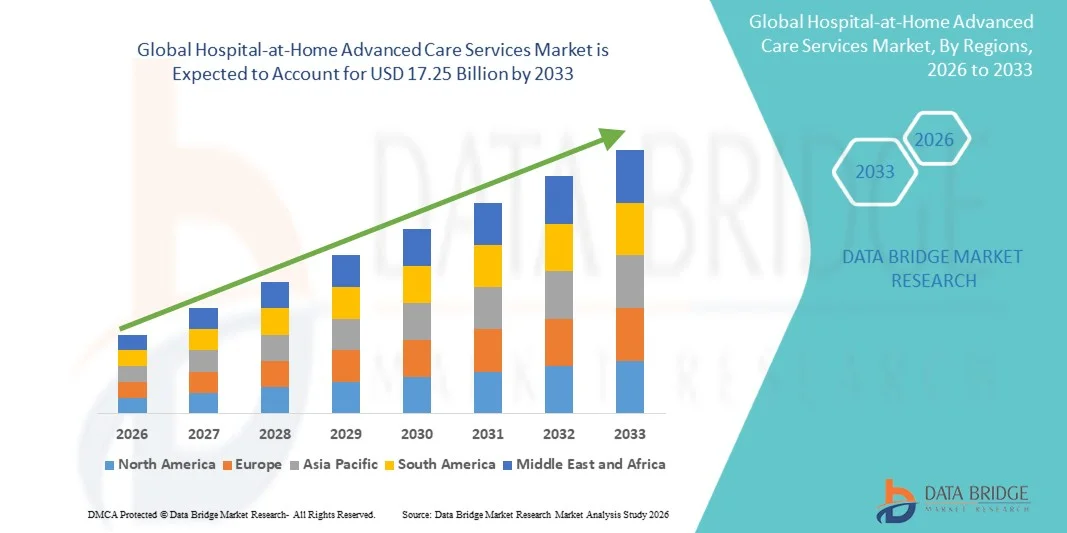
- The global Hospital-at-Home Advanced Care Services market size was valued at USD 5.84 billion in 2025 and is expected to reach USD 17.25 billion by 2033, at a CAGR of 14.50% during the forecast period
- The market growth is largely fueled by the increasing shift toward value-based healthcare and the rising preference for decentralized care models, leading to wider adoption of Hospital-at-Home Advanced Care Services that enable hospital-level treatment in the comfort of patients’ homes
- Furthermore, rapid advancements in telehealth, remote patient monitoring, and connected medical devices are improving care delivery efficiency and patient outcomes, making Hospital-at-Home Advanced Care Services a viable and cost-effective alternative to traditional inpatient hospitalization. These converging factors are accelerating the uptake of Hospital-at-Home Advanced Care Services solutions, thereby significantly boosting the industry's growth
Hospital-at-Home Advanced Care Services Market Analysis
- Hospital-at-Home Advanced Care Services, enabling hospital-level clinical treatment, monitoring, and recovery support in a home setting, are becoming a key component of modern healthcare delivery due to their ability to reduce hospital burden, lower costs, and improve patient comfort and outcomes
- The escalating demand for hospital-at-home advanced care services is primarily driven by the rising prevalence of chronic diseases, aging population, and rapid adoption of telehealth and remote patient monitoring technologies, along with increasing healthcare system pressure to optimize hospital capacity
- North America dominated the hospital-at-home advanced care services market with the largest revenue share of 42.3% in 2025, supported by advanced healthcare infrastructure, strong insurance coverage, high digital health adoption, and early implementation of hospital-at-home programs, particularly in the U.S.
- Asia-Pacific is expected to be the fastest growing region in the hospital-at-home advanced care services market during the forecast period due to improving healthcare accessibility, rising healthcare expenditure, increasing urban population, and rapid expansion of digital health ecosystems
- The Acute Care at Home segment dominated the market with the largest revenue share of 38.6% in 2025, driven by the increasing shift of hospital-level treatments to home settings supported by advanced telehealth infrastructure
Report Scope and Hospital-at-Home Advanced Care Services Market Segmentation
|
Attributes |
Hospital-at-Home Advanced Care Services Key Market Insights |
|
Segments Covered |
|
|
Countries Covered |
North America
Europe
Asia-Pacific
Middle East and Africa
South America
|
|
Key Market Players |
• Teladoc Health (U.S.) |
|
Market Opportunities |
|
|
Value Added Data Infosets |
In addition to the insights on market scenarios such as market value, growth rate, segmentation, geographical coverage, and major players, the market reports curated by the Data Bridge Market Research also include in-depth expert analysis, patient epidemiology, pipeline analysis, pricing analysis, and regulatory framework. |
Hospital-at-Home Advanced Care Services Market Trends
“Enhanced care delivery through AI, remote monitoring, and digital health integration”
- A significant and accelerating trend in the global Hospital-at-Home Advanced Care Services market is the deepening integration of artificial intelligence (AI), remote patient monitoring systems, and digital health platforms to enable hospital-level care in home settings. This integration is significantly improving patient convenience, clinical efficiency, and continuity of care outside traditional hospital environments
- For instance, in 2025, several healthcare providers in the U.S. and Europe expanded AI-enabled remote monitoring programs that allow clinicians to continuously track vitals such as oxygen saturation, heart rate, and blood pressure for patients receiving acute care at home, reducing unnecessary hospital admissions
- AI-driven predictive analytics tools are increasingly being used to identify early signs of patient deterioration, enabling timely clinical intervention and reducing emergency escalation rates in home-based care models
- For instance, hospitals in the U.K. have adopted AI-based early warning systems in hospital-at-home programs that alert care teams when patient vitals deviate from safe thresholds, improving response times
- The integration of telehealth platforms, IoT-enabled medical devices, and electronic health records is enabling seamless communication between patients, caregivers, and healthcare professionals, ensuring coordinated and real-time clinical oversight
- For instance, healthcare networks in Australia are using integrated digital dashboards that combine wearable device data with physician monitoring systems to manage post-surgical recovery at home more effectively
- This trend toward digitally connected, data-driven home healthcare ecosystems is fundamentally reshaping expectations of acute and chronic care delivery, encouraging healthcare providers to adopt more scalable and patient-centric treatment models
Hospital-at-Home Advanced Care Services Market Dynamics
Driver
“Rising Healthcare Demand and Shift Toward Decentralized Care Delivery Models”
- The increasing burden of chronic diseases, aging populations, and hospital capacity constraints is a key driver accelerating the adoption of hospital-at-home advanced care services globally. Healthcare systems are increasingly shifting toward decentralized care models to improve efficiency and reduce inpatient load
- For instance, during 2024–2025, several major hospital systems in the U.S. expanded Medicare-supported hospital-at-home programs, allowing patients with conditions such as pneumonia and heart failure to receive acute-level treatment at home
- Governments and healthcare providers are increasingly promoting home-based care initiatives to reduce healthcare costs while maintaining quality of care, particularly for elderly and high-risk patients
- For instance, France and Germany have expanded reimbursement frameworks for home hospitalization services, encouraging wider adoption of hospital-at-home programs across public healthcare systems
- Advances in portable medical devices, remote diagnostics, and digital health infrastructure are further enabling safe and effective delivery of hospital-grade care outside clinical settings
- For instance, compact infusion devices and wearable cardiac monitors are increasingly being used in home care programs across Japan to support continuous patient monitoring
- In addition, growing patient preference for personalized, comfortable, and home-based treatment environments is further accelerating market growth across both urban and semi-urban regions
Restraint/Challenge
“Limited Clinical Infrastructure Integration and Patient Safety Concerns in Home Settings”
- One of the major challenges in the hospital-at-home advanced care services market is the limited integration between home-based care systems and traditional hospital infrastructure, which can create gaps in communication and care coordination
- For instance, in several developing healthcare systems, fragmented digital health infrastructure makes it difficult to ensure real-time data sharing between home monitoring devices and hospital-based clinical teams
- Ensuring patient safety in non-hospital environments remains a key concern, particularly for patients requiring complex or high-acuity care, where rapid emergency response may be required
- In addition, variability in caregiver availability and training can impact the quality and consistency of home-based care delivery, especially for elderly or high-dependency patients
- For instance, in parts of Latin America, shortages of trained home healthcare professionals have limited the scalability of advanced hospital-at-home programs
- Addressing these challenges requires stronger integration of digital health systems, improved caregiver training programs, and enhanced emergency response frameworks to ensure safe and reliable home-based acute care delivery
Hospital-at-Home Advanced Care Services Market Scope
The market is segmented on the basis of service type, technology, and end-user.
• By Service Type
On the basis of service type, the Hospital-at-Home Advanced Care Services market is segmented into Acute Care at Home, Post-Acute Care, Chronic Disease Management, Palliative Care, and Remote Patient Monitoring Services. The Acute Care at Home segment dominated the market with the largest revenue share of 38.6% in 2025, driven by the increasing shift of hospital-level treatments to home settings supported by advanced telehealth infrastructure. This segment enables patients with conditions such as respiratory infections, cardiac conditions, and post-surgical needs to receive intensive care at home. Growing hospital overcrowding and cost reduction pressures significantly support adoption. Healthcare providers increasingly prefer this model to improve bed availability. Strong integration with remote monitoring devices enhances clinical outcomes. Rising patient preference for home-based recovery further strengthens demand. Government initiatives promoting decentralized care accelerate adoption. Expanding insurance coverage for home-based acute care boosts accessibility. Overall, acute care at home remains the dominant service type segment.
The Remote Patient Monitoring Services segment is expected to witness the fastest CAGR of 19.4% from 2026 to 2033, driven by rapid adoption of digital health technologies and continuous tracking of patient vitals outside clinical settings. These services enable real-time monitoring of chronic and post-acute patients using connected devices. Increasing prevalence of chronic diseases such as diabetes and cardiovascular disorders fuels demand. Healthcare providers benefit from early intervention and reduced hospital readmissions. Growing penetration of wearable devices and IoT-enabled health tools supports expansion. Rising telehealth adoption further enhances integration. Insurance companies increasingly reimburse remote monitoring solutions. Expansion of 5G and cloud-based healthcare systems accelerates growth. Overall, remote patient monitoring is the fastest-growing service segment.
• By Technology
On the basis of technology, the market is segmented into Telehealth Platforms, Remote Monitoring Devices, Mobile Health Applications, Wearable Devices, and Connected Medical Equipment. The Telehealth Platforms segment dominated the market with a revenue share of 34.9% in 2025, driven by widespread adoption of virtual consultations and digital care delivery systems. Telehealth platforms enable real-time communication between patients and healthcare professionals, reducing the need for physical hospital visits. Strong adoption during and after the COVID-19 pandemic significantly accelerated usage. Hospitals and providers increasingly integrate telehealth into hybrid care models. Government support for digital health infrastructure further strengthens adoption. Improved internet connectivity and smartphone penetration boost accessibility. Integration with electronic health records enhances clinical efficiency. Cost-effectiveness compared to in-person visits supports demand. Overall, telehealth platforms remain the dominant technology segment.
The Wearable Devices segment is expected to witness the fastest CAGR of 21.1% from 2026 to 2033, driven by rising consumer adoption of fitness and medical-grade monitoring devices. Wearables continuously track vital signs such as heart rate, oxygen saturation, and blood pressure. Increasing prevalence of chronic disease management at home supports growth. Integration with AI-powered analytics enhances predictive healthcare capabilities. Expanding use in elderly care and post-operative monitoring boosts demand. Technological advancements in miniaturization improve device comfort and accuracy. Rising investment in digital health startups accelerates innovation. Insurance-backed remote monitoring programs further promote adoption. Overall, wearable devices are the fastest-growing technology segment.
• By End-User
On the basis of end-user, the market is segmented into Hospitals, Home Healthcare Providers, Specialty Clinics, and Long-Term Care Facilities. The Hospitals segment dominated the market with a revenue share of 41.8% in 2025, driven by their central role in initiating and managing hospital-at-home programs. Hospitals leverage advanced infrastructure and clinical expertise to transition patients safely to home-based care. Increasing pressure to reduce inpatient burden supports adoption. Strong integration with telehealth and remote monitoring systems enhances service delivery. Hospitals also act as key coordinators between patients and home care providers. Growing reimbursement support for home hospitalization models strengthens demand. Expansion of hybrid care delivery systems boosts utilization. Overall, hospitals remain the dominant end-user segment.
The Home Healthcare Providers segment is expected to witness the fastest CAGR of 20.6% from 2026 to 2033, driven by rising demand for personalized and cost-effective care at home. These providers specialize in delivering nursing, monitoring, and rehabilitation services outside traditional hospital settings. Increasing aging population and chronic disease burden support growth. Advancements in portable medical technologies improve service efficiency. Growing preference for home-based recovery among patients accelerates adoption. Expansion of private home care agencies further strengthens availability. Integration with telehealth platforms enhances service coordination. Insurance coverage expansion supports affordability. Overall, home healthcare providers are the fastest-growing end-user segment.
Hospital-at-Home Advanced Care Services Market Regional Analysis
- North America dominated the hospital-at-home advanced care services market with the largest revenue share of 42.3% in 2025, supported by advanced healthcare infrastructure, strong insurance coverage, high digital health adoption, and early implementation of hospital-at-home programs, particularly in the U.S. The region continues to benefit from well-established healthcare delivery systems, increasing integration of remote patient monitoring technologies, and growing acceptance of home-based acute care models as an alternative to traditional hospitalization
- Patients and healthcare providers in North America are increasingly adopting hospital-at-home solutions due to improved care coordination, enhanced clinical outcomes, and the ability to deliver hospital-level treatment in comfortable home environments, which is significantly strengthening market demand
- This growth is further supported by strong reimbursement frameworks, rapid expansion of telehealth services, and continuous investment in digital health infrastructure, making North America a leading revenue-contributing region in the global hospital-at-home advanced care services market
U.S. Hospital-at-Home Advanced Care Services Market Insight
The U.S. hospital-at-home advanced care services market captured a dominant revenue share within North America in 2025, driven by early adoption of home-based acute care models, strong healthcare digitization, and widespread implementation of Medicare-supported hospital-at-home programs. The country benefits from advanced hospital networks, high patient awareness, and strong integration of remote monitoring systems that enable continuous clinical supervision. For instance, leading U.S. healthcare systems such as Mount Sinai and Mayo Clinic have expanded hospital-at-home programs for conditions like pneumonia and heart failure, demonstrating improved patient outcomes and reduced hospital readmission rates. Additionally, strong insurance coverage and growing investment in digital health platforms continue to support large-scale adoption across urban and suburban populations.
Europe Hospital-at-Home Advanced Care Services Market Insight
The Europe hospital-at-home advanced care services market is projected to expand at a steady CAGR during the forecast period, supported by strong public healthcare systems, increasing aging population, and rising focus on cost-efficient care delivery models. Governments across the region are actively promoting decentralized healthcare strategies to reduce hospital burden and improve patient comfort. For instance, France has expanded its “HAD (Hospitalisation à Domicile)” programs, enabling patients to receive chemotherapy and post-surgical care at home. Similarly, Germany and the Nordic countries are investing in digital health infrastructure to strengthen remote care capabilities.
U.K. Hospital-at-Home Advanced Care Services Market Insight
The U.K. hospital-at-home advanced care services market is expected to grow steadily during the forecast period, driven by NHS-led initiatives to reduce hospital overcrowding and improve patient care efficiency. Increasing adoption of virtual wards and home-based monitoring systems is enabling patients with chronic and acute conditions to receive continuous care outside hospitals. For instance, NHS England has expanded virtual ward programs that allow thousands of patients to be monitored at home using wearable devices and remote clinical dashboards. This shift is significantly improving hospital capacity management and patient satisfaction.
Germany Hospital-at-Home Advanced Care Services Market Insight
The Germany hospital-at-home advanced care services market is anticipated to expand at a considerable CAGR during the forecast period, supported by strong healthcare infrastructure, high digital health adoption, and increasing focus on efficient care delivery systems. For instance, German healthcare providers are increasingly implementing telemedicine-supported home care programs for elderly patients requiring continuous monitoring. The country’s emphasis on precision healthcare and structured insurance coverage is further enabling wider adoption of hospital-at-home models across both public and private healthcare sectors.
Asia-Pacific Hospital-at-Home Advanced Care Services Market Insight
The Asia-Pacific hospital-at-home advanced care services market is expected to be the fastest growing region during the forecast period due to improving healthcare accessibility, rising healthcare expenditure, increasing urban population, and rapid expansion of digital health ecosystems. For instance, countries such as India and China are scaling telemedicine platforms and home-based monitoring programs to support growing patient populations and reduce hospital burden. Expanding government initiatives focused on digital health transformation are further accelerating adoption of hospital-at-home services across the region.
Japan Hospital-at-Home Advanced Care Services Market Insight
The Japan hospital-at-home advanced care services market is gaining momentum due to its rapidly aging population, advanced healthcare system, and strong focus on remote patient monitoring solutions. For instance, Japanese healthcare providers are increasingly using wearable health devices and home infusion systems to manage elderly patients with chronic conditions at home. The country’s strong technological infrastructure and emphasis on elder care innovation are further supporting long-term market growth.
China Hospital-at-Home Advanced Care Services Market Insight
The China hospital-at-home advanced care services market accounted for a significant revenue share in Asia Pacific in 2025, driven by rapid urbanization, expanding healthcare infrastructure, and strong adoption of digital health technologies. For instance, major urban hospitals in China are increasingly integrating remote monitoring platforms to support post-discharge patient care at home. Government-backed smart healthcare initiatives and expanding insurance coverage are further improving accessibility and accelerating adoption of hospital-at-home care models across the country.
Hospital-at-Home Advanced Care Services Market Share
The Hospital-at-Home Advanced Care Services industry is primarily led by well-established companies, including:
• Teladoc Health (U.S.)
• Amwell (U.S.)
• Philips Healthcare (Netherlands)
• GE HealthCare (U.S.)
• Siemens Healthineers (Germany)
• Medtronic (Ireland)
• Baxter International (U.S.)
• Cardinal Health (U.S.)
• Fresenius Medical Care (Germany)
• Abbott Laboratories (U.S.)
• ResMed (U.S.)
• Hillrom (Baxter) (U.S.)
• Biofourmis (U.S.)
• Current Health (U.K.)
• DispatchHealth (U.S.)
• Doctor on Demand (U.S.)
• Cigna (U.S.)
• UnitedHealth Group (U.S.)
• LHC Group (U.S.)
• Amedisys (U.S.)
Latest Developments in Global Hospital-at-Home Advanced Care Services Market
- In November 2025, four major U.S. health systems rolled out new hospital-at-home programs, expanding acute-level care delivered in patients’ homes as an alternative to traditional inpatient stays. These programs were launched by NewYork-Presbyterian, Nemours Children’s Health, Valley Health System, and St. Luke’s Health System to improve patient experience and reduce hospital costs
- In June 2025, BrightSpring Health Services announced plans to expand its home care service lines, including home-based primary care, rehabilitation services, and home infusion care, reflecting growth and diversification in advanced home care offerings
- In June 2025, DispatchHealth and Medically completed their merger to create a combined home care provider aimed at delivering more integrated and precise home-based medical services, addressing complex patient needs outside the hospital setting
- In June 2025, Emcara Health (acquired by Lucet) expanded its home-based care capabilities to include behavioral health and chronic condition management, aligning with broader trends toward comprehensive hospital-at-home care models
- In December 2025, the “Hospital at Home” scheme in Manchester under the UK’s NHS significantly expanded, providing acute-level care at home for hundreds of patients daily, saving tens of thousands of hospital bed days and reducing healthcare costs as part of a broader shift to community-based care

- Interactive Data Analysis Dashboard
- Company Analysis Dashboard for high growth potential opportunities
- Research Analyst Access for customization & queries
- Competitor Analysis with Interactive dashboard
- Latest News, Updates & Trend analysis
- Harness the Power of Benchmark Analysis for Comprehensive Competitor Tracking
Data collection and base year analysis are done using data collection modules with large sample sizes. The stage includes obtaining market information or related data through various sources and strategies. It includes examining and planning all the data acquired from the past in advance. It likewise envelops the examination of information inconsistencies seen across different information sources. The market data is analysed and estimated using market statistical and coherent models. Also, market share analysis and key trend analysis are the major success factors in the market report. To know more, please request an analyst call or drop down your inquiry.
The key research methodology used by DBMR research team is data triangulation which involves data mining, analysis of the impact of data variables on the market and primary (industry expert) validation. Data models include Vendor Positioning Grid, Market Time Line Analysis, Market Overview and Guide, Company Positioning Grid, Patent Analysis, Pricing Analysis, Company Market Share Analysis, Standards of Measurement, Global versus Regional and Vendor Share Analysis. To know more about the research methodology, drop in an inquiry to speak to our industry experts.
Data Bridge Market Research is a leader in advanced formative research. We take pride in servicing our existing and new customers with data and analysis that match and suits their goal. The report can be customized to include price trend analysis of target brands understanding the market for additional countries (ask for the list of countries), clinical trial results data, literature review, refurbished market and product base analysis. Market analysis of target competitors can be analyzed from technology-based analysis to market portfolio strategies. We can add as many competitors that you require data about in the format and data style you are looking for. Our team of analysts can also provide you data in crude raw excel files pivot tables (Fact book) or can assist you in creating presentations from the data sets available in the report.













