


Hospital Workforce Management Market Size
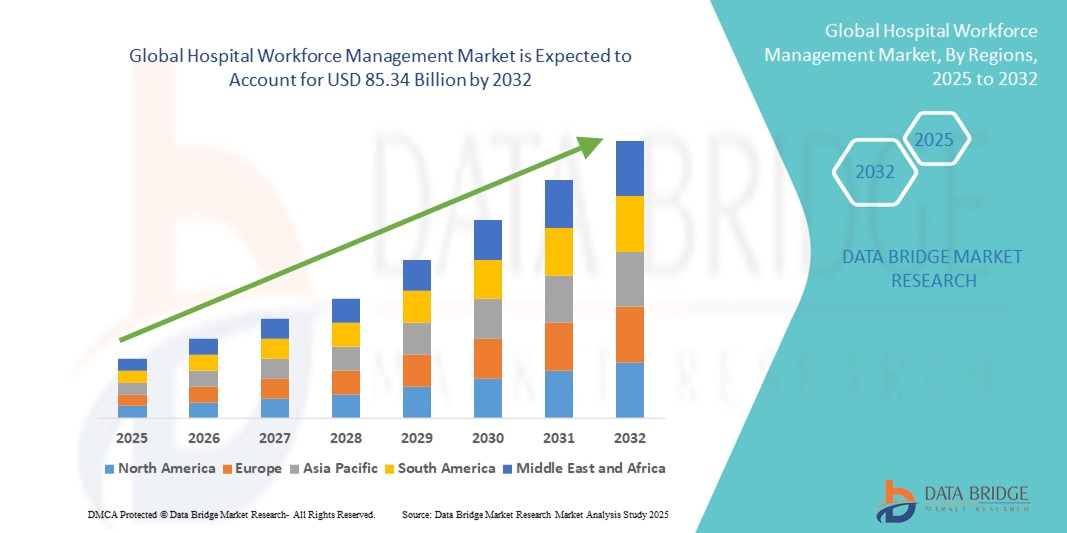
- The global hospital workforce management market size was valued at USD 26.94 billion in 2024 and is expected to reach USD 85.34 billion by 2032, at a CAGR of 15.50% during the forecast period
- The market growth is largely fueled by the rising need for efficient healthcare staffing, technological advancements in workforce management software, and the push toward operational efficiency in hospitals and healthcare facilities
- Furthermore, increasing demand for automated scheduling, compliance management, and AI-driven workforce solutions is establishing workforce management systems as essential tools in modern hospital administration. These converging factors are accelerating the adoption of hospital workforce management solutions, thereby significantly boosting the industry’s growth
Hospital Workforce Management Market Analysis
- Hospital workforce management solutions, offering digital tools for staff scheduling, time tracking, and resource optimization, are increasingly vital components of modern hospital operations in both clinical and administrative settings due to their ability to enhance efficiency, reduce labor costs, and ensure compliance with healthcare regulations
- The escalating demand for hospital workforce management systems is primarily fueled by growing healthcare staffing challenges, the need for operational efficiency, and the adoption of AI-driven scheduling and predictive analytics to optimize workforce utilization
- North America dominated the hospital workforce management market with the largest revenue share of 39.6% in 2024, characterized by advanced healthcare infrastructure, high healthcare spending, and excellent adoption of IT technologies. The U.S. experienced substantial growth, driven by hospitals implementing integrated workforce management systems to improve patient care and staff productivity
- Asia-Pacific is expected to be the fastest-growing region in the hospital workforce management market during the forecast period due to increasing healthcare investments, rising hospitalizations, and the adoption of digital healthcare technologies
- Public ownership of healthcare facilities dominated the hospital workforce management market with a 60.5% share, driven by standardized procurement processes and broader adoption of workforce management solutions across various institutions
Report Scope and Hospital Workforce Management Market Segmentation
|
Attributes |
Hospital Workforce Management Key Market Insights |
|
Segments Covered |
|
|
Countries Covered |
North America
Europe
Asia-Pacific
Middle East and Africa
South America
|
|
Key Market Players |
|
|
Market Opportunities |
|
|
Value Added Data Infosets |
In addition to the insights on market scenarios such as market value, growth rate, segmentation, geographical coverage, and major players, the market reports curated by the Data Bridge Market Research also include in-depth expert analysis, pricing analysis, brand share analysis, consumer survey, demography analysis, supply chain analysis, value chain analysis, raw material/consumables overview, vendor selection criteria, PESTLE Analysis, Porter Analysis, and regulatory framework. |
Hospital Workforce Management Market Trends
AI-Driven Scheduling and Predictive Workforce Optimization
- A significant and accelerating trend in the global hospital workforce management market is the integration of artificial intelligence (AI) and predictive analytics into workforce management systems. These technologies are enhancing hospital operational efficiency, optimizing staff allocation, and reducing labor costs
- For instance, AI-powered platforms such as Kronos Workforce Central and AMiON enable hospitals to predict peak patient inflows and dynamically adjust staff schedules, ensuring adequate coverage while minimizing overtime
- AI integration allows systems to analyze historical staffing patterns, anticipate shortages, and generate intelligent recommendations for shift planning. Some platforms even provide alerts for potential compliance issues or high-risk staffing scenarios, supporting proactive management decisions
- The seamless integration of workforce management systems with hospital information systems (HIS), electronic health records (EHR), and payroll platforms facilitates centralized management of human resources, scheduling, and compliance tracking. This integration enables hospitals to streamline operations and improve employee satisfaction
- This trend toward AI-enabled, predictive, and integrated workforce management is reshaping hospital administration, leading companies such as Kronos, AMiON, and Shiftboard to develop platforms with automated scheduling, real-time analytics, and predictive staffing capabilities
- The demand for hospital workforce management systems that leverage AI and predictive analytics is growing rapidly across both public and private healthcare sectors, as hospitals increasingly prioritize operational efficiency, patient care quality, and regulatory compliance
Hospital Workforce Management Market Dynamics
Driver
Rising Need for Operational Efficiency and Compliance Management
- The increasing complexity of hospital operations, combined with staffing shortages and regulatory requirements, is a key driver for the adoption of workforce management systems.
- For instance, in 2024, major hospital networks in North America implemented advanced workforce management solutions to automate scheduling, track staff compliance, and optimize shift allocation, driving market growth
- As hospitals seek to improve patient care and reduce labor costs, workforce management systems provide features such as automated shift scheduling, real-time attendance monitoring, and compliance tracking, offering significant efficiency improvements over manual processes
- Furthermore, the growing emphasis on quality care and staff productivity is making workforce management systems an essential tool for hospitals, facilitating integration with payroll, HR, and EHR platforms
- The trend toward digital transformation in healthcare, coupled with the need for predictive staffing and centralized workforce oversight, is further propelling the adoption of these systems across large hospitals, multi-chain networks, and specialty hospitals
Restraint/Challenge
High Implementation Costs and Integration Complexity
- The relatively high initial cost of advanced hospital workforce management systems can be a barrier, particularly for small and medium-sized hospitals or facilities in developing regions
- For instance, integrating AI-powered scheduling platforms with existing HIS and EHR systems may require substantial IT resources, training, and change management, making adoption challenging for budget-conscious healthcare providers
- In addition, concerns around data privacy and compliance with healthcare regulations (e.g., HIPAA in the U.S.) pose challenges for vendors and hospital administrators. Secure handling of staff and patient data, alongside adherence to local labor laws, is essential to prevent breaches and regulatory penalties
- Overcoming these challenges through cost-effective deployment models (such as cloud-based solutions), modular implementation, and staff training programs will be crucial for wider adoption
- Enhancing system interoperability, providing robust cybersecurity measures, and offering scalable pricing plans are key strategies for vendors to address adoption barriers and drive sustained growth in the hospital workforce management market
Hospital Workforce Management Market Scope
The market is segmented on the basis of offering, deployment model, organization size, application, pricing category, ownership, and end-user.
- By Offering
On the basis of offering, the hospital workforce management market is segmented into solutions and services. The solutions segment dominated the market with the largest share in 2024, driven by the increasing adoption of comprehensive software platforms that integrate scheduling, time and attendance tracking, compliance management, and payroll processing. Hospitals prefer these solutions for their ability to streamline operations, reduce administrative burden, and enhance efficiency. These platforms provide centralized control over multiple hospital locations and ensure real-time monitoring of staff productivity. Moreover, growing regulatory requirements in healthcare necessitate accurate record-keeping and reporting, which solutions efficiently provide. Solutions also allow hospitals to implement data-driven decision-making and predictive staffing, further solidifying their dominance.
The services segment is expected to witness the fastest growth from 2025 to 2032, fueled by increasing demand for implementation, training, and support services. Hospitals adopting sophisticated workforce management systems rely on professional services to ensure smooth deployment and optimization. Services include consulting, system integration, and ongoing maintenance, which are critical to achieving operational efficiency. The complexity of modern healthcare operations requires customized guidance, driving the growth of this segment. In addition, hospitals increasingly outsource IT and HR-related services to reduce overhead costs. Continuous service improvements and support packages further encourage adoption of this subsegment.
- By Deployment Model
On the basis of deployment model, the hospital workforce management market is segmented into cloud and on-premise. The cloud segment dominated the market in 2024, owing to its scalability, cost-effectiveness, and remote accessibility. Cloud solutions allow hospitals to manage workforce operations across multiple facilities with real-time updates. They reduce dependency on on-site IT infrastructure and minimize maintenance costs. Cloud deployment supports seamless integration with other hospital software, including EHR and payroll systems. The flexibility of cloud platforms enables hospitals to rapidly adjust to fluctuating staffing needs. In addition, the ease of software updates and security enhancements through cloud services reinforces its market dominance.
The hybrid deployment model is expected to witness the fastest growth from 2025 to 2032, as hospitals increasingly prefer combining cloud flexibility with on-premise control. Hybrid systems allow sensitive data to remain on-site while leveraging cloud advantages for scalability and remote monitoring. Hospitals adopt hybrid models to ensure regulatory compliance and secure handling of patient and staff information. The growing complexity of hospital IT infrastructure makes hybrid deployment an attractive choice. Vendors offer customizable hybrid solutions tailored to organizational needs, driving adoption. Hybrid models also facilitate phased digital transformation strategies, supporting gradual modernization.
- By Organization Size
On the basis of organization size, the hospital workforce management market is segmented into large organizations (multi-chain) and small & medium organizations. The large organization segment dominated the market in 2024, driven by the need to manage complex operations across multiple hospital locations. Multi-chain hospitals require centralized workforce management to standardize staffing policies and maintain efficiency across all facilities. These organizations benefit from comprehensive solutions that integrate scheduling, compliance, payroll, and analytics. Large hospitals face higher staffing demands, making automation critical for reducing administrative burden. Centralized data also supports strategic decision-making for resource allocation and cost management. The adoption of enterprise-grade workforce management platforms further cements this segment’s dominance.
The small & medium organization segment is expected to witness the fastest growth from 2025 to 2032, as smaller hospitals increasingly recognize the benefits of scalable workforce management systems. These organizations seek cost-effective solutions to optimize staffing, reduce overtime, and ensure compliance. Cloud-based and subscription models enable small and medium hospitals to access enterprise-grade functionalities without high upfront investments. Increasing awareness of digital solutions and training programs supports adoption. The flexibility of these systems allows customization according to specific hospital needs. Improved operational efficiency and staff productivity are major growth drivers for this segment.
- By Application
On the basis of application, the hospital workforce management market is segmented into recruitment, time and attendance management, scheduling, training & development, compliance management, inventory management, HR & payroll, salary & compensation management, analytics, and others. The scheduling segment dominated the market in 2024, as effective scheduling ensures optimal staffing, reduces overtime costs, and enhances patient care. Scheduling tools allow real-time updates and automatic conflict resolution, improving workforce efficiency. Hospitals use scheduling modules to comply with labor laws and maintain staffing standards. Integration with time-tracking and HR systems ensures accuracy and transparency. Automated scheduling reduces administrative workload and enhances staff satisfaction. Predictive scheduling features further enable hospitals to anticipate demand and allocate resources efficiently.
The analytics segment is expected to witness the fastest growth from 2025 to 2032, driven by hospitals’ need for data-driven insights for workforce optimization. Analytics tools leverage AI and machine learning to forecast staffing requirements and identify patterns in workforce utilization. Insights from analytics support proactive decision-making for recruitment, scheduling, and training. Hospitals use analytics to monitor productivity, reduce costs, and improve patient care outcomes. Advanced analytics also help in compliance reporting and strategic planning. The increasing focus on operational efficiency and measurable outcomes accelerates the adoption of analytics-driven applications.
- By Pricing Category
On the basis of pricing category, the hospital workforce management market is segmented into subscription and one-time license. The subscription segment dominated the market in 2024, due to predictable costs, lower upfront investment, and continuous updates. Subscription models allow hospitals to scale solutions according to operational needs without heavy capital expenditure. Ongoing updates and vendor support enhance system reliability and performance. Hospitals benefit from the flexibility to add modules or users as needed. Subscription pricing aligns with operational budgets and facilitates long-term planning. Many healthcare providers prefer subscription models to avoid technology obsolescence.
The one-time license segment is expected to witness the fastest growth from 2025 to 2032, particularly among large hospitals that prefer to own software outright. One-time licenses offer cost predictability over time and eliminate recurring fees. Hospitals with stable budgets and long-term planning horizons benefit from owning the system. These licenses enable full control over deployment and customization. The segment appeals to institutions seeking security, data control, and long-term investment value. Growing awareness of total cost of ownership (TCO) benefits drives adoption.
- By Ownership
On the basis of ownership, the hospital workforce management market is segmented into public and private hospitals. The public hospital segment dominated the market in 2024 with a share of 60.5%, driven by larger budgets, regulatory mandates, and standardized workforce management requirements. Public hospitals adopt comprehensive solutions to ensure compliance and enhance operational efficiency. Centralized systems help manage staffing across multiple facilities. Government funding often supports digital transformation initiatives in public hospitals. Integration with existing healthcare IT infrastructure strengthens efficiency. The demand for transparent reporting and labor compliance further consolidates public hospital dominance.
The private hospital segment is expected to witness the fastest growth from 2025 to 2032, driven by the need for operational efficiency, competitive advantage, and superior patient care. Private hospitals adopt advanced workforce management solutions to enhance service delivery and resource optimization. Increasing investments in digital health technologies and hospital expansions boost adoption. Flexible deployment options and customized solutions appeal to private healthcare providers. Integration with payroll, HR, and analytics platforms supports strategic workforce planning. Growing competition in private healthcare incentivizes the adoption of modern systems.
- By End-User
On the basis of end-user, the hospital workforce management market is segmented into general medical & surgical hospitals, teaching hospitals, community hospitals, specialty hospitals, and others. The general medical & surgical hospitals segment dominated the market in 2024 with 40% share, due to the complexity of operations and need for efficient resource allocation across multiple departments. These hospitals manage large staff numbers and diverse patient services, driving adoption of workforce management systems. Scheduling, compliance, payroll, and analytics features are crucial for efficient operations. Centralized systems enhance decision-making and operational transparency. Automated workforce management reduces administrative burden and improves staff satisfaction.
The specialty hospitals segment is expected to witness the fastest growth from 2025 to 2032, as these institutions require tailored solutions for specific medical disciplines. Specialty hospitals adopt workforce management systems to manage specialized staffing needs, compliance requirements, and resource allocation. Integration with EHR and HR systems supports operational efficiency. The demand for AI-driven scheduling and analytics is growing in specialty healthcare. These hospitals seek solutions that improve patient outcomes while optimizing costs. The need for specialized workforce planning and performance monitoring fuels rapid adoption.
Hospital Workforce Management Market Regional Analysis
- North America dominated the hospital workforce management market with the largest revenue share of 39.6% in 2024, characterized by advanced healthcare infrastructure, high healthcare spending, and excellent adoption of IT technologies
- Hospitals in the region are increasingly implementing workforce management systems to optimize staff scheduling, ensure compliance with labor and healthcare regulations, and improve overall patient care quality
- This widespread adoption is further supported by significant healthcare spending, technologically advanced hospital networks, and a growing focus on data-driven workforce analytics, establishing hospital workforce management systems as a critical solution for both public and private healthcare institutions
U.S. Hospital Workforce Management Market Insight
The U.S. hospital workforce management market captured the largest revenue share of 40% in 2024 within North America, fueled by the increasing adoption of digital healthcare solutions and the growing need to optimize staff efficiency across hospitals and healthcare networks. Hospitals are implementing workforce management systems to automate scheduling, time and attendance tracking, and compliance management, improving patient care quality and operational efficiency. The preference for cloud-based solutions and integration with existing HR and EHR systems further drives adoption. In addition, rising labor costs and staff shortages are encouraging healthcare providers to leverage predictive analytics for workforce planning. The U.S. continues to lead in advanced healthcare IT investments, making workforce management a critical operational priority.
Europe Hospital Workforce Management Market Insight
The Europe hospital workforce management market is projected to expand at a significant CAGR during the forecast period, driven by stringent labor regulations, growing demand for operational efficiency, and the increasing adoption of digital healthcare systems. Hospitals across the region are deploying workforce management solutions to optimize staffing, ensure compliance, and reduce administrative burdens. Increased focus on patient-centered care and standardized hospital operations further supports adoption. The rise of multi-hospital networks and integrated health systems encourages centralized workforce management. Countries such as Germany, France, and Italy are emphasizing digital transformation, thereby creating a robust market for workforce management platforms.
U.K. Hospital Workforce Management Market Insight
The U.K. hospital workforce management market is anticipated to grow at a noteworthy CAGR during the forecast period, driven by hospitals’ increasing need for staff optimization and compliance with healthcare labor regulations. Workforce management systems help in efficient scheduling, reducing overtime costs, and improving productivity across public and private healthcare institutions. The adoption of cloud-based solutions and analytics-driven scheduling tools is accelerating market growth. Furthermore, the integration of workforce management systems with HR and payroll platforms enhances operational efficiency. Rising healthcare expenditure and the push for digital hospital management are further propelling market adoption.
Germany Hospital Workforce Management Market Insight
The Germany hospital workforce management market is expected to expand at a considerable CAGR during the forecast period, fueled by advanced healthcare infrastructure, regulatory compliance requirements, and strong emphasis on operational efficiency. Hospitals are increasingly deploying workforce management platforms for scheduling, time tracking, and compliance monitoring. The integration of workforce systems with electronic health records and payroll management facilitates streamlined operations. German hospitals prioritize data security and privacy, supporting adoption of secure cloud-based and hybrid workforce management solutions. In addition, government initiatives for digital healthcare transformation accelerate the implementation of these systems across hospitals.
Asia-Pacific Hospital Workforce Management Market Insight
The Asia-Pacific hospital workforce management market is poised to grow at the fastest CAGR during the forecast period, driven by rapid urbanization, rising hospitalizations, and increasing investments in healthcare infrastructure in countries such as China, India, and Japan. Hospitals are adopting workforce management systems to address staffing shortages, optimize schedules, and improve patient care quality. Government initiatives promoting digital healthcare solutions and smart hospital implementations further support market growth. The region’s growing private healthcare sector and technological adoption among hospital chains are key factors driving workforce management solutions. In addition, the availability of affordable, scalable systems is enabling broader adoption across both public and private hospitals.
Japan Hospital Workforce Management Market Insight
The Japan hospital workforce management market is gaining momentum due to the country’s aging population, increasing demand for operational efficiency, and the adoption of advanced digital healthcare systems. Hospitals require efficient workforce management to optimize staffing and manage specialized care services. Integration with hospital information systems and predictive analytics tools supports proactive decision-making. The trend toward smart hospital implementations and connected healthcare systems is driving demand. Japan’s focus on improving patient outcomes and minimizing labor inefficiencies further accelerates market adoption. In addition, hospitals are emphasizing cloud-based and AI-powered scheduling solutions to handle growing operational complexity.
India Hospital Workforce Management Market Insight
The India hospital workforce management market accounted for the largest revenue share in Asia-Pacific in 2024, attributed to rapid urbanization, increasing hospital expansions, and rising demand for operational efficiency. Hospitals across the country are implementing workforce management systems to optimize scheduling, reduce administrative workload, and improve compliance with labor regulations. The push for digital healthcare transformation and smart hospital initiatives is further propelling adoption. Affordable solutions and scalable cloud-based platforms make these systems accessible to small and medium hospitals. The growing private healthcare sector and increasing awareness of workforce optimization benefits are key factors driving the market in India.
Hospital Workforce Management Market Share
The hospital workforce management industry is primarily led by well-established companies, including:
- WorkForce Software, LLC (U.S.)
- UKG Inc. (U.S.)
- Oracle (U.S.)
- McKesson Corporation (U.S.)
- Optum, Inc. (U.S.)
- Medtronic (Ireland)
- GE HealthCare (U.S.)
- Koninklijke Philips N.V., (Netherlands)
- Siemens Healthineers AG (Germany)
- Meditech (U.S.)
- eClinicalWorks (U.S.)
- Greenway Health (U.S.)
- NextGen Healthcare (U.S.)
- Veradigm LLC (U.S.)
- ShiftMed (U.S.)
- Allscripts Healthcare, LLC (U.S.)
- IBM U.S.)
- SAP SE (Germany)
What are the Recent Developments in Global Hospital Workforce Management Market?
- In July 2025, ShiftMed, a healthcare workforce technology company, announced the launch of its Workforce AI Suite. This suite of intelligent tools is designed to automate shift fulfillment and optimize workforce management by using AI to match clinicians to open shifts, route shifts to the most cost-effective labor source, and automate call-in fulfillment for last-minute gaps. The goal is to help health systems reduce reliance on expensive, manual processes and agency labor
- In March 2025, Ingenovis Health, a healthcare workforce solutions leader, announced an exclusive, strategic partnership with Findd, a company specializing in AI-driven workforce management technology and predictive analytics. This collaboration aims to provide healthcare organizations with data-driven staffing solutions to address persistent labor shortages and rising costs
- In October 2024, ShiftMed and Cottage Hospital announced a partnership to enhance workforce flexibility in New Hampshire. Cottage Hospital became the first health system in New Hampshire to offer on-demand work opportunities for local nurses through ShiftMed’s platform. This collaboration enables nurses to pick up per diem shifts, providing them with greater control over their schedules and helping the hospital address staffing challenges.
- In June 2023, Strata Decision Technology launched its new Real-Time Workforce Management (RTWM) solution. This press release provides details on the solution's features, its purpose to help nursing and financial leaders optimize staffing, and its real-world application with an early adopter, Texas Health Resources
- In June 2023, UKG announced a major agreement to acquire Immedis, a global payroll provider. This official press release from UKG details how the acquisition was a strategic move to create a more comprehensive, all-in-one solution for global businesses, including healthcare systems. It highlights the integration of Immedis's technology to create a "schedule to fund in one" experience

- Interactive Data Analysis Dashboard
- Company Analysis Dashboard for high growth potential opportunities
- Research Analyst Access for customization & queries
- Competitor Analysis with Interactive dashboard
- Latest News, Updates & Trend analysis
- Harness the Power of Benchmark Analysis for Comprehensive Competitor Tracking
Data collection and base year analysis are done using data collection modules with large sample sizes. The stage includes obtaining market information or related data through various sources and strategies. It includes examining and planning all the data acquired from the past in advance. It likewise envelops the examination of information inconsistencies seen across different information sources. The market data is analysed and estimated using market statistical and coherent models. Also, market share analysis and key trend analysis are the major success factors in the market report. To know more, please request an analyst call or drop down your inquiry.
The key research methodology used by DBMR research team is data triangulation which involves data mining, analysis of the impact of data variables on the market and primary (industry expert) validation. Data models include Vendor Positioning Grid, Market Time Line Analysis, Market Overview and Guide, Company Positioning Grid, Patent Analysis, Pricing Analysis, Company Market Share Analysis, Standards of Measurement, Global versus Regional and Vendor Share Analysis. To know more about the research methodology, drop in an inquiry to speak to our industry experts.
Data Bridge Market Research is a leader in advanced formative research. We take pride in servicing our existing and new customers with data and analysis that match and suits their goal. The report can be customized to include price trend analysis of target brands understanding the market for additional countries (ask for the list of countries), clinical trial results data, literature review, refurbished market and product base analysis. Market analysis of target competitors can be analyzed from technology-based analysis to market portfolio strategies. We can add as many competitors that you require data about in the format and data style you are looking for. Our team of analysts can also provide you data in crude raw excel files pivot tables (Fact book) or can assist you in creating presentations from the data sets available in the report.













