


Human Capital Management (HCM) Market Overview
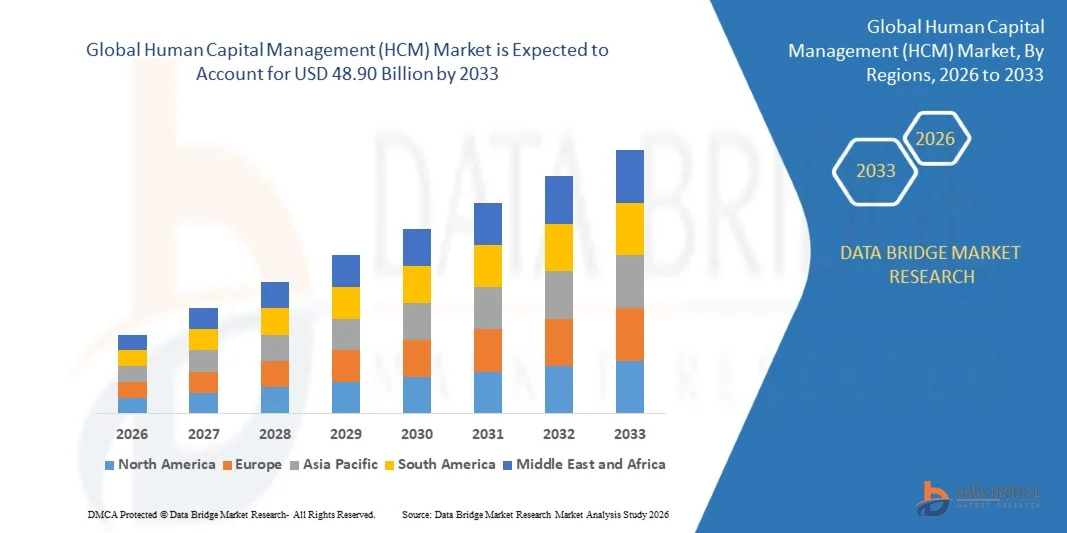
As per Data Bridge Market Research Analysis the human capital management (HCM) market was valued at USD 25.54 billion in 2025 and is projected to reach USD 48.90 billion by 2033, growing at a CAGR of 8.46% from 2026 to 2033. Market growth is supported by cloud migration, artificial intelligence, workforce analytics, remote and hybrid work, payroll modernization, skills-based hiring, employee-experience programs, and the need to manage increasingly distributed and diverse workforces.
HCM platforms combine core HR records with recruitment, onboarding, payroll, compensation, time and attendance, performance, learning, succession planning, workforce planning, and analytics. Large enterprises remain the main buyers because they manage complex workforces across countries and business units. However, cloud subscription models are making integrated HCM suites more accessible to small and medium-sized enterprises. Vendors are now embedding generative AI and autonomous agents into employee self-service, recruiting, payroll review, manager support, learning, and workforce decision-making. Data privacy, algorithmic bias, cybersecurity, integration with legacy systems, and regulatory compliance remain important market challenges.
Market Size & Forecast
- Market Value (2025): USD 25.54 Billion
- Expected Market Value (2034): USD 48.90 Billion
- Forecast CAGR (2026-2034): 8.46%
- Leading Region: North America
- Fastest-Growing Region: Asia-Pacific
Key Market Trends & Insights
- North America dominated the Human Capital Management (HCM) market with the largest revenue share of 38.12% in 2025, supported by widespread adoption of cloud-based HR platforms, strong enterprise spending on workforce technology, and the presence of leading HCM vendors.
- Asia-Pacific Human Capital Management (HCM) market is expected to witness the fastest growth rate of 10.11% from 2026 to 2033, supported by increasing workforce digitization, expanding cloud adoption, and rising investments in enterprise software across developing economies.
- The software segment held the largest market revenue share in 2025 driven by the widespread use of integrated platforms for core HR, payroll, talent management, workforce management, learning, and analytics. Software is preferred because it creates a centralized employee-data environment and supports automated workflows across the workforce lifecycle.
- The services segment is projected to register the fastest growth at a CAGR from 2026 to 2033, driven by increasing demand for consulting, system integration, data migration, configuration, employee training, and post-implementation support. Rising cloud migration and AI adoption are increasing the need for specialized expertise that helps organizations redesign HR processes and manage organizational change.
- The payroll management segment held the largest market revenue share in 2025 driven by complex tax codes, social-insurance mandates, multi-country payroll processing, and real-time reporting requirements. Enterprises prioritize payroll systems because payment errors can create direct financial penalties and employee dissatisfaction.
- The learning and development segment is projected to register the fastest growth at a CAGR from 2026 to 2033, driven by increasing demand for continuous upskilling, skills-based workforce planning, and personalized learning pathways. Organizations are investing in AI-supported learning to address talent shortages, improve internal mobility, and align workforce capability with changing business requirements.
Report Scope and Human Capital Management (HCM) Market Segmentation
|
Attributes |
Human Capital Management Key Market Insights |
|
Segments Covered |
|
|
Countries Covered |
North America
Europe
Asia-Pacific
Middle East and Africa
South America
|
|
Key Market Players |
|
|
Market Opportunities |
|
|
Value Added Data Infosets |
In addition to the market insights such as market value, growth rate, market segments, geographical coverage, market players, and market scenario, the market report curated by the Data Bridge Market Research team includes in-depth expert analysis, import/export analysis, pricing analysis, production consumption analysis, and pestle analysis. |
Human Capital Management (HCM) Market Trends
Trend: Rise Of AI-Native, Skills-Based, And Employee-Centric HCM Platforms
Organizations are increasingly moving beyond traditional HCM systems that primarily store employee records toward intelligent platforms capable of recommending actions, automating workflows, and supporting workforce decisions. Generative AI, conversational interfaces, and AI agents are being integrated across recruiting, payroll, learning, employee self-service, manager assistance, and workforce planning to improve operational efficiency and employee engagement.
The growing demand for personalized employee experiences, real-time workforce analytics, secure self-service capabilities, and skills-based talent management is accelerating the adoption of next-generation HCM platforms. Employers are increasingly shifting from job-title-based workforce models toward skills-centric approaches that connect employee capabilities, learning pathways, career interests, and business requirements through a unified digital ecosystem.
For instance, in March 2026, Workday introduced Sana from Workday, including a Self-Service Agent with more than 300 skills across pay, time, absence, and other HR and finance activities. The platform is designed to find information, complete actions, and automate workflows across Workday and connected enterprise applications, reflecting the growing industry investment in embedded agentic AI and intelligent workforce management solutions.
The continued expansion of trusted AI agents, skills intelligence, and personalized employee services is expected to reinforce long-term demand for Human Capital Management platforms, positioning vendors to benefit from increasing enterprise investment in intelligent, employee-centric workforce technologies.
Human Capital Management (HCM) Market Dynamics
Key Market Driver: Cloud Transformation And Need For Better Workforce Decisions
The global workforce management industry continues to experience rising demand for unified platforms capable of managing payroll, talent acquisition, attendance, benefits administration, compliance, and employee development. Hybrid work models, cross-border hiring, evolving labor regulations, and persistent skills shortages have increased the complexity of workforce management, encouraging organizations to replace legacy HR systems with cloud-based HCM suites.
Major software providers continue investing in cloud innovation to address growing enterprise requirements. Cloud HCM platforms offer centralized employee data, workflow automation, mobile access, continuous software updates, and real-time analytics that enable organizations to improve productivity and support strategic workforce planning.
For instance, in April 2025, SAP announced that its first-half 2025 SAP SuccessFactors release introduced more than 250 features and enhancements, including AI-enabled innovations such as Joule mobile capabilities and improvements across recruiting, onboarding, performance management, learning, and payroll workflows. The release demonstrates how continuous cloud innovation is expanding platform capabilities and accelerating enterprise migration toward integrated HCM solutions.
As organizations increasingly prioritize data-driven workforce decisions and modern HR operations, cloud transformation and workforce analytics are expected to remain significant drivers of Human Capital Management market growth throughout the forecast period.
Key Restraint/Challenge: Data Privacy, AI Bias, And Complex System Integration
Human Capital Management platforms contain highly sensitive employee, payroll, identity, performance, and benefits data, exposing organizations to significant privacy, cybersecurity, and compliance risks. In addition, enterprises must integrate HCM solutions with existing payroll, finance, benefits, and country-specific compliance systems, increasing implementation complexity and extending deployment timelines.
Organizations must also address concerns related to algorithmic bias, explainability, and governance as AI becomes increasingly embedded within workforce management processes. Regulatory frameworks governing AI-supported employment decisions are evolving rapidly, creating additional compliance obligations for both software providers and end users.
For instance, the European Union AI Act identifies several employment-related AI applications—including candidate screening, job advertising, and worker evaluation—as high-risk use cases requiring enhanced risk management, transparency, documentation, and human oversight. These requirements continue to increase the cost and complexity associated with deploying AI-enabled HCM platforms across multinational organizations.
Despite strong market demand, data privacy concerns, AI governance requirements, and complex legacy-system integration are expected to remain significant restraints, increasing implementation costs and encouraging organizations to prioritize secure, explainable, and compliant HCM solutions.
Key Market Opportunity: SME Cloud Adoption And Skills-Intelligence Platforms
Small and medium-sized enterprises are increasingly adopting cloud-based HCM platforms to manage payroll, attendance, recruiting, learning, and compliance without maintaining extensive internal IT resources. Industries including healthcare, retail, manufacturing, education, logistics, hospitality, and government are creating additional opportunities due to their large, distributed, and shift-based workforces.
Growing adoption of mobile-first employee services, localized payroll capabilities, multilingual support, and industry-specific workflows is expanding the addressable market for HCM vendors. At the same time, AI-enabled recruiting, workforce planning, and employee-development tools are creating new opportunities for vendors offering intelligent, scalable, and cost-effective solutions.
For instance, in March 2024, Oracle introduced generative AI capabilities across Oracle Fusion Cloud Applications, including HCM functionalities such as job-category content generation, candidate-assistant capabilities, job-match explanations, and manager survey creation. The development highlights how embedded AI is enabling vendors to deliver greater value across the employee lifecycle while supporting enterprise workforce transformation initiatives.
As SMEs continue formalizing HR operations and enterprises adopt skills-based workforce strategies, vendors that combine affordable cloud deployment, localized compliance, mobile accessibility, and responsible AI capabilities are expected to capture substantial long-term opportunities across the Human Capital Management market.
Human Capital Management (HCM) Market Scope
The HCM market is segmented on the basis of offering, software type, deployment, enterprise type, and end-use industry and by service.
- By Offering
On the basis of offering, the Human Capital Management market is segmented into software and services. The software segment held the largest market revenue share in 2025 driven by the widespread use of integrated platforms for core HR, payroll, talent management, workforce management, learning, and analytics. Software is preferred because it creates a centralized employee-data environment and supports automated workflows across the workforce lifecycle.
The services segment is projected to register the fastest growth at a CAGR from 2026 to 2033, driven by increasing demand for consulting, system integration, data migration, configuration, employee training, and post-implementation support. Rising cloud migration and AI adoption are increasing the need for specialized expertise that helps organizations redesign HR processes and manage organizational change.
- By Software Type
On the basis of software type, the Human Capital Management market is segmented into core HR, talent management, workforce management, payroll and compensation, learning and development, and others. The payroll management segment held the largest market revenue share in 2025 driven by complex tax codes, social-insurance mandates, multi-country payroll processing, and real-time reporting requirements. Enterprises prioritize payroll systems because payment errors can create direct financial penalties and employee dissatisfaction.
The learning and development segment is projected to register the fastest growth at a CAGR from 2026 to 2033, driven by increasing demand for continuous upskilling, skills-based workforce planning, and personalized learning pathways. Organizations are investing in AI-supported learning to address talent shortages, improve internal mobility, and align workforce capability with changing business requirements.
- By Deployment
On the basis of deployment, the Human Capital Management market is segmented into on-premises and cloud. The on-premises segment held the largest market revenue share of approximately 56.33% in 2025 driven by continued demand from BFSI, government, and other regulated organizations that require data sovereignty, customized controls, and detailed audit trails. These deployments remain important where legacy integrations and internal infrastructure policies limit immediate cloud migration.
The cloud segment is projected to register the fastest growth at a CAGR of 9.61% from 2026 to 2033, driven by faster implementation, automatic updates, mobile access, subscription pricing, and scalable infrastructure. Cloud-first release cycles are also accelerating access to AI copilots, analytics, and compliance engines, encouraging organizations to modernize HCM environments.
- By Enterprise Type
On the basis of enterprise type, the Human Capital Management market is segmented into large enterprises and small and medium-sized enterprises. The large enterprises segment held the largest market revenue share of approximately 62.67% in 2025 driven by multi-country payroll complexity, large employee populations, advanced role-based access requirements, and the need to integrate HR with finance and business planning. These organizations also invest more heavily in workforce analytics, talent mobility, and compliance automation.
The small and medium-sized enterprises segment is projected to register the fastest growth at a CAGR of 9.54% from 2026 to 2033, driven by subscription pricing, preconfigured workflows, mobile self-service, and shorter implementation cycles. Cloud platforms allow smaller employers to adopt payroll, recruiting, benefits, and performance capabilities without large upfront infrastructure investments.
- By End-Use Industry
On the basis of end-use industry, the market is segmented into IT and telecommunication, BFSI, government, retail, healthcare, education, manufacturing, and others. The BFSI segment held the largest market revenue share of approximately 23.39% in 2025 driven by strict workforce governance, security, audit, payroll, and regulatory-compliance requirements. Financial institutions use integrated HCM platforms to manage large and diverse workforces while maintaining controlled employee-data access.
The healthcare segment is projected to register the fastest growth at a CAGR of 11.43% from 2026 to 2033, driven by workforce shortages, shift-scheduling complexity, professional credential management, and high employee-retention requirements. Hospitals and care providers are adopting HCM systems to improve staffing decisions, monitor qualifications, and support workforce planning.
-
By Service
On the basis of service, the Human Capital Management market is segmented into integration and implementation, training and education, support and maintenance, and consulting. The integration and implementation segment held the largest market revenue share in 2025 driven by the complexity of connecting HCM suites with payroll, finance, identity, benefits, timekeeping, and legacy employee-data systems. Large transformation programs require data migration, testing, localization, workflow configuration, and change-management support before go-live.
The consulting segment is projected to register the fastest growth from 2026 to 2033, driven by increasing demand for cloud migration roadmaps, AI governance, operating-model redesign, global payroll strategy, and workforce analytics.
Human Capital Management (HCM) Market Regional Analysis
North America Human Capital Management (HCM) Market Insight
North America dominated the Human Capital Management (HCM) market with the largest revenue share of 38.12% in 2025, supported by widespread adoption of cloud-based HR platforms, strong enterprise spending on workforce technology, and the presence of leading HCM vendors. Organizations across the region increasingly rely on AI-enabled solutions for payroll, talent management, workforce analytics, and employee engagement. High SaaS penetration, mature IT infrastructure, and growing demand for automated compliance and workforce planning continue to strengthen the region's leadership in the global HCM market.
U.S. Human Capital Management (HCM) Market Insight
The U.S. Human Capital Management (HCM) market captured the largest revenue share in 2025 within North America, fueled by rapid enterprise adoption of cloud HCM platforms and increasing investment in AI-powered workforce solutions. Organizations are increasingly prioritizing integrated HR, payroll, and talent-management capabilities to support hybrid work environments and improve employee experiences. The growing adoption of generative AI, combined with strong demand for workforce analytics and employee self-service applications, continues to accelerate market expansion across large enterprises and SMEs.
Europe Human Capital Management (HCM) Market Insight
The Europe Human Capital Management (HCM) market is expected to witness substantial growth from 2026 to 2033, primarily driven by increasing digital transformation initiatives and evolving workforce regulations. Organizations across the region are investing in cloud-based HCM solutions to improve operational efficiency, talent retention, and compliance management. In addition, GDPR requirements and the implementation of the EU AI Act are encouraging vendors to enhance data security, transparency, and explainability capabilities, creating demand for next-generation HCM platforms.
U.K. Human Capital Management (HCM) Market Insight
The U.K. Human Capital Management (HCM) market is expected to witness significant growth from 2026 to 2033, driven by increasing adoption of hybrid work models and rising demand for employee-centric technologies. Businesses are increasingly implementing HCM platforms to support workforce flexibility, improve talent acquisition, and streamline payroll and compliance processes. The country's strong digital infrastructure and growing emphasis on workforce productivity are expected to continue supporting HCM adoption across multiple industry verticals.
Germany Human Capital Management (HCM) Market Insight
The Germany Human Capital Management (HCM) market is expected to witness notable growth from 2026 to 2033, fueled by the country's emphasis on digital transformation, workforce modernization, and data privacy. German enterprises increasingly prioritize secure, compliant, and scalable HCM solutions that align with local labor regulations and employee expectations. Furthermore, the growing integration of AI-powered workforce analytics and skills-management capabilities is supporting market expansion across both public and private sectors.
Asia-Pacific Human Capital Management (HCM) Market Insight
The Asia-Pacific Human Capital Management (HCM) market is expected to witness the fastest growth rate of 10.11% from 2026 to 2033, supported by increasing workforce digitization, expanding cloud adoption, and rising investments in enterprise software across developing economies. Government initiatives promoting digitalization, coupled with growing demand for automated payroll and compliance solutions, are accelerating HCM adoption throughout the region. Asia-Pacific's rapidly expanding enterprise base and increasing labor-management complexity are expected to position the region as the fastest-growing HCM market globally.
Japan Human Capital Management (HCM) Market Insight
The Japan Human Capital Management (HCM) market is expected to witness strong growth from 2026 to 2033 due to the country's aging workforce, labor shortages, and increasing demand for workforce optimization technologies. Organizations are adopting HCM platforms to improve employee productivity, support flexible work arrangements, and ensure compliance with evolving labor regulations. In addition, growing investments in AI and automation technologies are contributing to the adoption of intelligent workforce management solutions across Japanese enterprises.
China Human Capital Management (HCM) Market Insight
The China Human Capital Management (HCM) market accounted for the largest market revenue share in Asia-Pacific in 2025, attributed to the country's large workforce, accelerating enterprise digitalization, and increasing adoption of cloud technologies. Chinese organizations are increasingly investing in HCM platforms to manage payroll complexity, employee engagement, and workforce planning across large and distributed operations. Government support for digital transformation, coupled with rising demand for localized and scalable HR solutions, continues to drive significant market growth across the country.
Human Capital Management (HCM) Market Share
The human capital management (HCM) market is established by well known companies:
- SAP SE (Germany)
- Automatic Data Processing, Inc. (U.S.)
- Oracle Corporation (U.S.)
- Microsoft Corporation (U.S.)
- Workday, Inc. (U.S.)
- UKG Inc. (U.S.)
- Cornerstone OnDemand, Inc. (U.S.)
- Infor, Inc. (U.S.)
- Ramco Systems Limited (India)
- Paycom Software, Inc. (U.S.)
- Cegid Group (France)
- Bamboo HR LLC (U.S.)
Latest Developments in Human Capital Management (HCM) Market
- In March 2026, Workday introduced Sana from Workday, a conversational AI experience designed to find information, take actions, and automate workflows across enterprise systems. The launch included a Sana Self-Service Agent with more than 300 skills for routine HR and finance tasks, reflecting the HCM market shift toward agentic employee service and workflow automation.
- In April 2025, SAP released more than 250 features and enhancements in the first-half 2025 SAP SuccessFactors update, many supported by artificial intelligence. The release expanded Joule mobile capabilities, recruiting and onboarding, AI-assisted performance insights, skills-focused learning, and payroll visibility, showing how vendors are embedding AI across the full employee lifecycle.
- In March 2024, Oracle added new generative AI capabilities to Oracle Fusion Cloud Applications, including Oracle Cloud HCM. The HCM functions included job-category content, job-match explanations, a candidate assistant, and manager survey generation. The development demonstrated the growing use of secure, embedded generative AI in recruiting and employee management workflows.

- Interactive Data Analysis Dashboard
- Company Analysis Dashboard for high growth potential opportunities
- Research Analyst Access for customization & queries
- Competitor Analysis with Interactive dashboard
- Latest News, Updates & Trend analysis
- Harness the Power of Benchmark Analysis for Comprehensive Competitor Tracking
Data collection and base year analysis are done using data collection modules with large sample sizes. The stage includes obtaining market information or related data through various sources and strategies. It includes examining and planning all the data acquired from the past in advance. It likewise envelops the examination of information inconsistencies seen across different information sources. The market data is analysed and estimated using market statistical and coherent models. Also, market share analysis and key trend analysis are the major success factors in the market report. To know more, please request an analyst call or drop down your inquiry.
The key research methodology used by DBMR research team is data triangulation which involves data mining, analysis of the impact of data variables on the market and primary (industry expert) validation. Data models include Vendor Positioning Grid, Market Time Line Analysis, Market Overview and Guide, Company Positioning Grid, Patent Analysis, Pricing Analysis, Company Market Share Analysis, Standards of Measurement, Global versus Regional and Vendor Share Analysis. To know more about the research methodology, drop in an inquiry to speak to our industry experts.
Data Bridge Market Research is a leader in advanced formative research. We take pride in servicing our existing and new customers with data and analysis that match and suits their goal. The report can be customized to include price trend analysis of target brands understanding the market for additional countries (ask for the list of countries), clinical trial results data, literature review, refurbished market and product base analysis. Market analysis of target competitors can be analyzed from technology-based analysis to market portfolio strategies. We can add as many competitors that you require data about in the format and data style you are looking for. Our team of analysts can also provide you data in crude raw excel files pivot tables (Fact book) or can assist you in creating presentations from the data sets available in the report.













