


Hyaluronidase-Resistant Cross-Linked Hyaluronic Acid Market Size
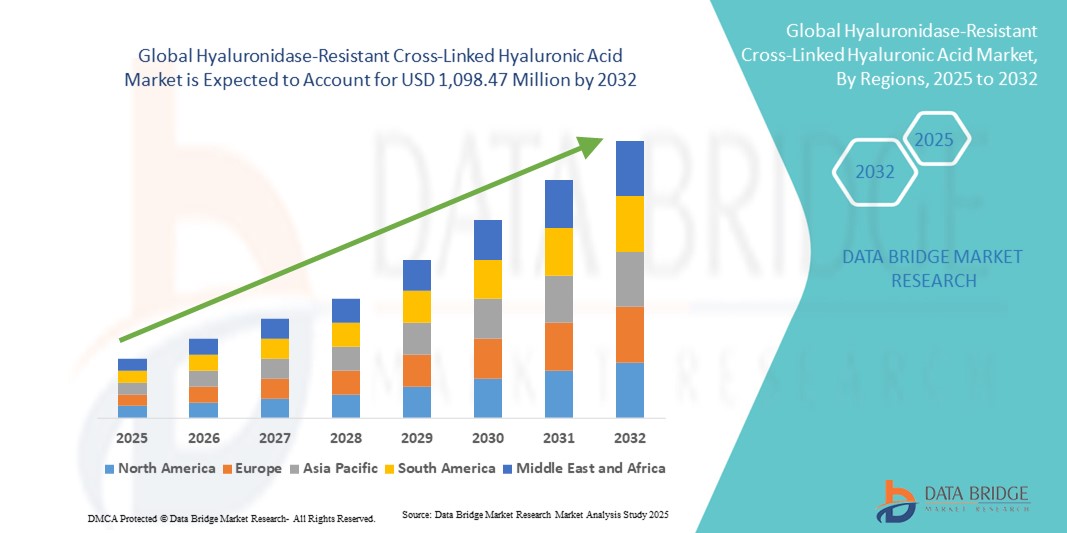
- The global hyaluronidase-resistant cross-linked hyaluronic acid market size was valued at USD 410.00 million in 2024 and is expected to reach USD 1,098.47 million by 2032, at a CAGR of 13.11% during the forecast period
- The market growth is primarily driven by the rising demand for long-lasting dermal fillers and aesthetic treatments, supported by innovations in cross-linking technologies that enhance enzyme resistance and product durability
- In addition, increasing consumer preference for minimally invasive cosmetic procedures, along with expanding applications in reconstructive and therapeutic areas, is positioning hyaluronidase-resistant HA as a preferred solution in the aesthetics and medical domains. These dynamics are accelerating product adoption and fueling robust market expansion
Hyaluronidase-Resistant Cross-Linked Hyaluronic Acid Market Analysis
- Hyaluronidase-resistant cross-linked hyaluronic acid, formulated through advanced cross-linking techniques, is increasingly vital in aesthetic and medical treatments due to its superior resistance to enzymatic degradation, improved durability, and ability to deliver natural-looking, long-lasting outcomes across multiple applications
- The growing demand for these products is fueled by rising adoption of minimally invasive aesthetic procedures, patient preference for safe and durable fillers, and continuous innovation in cross-linking chemistries such as BDDE and PEG, which are driving product differentiation and expanding treatment options
- North America dominated the hyaluronidase-resistant cross-linked hyaluronic acid market with the largest revenue share of 39.2% in 2024, driven by strong demand for minimally invasive aesthetic procedures and a rising preference for long-lasting dermal fillers
- Asia-Pacific is expected to be the fastest growing region during the forecast period, driven by increasing medical tourism, rising disposable incomes, and rapid adoption of facial rejuvenation and corrective procedures in countries such as China, South Korea, and India
- The Aesthetic segment dominated the hyaluronidase-resistant cross-linked hyaluronic acid market with a market share of 65% in 2024, driven by its widespread use in wrinkle reduction, volume restoration, and lip augmentation
Report Scope and Hyaluronidase-Resistant Cross-Linked Hyaluronic cid Market Segmentation
|
Attributes |
Hyaluronidase-Resistant Cross-Linked Hyaluronic Acid Key Market Insights |
|
Segments Covered |
|
|
Countries Covered |
North America
Europe
Asia-Pacific
Middle East and Africa
South America
|
|
Key Market Players |
|
|
Market Opportunities |
|
|
Value Added Data Infosets |
In addition to the insights on market scenarios such as market value, growth rate, segmentation, geographical coverage, and major players, the market reports curated by the Data Bridge Market Research also include in-depth expert analysis, pricing analysis, brand share analysis, consumer survey, demography analysis, supply chain analysis, value chain analysis, raw material/consumables overview, vendor selection criteria, PESTLE Analysis, Porter Analysis, and regulatory framework. |
Hyaluronidase-Resistant Cross-Linked Hyaluronic Acid Market Trends
Extended Longevity Through Advanced Cross-Linking Technologies
- A significant and accelerating trend in the global hyaluronidase-resistant cross-linked hyaluronic acid market is the advancement of cross-linking chemistries such as BDDE and PEG, which enhance enzyme resistance and extend filler longevity, thereby elevating patient satisfaction
- For instance, certain BDDE-based formulations are now offering durability of up to 18–24 months, allowing patients fewer retreatments and establishing these fillers as premium solutions within aesthetic practices
- PEG cross-linking is also emerging as a promising trend, enabling improved biocompatibility, reduced immunogenic response, and enhanced elasticity, which provide clinicians with safer and more customizable treatment outcomes
- Companies are innovating in rheological tailoring, creating fillers with varied cohesivity and elasticity levels to suit specific facial areas, such as high G′ products for volumization and low G′ products for fine-line correction
- This shift toward technology-driven differentiation is redefining competitive dynamics, as manufacturers emphasize both scientific validation and clinical performance to capture trust among dermatologists and plastic surgeons
- The rising demand for long-lasting, natural-looking, and enzyme-resistant fillers underscores this trend, with Asia-Pacific clinics particularly adopting premium formulations to attract medical tourism clients seeking minimally invasive enhancements.
Hyaluronidase-Resistant Cross-Linked Hyaluronic Acid Market Dynamics
Driver
Growing Demand Fueled by Rising Aesthetic Procedures and Durability Preference
- The increasing global volume of minimally invasive aesthetic procedures, coupled with patient demand for fillers that provide extended results, is a major driver propelling the adoption of hyaluronidase-resistant cross-linked HA
- For instance, the International Society of Aesthetic Plastic Surgery (ISAPS) reported a notable rise in dermal filler procedures in 2023, with HA fillers ranking among the most frequently performed non-surgical interventions worldwide
- The durability advantage of these formulations, which resist enzymatic degradation longer than conventional HA fillers, appeals to patients seeking both convenience and cost-effectiveness through fewer clinic visits
- Clinics and practitioners are also embracing these advanced fillers as they enable more predictable outcomes, increasing client loyalty and reinforcing the role of HA as a cornerstone material in aesthetic medicine
- Furthermore, the rise of medical tourism in regions such as South Korea, Turkey, and Thailand is boosting demand, as patients actively seek innovative filler technologies that promise long-lasting aesthetic improvements
- These converging factors are positioning hyaluronidase-resistant cross-linked HA as a high-growth category within the broader dermal filler market, ensuring steady expansion during the forecast period
Restraint/Challenge
Skin Irritation Issues and Regulatory Compliance Hurdle
- Potential adverse effects such as localized skin irritation, swelling, or granuloma formation following injection pose a restraint, as these safety concerns can limit adoption among cautious patients and practitioners
- For instance, regulatory bodies such as the U.S. FDA and European CE mark authorities require rigorous biocompatibility testing and long-term safety validation, which extends approval timelines for new filler formulations
- Some patients express concerns about hypersensitivity reactions or nodules, particularly in cases where higher cross-linking density is used, raising caution among dermatologists regarding product selection
- Stringent regulations and compliance requirements increase development costs for manufacturers, thereby limiting market entry for smaller players and concentrating competition among established global brands
- In addition, the premium pricing of advanced enzyme-resistant fillers compared to traditional HA injectables can be a barrier in cost-sensitive regions, where affordability often outweighs longevity as a purchasing factor
- Overcoming these challenges through ongoing clinical research, transparent safety communication, and tiered pricing strategies will be essential to ensure broader adoption and long-term market growth
Hyaluronidase-Resistant Cross-Linked Hyaluronic Acid Market Scope
The market is segmented on the basis of product, application, end user, and distribution channel.
- By Product
On the basis of product, the market is segmented into monophasic HA, biphasic HA, elasticity-based fillers, BDDE, PEG, and hyaluronidase-resistant variants. The monophasic HA segment dominated the market with the largest revenue share in 2024, owing to its homogeneous structure that provides smooth injection and natural aesthetic outcomes. Clinicians often prefer monophasic formulations for fine wrinkle correction and facial contouring, as they integrate seamlessly into the dermal tissue. Their lower tendency for particle migration compared to biphasic fillers has also increased trust among dermatologists and patients. The consistent rheology of monophasic HA ensures predictable treatment results, making it a leading choice across dermatology clinics and medical spas. In addition, its broad acceptance in both mature and emerging markets strengthens its dominance in the global landscape.
The PEG-based cross-linking segment is anticipated to witness the fastest growth during the forecast period, driven by its enhanced biocompatibility, lower immunogenic risk, and improved longevity compared to traditional BDDE fillers. PEG-cross-linked products allow better water retention and elasticity, which contribute to more natural and durable outcomes. Increasing clinical studies supporting PEG’s safety profile are encouraging regulatory approvals and wider adoption. Manufacturers are investing in PEG-based innovations as a differentiator in competitive markets, particularly in premium filler categories. Furthermore, patient awareness of newer, safer technologies is accelerating the demand trajectory of this segment.
- By Application
On the basis of application, the market is segmented into aesthetic, facial wrinkle reduction, volume restoration (cheeks, lips, chin), non-surgical rhinoplasty, periorbital, scar revision, ophthalmic uses, viscosupplementation adjuncts, and combination procedures. The aesthetic segment dominated the market with the largest revenue share of 65% in 2024, accounting for the majority of hyaluronidase-resistant cross-linked HA usage. This dominance is attributed to the rising demand for minimally invasive aesthetic treatments worldwide, particularly wrinkle reduction, lip augmentation, and cheek volumization. Consumers increasingly prefer dermal fillers as alternatives to surgical procedures due to shorter downtime and natural results. The segment also benefits from strong consumer acceptance across both developed and emerging markets, with Europe and Asia-Pacific driving procedure volumes. With aging populations and heightened beauty consciousness, the aesthetic application remains the cornerstone of market growth.
The non-surgical rhinoplasty segment is projected to grow at the fastest rate during the forecast period, fueled by consumer preference for safe, reversible, and cost-effective alternatives to traditional surgical nose jobs. Hyaluronidase-resistant cross-linked HA fillers provide structural integrity and longer-lasting outcomes, making them suitable for nasal contouring and corrections. This application has gained momentum in Asia-Pacific, particularly in South Korea and China, where non-surgical enhancements are highly popular. The minimal recovery time and reduced risks compared to invasive rhinoplasty attract younger patients seeking aesthetic refinement. Social media-driven awareness is further propelling demand in this niche but rapidly expanding application segment.
- By End User
On the basis of end user, the market is segmented into dermatology clinics, plastic & reconstructive surgeons, hospitals, surgical centers, and medical spas. Dermatology clinics held the largest market share in 2024, supported by their strong presence in both urban and semi-urban regions, making aesthetic treatments widely accessible. These clinics are often the first point of care for patients seeking dermal fillers, offering non-surgical options at competitive pricing. The concentration of dermatologists skilled in filler administration drives higher procedure volumes in this segment. Dermatology clinics also benefit from partnerships with key manufacturers for product promotions and training programs. Their central role in offering routine, repeat-based filler procedures solidifies their dominance in the end-user category.
Medical spas are expected to register the fastest growth during the forecast period, driven by increasing consumer demand for wellness-integrated aesthetic services. These facilities combine luxury spa experiences with professional medical treatments, attracting a younger demographic seeking preventive and enhancement-based procedures. The accessibility, affordability, and less clinical environment of medical spas make them appealing to patients new to cosmetic injectables. Growing investments in medical spa chains across North America, Europe, and Asia-Pacific are expanding availability. Furthermore, bundled services and promotional strategies make this segment highly competitive and rapidly growing.
- By Distribution Channel
On the basis of distribution channel, the market is segmented into direct sales, distributors, e-commerce, and OEM partnerships. Direct sales dominated the distribution channel segment in 2024, as leading manufacturers prioritize direct engagement with dermatology clinics, hospitals, and aesthetic centers. This channel allows companies to build strong relationships with practitioners, provide training, and ensure product authenticity. Direct sales also facilitate better control over pricing, branding, and customer feedback. The high reliance on trusted supply chains in the medical aesthetics industry further strengthens the dominance of this channel. In addition, key global players invest in field representatives and dedicated sales teams to ensure strong penetration in established markets.
E-commerce is projected to grow at the fastest CAGR during the forecast period, driven by the digitalization of healthcare and the rising acceptance of online procurement channels. Clinics and practitioners are increasingly sourcing HA fillers through verified online platforms due to convenience, transparent pricing, and wider product availability. The COVID-19 pandemic accelerated the shift toward digital ordering in medical aesthetics, creating a long-term behavioral shift. Emerging platforms are also integrating compliance checks and authentication systems to prevent counterfeit distribution, further boosting trust. This trend is particularly notable in Asia-Pacific, where digital adoption in medical supplies is advancing rapidly.
Hyaluronidase-Resistant Cross-Linked Hyaluronic Acid Market Regional Analysis
- North America dominated the hyaluronidase-resistant cross-linked hyaluronic acid market with the largest revenue share of 39.2% in 2024, driven by strong demand for minimally invasive aesthetic procedures and a rising preference for long-lasting dermal fillers
- Consumers in the region highly value the safety, natural outcomes, and extended durability offered by advanced cross-linked HA formulations, especially in applications such as wrinkle reduction, lip enhancement, and facial contouring
- This widespread adoption is further supported by a well-established network of dermatology clinics and medical spas, high disposable incomes, and increasing social acceptance of cosmetic enhancements, positioning North America as the global leader in this market
U.S. Hyaluronidase-Resistant Cross-Linked Hyaluronic Acid Market Insight
The U.S. hyaluronidase-resistant cross-linked HA market captured the largest revenue share of 79% in 2024 within North America, fueled by the strong demand for dermal fillers and facial aesthetics. Consumers are increasingly prioritizing minimally invasive treatments for wrinkle reduction, lip augmentation, and facial contouring. The rising popularity of outpatient dermatology clinics, combined with robust demand for long-lasting filler formulations, further propels the HA market. Moreover, the increasing integration of HA with advanced delivery systems and combination aesthetic procedures is significantly contributing to the market's expansion.
Europe Hyaluronidase-Resistant Cross-Linked Hyaluronic Acid Market Insight
The Europe hyaluronidase-resistant cross-linked HA market is projected to expand at a substantial CAGR throughout the forecast period, primarily driven by a growing demand for non-surgical cosmetic enhancements and supportive reimbursement policies in some countries. The increase in aging populations, coupled with the preference for safe and effective wrinkle reduction solutions, is fostering the adoption of HA fillers. European consumers are also drawn to premium formulations offering natural results and extended durability. The region is experiencing significant growth across dermatology, plastic surgery, and medical spa applications, with HA fillers being used in both routine aesthetic treatments and complex reconstructive procedures.
U.K. Hyaluronidase-Resistant Cross-Linked Hyaluronic Acid Market Insight
The U.K. hyaluronidase-resistant cross-linked HA market is anticipated to grow at a noteworthy CAGR during the forecast period, driven by the rising trend of aesthetic medicine and the demand for minimally invasive procedures. In addition, concerns regarding aging appearance and cosmetic appeal are encouraging both women and men to choose injectable filler solutions. The UK’s strong network of private clinics, alongside its highly competitive medical aesthetics sector, is expected to continue to stimulate market growth.
Germany Hyaluronidase-Resistant Cross-Linked Hyaluronic Acid Market Insight
The Germany hyaluronidase-resistant cross-linked HA market is expected to expand at a considerable CAGR during the forecast period, fueled by growing awareness of advanced aesthetic treatments and the demand for premium, high-quality solutions. Germany’s well-developed healthcare infrastructure, combined with its emphasis on clinical safety and regulatory compliance, promotes the adoption of HA fillers, particularly in urban centers. The integration of HA with regenerative medicine and facial rejuvenation procedures is also becoming increasingly prevalent, with a strong preference for scientifically validated, natural-looking results aligning with local consumer expectations.
Asia-Pacific Hyaluronidase-Resistant Cross-Linked Hyaluronic Acid Market Insight
The Asia-Pacific hyaluronidase-resistant cross-linked HA market is poised to grow at the fastest CAGR of 23% during the forecast period of 2025 to 2032, driven by rapid urbanization, rising disposable incomes, and the influence of beauty-conscious younger populations in countries such as China, Japan, and India. The region’s growing inclination towards aesthetic medicine, supported by government initiatives promoting medical tourism and digital healthcare adoption, is driving the use of HA fillers. Furthermore, as APAC emerges as a hub for affordable HA manufacturing, the accessibility of cost-effective yet advanced HA products is expanding across a wider consumer base.
Japan Hyaluronidase-Resistant Cross-Linked Hyaluronic Acid Market Insight
The Japan hyaluronidase-resistant cross-linked HA market is gaining momentum due to the country’s high aesthetic standards, advanced healthcare system, and preference for minimally invasive solutions. The Japanese market places a significant emphasis on natural results, and the adoption of HA is driven by the increasing number of dermatology clinics and medical spas offering safe and efficient filler treatments. The integration of HA with other non-invasive facial rejuvenation therapies is fueling growth. Moreover, Japan’s aging population is such asly to spur demand for long-lasting, subtle correction options in both men and women.
India Hyaluronidase-Resistant Cross-Linked Hyaluronic Acid Market Insight
The India hyaluronidase-resistant cross-linked HA market accounted for the largest market revenue share in Asia Pacific in 2024, attributed to the country’s expanding middle class, rapid urbanization, and rising adoption of cosmetic procedures. India stands as one of the largest emerging markets for medical aesthetics, and HA fillers are becoming increasingly popular in both tier-1 and tier-2 cities. The push towards medical tourism, combined with the availability of affordable HA filler options and strong domestic manufacturers, are key factors propelling the market in India.
Hyaluronidase-Resistant Cross-Linked Hyaluronic Acid Market Share
The Hyaluronidase-Resistant Cross-Linked Hyaluronic Acid industry is primarily led by well-established companies, including:
- GALDERMA (Switzerland)
- Anika Therapeutics, Inc. (U.S.)
- Merz Pharma (Germany)
- Teoxane (Switzerland)
- Croma-Pharma GmbH (Austria)
- Beijing Huaxi Haiyu Technology Co., Ltd. (China)
- Prollenium Medical Technologies (Canada)
- HUGEL, Inc. (South Korea)
- LG Chem (South Korea)
- Laboratoires VIVACY (France)
- Vida Srl (Italy)
- Revanesse (Canada)
- Symatese (France)
- Singclean Medical (China)
- Amhwa Biopharm Co., Ltd (South Korea)
- IBSA Farmaceutici Italia Srl (Italy)
- Laboratories Hyamed SA (Japan)
What are the Recent Developments in Global Hyaluronidase-Resistant Cross-Linked Hyaluronic Acid Market?
- In June 2025, Biopharma PEG achieved FDA Drug Master File (DMF) approval for HZ-PEG-HZ (1K), which bolsters the global supply chain for PEG-crosslinked HA derivatives by easing regulatory burdens for manufacturers using this crosslinker
- In March 2025, Halozyme filed a patent infringement lawsuit against Merck, alleging that Merck’s subcutaneous Keytruda formulation (“SC Keytruda”) infringes on Halozyme’s modified hyaluronidase (Mdase) patents. This is important for the HA/enzyme tech ecosystem since it reflects the value and protection of enzyme-resistant or enzyme-modulating technologies
- In September 2024, Roche’s Tecentriq Hybreza (atezolizumab + hyaluronidase-tqjs) was approved by the U.S. FDA. This product uses Halozyme’s ENHANZE drug delivery technology (which includes hyaluronidase) to enable subcutaneous administration of what was previously an intravenous therapy. While not a dermal filler product, this shows increasing use of hyaluronidase technology in enabling delivery of large biologics more conveniently
- In August 2024, “YYS series” crosslinked HA fillers (YYS-360 and YYS-720) underwent a safety evaluation: YYS-360 (lower G′) for fine wrinkles/nonsevere defects and YYS-720 (higher G′) for deeper folds/skin deformations. This confirms the development and clinical testing of products with varying crosslink densities and thus varied resistance to degradation
- In June 2021, ViiV Healthcare and Halozyme entered into a global collaboration and license agreement for ENHANZE technology to enable development of “ultra-long-acting” medicines for HIV. This again is more drug delivery than aesthetic filler launch, but relevant to cross-linked/enzyme resistant hyaluronidase utilization

- Interactive Data Analysis Dashboard
- Company Analysis Dashboard for high growth potential opportunities
- Research Analyst Access for customization & queries
- Competitor Analysis with Interactive dashboard
- Latest News, Updates & Trend analysis
- Harness the Power of Benchmark Analysis for Comprehensive Competitor Tracking
Data collection and base year analysis are done using data collection modules with large sample sizes. The stage includes obtaining market information or related data through various sources and strategies. It includes examining and planning all the data acquired from the past in advance. It likewise envelops the examination of information inconsistencies seen across different information sources. The market data is analysed and estimated using market statistical and coherent models. Also, market share analysis and key trend analysis are the major success factors in the market report. To know more, please request an analyst call or drop down your inquiry.
The key research methodology used by DBMR research team is data triangulation which involves data mining, analysis of the impact of data variables on the market and primary (industry expert) validation. Data models include Vendor Positioning Grid, Market Time Line Analysis, Market Overview and Guide, Company Positioning Grid, Patent Analysis, Pricing Analysis, Company Market Share Analysis, Standards of Measurement, Global versus Regional and Vendor Share Analysis. To know more about the research methodology, drop in an inquiry to speak to our industry experts.
Data Bridge Market Research is a leader in advanced formative research. We take pride in servicing our existing and new customers with data and analysis that match and suits their goal. The report can be customized to include price trend analysis of target brands understanding the market for additional countries (ask for the list of countries), clinical trial results data, literature review, refurbished market and product base analysis. Market analysis of target competitors can be analyzed from technology-based analysis to market portfolio strategies. We can add as many competitors that you require data about in the format and data style you are looking for. Our team of analysts can also provide you data in crude raw excel files pivot tables (Fact book) or can assist you in creating presentations from the data sets available in the report.













