


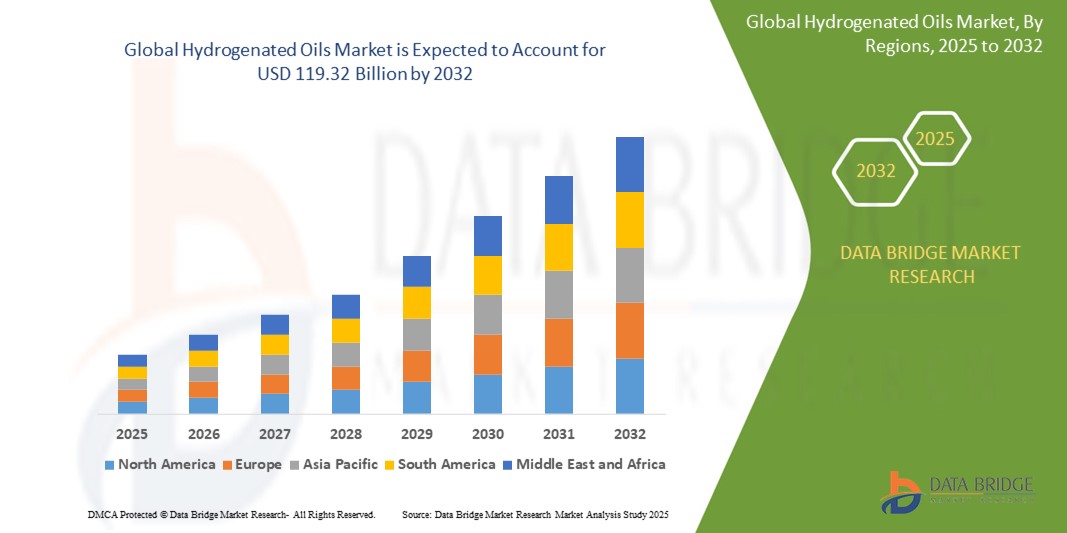
Hydrogenated Oils Market Size
- The global hydrogenated oils market was valued at USD 85.20 billion in 2024 and is expected to reach USD 119.32 billion by 2032
- During the forecast period of 2025 to 2032 the market is likely to grow at a CAGR of 4.30%, primarily driven by the increasing demand for processed foods and the growing use of hydrogenated oils in various industries.
- This growth is driven by factors such as rising consumer preference for longer shelf life and improved texture in food products, expanding applications in the cosmetics and personal care sectors, and the growing demand for convenience food products worldwide
Hydrogenated Oils Market Analysis
- Hydrogenated oils are widely used in the food industry for improving the texture, shelf life, and stability of various products. These oils are essential in processed foods, margarine, snack foods, and baked goods
- The demand for hydrogenated oils is significantly driven by the growing demand for convenience foods, an increasing preference for products with longer shelf life, and improvements in food processing techniques. North America and Europe are dominant regions, with high consumption in fast food chains, packaged snacks, and ready-to-eat meals
- For instance, in the U.S. and Europe, hydrogenated oils are extensively used in fast food chains, packaged snacks, and baked goods, driving the market. As a result, the demand for hydrogenated oils has surged, especially for their cost-effectiveness and ability to improve product texture
- Globally, hydrogenated oils are a key ingredient in the food and beverage industry, with demand growing steadily as consumers increasingly opt for ready-to-eat and processed food items. However, the market is facing rising health concerns over trans fats, prompting innovations in healthier alternatives such as non-hydrogenated oils
Report Scope and Hydrogenated Oils Market Segmentation
|
Attributes |
Hydrogenated Oils Key Market Insights |
|
Segments Covered |
|
|
Countries Covered |
North America
Europe
Asia-Pacific
Middle East and Africa
South America
|
|
Key Market Players |
|
|
Market Opportunities |
|
|
Value Added Data Infosets |
In addition to the insights on market scenarios such as market value, growth rate, segmentation, geographical coverage, and major players, the market reports curated by the Data Bridge Market Research also include in-depth expert analysis, pricing analysis, brand share analysis, consumer survey, demography analysis, supply chain analysis, value chain analysis, raw material/consumables overview, vendor selection criteria, PESTLE Analysis, Porter Analysis, and regulatory framework. |
Hydrogenated Oils Market Trend
“Growing Demand for Health-Conscious and Trans-Fat-Free Products”
- A prominent trend in the global hydrogenated oils market is the increasing demand for trans-fat-free and healthier oils due to growing consumer health awareness
- As consumers become more health-conscious, there is a shift towards oils that are free from harmful trans fats, leading manufacturers to innovate and develop hydrogenated oils with lower or zero trans-fat content
- For instance, hydrogenated oils with enhanced health profiles, such as those containing higher levels of monounsaturated fats or Omega-3 fatty acids, are gaining traction in both the food industry and among health-conscious consumers
- This trend is shaping the market by driving demand for healthier cooking oils, particularly in the processed food and baking sectors, and prompting the development of alternatives that maintain the stability and texture benefits of traditional hydrogenated oils
Hydrogenated Oils Market Dynamics
Driver
“Expanding Processed and Packaged Food Industry”
- The rapid growth of the processed and packaged food industry, particularly in emerging economies, is significantly boosting the demand for hydrogenated oils due to their longer shelf life and stability under various storage conditions
- As urbanization increases and lifestyles become more fast-paced, consumers are leaning towards convenient food options, further driving the consumption of processed foods that commonly incorporate hydrogenated oils
- Food manufacturers rely on hydrogenated oils for their functionality in enhancing texture, flavor, and shelf life in a wide range of products, from baked goods to snacks and ready-to-eat meals
- This rising dependency of the food processing industry on hydrogenated oils is creating sustained demand, thereby positively influencing the overall growth trajectory of the hydrogenated oils market
For instance,
- In January 2024, a report indicated that the Asia Pacific region held a substantial share of the edible hydrogenated oils market in 2023, driven by increasing consumer demand for processed foods and improved economic conditions in emerging markets such as China and India
- In June 2024, market analysis revealed that Asia Pacific holds the largest share in the hydrogenated palm oil market, with rapid urbanization, industrialization, and changing dietary patterns contributing to the growing demand for hydrogenated palm oil in various processed foods, snacks, and bakery products
Opportunity
“Emerging Markets Driving Demand for Affordable and Stable Cooking Oils”
- Rapid economic growth and urbanization in emerging markets are increasing the demand for affordable, shelf-stable cooking oils, creating strong opportunities for hydrogenated oils
- In many developing regions, hydrogenated oils are favored due to their cost-effectiveness, availability, and longer shelf life compared to other cooking oil alternatives
- As food consumption patterns shift with rising middle-class populations, the need for stable ingredients in mass-produced and street foods continues to grow, supporting the expansion of the hydrogenated oils market
- With targeted marketing and localized product development, companies can tap into these high-growth regions, driving both volume sales and market penetration for hydrogenated oils
For instance,
- In March 2023, a report projected the hydrogenated oil market to grow at a compound annual growth rate (CAGR) of 4.7% from 2023 to 2032, reaching an estimated value of USD 1,073.5 million by 2032
- In June 2023, data indicated that the Asia Pacific region held a significant share of the edible hydrogenated oils market in 2023, driven by increasing consumer demand for processed foods and improved economic conditions in emerging markets such as China and India
Restraint/Challenge
"Fluctuating Raw Material Prices and Supply Chain Disruptions"
- The fluctuating prices of raw materials, such as vegetable oils and seeds, pose a significant challenge to the global hydrogenated oils market, impacting production costs and profitability for manufacturers
- Supply chain disruptions, including those caused by geopolitical tensions, climate change, and logistical challenges, have further complicated the procurement of raw materials, leading to unpredictable pricing and production delays
- These issues can increase production costs for hydrogenated oils, potentially leading to higher retail prices and limiting market growth, especially in price-sensitive regions
For instance,
- In 2023, a report by the International Food and Agricultural Organization (FAO) highlighted that the global supply of vegetable oils was significantly impacted by the ongoing geopolitical tensions, driving up prices and affecting the availability of raw materials for hydrogenated oils
- These challenges not only strain manufacturers’ profit margins but also create barriers to entry for new players and hinder the overall growth potential of the hydrogenated oils market, particularly in emerging markets where cost sensitivity is high
Hydrogenated Oils Market Scope
The market is segmented on the basis of type, application, end use, and distribution channel.
|
Segmentation |
Sub-Segmentation |
|
By Type |
|
|
By Application |
|
|
By End Use |
|
|
By Distribution Channel
|
|
Hydrogenated Oils Market Regional Analysis
“North America is the Dominant Region in the Hydrogenated Oils Market”
- North America dominates the hydrogenated oils market, driven by high demand from the food and beverage industry, advancements in food processing technologies, and a strong presence of key market players
- The U.S. holds a significant share due to its well-established food processing sector, increased consumer awareness about ingredient sourcing, and innovations in the formulation of hydrogenated oils with healthier profiles, such as trans-fat-free options
- Additionally, the adoption of regulations focused on improving food labelling and transparency, along with increasing investments in R&D for healthier oils, further strengthens the market in the region
- The increasing demand for convenience foods, ready-to-eat meals, and the growing popularity of fast-food chains continue to drive the consumption of hydrogenated oils in North America
“Asia-Pacific is Projected to Register the Highest Growth Rate”
- The Asia-Pacific region is expected to witness the highest growth rate in the hydrogenated oils market, driven by expanding food manufacturing sectors, rising consumer demand for packaged and processed foods, and growing urbanization
- Countries such as China, India, and Indonesia are emerging as key markets due to their large populations, increasing middle-class income levels, and rapid adoption of westernized diets, which are driving the consumption of hydrogenated oils
- India and China, with their booming food service industries and fast-growing retail sectors, are witnessing rising demand for hydrogenated oils used in baking, frying, and packaged snacks, which is further boosting market growth
- Furthermore, government initiatives supporting the food processing industry and improving supply chain infrastructure contribute to the rapid expansion of the hydrogenated oils market in the region
Hydrogenated Oils Market Share
The market competitive landscape provides details by competitor. Details included are company overview, company financials, revenue generated, market potential, investment in research and development, new market initiatives, global presence, production sites and facilities, production capacities, company strengths and weaknesses, product launch, product width and breadth, application dominance. The above data points provided are only related to the companies' focus related to market.
The Major Market Leaders Operating in the Market Are:
- Cargill, Incorporated (U.S.)
- ADM (Archer Daniels Midland Company) (U.S.)
- Bunge Limited (U.S.)
- Wilmar International Limited (Singapore)
- Oleon NV (Belgium)
- IOI Corporation Berhad (Malaysia)
- Total Produce (Ireland)
- Fuji Oil Co., Ltd. (Japan)
- Sime Darby Plantation (Malaysia)
- Olam International (Singapore)
- Ruchi Soya Industries Limited (India)
- ConAgra Foods, Inc. (U.S.)
- AAK AB (Sweden)
- Marico Limited (India)
- KTC Edibles (U.K.)
- Vippy Industries Limited (India)
- Apical Group (Indonesia)
- Intercontinental Specialty Fats, Inc. (U.S.)
- Kadoya Sesame Mills, Inc. (Japan)
- American Vegetable Oils, Inc. (U.S.)
Latest Developments in Global Hydrogenated Oils Market
- In March 2025, Wilmar International Ltd introduced an innovative line of partially hydrogenated oils tailored for the cosmetic and personal care industry. These oils are specifically formulated to enhance emollience and improve the stability of cosmetic formulations, enabling manufacturers to create superior quality products that meet consumer demands for sustainability and ingredient effectiveness. This development is highly relevant to the global hydrogenated oils market, as it highlights the expanding application of hydrogenated oils beyond the food sector, catering to the growing trend for clean, sustainable, and high-performance ingredients in personal care products
- In January 2025, Bunge introduced a new range of partially hydrogenated oils specifically designed for the bakery sector. These oils are engineered to work seamlessly with cutting-edge technology, enhancing the texture and extending the shelf life of baked goods. The product line responds to the growing consumer demand for fresher products without the need for preservatives. By supporting the clean-label trend, Bunge aims to empower bakers to deliver high-quality products that align with evolving market preferences. This launch is particularly relevant to the global hydrogenated oils market, as it underscores the industry's shift towards healthier, more natural ingredients, catering to consumers' increasing demand for cleaner, more sustainable food options
- In June 2023, Bunge Ltd., a leading U.S.-based oilseeds processing company, and Viterra Ltd., a global agribusiness owned by Swiss commodities giant Glencore, along with the Canada Pension Plan Investment Board and B.C. Investment Management Corp., announced a landmark merger valued at US$8.2 billion. This strategic agreement aims to create a global powerhouse in the agricultural sector, further consolidating the industry which has experienced significant consolidation in recent years. With Bunge operating over 300 facilities across more than 40 countries, the merger is expected to significantly enhance the companies' capabilities in agricultural commodity trading, oilseeds processing, and the production of hydrogenated oils. The merger strengthens both companies' position in the global hydrogenated oils market by enabling them to leverage their combined expertise in oilseed processing and agricultural sourcing
- In November 2022, Neste Corporation completed the acquisition of the aggregation business, associated assets, and used cooking oil (UCO) collection operations from Crimson Renewable Energy Holdings, LLC, based in the United States. This strategic acquisition enhances Neste's ability to source sustainable raw materials, reinforcing its commitment to advancing renewable and circular solutions in the energy and oils sectors. This acquisition is highly relevant to the global hydrogenated oils market, as it strengthens Neste’s supply chain for used cooking oil (UCO), a critical feedstock for the production of sustainable hydrogenated oils
- In June 2022, Chevron Corporation successfully completed its acquisition of Renewable Energy Group, Inc., following approval from REG stockholders. This strategic merger combines the complementary strengths, assets, and customer relationships of both companies, positioning Chevron as one of the leading renewable fuel companies in the United States. This acquisition is highly significant for the global hydrogenated oils market, as it enhances Chevron’s capacity to produce renewable fuels, including those derived from hydrogenated oils

- Interactive Data Analysis Dashboard
- Company Analysis Dashboard for high growth potential opportunities
- Research Analyst Access for customization & queries
- Competitor Analysis with Interactive dashboard
- Latest News, Updates & Trend analysis
- Harness the Power of Benchmark Analysis for Comprehensive Competitor Tracking
Global Hydrogenated Oils Market, Supply Chain Analysis and Ecosystem Framework
To support market growth and help clients navigate the impact of geopolitical shifts, DBMR has integrated in-depth supply chain analysis into its Global Hydrogenated Oils Market research reports. This addition empowers clients to respond effectively to global changes affecting their industries. The supply chain analysis section includes detailed insights such as Global Hydrogenated Oils Market consumption and production by country, price trend analysis, the impact of tariffs and geopolitical developments, and import and export trends by country and HSN code. It also highlights major suppliers with data on production capacity and company profiles, as well as key importers and exporters. In addition to research, DBMR offers specialized supply chain consulting services backed by over a decade of experience, providing solutions like supplier discovery, supplier risk assessment, price trend analysis, impact evaluation of inflation and trade route changes, and comprehensive market trend analysis.
Data collection and base year analysis are done using data collection modules with large sample sizes. The stage includes obtaining market information or related data through various sources and strategies. It includes examining and planning all the data acquired from the past in advance. It likewise envelops the examination of information inconsistencies seen across different information sources. The market data is analysed and estimated using market statistical and coherent models. Also, market share analysis and key trend analysis are the major success factors in the market report. To know more, please request an analyst call or drop down your inquiry.
The key research methodology used by DBMR research team is data triangulation which involves data mining, analysis of the impact of data variables on the market and primary (industry expert) validation. Data models include Vendor Positioning Grid, Market Time Line Analysis, Market Overview and Guide, Company Positioning Grid, Patent Analysis, Pricing Analysis, Company Market Share Analysis, Standards of Measurement, Global versus Regional and Vendor Share Analysis. To know more about the research methodology, drop in an inquiry to speak to our industry experts.
Data Bridge Market Research is a leader in advanced formative research. We take pride in servicing our existing and new customers with data and analysis that match and suits their goal. The report can be customized to include price trend analysis of target brands understanding the market for additional countries (ask for the list of countries), clinical trial results data, literature review, refurbished market and product base analysis. Market analysis of target competitors can be analyzed from technology-based analysis to market portfolio strategies. We can add as many competitors that you require data about in the format and data style you are looking for. Our team of analysts can also provide you data in crude raw excel files pivot tables (Fact book) or can assist you in creating presentations from the data sets available in the report.













