


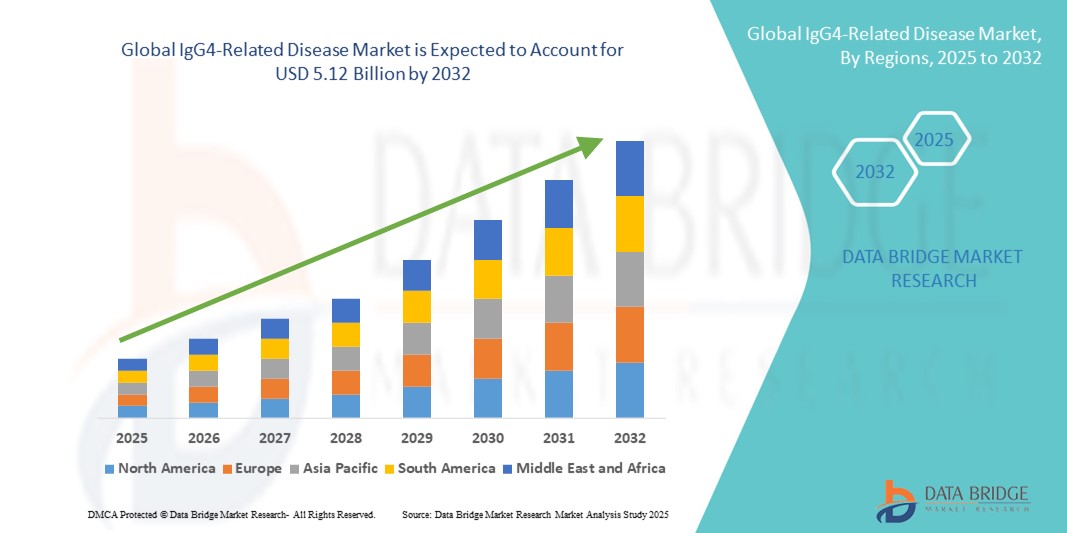
IgG4-Related Disease Market Size
- The global IgG4-Related disease market size was valued at USD 3.77 billion in 2024 and is expected to reach USD 5.12 billion by 2032, at a CAGR of 3.90% during the forecast period
- The market growth is largely fueled by the growing awareness and advancements in diagnostic capabilities, especially with the increased availability of immunohistochemical and serological testing for IgG4-Related Disease (IgG4-RD), enabling earlier and more accurate diagnoses across clinical settings
- Furthermore, rising healthcare expenditure and increased focus on managing rare autoimmune conditions are driving the demand for targeted therapeutic solutions. These converging factors are accelerating the uptake of IgG4-Related Disease treatments, thereby significantly boosting the industry's growth
IgG4-Related Disease Market Analysis
- The IgG4-Related disease market is witnessing substantial growth due to increased clinical recognition and advancements in diagnostic techniques, such as IgG4 immunostaining and serum IgG4 level measurement, which are enabling earlier and more accurate diagnosis of this rare autoimmune condition
- The growing prevalence of autoimmune and inflammatory disorders, coupled with rising awareness among healthcare providers and patients, is significantly driving demand for targeted therapeutic options, particularly corticosteroids and immunosuppressants used in managing IgG4-Related Disease symptoms and preventing organ damage
- North America dominated the IgG4-Related disease market with the largest revenue share of 39.4% in 2024, attributed to advanced healthcare infrastructure, early adoption of precision medicine, and an increasing number of research studies focused on rare autoimmune conditions. The U.S. remains the key revenue generator in the region, supported by high diagnosis rates and the availability of innovative treatment options across specialized clinics and academic medical centers
- Asia-Pacific is expected to be the fastest growing region in the IgG4-Related disease market with a CAGR of 10.2% during the forecast period, owing to improved healthcare access, rising public health initiatives targeting autoimmune diseases, and increasing diagnostic capabilities across countries like China, Japan, and India. Strategic collaborations and clinical trials in the region are also contributing to faster adoption of newer therapies
- Treatment segment dominated the IgG4-Related disease market with a market share of 69.8% in 2024, supported by the increasing use of corticosteroids, immunosuppressants, and monoclonal antibody therapies. This segment’s growth is driven by the effectiveness of these interventions in managing inflammation, preventing organ damage, and improving patient outcomes. The growing clinical preference for early and aggressive treatment has made therapeutic approaches the cornerstone of IgG4-Related Disease management globally
Report Scope and IgG4-Related Disease Market Segmentation
|
Attributes |
IgG4-Related Disease Key Market Insights |
|
Segments Covered |
|
|
Countries Covered |
North America
Europe
Asia-Pacific
Middle East and Africa
South America
|
|
Key Market Players |
|
|
Market Opportunities |
|
|
Value Added Data Infosets |
In addition to the insights on market scenarios such as market value, growth rate, segmentation, geographical coverage, and major players, the market reports curated by the Data Bridge Market Research also include in-depth expert analysis, pricing analysis, brand share analysis, consumer survey, demography analysis, supply chain analysis, value chain analysis, raw material/consumables overview, vendor selection criteria, PESTLE Analysis, Porter Analysis, and regulatory framework. |
IgG4-Related Disease Market Trends
“Growing Focus on Intelligent and Personalized Treatment Approaches”
- A significant and accelerating trend in the global IgG4-Related disease market is the growing emphasis on intelligent and personalized treatment strategies. This involves leveraging advanced diagnostics, predictive biomarkers, and real-time patient monitoring to optimize therapeutic outcomes
- For instance, targeted therapies like rituximab are being increasingly adopted to provide customized treatment plans based on individual immune profiles. Such therapies are helping reduce the need for long-term steroid use and minimizing relapse risks in IgG4-related systemic conditions
- Integration of digital health tools allows healthcare professionals to monitor disease progression remotely and adjust treatment regimens proactively. Real-time alerts and data-driven insights improve physician decision-making, leading to better patient management
- Advanced diagnostic platforms now combine serological testing (such as, IgG4 serum concentration) with imaging and histopathological evaluation, enabling faster and more accurate diagnosis of conditions like autoimmune pancreatitis and retroperitoneal fibrosis. Early detection is critical in preventing irreversible organ damage
- Moreover, companies such as Takeda and Pfizer are actively investing in the development of biologics and immune-modulating agents aimed at treating complex autoimmune conditions, including IgG4-related diseases. These treatments are being designed to offer long-term remission with fewer side effects
- The demand for comprehensive, integrated treatment and monitoring systems is rapidly increasing across both developed and emerging markets. As healthcare providers aim for precision-driven care, the IgG4-related disease space is witnessing substantial innovation and adoption of smarter, patient-centric solutions
IgG4-Related Disease Market Dynamics
Driver
“Growing Need Due to Rising Disease Awareness and Advancements in Diagnostic Technologies”
- The increasing recognition of IgG4-Related Disease (IgG4-RD) as a distinct clinical entity, combined with growing awareness among clinicians and patients, is a significant driver for the heightened demand for early diagnosis and effective treatment options
- For instance, in April 2024, researchers from the Mayo Clinic announced advancements in imaging techniques and serum biomarker testing, enabling more precise and earlier identification of IgG4-RD. Such strategies by key institutions are expected to drive the IgG4-Related Disease industry growth in the forecast period
- As healthcare providers become more aware of multi-organ involvement and the autoimmune nature of IgG4-RD, there is an increased demand for integrated diagnostic solutions, including histopathology, immunohistochemistry, and serum IgG4 level assessments
- Furthermore, the growing adoption of immunomodulatory therapies and the rising number of clinical trials for targeted biologics are making treatment more effective and accessible, offering new hope for long-term disease management
- The convenience of non-invasive imaging tools, targeted biologics, and improved disease classification systems are key factors propelling the adoption of comprehensive care strategies in both hospital and outpatient settings. The trend toward personalized medicine and increased collaboration between rheumatology, pathology, and radiology departments further contributes to market growth
Restraint/Challenge
“Challenges in Diagnosis and High Cost of Treatment”
- The complex and often overlapping clinical presentation of IgG4-RD with other autoimmune or neoplastic disorders poses a significant challenge to accurate and timely diagnosis. Misdiagnosis or delayed diagnosis can lead to organ damage and reduced treatment efficacy
- For instance, studies report that IgG4-RD is frequently misclassified as malignancy or other systemic autoimmune conditions, especially in its early stages, delaying appropriate therapeutic intervention
- Addressing these diagnostic challenges through better clinician training, updated clinical guidelines, and broader access to biopsy and immunostaining facilities is essential for improving patient outcomes. Institutions such as ACR and EULAR have emphasized the need for standardized diagnostic criteria
- In addition, the relatively high cost of advanced imaging, serological tests, and long-term immunosuppressive or biologic therapy can be a barrier to access for patients, particularly in low- and middle-income countries. While steroids remain a frontline treatment, relapses and side effects necessitate long-term care, increasing overall treatment burden
- While awareness and availability of testing are improving, affordability and accessibility remain key challenges. Overcoming these issues through public health initiatives, clinical training programs, and inclusion of IgG4-RD under insurance schemes will be vital for sustained market growth
IgG4-Related Disease Market Scope
The market is segmented on the basis of disease type, type, route of administration, and end user and distribution channel.
• By Disease Type
On the basis of disease type, the IgG4-related disease market is segmented into Type 1 (IgG4-Related) Autoimmune Pancreatitis (AIP), Retroperitoneal Fibrosis, IgG4-Related Tubulointerstitial Nephritis (TIN), IgG4-Related Sclerosing Cholangitis, IgG4-Related Dacryoadenitis and Sialadenitis, IgG4-Related Pachymeningitis, IgG4-Related Thyroid Disease, Serum IgG4 Concentration, and Others.
The Type 1 (IgG4-Related) Autoimmune Pancreatitis (AIP) segment dominated the market with the largest revenue share of 26.4% in 2024, owing to increased disease awareness and early diagnosis practices.
The IgG4-Related Dacryoadenitis and Sialadenitis segment is expected to register the fastest CAGR of 7.9% from 2025 to 2032, driven by the rising incidence of glandular disorders and advancements in autoimmune diagnostics.
• By Type
On the basis of type, the IgG4-related disease market is segmented into diagnostic and treatment. The treatment segment accounted for the largest share of 69.8% in 2024, supported by increasing use of corticosteroids, immunosuppressants, and monoclonal antibody therapies.
The diagnostic segment is expected to witness the fastest CAGR of 6.3% from 2025 to 2032, as precision diagnostics gain traction in autoimmune disease management.
• By Route of Administration
On the basis of route of administration, the IgG4-related disease market is segmented into parenteral, oral, and others. The parenteral segment held the dominant revenue share of 55.1% in 2024, driven by the wide use of intravenous biologics such as rituximab.
The oral segment is expected to witness the fastest CAGR of 5.6% from 2025 to 2032, as corticosteroids remain a mainstay for initial treatment and relapse management.
• By End User
On the basis of end user, the IgG4-related disease market is segmented into hospitals, specialty clinics, and others. The hospitals segment captured the largest market share of 61.3% in 2024, attributed to advanced treatment settings and higher patient admission rates for complex autoimmune conditions.
The specialty clinics segment is expected to witness the highest CAGR of 7.4% during the forecast period due to growing demand for outpatient specialty care and personalized treatment regimens.
• By Distribution Channel
On the basis of distribution channel, the IgG4-related disease market is segmented into hospital pharmacy, retail pharmacy, online pharmacy, and others.
The hospital pharmacy segment dominated with a revenue share of 47.6% in 2024, supported by bulk procurement of biologics and institutional use.
The online pharmacy segment is expected to witness the highest CAGR of 6.4% during the forecast period due to growing demand for outpatient specialty care and personalized treatment regimens.
IgG4-Related Disease Market Regional Analysis
- North America dominated the IgG4-related disease market with the largest revenue share of 39.4% in 2024, driven by increasing awareness among healthcare providers, improved diagnostic infrastructure, and the rising adoption of immunomodulatory therapies
- The presence of leading academic and research institutions and a high prevalence of autoimmune and inflammatory disorders further supports market growth in this region
- The growing focus on early detection, along with the availability of advanced imaging and serological tests, is propelling demand for targeted treatments in the U.S. and Canada. Moreover, favorable reimbursement policies and strong pharmaceutical pipelines contribute significantly to the region’s dominance
U.S. IgG4-Related Disease Market Insight
The U.S. IgG4-related disease market captured the largest revenue share of 83.7% in 2024 within North America, supported by the presence of a robust clinical research ecosystem and increased investment in autoimmune disease diagnostics. The growing availability of biopsy-based histopathology and serology testing, coupled with high awareness among specialists in rheumatology and gastroenterology, is fueling early diagnosis and effective treatment strategies. In addition, the U.S. is witnessing accelerated clinical trials for emerging biologics targeting IL-4 and IL-13 pathways.
Europe IgG4-Related Disease Market Insight
The Europe IgG4-related disease market is projected to expand at a substantial CAGR of 7.8% from 2025 to 2032, driven by enhanced disease surveillance programs and increasing collaboration between research institutions across Germany, the U.K., France, and Italy. The growing emphasis on autoimmune disease registries, coupled with improved patient access to specialized diagnostic facilities, is aiding market expansion. Furthermore, the region is experiencing a rise in demand for off-label use of immunosuppressants and corticosteroids to manage multi-organ IgG4-related inflammation.
U.K. IgG4-Related Disease Market Insight
The U.K. IgG4-related disease market is anticipated to grow at a noteworthy CAGR of 8.1% during the forecast period, owing to expanding national autoimmune disease awareness initiatives and increased funding for rare disease research. Advanced diagnostic capabilities at NHS hospitals, particularly in immunopathology, are enhancing early detection. The demand for steroid-sparing biologic therapies is rising as clinicians focus on long-term remission and minimizing side effects.
Germany IgG4-Related Disease Market Insight
The Germany IgG4-related disease market is expected to expand at a considerable CAGR of 7.5%, supported by a strong focus on early histological diagnosis and the country’s leadership in personalized medicine. Research programs on rare autoimmune diseases and integration of genomic data in routine care are facilitating accurate disease classification. The availability of tertiary care centers with multidisciplinary teams further enhances treatment outcomes.
Asia-Pacific IgG4-Related Disease Market Insight
The Asia-Pacific IgG4-related disease market is poised to grow at the fastest CAGR of 10.2% during the forecast period of 2025 to 2032, due to increasing awareness, improved healthcare infrastructure, and expanding access to diagnostic services. Countries such as Japan, China, South Korea, and India are investing in medical education and diagnostic technology for autoimmune and inflammatory diseases. In addition, regional collaborations for rare disease research and the rising use of biosimilars are expected to accelerate treatment availability.
Japan IgG4-Related Disease Market Insight
The Japan IgG4-related disease market is gaining momentum, driven by the country’s strong emphasis on rare disease identification and advanced imaging capabilities. Japanese researchers have contributed significantly to the clinical understanding of IgG4-RD, and this has translated into better diagnostic accuracy and earlier treatment initiation. The aging population and government-backed health initiatives are expected to further drive market demand for long-term immunomodulatory therapies.
China IgG4-Related Disease Market Insight
The China IgG4-related disease market accounted for the largest market revenue share of 41.6% in Asia Pacific in 2024, fueled by rapidly expanding healthcare access, increased physician awareness, and a growing middle class seeking advanced medical care. China is also ramping up investments in autoimmune disease diagnostics and the domestic production of immunoglobulin testing kits and biopsy devices. Rising participation in global clinical trials and government support for rare disease treatments are expected to enhance market penetration.
IgG4-Related Disease Market Share
The IgG4-related disease industry is primarily led by well-established companies, including:
- Hikma Pharmaceuticals PLC (U.K.)
- Lannett (U.S.)
- Sun Pharmaceutical Industries Ltd. (India)
- Baxter (U.S.)
- Viatris Inc. (U.S.)
- Amgen Inc. (U.S.)
- Sandoz Group AG (Switzerland)
- Fresenius Kabi AG (Germany)
- Pfizer Inc. (U.S.)
- Cipla Inc. (India)
- Celltrion Healthcare Co., Ltd. (South Korea)
- Antares Pharma (U.S.)
- Amneal Pharmaceuticals LLC (U.S.)
- Accord Healthcare (U.K.)
- Genentech, Inc. (U.S.)
- Ingenus Pharmaceuticals (U.S.)
- STI PHARMA (Canada)
- Sebela Pharmaceuticals (France)
- ANI Pharmaceuticals, Inc. (U.S.)
Latest Developments in Global IgG4-Related Disease Market
- In May 2024, Horizon Therapeutics announced the initiation of a Phase II clinical trial evaluating the safety and efficacy of tezepelumab, a biologic targeting thymic stromal lymphopoietin (TSLP), in patients with IgG4-Related Disease. This trial reflects growing interest in novel biologic therapies to manage the inflammatory and fibrotic features of IgG4-RD, as traditional steroid therapy remains suboptimal for long-term disease control
- In March 2024, the Mayo Clinic (U.S.) published results from a longitudinal cohort study involving over 200 patients with IgG4-RD, providing new insights into disease progression, organ involvement patterns, and biomarker utility. The findings are expected to refine diagnostic criteria and guide targeted therapeutic strategies, thus contributing to improved patient outcomes
- In February 2024, Kyowa Kirin (Japan) announced positive preclinical data for its anti-IL-4Rα monoclonal antibody, highlighting its potential application in IgG4-RD by modulating Th2-driven immune pathways. The company confirmed plans to move into early-stage human trials by 2025, focusing on multi-organ manifestations of the disease
- In December 2023, GlaxoSmithKline (GSK) expanded its autoimmune and rare diseases pipeline through a licensing agreement with a U.S.-based biotech firm developing therapies targeting plasmablasts—key immune cells involved in the pathogenesis of IgG4-RD. This collaboration aims to deliver a first-in-class precision therapy targeting disease-specific immune pathways
- In October 2023, a multidisciplinary task force led by the European League Against Rheumatism (EULAR) released updated guidelines for the diagnosis and treatment of IgG4-Related Disease. These guidelines emphasize the use of serological IgG4 levels, biopsy confirmation, and risk-based treatment algorithms that prioritize steroid-sparing regimens for long-term management
- In August 2023, the University of California, San Diego (UCSD) launched a dedicated research consortium focused on autoimmune pancreatitis and IgG4-related hepatobiliary disease. The initiative brings together gastroenterologists, immunologists, and pathologists to study tissue-specific manifestations and advance precision medicine approaches for these under-recognized conditions

- Interactive Data Analysis Dashboard
- Company Analysis Dashboard for high growth potential opportunities
- Research Analyst Access for customization & queries
- Competitor Analysis with Interactive dashboard
- Latest News, Updates & Trend analysis
- Harness the Power of Benchmark Analysis for Comprehensive Competitor Tracking
Data collection and base year analysis are done using data collection modules with large sample sizes. The stage includes obtaining market information or related data through various sources and strategies. It includes examining and planning all the data acquired from the past in advance. It likewise envelops the examination of information inconsistencies seen across different information sources. The market data is analysed and estimated using market statistical and coherent models. Also, market share analysis and key trend analysis are the major success factors in the market report. To know more, please request an analyst call or drop down your inquiry.
The key research methodology used by DBMR research team is data triangulation which involves data mining, analysis of the impact of data variables on the market and primary (industry expert) validation. Data models include Vendor Positioning Grid, Market Time Line Analysis, Market Overview and Guide, Company Positioning Grid, Patent Analysis, Pricing Analysis, Company Market Share Analysis, Standards of Measurement, Global versus Regional and Vendor Share Analysis. To know more about the research methodology, drop in an inquiry to speak to our industry experts.
Data Bridge Market Research is a leader in advanced formative research. We take pride in servicing our existing and new customers with data and analysis that match and suits their goal. The report can be customized to include price trend analysis of target brands understanding the market for additional countries (ask for the list of countries), clinical trial results data, literature review, refurbished market and product base analysis. Market analysis of target competitors can be analyzed from technology-based analysis to market portfolio strategies. We can add as many competitors that you require data about in the format and data style you are looking for. Our team of analysts can also provide you data in crude raw excel files pivot tables (Fact book) or can assist you in creating presentations from the data sets available in the report.













