


Image-Guided Biopsy Market Size
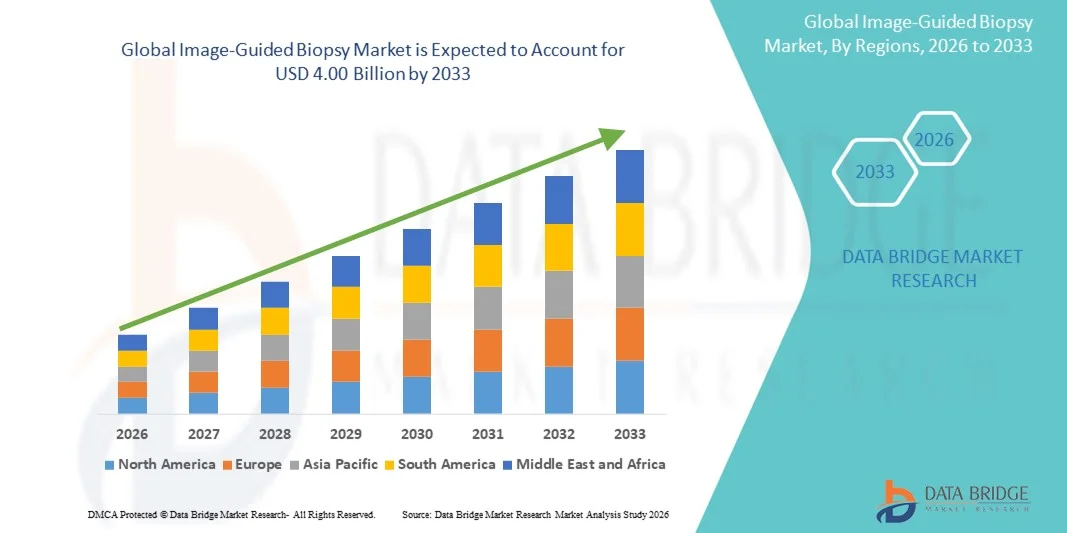
- The global image-guided biopsy market size was valued at USD 2.60 billion in 2025 and is expected to reach USD 4.00 billion by 2033, at a CAGR of 5.49% during the forecast period
- The market growth is largely fueled by the rising prevalence of cancer and chronic diseases, increasing adoption of minimally invasive diagnostic procedures with imaging modalities (CT, MRI, ultrasound), and growing awareness of early diagnosis and precision medicine
- Furthermore, advancements in imaging technologies, real‑time navigation, and portable biopsy systems alongside the expansion of healthcare infrastructure in emerging economies are establishing image‑guided biopsy as the modern standard for accurate tissue sampling. These converging factors are accelerating the uptake of image‑guided biopsy solutions, thereby significantly boosting the industry’s growth
Image-Guided Biopsy Market Analysis
- Image-guided biopsy systems, offering real-time imaging-assisted tissue sampling, are increasingly vital components of modern diagnostic and interventional procedures in both hospitals and outpatient settings due to their enhanced accuracy, minimally invasive approach, and integration with advanced imaging modalities such as ultrasound, CT, and MRI
- The escalating demand for image-guided biopsy systems is primarily fueled by the rising incidence of cancer and chronic diseases, growing adoption of minimally invasive procedures, and a preference for precise, patient-friendly diagnostic solutions
- North America dominated the image-guided biopsy market with the largest revenue share of 41.7% in 2025, characterized by advanced healthcare infrastructure, high adoption of imaging technologies, and a strong presence of key industry players, with the U.S. experiencing substantial growth in procedures due to favorable reimbursement policies and innovations in real-time navigation and robotic-assisted biopsy systems
- Asia-Pacific is expected to be the fastest growing region in the image-guided biopsy market during the forecast period due to increasing healthcare investments, rising incidence of cancer, and expanding availability of advanced diagnostic imaging equipment
- Ultrasound segment dominated the image-guided biopsy market with a market share of 38.9% in 2025, driven by its cost-effectiveness, real-time imaging capabilities, and broad applicability across soft tissue diagnostics
Report Scope and Image-Guided Biopsy Market Segmentation
|
Attributes |
Image-Guided Biopsy Key Market Insights |
|
Segments Covered |
|
|
Countries Covered |
North America
Europe
Asia-Pacific
Middle East and Africa
South America
|
|
Key Market Players |
|
|
Market Opportunities |
|
|
Value Added Data Infosets |
In addition to the insights on market scenarios such as market value, growth rate, segmentation, geographical coverage, and major players, the market reports curated by the Data Bridge Market Research also include in-depth expert analysis, patient epidemiology, pipeline analysis, pricing analysis, and regulatory framework |
Image-Guided Biopsy Market Trends
Advancements Through AI and Robotic Integration
- A significant and accelerating trend in the global image-guided biopsy market is the increasing integration of artificial intelligence (AI) and robotic-assisted systems with imaging modalities such as ultrasound, CT, and MRI, enhancing precision and procedural efficiency
- For instance, the iSR’obot™ system integrates AI algorithms with robotic navigation to assist radiologists in accurate lesion targeting, reducing procedure time and patient discomfort
- AI integration enables features such as real-time lesion identification, predictive analytics for biopsy outcomes, and improved needle trajectory planning. For instance, some Medtronic robotic biopsy platforms utilize AI to refine needle placement and alert clinicians to potential deviations during procedures
- The combination of robotic assistance and AI-driven imaging analytics allows clinicians to perform minimally invasive biopsies with higher accuracy, lower complication rates, and improved reproducibility. Through a single interface, physicians can visualize, plan, and execute biopsy procedures with automated precision
- This trend toward more intelligent, automated, and precise biopsy systems is fundamentally reshaping expectations in clinical diagnostics. Consequently, companies such as Hologic are developing AI-enabled robotic biopsy solutions with real-time imaging feedback and automated needle guidance
- The demand for image-guided biopsy systems with AI and robotic integration is growing rapidly across hospitals and outpatient clinics, as healthcare providers increasingly prioritize procedure accuracy, patient safety, and workflow efficiency
Image-Guided Biopsy Market Dynamics
Driver
Rising Incidence of Cancer and Demand for Minimally Invasive Procedures
- The increasing integration of artificial intelligence (AI) and robotic-assisted systems with imaging modalities such as ultrasound, CT, and MRI, enhancing precision and procedural efficiency
- For instance, in March 2025, Siemens Healthineers launched an AI-assisted biopsy platform aimed at improving accuracy in breast and liver lesion sampling, expected to accelerate market growth
- As healthcare providers focus on minimally invasive and patient-friendly diagnostic solutions, image-guided biopsy systems offer precise lesion targeting, reduced patient discomfort, and lower complication risks, providing a compelling advantage over traditional biopsy methods
- Furthermore, the growing adoption of advanced imaging modalities in hospitals and diagnostic centers is making image-guided biopsy an integral component of standard care, facilitating seamless integration with other imaging and diagnostic procedures
- The ability to plan, monitor, and execute procedures with high accuracy, real-time feedback, and reduced procedure time are key factors propelling the adoption of image-guided biopsy systems in both developed and emerging markets
Restraint/Challenge
High System Costs and Regulatory Compliance Hurdles
- Concerns regarding the high cost of advanced image-guided biopsy systems and the complexity of regulatory approvals pose significant challenges to market expansion. As these systems require sophisticated imaging, robotics, and software, initial investment and maintenance costs can be substantial
- For instance, expensive MRI-compatible robotic biopsy platforms may limit adoption in smaller hospitals or outpatient clinics with budget constraints
- Addressing cost barriers through flexible financing, leasing options, and scalable system configurations is crucial for wider adoption. In addition, obtaining regulatory approvals across multiple regions adds time and complexity, potentially delaying market entry
- Furthermore, clinicians require training to effectively operate AI-assisted and robotic biopsy systems, which can hinder rapid deployment in resource-limited settings. Proper education and support programs are necessary to ensure optimal utilization and patient safety
- Overcoming these challenges through cost-effective solutions, streamlined regulatory pathways, and clinician training will be vital for sustained growth and broader adoption of image-guided biopsy technologies
Image-Guided Biopsy Market Scope
The market is segmented on the basis of technology, process, and end-user.
- By Technology
On the basis of technology, the image-guided biopsy market is segmented into X‑Ray, Ultrasound, Mammography, CT, and MRI. The Ultrasound segment dominated the market with the largest revenue share of 38.9% in 2025, driven by its real-time imaging capability, cost-effectiveness, and non-invasive nature. Ultrasound-guided biopsy is widely used for soft tissue lesions including breast, thyroid, and liver, providing clinicians with precise needle placement and reducing procedure complications. Its portability and accessibility make it highly favored in both hospitals and outpatient clinics. The segment benefits from strong adoption in emerging economies due to relatively lower equipment costs and minimal radiation exposure. In addition, ultrasound guidance supports multiple biopsy processes such as fine needle, core needle, and vacuum-assisted biopsy, further increasing its market utilization. Continuous advancements in imaging resolution and AI-assisted lesion detection are also enhancing accuracy and expanding clinical applications.
The MRI segment is anticipated to witness the fastest growth rate of 12.8% from 2026 to 2033, fueled by its superior soft tissue contrast and ability to detect lesions not visible on other imaging modalities. MRI-guided biopsies are critical for complex cases such as breast and prostate cancer, particularly when prior imaging is inconclusive. The growth is also driven by increasing adoption of MRI-compatible robotic biopsy devices and integration with AI for automated needle trajectory planning. Hospitals and specialty centers are increasingly investing in MRI-guided biopsy systems to provide high-precision interventions, improving patient outcomes. The segment’s growth is supported by rising awareness of early cancer detection and minimally invasive procedures in developed regions. Ongoing technological innovations such as real-time MRI sequences and enhanced needle guidance further propel its adoption.
- By Process
On the basis of process, the market is segmented into fine needle, core needle, and vacuum-assisted biopsy. The Core Needle Biopsy segment dominated the market with a revenue share of 45% in 2025, owing to its ability to extract larger tissue samples for more accurate histopathological evaluation. Core needle biopsies are commonly used for breast, liver, and prostate lesions, providing reliable diagnostic accuracy and reducing the need for repeat procedures. The segment benefits from widespread clinical familiarity and strong adoption in hospitals and specialized diagnostic centers. In addition, the combination of core needle biopsy with imaging modalities such as ultrasound and MRI improves lesion targeting and patient safety. Rising incidence of cancer and chronic diseases continues to boost demand for core needle biopsy procedures. Moreover, developments in needle design and real-time imaging integration are enhancing procedural efficiency and patient comfort.
The Vacuum-Assisted Biopsy segment is expected to witness the fastest CAGR of 13.1% from 2026 to 2033, driven by its minimally invasive nature and ability to remove larger tissue volumes in a single insertion. This process is particularly preferred for breast lesions detected on mammography or MRI, reducing sampling errors and repeat biopsies. The segment growth is fueled by increasing use in outpatient clinics and ambulatory surgery centers due to patient convenience and faster recovery times. Innovations in vacuum-assisted devices with integrated imaging guidance and AI-assisted lesion targeting are enhancing procedural precision. Rising awareness of early cancer diagnosis and preference for less invasive procedures further support rapid adoption. Furthermore, collaborations between device manufacturers and healthcare providers are expanding accessibility in emerging markets.
- By End-User
On the basis of end-user, the market is segmented into hospitals, ambulatory surgery centers (ASCs), clinics, and research & academic institutes. The Hospitals segment dominated the market with the largest revenue share of 52% in 2025, due to their advanced infrastructure, high patient volume, and availability of multiple imaging modalities for diverse biopsy procedures. Hospitals provide comprehensive services, enabling complex image-guided biopsies such as MRI- and CT-guided interventions. Strong adoption is also supported by favorable reimbursement policies, skilled radiologists, and integration with electronic health records. Hospitals serve as primary centers for training clinicians in image-guided biopsy techniques, further solidifying market dominance. The segment benefits from continuous technology upgrades, including AI-assisted navigation and robotic biopsy platforms. In addition, hospitals’ capacity to handle high-risk and multiple-site biopsies drives large-scale adoption.
The Ambulatory Surgery Centers (ASCs) segment is expected to witness the fastest growth rate of 11.5% from 2026 to 2033, driven by increasing demand for outpatient procedures that are minimally invasive, cost-effective, and time-efficient. ASCs are expanding adoption of ultrasound- and CT-guided biopsies to reduce hospital stays and enhance patient throughput. Growth is further fueled by rising investments in portable imaging systems and AI-assisted biopsy tools. The segment benefits from patient preference for convenient, lower-cost alternatives to hospital-based procedures. Integration with electronic scheduling and telemedicine platforms supports workflow efficiency and accessibility. Furthermore, expanding healthcare infrastructure in emerging economies is increasing the number of ASCs offering advanced biopsy services.
Image-Guided Biopsy Market Regional Analysis
- North America dominated the image-guided biopsy market with the largest revenue share of 41.7% in 2025, characterized by advanced healthcare infrastructure, high adoption of imaging technologies, and a strong presence of key industry players
- Healthcare providers in the region highly prioritize accuracy, minimally invasive procedures, and integration of AI and robotic-assisted systems with imaging modalities such as ultrasound, CT, and MRI for precise tissue sampling
- This widespread adoption is further supported by favorable reimbursement policies, skilled radiologists, and the presence of leading medical device manufacturers, establishing image-guided biopsy systems as the preferred choice for hospitals, outpatient clinics, and specialized diagnostic centers
U.S. Image-Guided Biopsy Market Insight
The U.S. image-guided biopsy market captured the largest revenue share of 42% in 2025 within North America, fueled by advanced healthcare infrastructure, high adoption of imaging modalities, and rising cancer prevalence. Hospitals and outpatient centers are increasingly prioritizing minimally invasive procedures with real-time imaging guidance. The growing preference for AI-assisted and robotic biopsy systems, combined with robust reimbursement policies and skilled radiologists, further propels the market. Moreover, increasing integration of imaging technologies such as ultrasound, CT, and MRI with automated needle guidance is significantly contributing to market expansion.
Europe Image-Guided Biopsy Market Insight
The Europe image-guided biopsy market is projected to expand at a substantial CAGR throughout the forecast period, primarily driven by increasing cancer incidence, stringent healthcare regulations, and rising awareness of minimally invasive diagnostics. The growth of specialized oncology centers and the demand for precise tissue sampling in hospitals and clinics are fostering adoption. European healthcare providers are drawn to the improved accuracy, patient safety, and reduced procedural complications offered by advanced image-guided biopsy systems. The region is experiencing growth across breast, liver, and prostate biopsy applications, with hospitals and ambulatory centers incorporating modern imaging modalities for both new procedures and upgrades.
U.K. Image-Guided Biopsy Market Insight
The U.K. image-guided biopsy market is anticipated to grow at a noteworthy CAGR during the forecast period, driven by increasing adoption of advanced imaging modalities and minimally invasive procedures. Concerns over diagnostic accuracy and patient safety are encouraging hospitals and diagnostic centers to invest in ultrasound-, CT-, and MRI-guided biopsy systems. The U.K.’s focus on precision medicine, digital healthcare infrastructure, and strong research collaborations is expected to continue stimulating market growth. Moreover, rising awareness among patients about early cancer detection and minimally invasive diagnostic options is further accelerating adoption.
Germany Image-Guided Biopsy Market Insight
The Germany image-guided biopsy market is expected to expand at a considerable CAGR during the forecast period, fueled by high healthcare spending, well-developed infrastructure, and increasing cancer awareness. Hospitals and specialized diagnostic centers are adopting advanced imaging-guided biopsy systems to improve procedural precision and patient outcomes. The country’s emphasis on technological innovation and integration of AI and robotic-assisted navigation promotes the uptake of minimally invasive biopsy procedures. Growing demand for patient-friendly diagnostics and efficient clinical workflows aligns with local healthcare priorities, particularly in oncology care.
Asia-Pacific Image-Guided Biopsy Market Insight
The Asia-Pacific image-guided biopsy market is poised to grow at the fastest CAGR of 13% during the forecast period of 2026 to 2033, driven by increasing incidence of cancer, rising healthcare expenditure, and expansion of advanced diagnostic facilities in countries such as China, Japan, and India. The region’s growing adoption of minimally invasive procedures supported by government initiatives in healthcare modernization is driving market growth. Furthermore, the expansion of imaging infrastructure and domestic manufacturing of biopsy systems are improving accessibility and affordability across hospitals and outpatient clinics.
Japan Image-Guided Biopsy Market Insight
The Japan image-guided biopsy market is gaining momentum due to the country’s advanced healthcare system, rising cancer prevalence, and growing demand for precise, minimally invasive diagnostics. Hospitals and specialized centers emphasize the adoption of ultrasound-, CT-, and MRI-guided biopsy procedures integrated with AI-assisted navigation for improved accuracy. The aging population and focus on patient-friendly procedures further spur demand for easier-to-use, high-precision biopsy systems. Moreover, Japan’s strong research ecosystem and technological innovation contribute to continuous development and adoption of advanced imaging-guided biopsy solutions.
India Image-Guided Biopsy Market Insight
The India image-guided biopsy market accounted for the largest market revenue share in Asia-Pacific in 2025, attributed to increasing cancer incidence, growing healthcare infrastructure, and rising awareness of minimally invasive diagnostics. India is witnessing higher adoption of ultrasound- and CT-guided biopsy systems across hospitals, outpatient clinics, and specialized diagnostic centers. The push towards modernizing healthcare facilities, expanding private hospitals, and availability of cost-effective biopsy solutions are key factors propelling the market. Moreover, government initiatives promoting cancer screening and early diagnosis are further accelerating adoption of image-guided biopsy systems in the country.
Image-Guided Biopsy Market Share
The Image-Guided Biopsy industry is primarily led by well-established companies, including:
- Koninklijke Philips N.V. (Netherlands)
- Siemens Healthineers AG (Germany)
- Analogic Corporation (U.S.)
- General Electric Company (U.S.)
- Varian Medical Systems, Inc. (U.S.)
- Medtronic (Ireland)
- Olympus Corporation (Japan)
- KARL STORZ Endoscopy (Germany)
- Stryker (U.S.)
- Hologic, Inc. (U.S.)
- BD (U.S.)
- ARGON Medical Devices, Inc. (U.S.)
- B. Braun SE (Germany)
- FUJIFILM Holdings Corporation (Japan)
- Hitachi, Ltd. (Japan)
- Bracco Imaging S.p.A. (Italy)
- Devicor Medical Products, Inc. (U.S.)
- Cook (U.S.)
- Cardinal Health (U.S.)
- CONMED Corporation (U.S.)
What are the Recent Developments in Global Image-Guided Biopsy Market?
- In July 2025, Philips received FDA 510(k) clearance for its updated UroNav image‑guided navigation platform, which fuses MR and real‑time US imaging and integrates treatment planning, biopsy pathology and 3D guidance positioned for focal therapy and biopsy accuracy enhancement in prostate cancer
- In June 2025, GE HealthCare announced the launch of its bkActiv S series intra‑operative ultrasound system enhanced for guiding urology, colorectal and pelvic‑floor procedures including biopsies; features include AI‑based prostate volume assist, customizable interface and real‑time image‑compare mode
- In March 2025, Quibim S.L.’s “QP‑Prostate® CAD” software achieved FDA submission documentation noting its lesion detection algorithm for prostate MRI‑guided biopsies; the dataset included over 200 cases and demonstrated AUC ~0.732 with sensitivity ~0.795 for moderate/high suspicion markers
- In April 2023, GE HealthCare introduced its CT‑Navigation solution a real‑time 3‑D CT image‑guided platform for stereotactic needle guidance across interventional oncology, including biopsies and ablations. The system integrates mobile workstation, guidance software and a disposable procedure kit, aiming to improve accuracy while reducing radiation dose and procedure time
- In April 2023, FUJIFILM Healthcare launched the ARIETTA 65 IntuitiveFusion system for MRI‑US fusion guided prostate biopsy. The system combines an ultrasound platform with BiopSee software for fusion planning, elastic tissue deformation correction, needle guidance and report generation, including compatibility with trans‑perineal biopsy routes

- Interactive Data Analysis Dashboard
- Company Analysis Dashboard for high growth potential opportunities
- Research Analyst Access for customization & queries
- Competitor Analysis with Interactive dashboard
- Latest News, Updates & Trend analysis
- Harness the Power of Benchmark Analysis for Comprehensive Competitor Tracking
Data collection and base year analysis are done using data collection modules with large sample sizes. The stage includes obtaining market information or related data through various sources and strategies. It includes examining and planning all the data acquired from the past in advance. It likewise envelops the examination of information inconsistencies seen across different information sources. The market data is analysed and estimated using market statistical and coherent models. Also, market share analysis and key trend analysis are the major success factors in the market report. To know more, please request an analyst call or drop down your inquiry.
The key research methodology used by DBMR research team is data triangulation which involves data mining, analysis of the impact of data variables on the market and primary (industry expert) validation. Data models include Vendor Positioning Grid, Market Time Line Analysis, Market Overview and Guide, Company Positioning Grid, Patent Analysis, Pricing Analysis, Company Market Share Analysis, Standards of Measurement, Global versus Regional and Vendor Share Analysis. To know more about the research methodology, drop in an inquiry to speak to our industry experts.
Data Bridge Market Research is a leader in advanced formative research. We take pride in servicing our existing and new customers with data and analysis that match and suits their goal. The report can be customized to include price trend analysis of target brands understanding the market for additional countries (ask for the list of countries), clinical trial results data, literature review, refurbished market and product base analysis. Market analysis of target competitors can be analyzed from technology-based analysis to market portfolio strategies. We can add as many competitors that you require data about in the format and data style you are looking for. Our team of analysts can also provide you data in crude raw excel files pivot tables (Fact book) or can assist you in creating presentations from the data sets available in the report.













