


Image-Guided Surgery Equipment and Navigation-Assisted Surgical Equipment Market Size
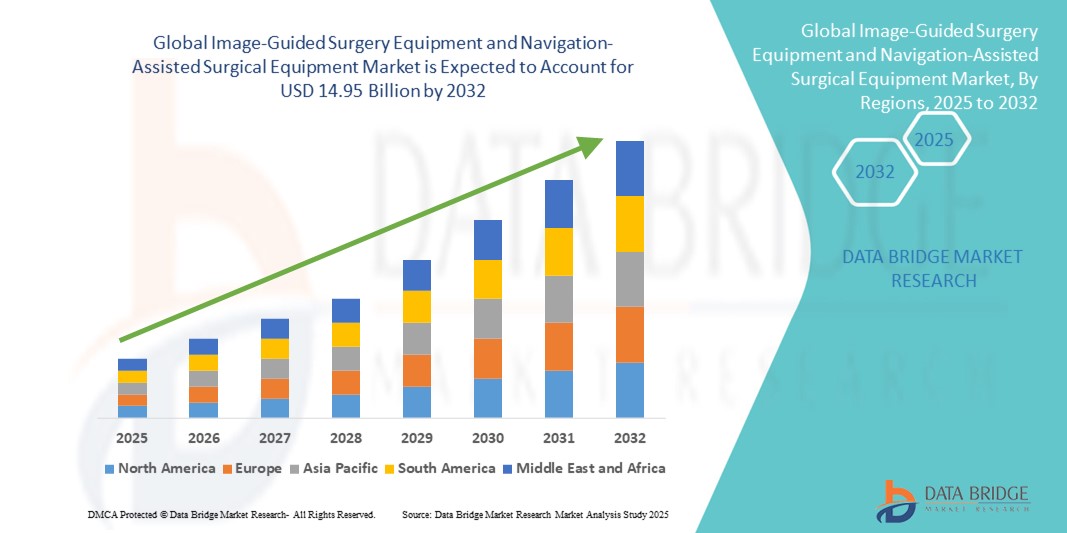
- The global image-guided surgery equipment and navigation-assisted surgical equipment market size was valued at USD 8.96 billion in 2024 and is expected to reach USD 14.95 billion by 2032, at a CAGR of 6.60% during the forecast period
- The market growth is largely fueled by the increasing adoption of advanced surgical technologies, rising preference for minimally invasive procedures, and the integration of imaging and navigation systems in operating rooms, which enhance surgical precision and patient outcomes
- Furthermore, growing demand from hospitals and ambulatory surgical centers for solutions that reduce operative time, improve safety, and support complex procedures is establishing image-guided and navigation-assisted equipment as essential tools in modern surgery. These converging factors are accelerating the uptake of such surgical solutions, thereby significantly boosting the industry's growth
Image-Guided Surgery Equipment and Navigation-Assisted Surgical Equipment Market Analysis
- Image-guided surgery and navigation-assisted surgical equipment, which provide real-time imaging and precise guidance during surgical procedures, are increasingly essential components of modern operating rooms in both hospitals and ambulatory surgical centers due to their ability to enhance surgical accuracy, reduce complications, and improve patient outcomes
- The escalating demand for these systems is primarily fueled by the rising prevalence of chronic diseases, the growing adoption of minimally invasive surgeries, advancements in imaging and navigation technologies, and the need for improved procedural efficiency and patient safety
- North America dominated the image-guided surgery equipment and navigation-assisted surgical equipment market with the largest revenue share of 42.5% in 2024, characterized by advanced healthcare infrastructure, high healthcare expenditure, and a strong presence of key industry players, with the U.S. experiencing substantial growth in adoption across neurosurgery, orthopedic, and spinal procedures, driven by innovations in robotic-assisted and AI-integrated surgical solutions
- Asia-Pacific is expected to be the fastest-growing region in the image-guided surgery equipment and navigation-assisted surgical equipment market during the forecast period due to increasing healthcare investments, rising prevalence of chronic diseases, and expanding healthcare infrastructure in countries such as China and India
- The Minimally Invasive surgery segment dominated the image-guided surgery equipment and navigation-assisted surgical equipment market with a share of 72.5% in 2024, driven by its ability to reduce patient recovery time, minimize complications, and enhance surgical precision through advanced image-guided and navigation-assisted technologies
Report Scope and Image-Guided Surgery Equipment and Navigation-Assisted Surgical Equipment Market Segmentation
|
Attributes |
Image-Guided Surgery Equipment and Navigation-Assisted Surgical Equipment Key Market Insights |
|
Segments Covered |
|
|
Countries Covered |
North America
Europe
Asia-Pacific
Middle East and Africa
South America
|
|
Key Market Players |
|
|
Market Opportunities |
|
|
Value Added Data Infosets |
In addition to the insights on market scenarios such as market value, growth rate, segmentation, geographical coverage, and major players, the market reports curated by the Data Bridge Market Research also include in-depth expert analysis, pricing analysis, brand share analysis, consumer survey, demography analysis, supply chain analysis, value chain analysis, raw material/consumables overview, vendor selection criteria, PESTLE Analysis, Porter Analysis, and regulatory framework. |
Image-Guided Surgery Equipment and Navigation-Assisted Surgical Equipment Market Trends
Advancements Through AI and Robotic Integration
- A significant and accelerating trend in the global image-guided surgery and navigation-assisted surgical equipment market is the deepening integration with artificial intelligence (AI) and robotic-assisted systems. This integration enhances surgical precision, reduces intraoperative errors, and improves patient outcomes
- For instance, systems such as Medtronic’s StealthStation™ navigation and Brainlab’s AI-powered surgical navigation platforms enable surgeons to perform complex procedures with real-time guidance and predictive analytics. Similarly, robotic-assisted platforms such as the Mazor X Stealth Edition facilitate highly accurate spinal and orthopedic interventions
- AI integration in these systems enables features such as automated instrument tracking, predictive modeling of surgical outcomes, and intelligent alerts during procedures. For example, AI-powered navigation can suggest optimal trajectories for implants or highlight potential risks based on patient-specific imaging data. Robotic assistance allows for steadier, more precise instrument manipulation, reducing the such aslihood of complications
- The seamless integration of these systems with hospital PACS, preoperative imaging, and surgical planning software facilitates centralized workflow management, allowing surgeons and surgical teams to access imaging, planning, and navigation data from a single interface, enhancing operational efficiency
- This trend towards more intelligent, precise, and integrated surgical systems is reshaping expectations for modern operating rooms. Consequently, companies such as Medtronic, Brainlab, and Stryker are developing AI-enabled and robotic-assisted navigation systems with features such as predictive modeling, automated tracking, and integration with multiple imaging modalities
- The demand for image-guided and navigation-assisted surgical equipment that incorporates AI and robotic technologies is growing rapidly across hospitals and surgical centers, as healthcare providers increasingly prioritize improved surgical outcomes, workflow efficiency, and minimally invasive procedures
Image-Guided Surgery Equipment and Navigation-Assisted Surgical Equipment Market Dynamics
Driver
Rising Demand Due to Increasing Surgical Complexity and Minimally Invasive Procedures
- The growing prevalence of complex and chronic diseases, along with the rising adoption of minimally invasive surgeries, is a key driver of demand for image-guided and navigation-assisted surgical systems
- For instance, in 2024, Brainlab expanded its neurosurgery navigation portfolio with AI-enabled features to improve surgical accuracy, demonstrating how technological advancements are driving adoption
- As hospitals and surgical centers focus on reducing complications, improving precision, and shortening recovery times, image-guided systems provide real-time visualization, predictive guidance, and enhanced control during complex procedures
- Furthermore, the increasing popularity of robotic-assisted and minimally invasive surgeries is making these systems indispensable, integrating with preoperative planning, intraoperative imaging, and post-operative monitoring for a comprehensive surgical workflow
- The ability to perform complex procedures with higher accuracy, reduce human error, and provide data-driven insights is propelling the adoption of these systems across neurology, orthopedics, spinal surgery, and other surgical specialties
Restraint/Challenge
High Cost and Regulatory Compliance Hurdle
- The relatively high cost of advanced image-guided and navigation-assisted surgical systems, including AI and robotic integration, poses a significant barrier, particularly for smaller hospitals and emerging markets
- For instance, premium robotic-assisted platforms and AI-powered navigation systems from companies such as Medtronic and Stryker often come with multi-million-dollar price tags, limiting adoption in budget-constrained settings
- In addition, stringent regulatory approvals and compliance requirements across regions can delay product launches and add to development costs. Each system must meet rigorous safety and efficacy standards set by authorities such as the FDA and CE, which can be time-consuming
- Overcoming these challenges through cost-effective modular solutions, leasing models, and accelerated regulatory pathways, along with training programs for clinical staff, will be critical to broadening adoption and sustaining market growth
- While technological advancements continue to expand the capabilities of these systems, balancing affordability, regulatory compliance, and clinical efficacy remains a key challenge for manufacturers and healthcare providers
Image-Guided Surgery Equipment and Navigation-Assisted Surgical Equipment Market Scope
The market is segmented on the basis of type, application, procedure type, workflow, usability, modality, end user, and distribution channel.
- By Type
On the basis of type, the image-guided surgery equipment and navigation-assisted surgical equipment market is segmented into systems, instruments & accessories, and services & software. Systems segment dominated the market with the largest revenue share of 62% in 2024, driven by the increasing adoption of integrated imaging and navigation platforms in hospitals and surgical centers. Systems offer real-time guidance, improved accuracy, and enhanced workflow efficiency during complex procedures. Surgeons rely on these systems for neurosurgery, orthopedic, and spinal operations due to their precision and reliability. The integration of AI and robotic assistance in systems further boosts adoption, enabling predictive analytics, automated tracking, and better intraoperative decision-making. Hospitals are investing in systems to improve patient outcomes and operational efficiency. Leading manufacturers are developing advanced systems with multiple imaging modalities to meet the growing demand for precision surgery.
The services & software segment is anticipated to witness the fastest growth rate of 18% from 2025 to 2032, fueled by the rising need for surgical planning, real-time navigation software, and post-procedure analytics. Cloud-based platforms allow data sharing and collaboration among surgical teams, enhancing procedural efficiency. AI-driven software aids in 3D visualization, preoperative planning, and predictive modeling, reducing complications. Continuous software updates and support services keep systems up-to-date with technological advancements. Training services for clinical staff increase adoption and effective utilization. The integration of software solutions across multiple surgical specialties makes this segment highly attractive for investment.
- By Application
On the basis of application, the image-guided surgery equipment and navigation-assisted surgical equipment market is segmented into neurology, orthopedic trauma surgery, spine surgery, cardiology, urology, oncology, gynecology, and others. The neurology segment dominated the market with a share of 28% in 2024, owing to the complexity and precision required in brain and spinal surgeries. Image-guided and navigation-assisted systems are critical for tumor resection, deep brain stimulation, and epilepsy procedures. The increasing prevalence of neurological disorders and the adoption of minimally invasive neurosurgical techniques drive demand. Advanced imaging modalities such as functional MRI and PET improve surgical planning. Hospitals and research centers are investing in state-of-the-art systems to ensure better patient outcomes. Integration with robotic assistance further enhances accuracy and reduces intraoperative risks.
The orthopedic trauma surgery segment is anticipated to be the fastest-growing application with a CAGR of 16% during forecast period, driven by the rising incidence of fractures, road accidents, and sports-related injuries. These systems aid in precise implant placement, alignment, and navigation during trauma surgeries. Portable and compact systems allow flexible usage across various hospital departments. Surgeons prefer these technologies for enhanced accuracy and reduced postoperative complications. Increasing geriatric populations with higher susceptibility to musculoskeletal injuries also support market growth. Continuous innovation in orthopedic navigation tools accelerates adoption in trauma care.
- By Procedure Type
On the basis of procedure type, the image-guided surgery equipment and navigation-assisted surgical equipment market is segmented into minimally invasive surgery and open surgery. The minimally invasive surgery segment dominated the market with a share of 72.5% in 2024, driven by reduced patient recovery times, lower risk of complications, and improved precision using image-guided systems. These systems allow surgeons to perform complex procedures through small incisions, enhancing patient safety and comfort. Hospitals increasingly adopt minimally invasive techniques to meet patient demand and reduce healthcare costs. Robotic assistance further supports precise movements in constrained operative spaces. Integration with preoperative planning and intraoperative imaging ensures accurate navigation. The growth of minimally invasive procedures across neurology, orthopedics, and urology reinforces the dominance of this segment.
The open surgery segment is expected to witness the fastest growth from 2025 to 2032, due to the adoption of navigation-assisted and AI-driven systems in complex surgical interventions such as spinal reconstructions and tumor resections. Open surgery benefits from enhanced visualization and accuracy provided by advanced systems. Surgeons rely on these tools to reduce operative errors and improve outcomes. The increasing prevalence of chronic conditions requiring major surgeries fuels demand. Integration of augmented reality and 3D imaging is expanding applications in open surgery. The development of hybrid systems capable of supporting both open and minimally invasive procedures further drives growth.
- By Workflow
On the basis of workflow, the image-guided surgery equipment and navigation-assisted surgical equipment market is segmented into surgical procedures, preoperative imaging, and surgical planning. The surgical procedures segment dominated the market with a share of 53% in 2024, as these systems are primarily used intraoperatively for navigation, visualization, and decision-making. Real-time imaging and guidance reduce surgical errors and enhance precision. Robotic integration allows steadier instrument manipulation. Hospitals benefit from improved procedural efficiency and patient safety. Surgeons increasingly rely on these systems for high-risk surgeries across specialties. The segment’s dominance is reinforced by ongoing investments in advanced intraoperative imaging technologies.
The surgical planning segment is anticipated to be the fastest-growing workflow with a CAGR of 17% during forecast period, driven by the need for detailed preoperative assessments and simulation. Software platforms allow 3D modeling, predictive outcomes, and collaboration among surgical teams. AI-enabled planning helps optimize surgical trajectories and implant placement. Increasing complexity of procedures necessitates thorough preoperative planning. Hospitals and ASCs are investing in planning solutions to improve outcomes. Growth is further supported by cloud-based platforms facilitating secure data sharing.
- By Usability
On the basis of usability, the image-guided surgery equipment and navigation-assisted surgical equipment market is segmented into reusable and non-reusable systems. The reusable segment dominated the market with a share of 61% in 2024, due to cost-effectiveness and sustainability across multiple surgical cycles. Hospitals prefer durable systems capable of repeated sterilization without compromising performance. Reusable instruments align with environmental and operational efficiency initiatives. Leading manufacturers emphasize high-quality, long-lasting components. Adoption spans various surgical specialties, including neurosurgery, orthopedics, and cardiac surgery. Hospitals achieve significant cost savings over time through reusable systems.
The non-reusable segment is expected to witness the fastest growth during forecast period, driven by the need for sterile, single-use instruments in high-risk surgeries. These items reduce cross-contamination risks and improve patient safety. Hospitals and ASCs increasingly adopt non-reusable tools for infection control. Convenience and time-saving aspects enhance workflow efficiency. Manufacturers are innovating high-quality disposable solutions. Regulatory compliance and sterilization standards further support growth.
- By Modality
On the basis of modality, the image-guided surgery equipment and navigation-assisted surgical equipment market is segmented into portable, compact, standalone, and handheld systems. The standalone segment dominated the market with a share of 45% in 2024, offering comprehensive imaging, navigation, and robotic functionalities in one platform. Hospitals prefer standalone systems for complex procedures requiring high integration. User-friendly interfaces and multi-modality support enhance adoption. Surgeons rely on standalone systems for precise and efficient operations. Leading manufacturers focus on developing advanced standalone platforms. Integration with hospital IT and PACS systems further drives demand.
The portable segment is anticipated to be the fastest-growing modality during forecast period, due to flexibility, mobility, and suitability for diverse surgical environments. Portable systems allow point-of-care guidance in operating rooms, emergency departments, and outpatient clinics. Compact design and lightweight construction facilitate quick setup. Hospitals and ASCs benefit from flexible deployment across multiple locations. Portable systems maintain high performance comparable to larger stationary units. The growing trend of mobile surgical units accelerates adoption.
- By End User
On the basis of end user, the image-guided surgery equipment and navigation-assisted surgical equipment market is segmented into hospitals, ambulatory surgical centers, cardiac cath labs, clinics, and others. The hospitals segment dominated the market with a share of 54% in 2024, owing to the high volume of complex surgeries performed and investments in advanced surgical technologies. Hospitals prioritize patient safety, surgical accuracy, and workflow efficiency, driving adoption of image-guided systems. Integration with robotic assistance and advanced imaging enhances procedural outcomes. Surgeons rely on these systems across multiple specialties. Hospitals benefit from improved efficiency, reduced complications, and competitive advantages. Leading hospitals globally are early adopters of innovative navigation technologies.
The ambulatory surgical centers segment is expected to witness the fastest growth during forecast period, due to the rising popularity of outpatient procedures and minimally invasive surgeries. ASCs seek cost-effective solutions for complex surgeries requiring precision. Portable and software-based systems enable ASCs to adopt advanced technologies without heavy capital investment. Patients increasingly prefer outpatient care for convenience and faster recovery. Manufacturers are developing ASC-tailored solutions to facilitate adoption. Growth is further supported by the shift toward value-based care and efficiency improvements.
- By Distribution Channel
On the basis of distribution channel, the image-guided surgery equipment and navigation-assisted surgical equipment market is segmented into direct tender and retail sales. The direct tender segment dominated the market with a share of 63% in 2024, particularly for bulk purchases by hospitals and public healthcare institutions. Direct procurement allows negotiation of pricing, support, and maintenance contracts. Healthcare providers ensure equipment meets required specifications. Manufacturers provide training and installation services through this channel. Long-term relationships between providers and manufacturers foster repeated sales. Major hospitals prefer direct tender to acquire advanced systems tailored to surgical needs.
The retail sales segment is expected to witness the fastest growth during forecast period, driven by increasing adoption of image-guided systems by smaller clinics and ASCs. Online and retail platforms provide easier access to advanced systems without bulk purchasing requirements. Flexible payment options and modular systems appeal to budget-conscious buyers. Retail sales expand reach in emerging markets. Manufacturers are enhancing user-friendliness and support for retail-distributed systems. Growth is accelerated by the rising trend of point-of-care procedures and outpatient surgeries.
Image-Guided Surgery Equipment and Navigation-Assisted Surgical Equipment Market Regional Analysis
- North America dominated the image-guided surgery equipment and navigation-assisted surgical equipment market with the largest revenue share of 42.5% in 2024, characterized by advanced healthcare infrastructure, high healthcare expenditure, and a strong presence of key industry players
- Hospitals and surgical centers in the U.S. and Canada are early adopters of image-guided and navigation-assisted systems, seeking to improve surgical precision, reduce complications, and enhance patient outcomes
- The widespread adoption is further supported by the presence of key market players, well-established healthcare systems, and high healthcare expenditure per capita
U.S. Image-Guided Surgery Equipment and Navigation-Assisted Surgical Equipment Market Insight
The U.S. image-guided surgery equipment and navigation-assisted surgical equipment market captured the largest revenue share of 42% in 2024 within North America, driven by a high adoption rate of advanced surgical technologies and minimally invasive procedures. Hospitals and specialized surgical centers are increasingly investing in image-guided and navigation-assisted systems to improve procedural accuracy and patient outcomes. The demand is further fueled by a strong focus on robotic-assisted surgery, AI integration, and real-time intraoperative guidance. Surgeons are leveraging these technologies for neurology, orthopedic, and spinal surgeries, supported by extensive training programs and high healthcare expenditure. In addition, the presence of key market players and continuous innovations in imaging and navigation systems reinforce market dominance. The expanding trend of outpatient and ambulatory surgical procedures also contributes to increasing adoption.
Europe Image-Guided Surgery Equipment and Navigation-Assisted Surgical Equipment Market Insight
The Europe image-guided surgery equipment and navigation-assisted surgical equipment market is witnessing steady growth in the market, driven by well-established healthcare infrastructure, strict regulatory standards, and the rising prevalence of chronic and age-related diseases. Hospitals and surgical centers across Germany, France, and the U.K. are investing in advanced image-guided systems to enhance precision in neurosurgery, orthopedic, and cardiac procedures. Government initiatives supporting minimally invasive and navigation-assisted surgeries are further promoting adoption. The market growth is also fueled by rising awareness among surgeons regarding procedural accuracy and patient safety. Integration of AI, robotic guidance, and preoperative planning software is increasing the efficiency of surgical workflows. Europe’s skilled medical workforce and focus on high-quality surgical outcomes reinforce demand across hospitals and specialty centers.
U.K. Image-Guided Surgery Equipment and Navigation-Assisted Surgical Equipment Market Insight
The U.K. image-guided surgery equipment and navigation-assisted surgical equipment market is projected to grow at a notable CAGR during the forecast period, driven by rising demand for minimally invasive procedures and advanced surgical planning solutions. Increasing concerns regarding patient safety, postoperative complications, and procedural accuracy encourage hospitals and surgical centers to adopt navigation-assisted systems. The country’s emphasis on healthcare innovation and integration of AI and robotics in surgery fuels market expansion. High adoption of digital imaging, surgical workflow optimization, and cloud-based planning platforms enhances operational efficiency. In addition, the strong presence of medical technology companies and supportive regulatory frameworks further stimulate market growth. The growing trend of outpatient and ambulatory surgical procedures also contributes to rising demand.
Germany Image-Guided Surgery Equipment and Navigation-Assisted Surgical Equipment Market Insight
The Germany image-guided surgery equipment and navigation-assisted surgical equipment market is witnessing substantial growth in 2024, attributed to advanced healthcare infrastructure, high-quality surgical facilities, and strong technological awareness among healthcare providers. Hospitals and specialized surgical centers are adopting image-guided and navigation-assisted systems to perform complex neurosurgical, orthopedic, and cardiac procedures with enhanced accuracy. The focus on innovation, patient safety, and surgical precision drives investment in integrated systems combining imaging, AI, and robotic guidance. Germany’s emphasis on eco-conscious, efficient, and technologically advanced medical solutions also supports market growth. The trend of integrating systems into multi-specialty hospitals and research centers further promotes adoption. Rising prevalence of chronic and age-related diseases contributes to increasing procedural demand.
Asia-Pacific Image-Guided Surgery Equipment and Navigation-Assisted Surgical Equipment Market Insight
The Asia-Pacific image-guided surgery equipment and navigation-assisted surgical equipment market is expected to grow at the fastest CAGR of 22% during the forecast period, driven by rapid healthcare infrastructure development, increasing awareness of minimally invasive procedures, and rising demand for advanced surgical technologies. Countries such as China, Japan, and India are experiencing expanding adoption of navigation-assisted and image-guided systems in hospitals and surgical centers. Government initiatives promoting digital healthcare and smart hospitals accelerate adoption. The region also benefits from a growing medical tourism industry and increasing investment by global medical device manufacturers. Technological collaborations, training programs, and the rise of outpatient surgical centers further support market expansion. Increasing prevalence of chronic conditions, trauma cases, and orthopedic disorders is driving demand across multiple specialties.
Japan Image-Guided Surgery Equipment and Navigation-Assisted Surgical Equipment Market Insight
The Japan image-guided surgery equipment and navigation-assisted surgical equipment market is growing steadily due to high technological awareness, advanced hospital infrastructure, and a strong focus on patient safety and precision surgeries. The adoption of image-guided and navigation-assisted systems is driven by increasing numbers of minimally invasive surgeries, neurosurgical procedures, and orthopedic interventions. Integration with AI, robotic guidance, and advanced imaging technologies improves procedural outcomes. Japan’s aging population creates higher demand for safe, precise, and less invasive surgical options. Hospitals and specialty surgical centers are investing in comprehensive systems that support preoperative planning, intraoperative navigation, and postoperative evaluation. The growing trend of connected healthcare devices and surgical workflow optimization further enhances adoption.
India Image-Guided Surgery Equipment and Navigation-Assisted Surgical Equipment Market Insight
The India image-guided surgery equipment and navigation-assisted surgical equipment market accounted for the largest market revenue share in Asia-Pacific in 2024, fueled by expanding healthcare infrastructure, increasing urbanization, and rising awareness of advanced surgical technologies. Hospitals and multispecialty surgical centers are adopting image-guided and navigation-assisted systems to improve surgical accuracy and reduce complications. Government initiatives supporting modern hospitals, smart healthcare infrastructure, and minimally invasive surgeries promote market growth. The availability of affordable systems and training programs enhances adoption in both private and public healthcare facilities. Increasing prevalence of trauma cases, orthopedic disorders, and neurological conditions drives procedural demand. The growing medical tourism sector and collaborations with global manufacturers further accelerate market expansion.
Image-Guided Surgery Equipment and Navigation-Assisted Surgical Equipment Market Share
The image-guided surgery equipment and navigation-assisted surgical equipment industry is primarily led by well-established companies, including:
- Medtronic (Ireland)
- Stryker (U.S.)
- Siemens (Germany)
- GE HealthCare. (U.S.)
- Koninklijke Philips N.V. (Netherlands)
- Brainlab AG (Germany)
- Intuitive Surgical, Inc. (U.S.)
- Zimmer Biomet (U.S.)
- Olympus Corporation (Japan)
- CANON MEDICAL SYSTEMS CORPORATION (Japan)
- Hitachi, Ltd. (Japan)
- Medivis, Inc. (U.S.)
- Accuray Incorporated (U.S.)
- Varian Medical Systems, Inc. (U.S.)
- Surgical Theater, LLC (U.S.)
- Nikon Corporation (Japan)
- Samsung Medison Co., Ltd. (South Korea)
- Elekta AB (Sweden)
- FUJIFILM Holdings Corporation (Japan)
- Carestream Health, Inc. (U.S.)
What are the Recent Developments in Global Image-Guided Surgery Equipment and Navigation-Assisted Surgical Equipment Market?
- In April 2025, Medivis announced that it had received FDA 510(k) clearance for its spine navigation system. The company also launched the system commercially in the United States, making it available to hospitals and ambulatory surgical centers nationwide
- In March 2025, Philips announced its collaboration with Leiden University Medical Center (LUMC) to open the Leiden Image Guided Therapy Center. The center aims to treat more patients minimally invasively, utilizing Philips' advanced imaging technologies
- In July 2024, Stryker announced that its Q Guidance System with Spine Guidance 5 Software featuring Copilot received 510(k) clearance from the U.S. Food and Drug Administration (FDA). This new software integrates smart-powered instruments into Stryker's system, providing multiple feedback modalities to support bone resection, pedicle preparation, and screw delivery. This development aims to enhance a surgeon's effectiveness and improve patient outcomes
- In February 2024, Philips announced the launch of its new Azurion neuro biplane system at the European Congress of Radiology (ECR). This new system is an enhancement to its existing Image-Guided Therapy System, designed to streamline neurovascular procedures and improve patient outcomes. It features enhanced 2D and 3D imaging capabilities, alongside flexible X-ray detector positioning
- In April 2021, Medtronic announced a partnership with Surgical Theater to integrate Surgical Theater's Sync AR augmented reality (AR) technology with Medtronic's StealthStation S8 surgical navigation system. This collaboration enables neurosurgeons to use AR technology in real-time to enhance visualization during complex cranial procedures

- Interactive Data Analysis Dashboard
- Company Analysis Dashboard for high growth potential opportunities
- Research Analyst Access for customization & queries
- Competitor Analysis with Interactive dashboard
- Latest News, Updates & Trend analysis
- Harness the Power of Benchmark Analysis for Comprehensive Competitor Tracking
Data collection and base year analysis are done using data collection modules with large sample sizes. The stage includes obtaining market information or related data through various sources and strategies. It includes examining and planning all the data acquired from the past in advance. It likewise envelops the examination of information inconsistencies seen across different information sources. The market data is analysed and estimated using market statistical and coherent models. Also, market share analysis and key trend analysis are the major success factors in the market report. To know more, please request an analyst call or drop down your inquiry.
The key research methodology used by DBMR research team is data triangulation which involves data mining, analysis of the impact of data variables on the market and primary (industry expert) validation. Data models include Vendor Positioning Grid, Market Time Line Analysis, Market Overview and Guide, Company Positioning Grid, Patent Analysis, Pricing Analysis, Company Market Share Analysis, Standards of Measurement, Global versus Regional and Vendor Share Analysis. To know more about the research methodology, drop in an inquiry to speak to our industry experts.
Data Bridge Market Research is a leader in advanced formative research. We take pride in servicing our existing and new customers with data and analysis that match and suits their goal. The report can be customized to include price trend analysis of target brands understanding the market for additional countries (ask for the list of countries), clinical trial results data, literature review, refurbished market and product base analysis. Market analysis of target competitors can be analyzed from technology-based analysis to market portfolio strategies. We can add as many competitors that you require data about in the format and data style you are looking for. Our team of analysts can also provide you data in crude raw excel files pivot tables (Fact book) or can assist you in creating presentations from the data sets available in the report.













