


What is the Imaging Flow Cytometer Equipment Market Size and Overview ?
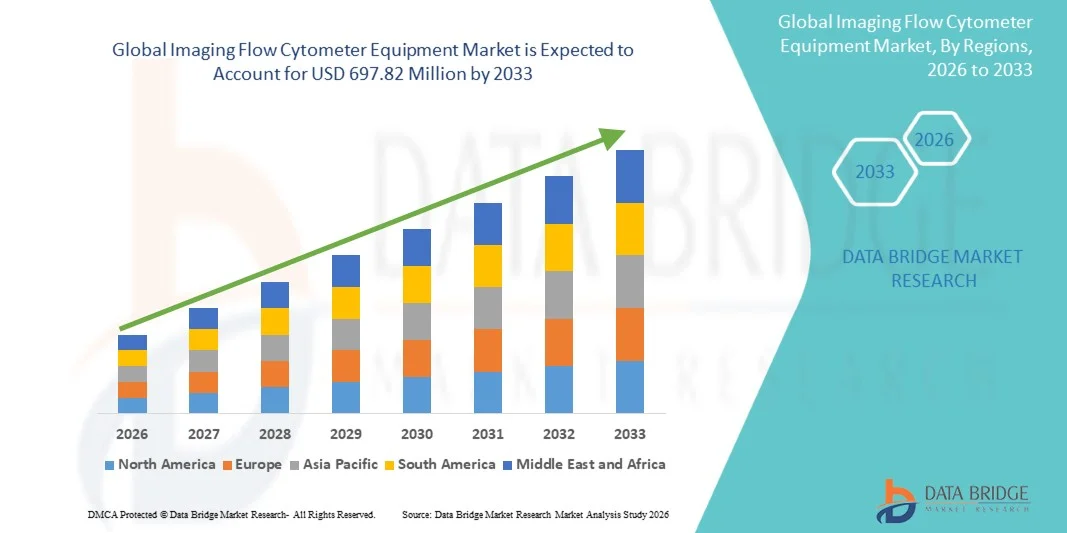
As per Data Bridge Market Research Analysis the Imaging Flow Cytometer Equipment Market was valued at USD 292.11 million in 2025 and is projected to reach USD 697.82 million by 2033, growing at a CAGR of 11.50% from 2026 to 2033. The market is witnessing steady expansion driven by increasing adoption of advanced cell analysis technologies, rising demand for high-throughput single-cell imaging, and growing applications in immunology, oncology research, and drug discovery. Integration of high-resolution imaging with flow cytometry is significantly enhancing analytical precision, enabling researchers to capture both quantitative and morphological cellular data in a single workflow.
The rising prevalence of chronic diseases such as cancer and autoimmune disorders, coupled with increasing investments in life sciences research and biotechnology, is accelerating demand for imaging flow cytometer systems. Furthermore, technological advancements such as AI-powered image analysis, multi-parameter detection, and automation are improving efficiency and reproducibility in laboratory workflows. Expanding applications in clinical diagnostics, pharmaceutical R&D, and academic research institutions are further supporting market growth, positioning imaging flow cytometry as a critical tool in next-generation cellular analysis.
Market Size & Forecast
- Global Market Value (2025): USD 292.11 Million
- Expected Market Value (2033): USD 697.82 Million
- Forecast CAGR (2026–2033): 11.50%
- Leading Region in 2025: North America
- Fastest Growing Region: Asia Pacific
What are the Major Takeaways of Imaging Flow Cytometer Equipment Market?
- North America dominated the Imaging Flow Cytometer Equipment Market with the largest revenue share of 36.2% in 2025, supported by strong presence of biotechnology companies, advanced research infrastructure, and high funding for life sciences and precision medicine.
- The 12K High Resolution segment led the market with a 58.4% share in 2025, driven by superior image clarity, higher sensitivity, and advanced capability to capture fine cellular morphology and subcellular structures.
- Asia-Pacific is expected to be the fastest-growing region at a CAGR of 7.5% from 2026 to 2033, fueled by expanding biotechnology investments, rising clinical research activities, and rapid growth of pharmaceutical industries in China, India, and Japan.
- 6K High Resolution are the fastest-growing product type, projected to register a CAGR of 7.2%, reflecting the surge in demand for rising adoption in mid-sized research institutes and clinical laboratories.
- The cell-based segment dominated the technology category with a 64.7% revenue share in 2025, led by extensive use in single-cell analysis, immunology research, and oncology studies.
- Academic and research institutes accounted for 45.3% of the market, preferred by strong funding in life sciences research and widespread use in basic and translational cell biology studies.
- The bead-based segment is the fastest-growing technology category, with a CAGR of 6.9%, driven by increasing use in standardized assay development and high-throughput screening applications.
Report Scope and Imaging Flow Cytometer Equipment Market Segmentation
|
Attributes |
Imaging Flow Cytometer Equipment Key Market Insights |
|
Segments Covered |
|
|
Countries Covered |
North America · U.S. · Canada · Mexico Europe · Germany · France · U.K. · Netherlands · Switzerland · Belgium · Russia · Italy · Spain · Turkey · Rest of Europe Asia-Pacific · China · Japan · India · South Korea · Singapore · Malaysia · Australia · Thailand · Indonesia · Philippines · Rest of Asia-Pacific Middle East and Africa · Saudi Arabia · U.A.E. · South Africa · Egypt · Israel · Rest of Middle East and Africa South America · Brazil · Argentina · Rest of South America |
|
Key Market Players |
· BD (U.S.) · Danaher (U.S.) · Beckman Coulter Life Sciences (U.S.) · Bio-Rad Laboratories, Inc. (U.S.) · Thermo Fisher Scientific Inc. (U.S.) · Agilent Technologies, Inc. (U.S.) · Cytek Biosciences, Inc. (U.S.) · Sysmex Corporation (Japan) · Miltenyi Biotec GmbH (Germany) · Merck KGaA (Germany) · Sartorius AG (Germany) · Sony Biotechnology Inc. (Japan) · Apogee Flow Systems Ltd. (Spain) · Curiox Biosystems Pte Ltd (Singapore) · Standard BioTools Inc. (U.S.) · NanoCellect Biomedical, Inc. (U.S.) · On-Chip Biotechnologies Co., Ltd. (Japan) · BioLegend, Inc. (U.S.) · Stratedigm, Inc. (U.S.) · Immudex A/S (Denmark) |
|
Market Opportunities |
· Growing adoption of imaging flow cytometry in liquid biopsy research · Expanding use in gene and cell therapy development · Increasing integration of AI-driven single-cell image analytics |
|
Value Added Data Infosets |
In addition to the insights on market scenarios such as market value, growth rate, segmentation, geographical coverage, and major players, the market reports curated by the Data Bridge Market Research also include in-depth expert analysis, patient epidemiology, pipeline analysis, pricing analysis, and regulatory framework. |
What is the Key Trend in the Imaging Flow Cytometer Equipment Market ?
Trend: Expansion of Single-Cell Multi-Omics and High-Content Analysis
Imaging flow cytometry is increasingly being integrated with single-cell multi-omics and high-content screening platforms to enable simultaneous analysis of cellular morphology, protein expression, and functional state in complex biological systems. This convergence allows researchers to obtain highly granular insights into disease mechanisms, immune responses, and cellular heterogeneity. Academic institutes and pharmaceutical companies are adopting these systems for advanced translational research, while AI-based image reconstruction and automated gating are improving data accuracy and throughput in large-scale studies. For instance, imaging flow cytometry is now widely used in tumor microenvironment profiling and immune checkpoint research for precision oncology studies.
Imaging Flow Cytometer Equipment Market Dynamics
Key Market Driver: Rising Demand for Advanced Single-Cell Analysis in Disease Research
The increasing prevalence of cancer, autoimmune disorders, and infectious diseases has significantly driven the demand for high-resolution single-cell analysis technologies such as imaging flow cytometers. These systems provide combined quantitative and visual cellular data, enabling deeper understanding of disease progression and therapeutic response at the cellular level. Pharmaceutical companies, biotechnology firms, and research institutes are increasingly relying on these platforms for biomarker discovery, drug screening, and immunophenotyping applications. For instance, imaging flow cytometry is extensively used in CAR-T cell therapy research to monitor cell activation, viability, and functional behavior during therapeutic development.
Key Restraint/Challenge: High Instrument Cost and Operational Complexity
A major restraint in the global imaging flow cytometer market is the high acquisition cost of advanced systems combined with complex operational and maintenance requirements. These instruments require skilled personnel, specialized software, and regular calibration, making them less accessible for small laboratories and academic institutions with limited funding. In addition, data processing and storage demands further increase operational burden, limiting widespread adoption in cost-sensitive regions. For instance, high-end imaging flow cytometry platforms with multi-laser configurations and AI-enabled analytics often require substantial capital investment and ongoing service contracts, restricting scalability across emerging research facilities.
Key Market Opportunity: Expansion of AI-Driven Automated Cell Analysis Platforms
The integration of artificial intelligence and machine learning into imaging flow cytometry presents a major growth opportunity by enabling automated image classification, pattern recognition, and predictive cellular modeling. AI-driven platforms significantly reduce manual intervention, improve analytical precision, and allow high-throughput processing of complex biological datasets. This is particularly valuable in drug discovery, personalized medicine, and large-scale clinical research applications. For instance, AI-enabled imaging flow cytometry systems are being developed to automatically detect rare circulating tumor cells and classify immune cell subtypes in oncology and immunology research.
How is the Imaging Flow Cytometer Equipment Market Segmented ?
The imaging flow cytometer equipment market is segmented on the basis of product type, technology, and application.
- By Product Type
On the basis of product type, the Imaging Flow Cytometer Equipment Market is segmented into 12K High Resolution and 6K High Resolution systems. The 12K High Resolution segment dominated the market with a 58.4% share in 2025, owing to superior image clarity, higher sensitivity, and advanced capability to capture fine cellular morphology and subcellular structures. These systems are widely used in oncology research, immunology studies, and drug discovery where detailed single-cell visualization is critical. They enable researchers to perform high-precision phenotypic and functional analysis of rare cell populations. Increasing adoption in pharmaceutical R&D and precision medicine studies is further strengthening demand. Continuous improvements in optics, laser technology, and image processing algorithms are enhancing performance efficiency. However, higher cost and operational complexity limit their penetration in small-scale laboratories.
The 6K High Resolution segment is projected to register the fastest growth at a CAGR of 7.2% from 2026 to 2033, driven by rising adoption in mid-sized research institutes and clinical laboratories. These systems offer a balance between performance and affordability, making them suitable for routine cell analysis applications. They are increasingly used in academic research, disease screening, and basic immunophenotyping studies. Lower operational cost and simpler system integration are accelerating adoption in emerging markets. Expanding clinical diagnostics infrastructure is further supporting demand growth. Continuous upgrades in software-based image enhancement are improving analytical output despite moderate resolution limitations.
- By Technology
On the basis of technology, the global imaging flow cytometer market is segmented into cell-based and bead-based systems. The cell-based segment dominated the market with a 64.7% share in 2025, driven by its extensive use in single-cell analysis, immunology research, and oncology studies. These systems enable direct visualization of cellular morphology along with quantitative biomarker expression, making them highly valuable in translational research. Pharmaceutical companies rely on cell-based imaging flow cytometry for drug screening, toxicity testing, and immune response profiling. High accuracy and ability to analyze heterogeneous cell populations are key advantages. Continuous integration with AI-based image analysis tools is further enhancing efficiency. Strong adoption in academic and clinical research institutions continues to reinforce its leadership position.
The bead-based segment is expected to witness the fastest growth at a CAGR of 6.9% from 2026 to 2033, driven by increasing use in standardized assay development and high-throughput screening applications. Bead-based systems offer high reproducibility and are widely used in multiplex immunoassays and biomarker quantification. They are gaining traction in clinical diagnostics due to their simplicity and faster processing time. Lower sample variability compared to cell-based systems is supporting adoption in routine testing environments. Expanding applications in infectious disease detection and cytokine profiling are further accelerating growth. Ongoing advancements in assay sensitivity and bead engineering are improving analytical performance.
- By Application
On the basis of application, the global imaging flow cytometer market is segmented into academic and research institutes, hospitals and clinical testing laboratories, and pharmaceutical and biotechnology companies. The academic and research institutes segment dominated the market with a 45.3% share in 2025, driven by strong funding in life sciences research and widespread use in basic and translational cell biology studies. These institutions extensively utilize imaging flow cytometry for studying immune responses, cellular signaling pathways, and disease mechanisms. Availability of government grants and collaborative research programs is further supporting adoption. High utilization in cancer biology and stem cell research is reinforcing segment leadership. Continuous development of advanced research infrastructure is enhancing instrument deployment. Growing focus on precision medicine research is further strengthening demand.
The pharmaceutical and biotechnology companies segment is expected to register the fastest growth at a CAGR of 7.4% from 2026 to 2033, driven by increasing demand for drug discovery, biologics development, and personalized medicine research. These companies rely on imaging flow cytometry for high-throughput screening, biomarker validation, and therapeutic efficacy testing. Rising investments in biologics and cell-based therapies are accelerating adoption. Integration with AI-powered analytics is improving drug development efficiency and reducing time-to-market. Expanding clinical pipeline complexity is further driving demand for advanced analytical tools. Increasing use in immunotherapy and gene therapy development is also supporting rapid segment growth.
Which Region Holds the Largest Share of the Imaging Flow Cytometer Equipment Market?
North America dominated the Imaging Flow Cytometer Equipment Market with the largest revenue share of 36.2% in 2025, supported by strong presence of biotechnology companies, advanced research infrastructure, and high funding for life sciences and precision medicine. The region also benefits from the presence of leading market players, advanced academic research institutes, and widespread use of imaging flow cytometry in oncology, immunology, and drug discovery applications. Increasing focus on precision medicine, single-cell analysis, and AI-integrated bioimaging platforms continues to strengthen North America’s leadership position in the global market.
U.S. Imaging Flow Cytometer Equipment Market Insight
The U.S. imaging flow cytometer equipment market is witnessing strong growth due to rising investments in advanced biomedical research, precision medicine programs, and high-throughput single-cell analysis technologies. The country’s strong pharmaceutical and biotechnology ecosystem, along with the presence of leading research universities and clinical laboratories, is driving widespread adoption. Increasing use of imaging flow cytometry in oncology, immunology, and drug discovery applications is further supporting market expansion. In addition, growing integration of AI-powered image analysis and automation in laboratory workflows is enhancing research efficiency and strengthening the U.S. position as a global innovation hub.
Europe Imaging Flow Cytometer Equipment Market Insight
The Europe imaging flow cytometer equipment market remains a major contributor to global revenue, driven by strong government funding for life sciences research, advanced academic infrastructure, and high adoption of cell-based analytical technologies. The region’s widespread use of imaging flow cytometry in cancer research, immunology studies, and translational medicine is supporting steady market expansion. Increasing investments in biomedical innovation, coupled with strong regulatory focus on clinical research quality and precision diagnostics, continue to enhance adoption across pharmaceutical and research institutions in Europe.
U.K. Imaging Flow Cytometer Equipment Market Insight
The U.K. imaging flow cytometer equipment market is experiencing steady growth, supported by rising investments in biomedical research, expanding clinical trial activity, and strong adoption of advanced imaging technologies in academic institutions. Increasing focus on immunotherapy research, cell and gene therapy development, and precision diagnostics is driving demand for high-resolution single-cell analysis systems. Furthermore, integration of AI-driven image analytics and growing collaboration between universities and biotech firms are strengthening the U.K.’s position as a key innovation hub in the imaging flow cytometry market.
Germany Imaging Flow Cytometer Equipment Market Insight
The Germany imaging flow cytometer equipment market is expanding steadily due to strong pharmaceutical manufacturing capabilities, advanced research infrastructure, and increasing adoption of high-precision analytical instruments. Research institutes, biotechnology companies, and clinical laboratories are increasingly utilizing imaging flow cytometry for drug development, immunology research, and oncology studies. Continuous technological advancements, strong government support for life sciences innovation, and growing emphasis on digital and automated laboratory systems are further driving market growth in Germany.
Asia-Pacific Imaging Flow Cytometer Equipment Market Insight
The Asia-Pacific imaging flow cytometer equipment market is expected to witness rapid growth, driven by increasing investments in biotechnology, expanding pharmaceutical industries, and rising focus on advanced medical research infrastructure across countries such as China, India, and Japan. Growing awareness of single-cell analysis technologies, rising clinical research activities, and increasing demand for cost-effective diagnostic tools are supporting regional market expansion. In addition, the growing presence of contract research organizations and academic research collaborations is accelerating adoption across the region.
Japan Imaging Flow Cytometer Equipment Market Insight
The Japan imaging flow cytometer equipment market is witnessing consistent growth due to strong investments in life sciences research, advanced healthcare infrastructure, and increasing focus on regenerative medicine and oncology research. Academic institutions, pharmaceutical companies, and research laboratories are increasingly adopting high-resolution imaging flow cytometry for precision cell analysis and biomarker discovery. Moreover, integration of AI-based image processing and Japan’s emphasis on technological innovation in biomedical instrumentation are further contributing to market growth.
China Imaging Flow Cytometer Equipment Market Insight
The China imaging flow cytometer equipment market is growing rapidly, driven by expanding biotechnology investments, rising government support for healthcare innovation, and increasing demand for advanced diagnostic and research tools. Growing adoption of single-cell analysis technologies across pharmaceutical, academic, and clinical sectors is significantly boosting market demand. In addition, increasing focus on precision medicine, rapid expansion of research infrastructure, and strong growth in domestic biotech companies are positioning China as one of the fastest-growing markets for imaging flow cytometer equipment globally.
Which are the Top Companies in Imaging Flow Cytometer Equipment Market ?
The imaging flow cytometer equipment industry is primarily led by well-established companies, including:
- BD (U.S.)
- Danaher (U.S.)
- Beckman Coulter Life Sciences (U.S.)
- Bio-Rad Laboratories, Inc. (U.S.)
- Thermo Fisher Scientific Inc. (U.S.)
- Agilent Technologies, Inc. (U.S.)
- Cytek Biosciences, Inc. (U.S.)
- Sysmex Corporation (Japan)
- Miltenyi Biotec GmbH (Germany)
- Merck KGaA (Germany)
- Sartorius AG (Germany)
- Sony Biotechnology Inc. (Japan)
- Apogee Flow Systems Ltd. (Spain)
- Curiox Biosystems Pte Ltd (Singapore)
- Standard BioTools Inc. (U.S.)
- NanoCellect Biomedical, Inc. (U.S.)
- On-Chip Biotechnologies Co., Ltd. (Japan)
- BioLegend, Inc. (U.S.)
- Stratedigm, Inc. (U.S.)
- Immudex A/S (Denmark)
What are Latest Developments in Imaging Flow Cytometer Equipment Market ?
- In February 2024, Sartorius continued strengthening its cell analysis and laboratory instrumentation portfolio through expansion of its bioanalytical solutions, supporting advanced cellular research workflows including imaging-assisted cytometry applications in pharmaceutical and biotechnology research environments. This reflects growing integration of digital and automated cell analysis tools in life sciences research
- In June 2023, Miltenyi Biotec advanced its single-cell analysis ecosystem through expanded applications of its flow cytometry and imaging-based analytical platforms, supporting research in immunotherapy, cell therapy, and translational biomedical studies. The company’s technologies are increasingly used in high-parameter cellular characterization workflows across research institutes
- In March 2022, Luminex Corporation (part of DiaSorin) continued expanding adoption and workflow integration of its ImageStreamX imaging flow cytometry platform, which combines flow cytometry with high-resolution microscopy for single-cell imaging and analysis in immunology and cancer research applications. The system remains widely used in academic and pharmaceutical laboratories globally
- In August 2021, Cytek Biosciences, a major player in advanced flow cytometry solutions, successfully completed its initial public offering (IPO) on NASDAQ under the ticker “CTKB,” raising capital to accelerate innovation in high-resolution cell analysis platforms. The funding supported expansion of spectral and imaging cytometry technologies used in immunology and oncology research
- In January 2021, DiaSorin, a global diagnostics company, completed the acquisition of Luminex Corporation, strengthening its position in multiplexing and imaging flow cytometry technologies, including the ImageStream platform widely used for advanced single-cell analysis. This acquisition expanded DiaSorin’s life sciences portfolio and reinforced its presence in high-end cellular imaging solutions used in research and clinical diagnostics

- Interactive Data Analysis Dashboard
- Company Analysis Dashboard for high growth potential opportunities
- Research Analyst Access for customization & queries
- Competitor Analysis with Interactive dashboard
- Latest News, Updates & Trend analysis
- Harness the Power of Benchmark Analysis for Comprehensive Competitor Tracking
Data collection and base year analysis are done using data collection modules with large sample sizes. The stage includes obtaining market information or related data through various sources and strategies. It includes examining and planning all the data acquired from the past in advance. It likewise envelops the examination of information inconsistencies seen across different information sources. The market data is analysed and estimated using market statistical and coherent models. Also, market share analysis and key trend analysis are the major success factors in the market report. To know more, please request an analyst call or drop down your inquiry.
The key research methodology used by DBMR research team is data triangulation which involves data mining, analysis of the impact of data variables on the market and primary (industry expert) validation. Data models include Vendor Positioning Grid, Market Time Line Analysis, Market Overview and Guide, Company Positioning Grid, Patent Analysis, Pricing Analysis, Company Market Share Analysis, Standards of Measurement, Global versus Regional and Vendor Share Analysis. To know more about the research methodology, drop in an inquiry to speak to our industry experts.
Data Bridge Market Research is a leader in advanced formative research. We take pride in servicing our existing and new customers with data and analysis that match and suits their goal. The report can be customized to include price trend analysis of target brands understanding the market for additional countries (ask for the list of countries), clinical trial results data, literature review, refurbished market and product base analysis. Market analysis of target competitors can be analyzed from technology-based analysis to market portfolio strategies. We can add as many competitors that you require data about in the format and data style you are looking for. Our team of analysts can also provide you data in crude raw excel files pivot tables (Fact book) or can assist you in creating presentations from the data sets available in the report.













