


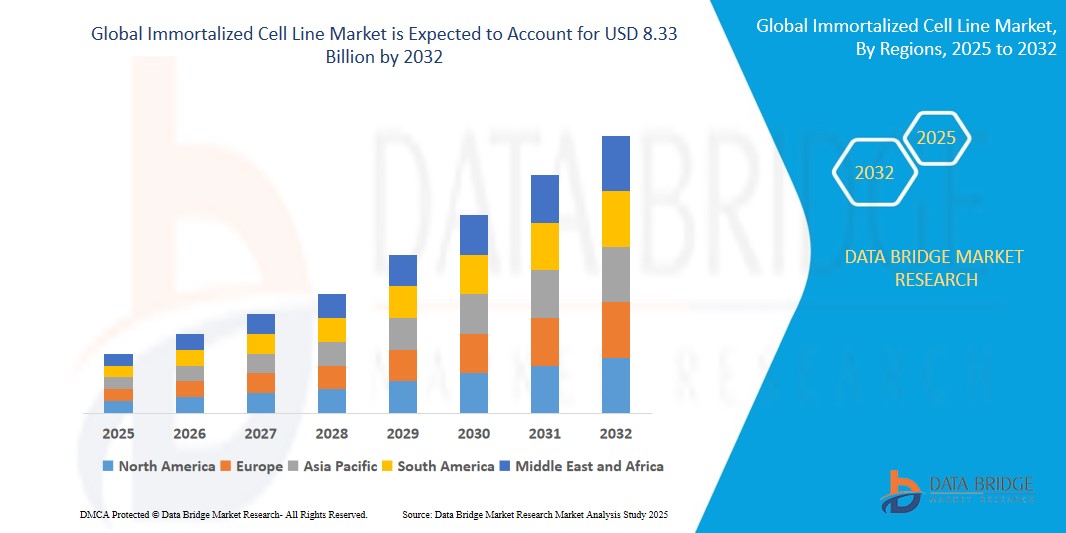
Immortalized Cell Line Market Size
- The global Immortalized Cell Line market size was valued at USD 4.87 billion in 2024 and is expected to reach USD 8.33 billion by 2032, at a CAGR of 6.94% during the forecast period
- The market’s significant expansion is primarily driven by the increasing adoption of immortalized cell lines in biomedical research, coupled with advancements in cell culture technologies, gene editing, and bioprocessing techniques that enhance the efficiency and applicability of these cell lines.
- Furthermore, the rising demand for advanced therapeutic solutions, including precision medicine, vaccine development, and drug discovery, is positioning immortalized cell lines as indispensable tools in biotechnology and pharmaceutical industries. These converging factors, including technological innovation and growing investments in research and development, are significantly accelerating the adoption of immortalized cell lines, thereby propelling the industry’s growth trajectory.
Immortalized Cell Line Market Analysis
- Immortalized cell lines are specialized cells that have been genetically modified or naturally adapted to proliferate indefinitely in vitro, making them critical tools for research in drug discovery, cancer studies, regenerative medicine, and vaccine production. These cell lines are equipped with advanced properties, such as consistent reproducibility and scalability, enabling their use in a wide range of biomedical applications.
- The escalating demand for immortalized cell lines is primarily driven by their ability to support high-throughput screening, disease modeling, and therapeutic development, coupled with increasing investments in biotechnology research and the growing prevalence of chronic diseases like cancer.
- North America held the largest revenue share of 38.45% in the global immortalized cell line market in 2024, driven by a robust biotechnology infrastructure, significant research funding, and high adoption rates in pharmaceutical and academic research. The United States, in particular, has emerged as a leader due to the presence of major biotechnology companies and supportive regulatory frameworks.
- The Asia-Pacific region is anticipated to experience the fastest growth rate during the forecast period, propelled by rapid advancements in healthcare infrastructure, increasing government investments in biotechnology, and rising research activities in countries such as China, India, and Japan.
- Among product types, the human cell line segment dominated the market with a commanding share of over 55.91% in 2024, attributed to its widespread use in drug discovery, cancer research, and regenerative medicine due to its relevance to human physiology.
Report Scope and Immortalized Cell Line Market Segmentation
|
Attributes |
Immortalized Cell Line Key Market Insights |
|
Segments Covered |
|
|
Countries Covered |
North America
Europe
Asia-Pacific
Middle East and Africa
South America
|
|
Key Market Players |
|
|
Market Opportunities |
|
|
Value Added Data Infosets |
In addition to the insights on market scenarios such as market value, growth rate, segmentation, geographical coverage, and major players, the market reports curated by the Data Bridge Market Research also include in-depth expert analysis, pricing analysis, brand share analysis, consumer survey, demography analysis, supply chain analysis, value chain analysis, raw material/consumables overview, vendor selection criteria, PESTLE Analysis, Porter Analysis, and regulatory framework. |
Immortalized Cell Line Market Trends
“Advancements in Gene Editing and Bioprocessing Technologies”
- A prominent and transformative trend in the global immortalized cell line market is the integration of advanced gene editing technologies, such as CRISPR/Cas9, and bioprocessing innovations, which enhance the precision, scalability, and applicability of immortalized cell lines in biomedical research.
- For instance, Thermo Fisher Scientific’s Gibco™ CTS™ Cell Lines, launched in 2023, incorporate advanced gene editing capabilities to support scalable cell-based therapies, significantly improving outcomes in regenerative medicine and vaccine production.
- Gene-edited immortalized cell lines enable researchers to model diseases with high accuracy, optimize drug screening processes, and develop targeted therapies, making them ideal for applications in cancer research and personalized medicine.
- Bioprocessing advancements, such as automated cell culture systems and serum-free media, allow for consistent and high-yield production of cell lines, improving reproducibility and reducing costs for large-scale research and production.
- This trend towards more precise, scalable, and technology-driven cell line solutions is fundamentally reshaping the biotechnology landscape, with companies like Lonza Group developing customized cell lines for biopharmaceutical applications.
Immortalized Cell Line Market Dynamics
Driver
“Growing Demand for Precision Medicine and Drug Discovery”
- The increasing need for precision medicine, coupled with the rising prevalence of chronic diseases such as cancer and neurodegenerative disorders, is a significant driver propelling the growth of the immortalized cell line market. Additionally, the demand for high-throughput drug screening and vaccine development is further fueling market expansion.
- For example, in June 2023, Merck KGaA introduced a new line of CRISPR-edited human cell lines for accelerated drug discovery, enabling researchers to identify novel therapeutic targets with greater efficiency.
- Immortalized cell lines provide cost-effective and reproducible platforms for studying disease mechanisms, testing drug efficacy, and developing vaccines, significantly reducing the time and cost of research compared to primary cell cultures.
- Supportive government initiatives, such as increased funding for biomedical research in the United States and Europe, are facilitating broader adoption of immortalized cell lines in academic and industrial settings.
Restraint/Challenge
“Ethical Concerns and High Development Costs”
- Ethical concerns surrounding the use of human and animal-derived cell lines, particularly in terms of sourcing and genetic manipulation, pose significant challenges to the widespread adoption of immortalized cell lines, especially in regions with strict bioethical regulations.
- High development costs for advanced immortalized cell lines, particularly those involving gene editing or specialized bioprocessing, can act as a barrier to adoption, especially for small research institutions or startups in cost-sensitive markets. While basic cell lines are relatively affordable, premium lines with customized features often come with a higher price tag.
- Regulatory complexities, such as stringent guidelines for cell-based therapies and biologics, can hinder market growth by increasing the time and cost of product development and commercialization.
- Addressing these challenges through ethical sourcing practices, cost-effective bioprocessing solutions, and harmonized global regulatory frameworks is critical to building consumer trust and ensuring sustained market growth.
Immortalized Cell Line Market Scope
The global Immortalized Cell Line market is segmented on the basis of product type, component, and application.
- By Product Type
On the basis of product type, the immortalized cell line market is segmented into human cell lines, animal cell lines, plant cell lines, and others. The human cell line segment dominated the market with a commanding revenue share of over 55.91% in 2024, driven by its critical role in drug discovery, cancer research, and regenerative medicine due to its direct relevance to human physiology. Human cell lines, such as HeLa and HEK293, are widely used for their reproducibility and versatility.
The animal cell line segment is anticipated to witness the fastest CAGR of 14.5% from 2025 to 2032, fueled by increasing use in vaccine production and toxicity testing, where animal-derived lines like CHO (Chinese Hamster Ovary) cells are preferred for their scalability and compatibility with bioprocessing.
- By Component
On the basis of component, the immortalized cell line market is segmented into cell culture media, reagents, and cell line products. The cell culture media segment held the largest market revenue share in 2024, driven by the critical need for optimized media formulations to support cell growth and viability in research and production.
The reagents segment is expected to witness the fastest CAGR from 2025 to 2032, propelled by advancements in gene editing reagents, such as CRISPR kits, and the increasing demand for high-quality reagents to ensure consistent experimental outcomes.
- By Application
On the basis of application, the immortalized cell line market is segmented into drug discovery and development, regenerative medicine, vaccine production, cancer research, toxicity testing, and others. The drug discovery and development segment accounted for the largest market revenue share of over 32.11% in 2024, driven by the widespread use of immortalized cell lines in high-throughput screening and preclinical studies.
The regenerative medicine segment is expected to witness the fastest CAGR from 2025 to 2032, fueled by growing investments in stem cell therapies and tissue engineering, where immortalized cell lines serve as critical tools for developing scalable therapeutic solutions.
Immortalized Cell Line Market Regional Analysis
North America
North America dominated the global immortalized cell line market with a revenue share of 38.45% in 2024, driven by the region’s advanced biotechnology infrastructure, significant research funding, and high adoption rates in pharmaceutical and academic research. Researchers and companies in North America highly value the reproducibility, scalability, and versatility offered by immortalized cell lines, which integrate seamlessly with advanced technologies like CRISPR and automated bioprocessing systems. The widespread adoption is further supported by substantial government and private investments in biomedical research, a highly skilled research community, and a favorable regulatory environment.
U.S. Immortalized Cell Line Market Insight
The U.S. immortalized cell line market captured the largest revenue share of 77.42% within North America in 2024, fueled by the rapid adoption of advanced biotechnologies and the expanding trend of precision medicine. Researchers and biopharmaceutical companies are increasingly prioritizing cell-based platforms for drug discovery, vaccine development, and regenerative medicine. The growing preference for scalable and reproducible cell lines, combined with robust demand for gene-edited cell lines and integration with high-throughput screening platforms, further propels the market. Supportive funding from the National Institutes of Health (NIH) and the presence of leading companies like Thermo Fisher Scientific and ATCC are significantly contributing to the market’s expansion.
Europe Immortalized Cell Line Market Insight
The Europe immortalized cell line market is projected to expand at a substantial CAGR throughout the forecast period, primarily driven by stringent regulatory standards for biopharmaceuticals and the escalating need for advanced research tools in drug discovery and cancer research. The increase in research funding, coupled with the demand for innovative biotechnologies, is fostering the adoption of immortalized cell lines across academic, pharmaceutical, and clinical applications. European researchers are also drawn to the efficiency and scalability benefits offered by these cell lines, with significant growth observed in regenerative medicine and vaccine production initiatives.
U.K. Immortalized Cell Line Market Insight
The U.K. immortalized cell line market is anticipated to grow at a noteworthy CAGR during the forecast period, driven by the escalating trend of precision medicine and the desire for advanced research tools to address complex diseases. Increasing investments in biotechnology research and the growing prevalence of chronic diseases are encouraging academic institutions and biopharmaceutical companies to adopt immortalized cell lines. The U.K.’s robust research infrastructure, alongside its strong academic-industry collaborations, is expected to continue stimulating market growth.
Germany Immortalized Cell Line Market Insight
The Germany immortalized cell line market is expected to expand at a considerable CAGR during the forecast period, fueled by increasing awareness of advanced biotechnologies and the demand for innovative, scalable research solutions. Germany’s well-developed biotechnology sector, combined with its emphasis on precision medicine and sustainable bioprocessing, promotes the adoption of immortalized cell lines, particularly in drug discovery and regenerative medicine. The integration of cell lines with gene editing technologies is becoming increasingly prevalent, aligning with local research priorities for high-quality, reproducible outcomes.
Asia-Pacific Immortalized Cell Line Market Insight
The Asia-Pacific immortalized cell line market is poised to grow at the fastest CAGR of 15.8% during the forecast period of 2025 to 2032, driven by rapid advancements in healthcare infrastructure, rising government investments in biotechnology, and increasing research activities in countries such as China, India, and Japan. The region’s growing focus on precision medicine, supported by government initiatives promoting biopharmaceutical innovation, is driving the adoption of immortalized cell lines. Furthermore, as Asia-Pacific emerges as a hub for bioprocessing and contract research, the affordability and accessibility of cell lines are expanding to a wider research community.
Japan Immortalized Cell Line Market Insight
The Japan immortalized cell line market is gaining momentum due to the country’s advanced biotechnology sector, rapid growth in regenerative medicine, and demand for high-quality research tools. The Japanese market places a significant emphasis on precision and reliability, and the adoption of immortalized cell lines is driven by the increasing number of biopharmaceutical projects and clinical research initiatives. The integration of cell lines with advanced technologies, such as CRISPR and automated bioprocessing, is fueling growth. Moreover, Japan’s aging population is likely to spur demand for regenerative medicine solutions, further driving market expansion.
China Immortalized Cell Line Market Insight
The China immortalized cell line market accounted for the largest market revenue share in Asia-Pacific in 2024, attributed to the country’s expanding biotechnology sector, rapid growth in research funding, and high rates of technological adoption. China stands as one of the largest markets for biopharmaceutical research, with widespread use of immortalized cell lines in drug discovery, vaccine production, and cancer research. The push towards precision medicine and the availability of cost-effective cell line solutions, alongside strong domestic manufacturers like FUJIFILM Irvine Scientific, are key factors propelling the market in China.
Immortalized Cell Line Market Share
The Immortalized Cell Line industry is primarily led by well-established companies, including:
- Thermo Fisher Scientific Inc. (United States)
- Merck KGaA (Germany)
- Lonza Group AG (Switzerland)
- Corning Incorporated (United States)
- ATCC (American Type Culture Collection) (United States)
- Sigma-Aldrich (United States)
- Promega Corporation (United States)
- Sartorius AG (Germany)
- FUJIFILM Irvine Scientific (United States)
- Bio-Techne Corporation (United States)
Latest Developments in Global Immortalized Cell Line Market
- In June 2023, Merck KGaA launched a new line of CRISPR-edited human cell lines designed for accelerated drug discovery, enabling researchers to identify novel therapeutic targets with greater efficiency and precision.
- In March 2024, Thermo Fisher Scientific introduced the Gibco™ CTS™ Cell Lines, incorporating advanced gene editing capabilities to support scalable cell-based therapies for regenerative medicine and vaccine production.
- In January 2024, Lonza Group AG announced a strategic partnership with a leading biopharmaceutical company to develop customized immortalized cell lines for monoclonal antibody production, enhancing scalability and efficiency in bioprocessing.
- In September 2023, ATCC expanded its portfolio of human cell lines with new cancer-specific lines, designed to support high-throughput screening and precision oncology research.
- In April 2023, FUJIFILM Irvine Scientific launched a new serum-free cell culture media optimized for immortalized cell lines, improving cell growth and reproducibility in large-scale bioprocessing applications.

- Interactive Data Analysis Dashboard
- Company Analysis Dashboard for high growth potential opportunities
- Research Analyst Access for customization & queries
- Competitor Analysis with Interactive dashboard
- Latest News, Updates & Trend analysis
- Harness the Power of Benchmark Analysis for Comprehensive Competitor Tracking
Data collection and base year analysis are done using data collection modules with large sample sizes. The stage includes obtaining market information or related data through various sources and strategies. It includes examining and planning all the data acquired from the past in advance. It likewise envelops the examination of information inconsistencies seen across different information sources. The market data is analysed and estimated using market statistical and coherent models. Also, market share analysis and key trend analysis are the major success factors in the market report. To know more, please request an analyst call or drop down your inquiry.
The key research methodology used by DBMR research team is data triangulation which involves data mining, analysis of the impact of data variables on the market and primary (industry expert) validation. Data models include Vendor Positioning Grid, Market Time Line Analysis, Market Overview and Guide, Company Positioning Grid, Patent Analysis, Pricing Analysis, Company Market Share Analysis, Standards of Measurement, Global versus Regional and Vendor Share Analysis. To know more about the research methodology, drop in an inquiry to speak to our industry experts.
Data Bridge Market Research is a leader in advanced formative research. We take pride in servicing our existing and new customers with data and analysis that match and suits their goal. The report can be customized to include price trend analysis of target brands understanding the market for additional countries (ask for the list of countries), clinical trial results data, literature review, refurbished market and product base analysis. Market analysis of target competitors can be analyzed from technology-based analysis to market portfolio strategies. We can add as many competitors that you require data about in the format and data style you are looking for. Our team of analysts can also provide you data in crude raw excel files pivot tables (Fact book) or can assist you in creating presentations from the data sets available in the report.













