What is the Global Indoor Air Quality Meters Market Size and Growth Rate?
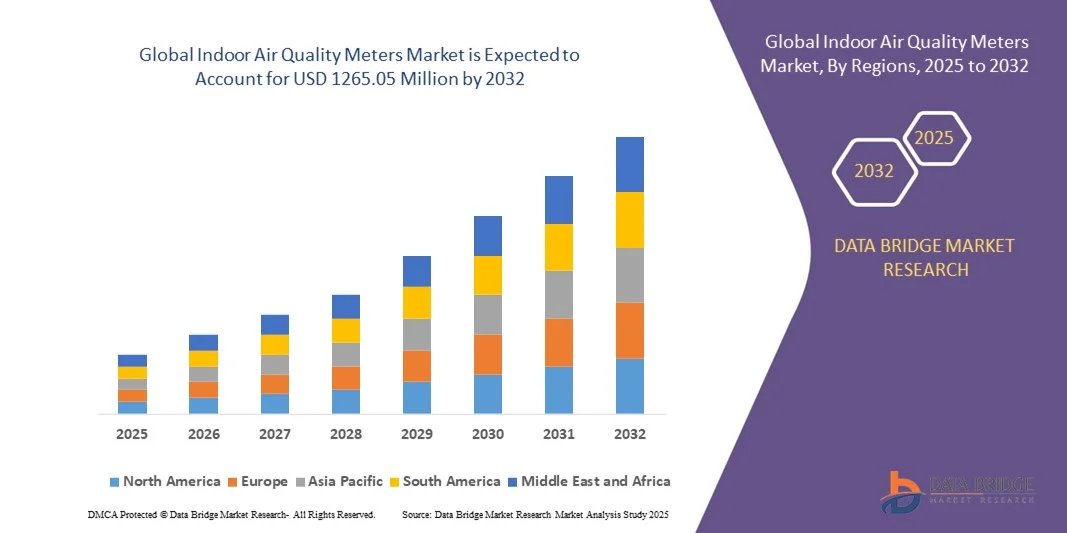
- The global indoor air quality meters market size was valued at USD 625.18 million in 2024 and is expected to reach USD 1265.05 million by 2032, at a CAGR of 9.21% during the forecast period
- Increasing public-private funding for effective air pollution monitoring, supportive government regulations for effective air pollution monitoring and control, increasing public awareness pertaining to healthcare and environmental implications of air pollution, rising growth of the environment friendly industries are some of the major as well as important factors which will such asly to augment the growth of the indoor air quality meters market
What are the Major Takeaways of Indoor Air Quality Meters Market?
- Increasing growth of the industrial sector, rising number of applications from emerging economies along with technological advancement in the field of air pollution monitoring which will further contribute by generating immense opportunities that will led to the growth of the indoor air quality meters market in the above mentioned projected timeframe
- Growing number of technical limitations regarding air quality monitoring products along with high cost of the product which will such asly to act as market restraints factor for the growth of the indoor air quality meters
- North America dominated the indoor air quality (IAQ) meters market with the largest revenue share of 40.12% in 2024, driven by heightened awareness of indoor air pollution, increasing implementation of air quality regulations, and widespread adoption of smart building technologies
- The Asia-Pacific indoor air quality meters market is poised to grow at the fastest CAGR of 9.8% from 2025 to 2032, driven by escalating urbanization, rising pollution levels, and increasing consumer awareness about indoor air health
- The portable meters segment dominated the market with the largest revenue share of 58.4% in 2024, driven by its flexibility, ease of use, and growing preference for on-site air quality testing in residential, educational, and small-scale industrial applications
Report Scope and Indoor Air Quality Meters Market Segmentation
|
Attributes |
Indoor Air Quality Meters Key Market Insights |
|
Segments Covered |
|
|
Countries Covered |
North America
Europe
Asia-Pacific
Middle East and Africa
South America
|
|
Key Market Players |
|
|
Market Opportunities |
|
|
Value Added Data Infosets |
In addition to the insights on market scenarios such as market value, growth rate, segmentation, geographical coverage, and major players, the market reports curated by the Data Bridge Market Research also include in-depth expert analysis, pricing analysis, brand share analysis, consumer survey, demography analysis, supply chain analysis, value chain analysis, raw material/consumables overview, vendor selection criteria, PESTLE Analysis, Porter Analysis, and regulatory framework. |
What is the Key Trend in the Indoor Air Quality Meters Market?
Enhanced Accuracy Through AI and IoT Integration
- A major emerging trend in the global Indoor Air Quality (IAQ) Meters market is the deep integration of artificial intelligence (AI) and Internet of Things (IoT) technologies to enhance real-time data accuracy, predictive analytics, and automated air quality management. This convergence is enabling more proactive and efficient monitoring solutions across residential, commercial, and industrial environments
- For instance, Aeroqual has launched smart air monitoring systems equipped with AI-driven calibration algorithms that automatically adjust sensor sensitivity to ensure accurate readings under changing environmental conditions. Similarly, TSI Incorporated integrates IoT connectivity in its IAQ meters, enabling remote monitoring through cloud-based dashboards and mobile apps
- AI integration allows IAQ meters to identify air quality patterns, forecast pollution spikes, and send intelligent alerts to users. Devices can now analyze variables such as CO₂, PM2.5, VOCs, and humidity to optimize indoor ventilation and energy consumption. For instance, Honeywell International Inc. offers smart IAQ meters capable of autonomously adjusting HVAC systems to maintain ideal indoor conditions
- The seamless integration of AI and IoT technologies also facilitates centralized control across multiple devices through a single platform. Building managers can monitor air quality across multiple floors or locations, integrating data with other smart systems such as lighting and temperature control for a holistic facility management solution
- This evolution towards intelligent, connected, and adaptive IAQ meters is reshaping how users perceive air monitoring—from being purely reactive to becoming predictive and preventive. Leading manufacturers such as Siemens and Thermo Fisher Scientific, Inc. are investing in AI-based air monitoring systems that can learn environmental patterns and offer automated responses to ensure optimal indoor health
- The increasing consumer and corporate demand for smart, self-learning IAQ systems that offer precision, real-time reporting, and remote control capabilities is driving rapid adoption globally across healthcare, education, manufacturing, and smart building sectors
What are the Key Drivers of Indoor Air Quality Meters Market?
- The rising awareness of health impacts caused by poor indoor air quality, coupled with stringent environmental and occupational safety regulations, is a key factor driving the demand for IAQ meters. Increasing pollution levels, urbanization, and time spent indoors have further accelerated market growth
- For instance, in June 2024, Siemens AG launched a new generation of IoT-enabled room air quality sensors under its Desigo portfolio, designed to improve indoor environments by integrating real-time data with building management systems. Such advancements by leading companies are expected to fuel the IAQ meters industry growth during the forecast period
- Furthermore, the rising adoption of smart building technologies and the shift toward energy-efficient infrastructure are major growth enablers. IAQ meters play a crucial role in maintaining ventilation efficiency while meeting energy-saving goals. Building automation systems increasingly incorporate air quality monitoring to balance occupant comfort with sustainability targets
- In addition, post-pandemic health awareness has led to heightened concern about airborne contaminants, including viruses and allergens, prompting institutions such as schools, hospitals, and offices to deploy IAQ meters for continuous monitoring and compliance with air quality standards
- Technological innovations—such as wireless connectivity, portable sensors, and mobile integration—are making IAQ meters more accessible and user-friendly, encouraging adoption across both residential and commercial applications
Which Factor is Challenging the Growth of the Indoor Air Quality Meters Market?
- One of the major challenges facing the market is the high initial cost and maintenance requirements of advanced IAQ monitoring systems. Professional-grade meters equipped with multi-gas sensors, data loggers, and IoT connectivity can be expensive, which limits adoption in cost-sensitive regions
- For instance, while industrial facilities and large commercial buildings invest heavily in precision monitoring tools from brands such as TSI Incorporated and Thermo Fisher Scientific, small businesses and residential users often opt for low-cost alternatives that may compromise measurement accuracy
- Another critical challenge is the calibration and accuracy limitations of low-cost IAQ sensors. Variability in environmental conditions can lead to inconsistent readings, undermining user confidence. Continuous maintenance and periodic recalibration add to the overall ownership cost
- Data privacy and network security concerns also present barriers, as IoT-connected IAQ meters transmit sensitive environmental data over cloud platforms. Inadequate encryption and weak cybersecurity frameworks can expose systems to data breaches or unauthorized access
- Overcoming these obstacles will require manufacturers to focus on cost optimization, standardization, and cybersecurity enhancements. Companies such as Honeywell International Inc. and Emerson Electric Co. are increasingly emphasizing secure, scalable, and affordable IAQ monitoring systems that meet both regulatory and consumer expectations
- By addressing these challenges through affordable innovations, reliable calibration systems, and secure connectivity, the IAQ meters market is expected to achieve sustainable growth, enabling healthier and more efficient indoor environments globally
How is the Indoor Air Quality Meters Market Segmented?
The market is segmented on the basis of type, pollutant type, and end use application.
- By Type
On the basis of type, the indoor air quality (IAQ) meters market is segmented into portable meters and fixed meters. The portable meters segment dominated the market with the largest revenue share of 58.4% in 2024, driven by its flexibility, ease of use, and growing preference for on-site air quality testing in residential, educational, and small-scale industrial applications. Portable IAQ meters are widely used for spot-checking multiple locations, providing real-time readings for pollutants such as CO₂, PM2.5, and VOCs. Their compact size, battery operation, and lower cost make them ideal for personal and professional use.
The fixed meters segment is expected to witness the fastest growth rate of 20.3% from 2025 to 2032, supported by the rising adoption of continuous monitoring systems in smart buildings, healthcare facilities, and manufacturing plants. Fixed IAQ meters provide long-term monitoring and data logging capabilities, offering integrated connectivity with HVAC systems for automated air management.
- By Pollutant Type
Based on pollutant type, the market is segmented into chemical pollutants, physical pollutants, and biological pollutants. The chemical pollutants segment dominated the market with the largest revenue share of 46.9% in 2024, attributed to increasing concerns regarding volatile organic compounds (VOCs), carbon monoxide (CO), and nitrogen dioxide (NO₂) emissions from household and industrial sources. The demand for IAQ meters capable of detecting chemical gases has surged due to their critical role in maintaining safe indoor environments.
The biological pollutants segment is anticipated to record the fastest CAGR of 22.1% from 2025 to 2032, fueled by the growing awareness of airborne pathogens, mold spores, and allergens impacting indoor health. Post-pandemic, healthcare institutions and public buildings have intensified the deployment of biological monitoring systems to ensure air hygiene. The rising integration of biosensors and AI-enabled pathogen detection technologies further supports segmental growth.
- By End Use Application
On the basis of end use application, the indoor air quality meters market is segmented into government buildings, industrial, private establishments, commercial, residential, and others. The industrial segment held the largest market revenue share of 38.7% in 2024, driven by strict occupational health regulations and the necessity for monitoring emissions and particulate levels in production facilities. Industries such as manufacturing, energy, and chemicals heavily rely on IAQ meters for compliance and worker safety.
The residential segment is projected to witness the fastest growth rate of 21.6% from 2025 to 2032, propelled by the rising awareness of indoor pollution and health-conscious consumer behavior. The proliferation of smart homes, coupled with affordable, app-connected IAQ devices, is enhancing adoption among homeowners. In addition, government initiatives promoting clean indoor environments and energy-efficient ventilation systems further contribute to market expansion in the residential domain.
Which Region Holds the Largest Share of the Indoor Air Quality Meters Market?
- North America dominated the indoor air quality (IAQ) meters market with the largest revenue share of 40.12% in 2024, driven by heightened awareness of indoor air pollution, increasing implementation of air quality regulations, and widespread adoption of smart building technologies. The region’s strong focus on health, safety, and environmental sustainability has made IAQ meters essential across residential, commercial, and industrial facilities
- Consumers and businesses are increasingly investing in IAQ meters to monitor pollutants such as CO₂, VOCs, and particulate matter, ensuring compliance with indoor air quality standards established by agencies such as the U.S. Environmental Protection Agency (EPA) and ASHRAE
- The market’s growth is further supported by rising demand for energy-efficient ventilation systems and a growing preference for real-time air monitoring solutions integrated with HVAC and building management systems
U.S. Indoor Air Quality Meters Market Insight
The U.S. indoor air quality meters market captured the largest revenue share of 82% in 2024 within North America, fueled by strict regulatory frameworks such as the Clean Air Act and the increasing prevalence of respiratory disorders linked to poor indoor environments. The surge in green building certifications, including LEED and WELL, has accelerated IAQ meter adoption across commercial and institutional buildings. In addition, the expansion of smart home ecosystems and the availability of connected IAQ solutions from key players such as Thermo Fisher Scientific, Inc., TSI Incorporated, and Honeywell International Inc. are further propelling market growth. The rising awareness among consumers regarding air pollutants and the integration of IoT-enabled monitoring devices are solidifying the U.S. as a dominant market for advanced IAQ technologies.
Europe Indoor Air Quality Meters Market Insight
The Europe indoor air quality meters market is projected to expand at a significant CAGR throughout the forecast period, driven by stringent environmental regulations, increasing public health awareness, and the region’s focus on sustainable building practices. European countries are actively implementing policies to reduce indoor air pollutants in schools, workplaces, and healthcare facilities. In addition, initiatives such as the European Green Deal and Healthy Buildings Directive are promoting IAQ monitoring as a key element of smart infrastructure development. Demand is rising across both new construction and retrofit projects as IAQ monitoring becomes a standard component of energy-efficient and occupant-friendly building designs.
U.K. Indoor Air Quality Meters Market Insight
The U.K. indoor air quality meters market is expected to grow at a robust CAGR during the forecast period, supported by the government’s emphasis on improving indoor environmental quality and health outcomes. Growing public concern over airborne allergens, urban pollution, and volatile chemical exposure has led to greater adoption of IAQ meters across residential and commercial sectors. The Building Regulations Part F and Public Health England initiatives have encouraged real-time IAQ monitoring in offices, schools, and public facilities. Moreover, the integration of smart sensors into building automation systems is enhancing the precision and functionality of IAQ monitoring solutions across the U.K. market.
Germany Indoor Air Quality Meters Market Insight
The Germany indoor air quality meters market is anticipated to expand at a notable CAGR, driven by the country’s strong commitment to environmental health, energy efficiency, and digital transformation. The increasing adoption of smart HVAC systems and IoT-based monitoring solutions across commercial and industrial sectors is fueling market growth. German consumers and enterprises prioritize sustainability and air quality optimization, encouraging the use of advanced meters for continuous pollutant detection. Furthermore, government-backed programs supporting energy-efficient buildings and strict indoor air standards are fostering demand for precision air monitoring solutions in offices, schools, and hospitals across the country.
Which Region is the Fastest Growing Region in the Indoor Air Quality Meters Market?
The Asia-Pacific indoor air quality meters market is poised to grow at the fastest CAGR of 9.8% from 2025 to 2032, driven by escalating urbanization, rising pollution levels, and increasing consumer awareness about indoor air health. Rapid industrialization and government-led initiatives promoting clean indoor environments are propelling the adoption of IAQ meters across residential, commercial, and industrial spaces in major economies such as China, Japan, and India. The region’s expansion of smart city projects and growing middle-class population with higher health consciousness are also key growth catalysts.
Japan Indoor Air Quality Meters Market Insight
The Japan indoor air quality meters market is witnessing rapid growth, supported by the nation’s strong focus on technological innovation, urban sustainability, and health-oriented building design. Japanese consumers are increasingly adopting smart IAQ monitoring devices integrated with IoT platforms for real-time environmental tracking. The country’s aging population and focus on healthcare safety standards are further driving demand for accurate and user-friendly air quality monitoring systems across residential complexes, hospitals, and office spaces.
China Indoor Air Quality Meters Market Insight
The China indoor air quality meters market accounted for the largest revenue share in Asia-Pacific in 2024, driven by worsening air pollution, rapid urbanization, and growing consumer demand for clean indoor environments. The expansion of smart city projects and stricter government air quality regulations—such as the Healthy China 2030 Plan—are fueling adoption across homes, offices, and public buildings. China’s robust manufacturing ecosystem and the availability of affordable, IoT-enabled IAQ devices from domestic brands are further strengthening its market position. As consumer health awareness continues to rise, China remains a central hub for both IAQ meter production and consumption in the region.
Which are the Top Companies in Indoor Air Quality Meters Market?
The indoor air quality meters industry is primarily led by well-established companies, including:
- Thermo Fisher Scientific, Inc. (U.S.)
- Siemens (Germany)
- Emerson Electric Co. (U.S.)
- 3M (U.S.)
- Honeywell International Inc. (U.S.)
- TSI (U.S.)
- HORIBA, Ltd. (Japan)
- Testo SE & Co. KGaA (Germany)
- Aeroqual (New Zealand)
- Agilent Technologies, Inc. (U.S.)
- Dwyer Instruments, Inc. (U.S.)
- Camfil (Sweden)
- BACHARACH, INC. (U.S.)
- Critical Environment Technologies Canada Inc. (Canada)
- Daikin North America LLC. (U.S.)
- Ecotech (Australia)
- Fluke Corporation (U.S.)
- KANOMAX USA, INC. (U.S.)
- PARKER HANNIFIN CORP. (U.S.)
- Lennox International, Inc. (U.S.)
What are the Recent Developments in Global Indoor Air Quality Meters Market?
- In May 2025, 3M, a global company known for applying science to life, announced a joint venture with Savante, a rapidly growing manufacturer of solid sorbent-based filters, to develop Direct Air Capture (DAC) products for the carbon dioxide removal (CDR) industry. This initiative aims to capture and permanently eliminate atmospheric carbon dioxide. The collaboration is expected to accelerate advancements in carbon capture technologies and strengthen both companies’ positions in the global sustainability market
- In April 2025, Delta Electronics (Thailand) PCL inaugurated the Delta Thailand Net Zero Container Showroom at Amata City Chonburi, supporting Thailand’s transition toward a low-carbon society. The initiative focuses on renewable energy and energy storage solutions to reduce carbon emissions and promote smarter grids. This step reinforces Delta’s mission to deliver innovative, clean, and energy-efficient solutions while driving the development of greener factories, smarter buildings, and sustainable businesses across Thailand and Southeast Asia
- In April 2025, ActiveBuildings, a start-up, announced the signing of an MoU with Balvi Fund to deploy 5,000 indoor air quality monitors and 10,000 air cleaners across Karnataka and Maharashtra. With growing concerns about air pollution in these regions, the company secured USD 1 million in funding to enhance air monitoring and filtration efforts. This partnership will enable ActiveBuildings to strengthen its foothold in the Indian air quality management market and expand its influence in the public-private sustainability sector
- In February 2025, TSI Incorporated, a global leader in filter testing equipment, launched the Production Line Stimulator (PLS) 8150-PLS, enhancing the performance of its Automated Filter Tester 8150. The PLS offers key upgrades that enable efficient operations outside traditional production line environments. This innovation demonstrates TSI’s ongoing commitment to advancing testing solutions and improving efficiency in air filtration and quality control systems
- In July 2024, BreezoMeter announced a collaboration with Siemens Smart Infrastructure to develop a solution that determines the optimal time to refresh indoor air quality using external air quality data. The partnership offers a cost-effective alternative to in-house system development, making advanced air monitoring more accessible. This joint effort is expected to increase the availability of smart air quality solutions and improve overall building efficiency in the global market
- In October 2020, Emerson, a leader in the heating, ventilation, and air conditioning (HVAC) industry, introduced its ENERGY STAR-certified Sensi Smart Thermostats, which are now compatible with Awair’s indoor air quality monitoring platform. This certification strengthens Emerson’s product line by integrating smart monitoring and energy-saving capabilities. The development is anticipated to enhance customer adoption and boost Emerson’s market presence in the smart HVAC segment

- Interactive Data Analysis Dashboard
- Company Analysis Dashboard for high growth potential opportunities
- Research Analyst Access for customization & queries
- Competitor Analysis with Interactive dashboard
- Latest News, Updates & Trend analysis
- Harness the Power of Benchmark Analysis for Comprehensive Competitor Tracking
Data collection and base year analysis are done using data collection modules with large sample sizes. The stage includes obtaining market information or related data through various sources and strategies. It includes examining and planning all the data acquired from the past in advance. It likewise envelops the examination of information inconsistencies seen across different information sources. The market data is analysed and estimated using market statistical and coherent models. Also, market share analysis and key trend analysis are the major success factors in the market report. To know more, please request an analyst call or drop down your inquiry.
The key research methodology used by DBMR research team is data triangulation which involves data mining, analysis of the impact of data variables on the market and primary (industry expert) validation. Data models include Vendor Positioning Grid, Market Time Line Analysis, Market Overview and Guide, Company Positioning Grid, Patent Analysis, Pricing Analysis, Company Market Share Analysis, Standards of Measurement, Global versus Regional and Vendor Share Analysis. To know more about the research methodology, drop in an inquiry to speak to our industry experts.
Data Bridge Market Research is a leader in advanced formative research. We take pride in servicing our existing and new customers with data and analysis that match and suits their goal. The report can be customized to include price trend analysis of target brands understanding the market for additional countries (ask for the list of countries), clinical trial results data, literature review, refurbished market and product base analysis. Market analysis of target competitors can be analyzed from technology-based analysis to market portfolio strategies. We can add as many competitors that you require data about in the format and data style you are looking for. Our team of analysts can also provide you data in crude raw excel files pivot tables (Fact book) or can assist you in creating presentations from the data sets available in the report.