


What is the Inflated Soft Robotics Market Size and Growth Rate?
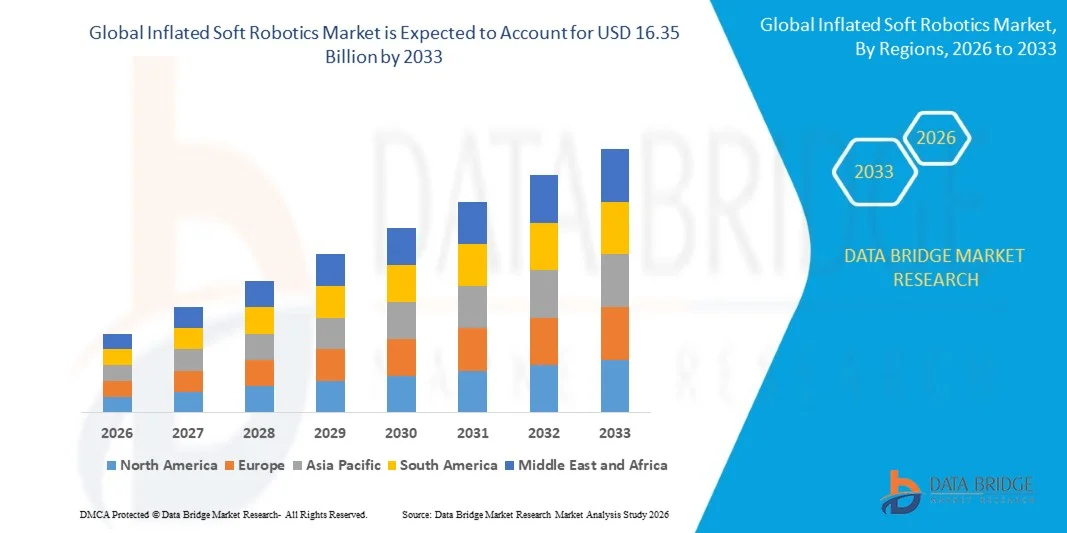
- As per Data Bridge Market Research analysis, the inflated soft robotics market was valued at USD 1.98 billion in 2025 and is projected to reach USD 16.35 billion by 2033, growing at a CAGR of 30.20% from 2026 to 2033.
- The market is experiencing consistent growth driven by advancements in soft robotics technology, increasing demand for flexible and adaptable robotic systems, and expanding applications across healthcare, manufacturing, logistics, automotive, and consumer-oriented industries.
- The increasing demand for safe human-robot interaction, delicate object handling, and maneuverability in constrained environments, combined with advancements in materials, sensors, actuators, and automation technologies, is encouraging industries to adopt inflated soft robotics solutions. The integration of these technologies is also expanding applications in prosthetics, wearable devices, soft grippers, healthcare, and industrial automation.
Market Size & Forecast
- Global Market Value (2025): USD 1.98 Billion
- Expected Market Value (2033): USD 16.35 Billion
- Forecast CAGR (2026–2033): 30.20%
- Leading Region in 2025: North America
- Fastest Growing Region: Asia Pacific
What are the Major Takeaways of the Inflated Soft Robotics Market?
- North America dominated the inflated soft robotics market with the largest revenue share of 35.2% in 2025, supported by the presence of key robotics companies, research institutions, and strong government initiatives promoting soft robotics development.
- Asia-Pacific is expected to be the fastest-growing region at a CAGR of 31.1% from 2026 to 2033, fueled by increasing automation, expanding manufacturing industries, and rising adoption of robotics technologies across China, Japan, South Korea, and India.
- The hardware segment led the market with a 60% share in 2025, driven by the essential role of flexible materials, actuators, sensors, valves, and other physical components in soft robotic systems.
- Software is the fastest-growing component type, projected to register a CAGR of 30.0%, reflecting the surge in integration of artificial intelligence, machine learning, sensing, and advanced control algorithms into inflated robotic systems.
- The soft inflatable segment dominated the product category with a 35% revenue share in 2025, led by their lightweight construction, flexibility, compliance, and ability to achieve substantial deformation through controlled inflation.
- Pneumatic actuation accounted for 45% of the market share in 2025, preferred by manufacturers and end users seeking lightweight, flexible, compliant, and cost-effective actuation systems for soft grippers, wearable robots, rehabilitation devices, and industrial automation
- The hybrid actuation segment is the fastest-growing technology category, with a CAGR of 31.0%, driven by the ability to combine the advantages of multiple actuation mechanisms, enabling greater flexibility, adaptability, precision, and improved performance
Report Scope and Inflated Soft Robotics Market Segmentation
|
Attributes |
Inflated Soft Robotics Key Market Insights |
|
Segments Covered |
|
|
Countries Covered |
North America
Europe
Asia-Pacific
Middle East and Africa
South America
|
|
Key Market Players |
|
|
Market Opportunities |
|
|
Value Added Data Infosets |
In addition to the insights on market scenarios such as market value, growth rate, segmentation, geographical coverage, and major players, the market reports curated by the Data Bridge Market Research also include in-depth expert analysis, geographically represented company-wise production and capacity, network layouts of distributors and partners, detailed and updated price trend analysis and deficit analysis of supply chain and demand. |
What is the Key Trend in the Inflated Soft Robotics Market?
- Inflated soft robotics is increasingly shifting toward sensor-integrated and self-sensing systems, enabling robots to detect their own shape, contact position, applied force, and surrounding interactions without relying heavily on external cameras or tracking systems.
- For instance, in August 2024, according to the Singapore University of Technology and Design (SUTD), researchers developed lightweight, untethered FiBa soft robots using pneumatic balloon modules, enabling crawling, climbing, perching, and flying while reducing dependence on conventional rigid robotic structures.
- The integration of machine learning with pneumatic sensing is improving real-time control and enabling inflated robots to adapt their movements according to changing loads, contact conditions, and operating environments.
- Healthcare is becoming an important application area, with pneumatic soft robots being developed for rehabilitation, compression therapy, wearable assistance, and minimally invasive medical procedures because of their compliance and safe interaction with the human body.
- Inflatable soft grippers are also advancing toward multimode and adaptable grasping, allowing a single robotic system to handle fragile, irregular, and differently shaped objects while maintaining gentle contact and improving load-bearing capability.
- Lightweight fabric-reinforced actuators are gaining attention because they combine flexibility, low weight, adaptability, and multifunctionality, making them suitable for wearable systems, industrial automation, and mobile robotic applications.
- For instance, in December 2024, according to NC State News, researchers developed a manta-ray-inspired soft robot powered by an air-filled chamber, allowing the robot to swim both at the surface and throughout the water column while using a single actuator for rapid fin movement.
- As manufacturers increasingly seek robots capable of safely interacting with humans and manipulating objects of varying shapes, the integration of sensing, machine learning, and pneumatic actuation is expected to accelerate adoption across industrial and healthcare applications.
What are the Key Drivers of the Inflated Soft Robotics Market?
- The growing demand for safe human-robot collaboration is increasing the adoption of inflated soft robots because their compliant structures can absorb contact forces and conform to irregular surfaces more safely than conventional rigid robotic mechanisms.
- For instance, in October 2024, according to arXiv, researchers developed a hybrid gripper incorporating a soft pneumatic ring around a rigid joint, improving its ability to grasp thin and deformable objects such as paper sheets while reducing the required gripping distance by up to eightfold compared with conventional rigid grippers.
- Expanding automation in food handling, packaging, logistics, and manufacturing is creating demand for pneumatic soft grippers capable of manipulating fragile, irregular, and deformable products while reducing damage during automated picking and handling operations.
- Increasing healthcare requirements for non-invasive rehabilitation and wearable assistance are encouraging the development of pneumatic soft robotic systems that can provide controlled mechanical assistance while maintaining comfort and adaptability during prolonged human interaction.
- Advances in soft materials, pneumatic actuators, flexible sensors, and control technologies are improving the performance, precision, durability, and scalability of inflated robotic systems, supporting their transition from laboratory prototypes toward practical commercial applications.
- For instance, in July 2024, according to arXiv, researchers demonstrated a single-casting fabrication method for pneumatic soft actuators that produced bending and linear-motion actuators for an earthworm-inspired robot, quadruped robot, and robotic gripper, reducing fabrication iterations and supporting more accessible soft-robot production
- The combination of lightweight construction and adaptable actuation is expanding inflated soft robotics into space exploration and inspection, where conventional rigid systems can face limitations in weight, maneuverability, and interaction with delicate structures
Which Factors are Challenging the Growth of the Inflated Soft Robotics Market?
- Inflated soft robots continue to face durability and fatigue limitations because repeated inflation, deflation, bending, and deformation can cause material degradation, leakage, actuator fatigue, and reduced performance over extended operating cycles.
- For instance, in March 2024, according to Stanford University’s Robotics Center, researchers highlighted that pneumatic soft robots remain constrained by bulky external air and power supplies, limiting portability and dynamic performance; the team developed the phloSAR portable pressure-supply system to address this limitation.
- The integration of sensors, actuators, control systems, and soft materials remains technically challenging because components can interact mechanically in unpredictable ways, making precise modeling, calibration, control, and large-scale manufacturing more difficult.
- Many pneumatic systems remain dependent on external pumps, compressors, tubing, and power equipment, which can increase system size, energy consumption, and complexity and restrict the mobility of untethered inflated robots.
- For instance, in November 2024, according to arXiv, researchers noted that the inherent material properties of soft robots can limit rapid response and large-scale movement simultaneously, restricting overall speed and efficiency; they developed a high-frequency pneumatic oscillator that achieved actuation frequencies of up to 20 Hz to overcome these limitations.
- The combination of material fatigue, complex system integration, and pneumatic infrastructure requirements continues to constrain the commercialization of inflated soft robotics, particularly where continuous operation, compactness, high precision, and long service life are essential.
How is the Inflated Soft Robotics Market Segmented?
The inflated soft robotics market is segmented on the basis of component, product, technology, and end-user.
- By Component
On the basis of component, the inflated soft robotics market is segmented into hardware and software. The hardware segment dominated the market with 60% share in 2025, owing to the essential role of flexible materials, actuators, sensors, valves, and other physical components in soft robotic systems. Hardware components enable robots to inflate, deform, bend, grasp, and interact safely with objects and humans. The increasing development of lightweight elastomers, fabric-reinforced structures, and flexible sensing technologies is strengthening hardware adoption. Hardware also represents the core physical infrastructure required for deploying soft robotic systems across healthcare, logistics, food handling, and industrial automation.
The software segment is projected to register the fastest growth at CAGR of 30.0% during forecast period, driven by increasing integration of artificial intelligence, machine learning, sensing, and advanced control algorithms into inflated robotic systems. Software enables precise control of pneumatic pressure, deformation, movement, grasping force, and interaction with the surrounding environment. Machine-learning algorithms can also compensate for the complex and nonlinear behavior of soft materials. Increasing adoption of sensor-driven feedback systems is creating additional demand for sophisticated software platforms. Digital simulation and control tools are further helping developers optimize soft-robotic designs before physical deployment.
- By Product
On the basis of product, the inflated soft robotics market is segmented into soft inflatable structures, pneumatic robots, inflatable grippers, inflatable wearable robots, and inflatable manipulators. The soft inflatable structures segment dominated the market with 35% share in 2025, supported by their lightweight construction, flexibility, compliance, and ability to achieve substantial deformation through controlled inflation. These structures form the foundation of numerous inflated robotic systems and can be configured for different movements and operating environments. Their ability to safely conform to irregular surfaces makes them particularly valuable for human-robot interaction. Soft inflatable structures are also relatively simple to fabricate compared with complex rigid robotic mechanisms. Increasing research into fabric-based actuators, inflatable chambers, and variable-stiffness structures is further expanding their applications.
The inflatable grippers segment is projected to register the fastest growth at a CAGR of 32.0% during forecast period, driven by increasing demand for flexible robotic handling solutions capable of manipulating fragile, irregular, and deformable objects. Unlike rigid grippers, inflatable grippers can conform to different object geometries while distributing gripping forces more gently. This characteristic is particularly valuable in food processing, packaging, agriculture, logistics, and e-commerce fulfillment. Advances in pneumatic chambers, soft materials, embedded sensing, and pressure control are improving gripping precision and repeatability. The growing adoption of automation for delicate-object handling is further expanding the addressable market for inflatable grippers.
- By Technology
On the basis of technology, the inflated soft robotics market is segmented into pneumatic actuation, hydraulic actuation, vacuum actuation, cable-driven actuation, and hybrid actuation. The pneumatic actuation segment dominated the market with 45% share in 2025, because inflation-based movement is particularly compatible with the compliant structures used in soft robotics. Pneumatic systems can generate bending, twisting, elongation, and gripping motions by controlling air pressure within flexible chambers. They also provide relatively high power-to-weight ratios while maintaining the compliance required for safe interaction with humans and delicate objects. Pneumatic actuation is widely used in soft grippers, wearable robots, rehabilitation devices, and industrial manipulators. Continued development of miniature valves, portable pumps, pressure sensors, and pneumatic controllers is improving system performance.
The hybrid actuation segment is projected to witness the fastest growth at a CAGR of 31.2% during forecast period, as manufacturers increasingly combine pneumatic systems with complementary actuation technologies to overcome the limitations of individual mechanisms. Hybrid systems can integrate pneumatic, cable-driven, hydraulic, or other mechanisms to achieve greater motion range, force, precision, and controllability. This approach is particularly valuable for complex robotic movements that cannot be achieved efficiently through a single actuation method. Integration with embedded sensors can provide real-time feedback for controlling pressure, position, and force. Hybrid architectures are also supporting the development of multifunctional robots capable of switching between different operating modes
- By End User
On the basis of end user, the inflated soft robotics market is segmented into medical and healthcare, food and beverages, logistics, entertainment and gaming, automotive, survey and exploration, and others. The medical and healthcare segment dominated the market with 35% share in 2025, driven by the suitability of compliant inflated robots for direct interaction with the human body. Soft pneumatic technologies are increasingly being investigated for rehabilitation, wearable assistance, prosthetics, therapeutic devices, and minimally invasive procedures. Their lightweight and flexible structures can provide controlled assistance while reducing the risk of excessive forces during physical interaction. The technology is also attractive for applications requiring compact and adaptable mechanisms inside constrained anatomical environments. Growing demand for rehabilitation technologies and assistive devices is creating additional opportunities for inflated soft robotics.
The logistics segment is projected to register the fastest growth at a CAGR of 31.0% during forecast period, supported by increasing automation of picking, sorting, packaging, and material-handling activities. Inflatable grippers can adapt to objects with different shapes, sizes, weights, and surface characteristics, making them suitable for highly variable warehouse inventories. Their compliant structures can also reduce product damage when handling fragile or deformable goods. The rapid expansion of e-commerce is increasing the need for flexible robotic systems capable of automating high-volume fulfillment operations. Advances in machine vision, tactile sensing, and AI-based grasp planning are further improving the ability of soft robots to perform autonomous handling tasks.
Which Region Holds the Largest Share of the Inflated Soft Robotics Market?
- North America dominated the inflated soft robotics market with the largest revenue share of 35.2% in 2025, supported by the presence of key robotics companies, research institutions, and strong government initiatives promoting soft robotics development.
- The region also benefits from high adoption of soft robotic systems across healthcare, manufacturing, logistics, and food handling applications, along with strong research and development activity and established supplier networks. Growing demand for flexible automation, human-safe robotic systems, and advanced collaborative robotics continues to strengthen North America’s leadership position in the global market.
U.S. Inflated Soft Robotics Market Insight
The U.S. inflated soft robotics market is witnessing strong growth due to rising investments in advanced robotic systems, healthcare automation, and flexible manufacturing technologies. The country’s mature robotics and technology ecosystem, along with increasing adoption of pneumatic, AI-enabled, and sensor-integrated soft robotic systems, is driving demand across medical, logistics, food handling, and industrial applications. In addition, growing emphasis on human-safe automation, rehabilitation technologies, and adaptable robotic solutions is accelerating soft robotics adoption across research institutions, healthcare providers, and manufacturers.
Asia-Pacific Inflated Soft Robotics Market Insight
The Asia-Pacific inflated soft robotics market is expected to witness rapid growth, driven by increasing industrial automation, expanding manufacturing activities, and rising investments in robotics technologies across countries such as China, Japan, and South Korea. Growing adoption of lightweight robotic systems, increasing demand for flexible automation, and advancements in pneumatic actuation technologies are supporting regional market expansion. In addition, the growing presence of robotics research centers, healthcare technology development, and smart manufacturing initiatives is accelerating inflated soft robotics adoption across industrial and commercial sectors.
Japan Inflated Soft Robotics Market Insight
The Japan inflated soft robotics market is witnessing consistent growth due to rising investments in advanced robotics technologies, healthcare automation, and manufacturing innovation. Automotive manufacturers, research institutes, and healthcare organizations are increasingly adopting inflatable and pneumatic soft robotic systems for automation, rehabilitation, assistance, and precision handling applications. Moreover, increasing integration of sensors, AI technologies, and lightweight materials, along with the country’s focus on human-robot collaboration and advanced mobility solutions, is further contributing to market growth.
China Inflated Soft Robotics Market Insight
The China inflated soft robotics market is growing rapidly, driven by increasing industrial automation, expanding manufacturing infrastructure, and rising government focus on advanced robotics development. Growing adoption of pneumatic and AI-enabled soft robotic systems across manufacturing, logistics, healthcare, and food handling sectors is significantly boosting market demand. In addition, rising investments in robotics R&D, increasing demand for flexible automation, and rapid advancements in materials and sensing technologies are positioning China as one of the fastest-growing markets for inflated soft robotics globally.
U.K. Inflated Soft Robotics Market Insight
The U.K. inflated soft robotics market is experiencing steady growth, supported by rising adoption of soft robotic technologies in healthcare, manufacturing, logistics, and research applications. Increasing investments in advanced robotic systems and growing demand for lightweight, flexible, and human-safe automation solutions are contributing to market growth. Furthermore, integration of AI, sensors, pneumatic technologies, and advanced materials is improving robotic adaptability and operational efficiency, positioning the U.K. as a key innovation hub in the inflated soft robotics industry.
Germany Inflated Soft Robotics Market Insight
The Germany inflated soft robotics market is expanding steadily due to the country’s strong industrial manufacturing base, advanced research capabilities, and increasing adoption of next-generation robotics technologies. Automotive companies, logistics operators, healthcare organizations, and research institutes are increasingly utilizing inflated soft robotic systems for material handling, automation, rehabilitation, and precision applications. Continuous advancements in pneumatic actuation, sensor integration, AI, and flexible materials, along with strong industry focus on automation and human-robot collaboration, are further driving market growth in Germany.
Which are the Top Companies in Inflated Soft Robotics Market?
The inflated soft robotics industry is primarily led by well-established companies, including:
- Festo SE & Co. KG (Germany)
- SCHUNK SE & Co. KG (Germany)
- Shadow Robot Company Limited (U.K.)
- RightHand Robotics, Inc. (U.S.)
- Artimus Robotics, Inc. (U.S.)
- Softwear Automation, Inc. (U.S.)
- Innophys Co., Ltd. (Japan)
- Ekso Bionics Holdings, Inc. (U.S.)
- Ottobock SE & Co. KGaA (Germany)
- Asea Brown Boveri Ltd (Switzerland)
- FANUC CORPORATION (Japan)
- Yaskawa Electric Corporation (Japan)
- SMC Corporation (Japan)
- Piab AB (Sweden)
- OnRobot A/S (Denmark)
- New Scale Robotics LLC (U.S.)
- Tactile Robotics Ltd. (U.K.)
- Beijing Soft Robot Technology Co., Ltd. (China)
- Wisson Robotics (China)
- Soft Robotics Inc. (U.S.)
What are Latest Developments in Inflated Soft Robotics Market?
- In June 2025, according to arXiv, researchers developed a multimodal limbless crawling soft robot using antagonistic inflatable actuators and a flexible kirigami skin. The robot combines cyclic inflation with asymmetric steering to achieve forward movement and turning, while onboard proximity sensors enable adaptive obstacle avoidance. The development demonstrates the potential of inflatable soft robots for search-and-rescue, environmental monitoring, and industrial inspection applications.
- In October 2024, according to arXiv, researchers developed an inflatable rotational joint with anisotropic stiffness and programmable actuation for soft robots. The technology uses controlled partial wrinkling to establish a defined bending direction while allowing the stiffness to be tuned through the structure’s geometry. The development enables more sophisticated actuation and improves the ability of inflatable soft robots to perform complex movements under varying load conditions.
- In November 2023, according to arXiv, researchers developed a mechanically inflatable soft robot for pipeline inspection inspired by the locomotion of parasitic wasps. The robot uses a flexible mechanical inflation mechanism to adapt its diameter and move through pipelines of different sizes and shapes. The prototype demonstrated substantial holding force and adaptable locomotion, highlighting its potential for inspection and navigation in confined industrial environments
- In March 2022, according to the University of Tulsa, researchers advanced the development of “Squishy,” a fabric-reinforced inflatable soft robot, by introducing a state-estimation approach for improved control. The researchers used pressure-sensor data to estimate the robot’s position, velocity, and acceleration, addressing the difficulty of sensing the continuously deforming body of an inflatable robot. The development supports more reliable and intelligent control of inflatable soft robotic systems.
- In July 2021, according to the University of Maryland, researchers demonstrated a 3D-printed soft robotic hand capable of controlling its movements using fluidic actuation. The development highlighted advances in flexible and inflatable robotics powered by air or water rather than conventional electric motors, with the robotic hand successfully completing a level of Super Mario Bros. The work demonstrated the potential of soft, compliant robots for applications requiring adaptable and safe interaction

- Interactive Data Analysis Dashboard
- Company Analysis Dashboard for high growth potential opportunities
- Research Analyst Access for customization & queries
- Competitor Analysis with Interactive dashboard
- Latest News, Updates & Trend analysis
- Harness the Power of Benchmark Analysis for Comprehensive Competitor Tracking
Global Inflated Soft Robotics Market, Supply Chain Analysis and Ecosystem Framework
To support market growth and help clients navigate the impact of geopolitical shifts, DBMR has integrated in-depth supply chain analysis into its Global Inflated Soft Robotics Market research reports. This addition empowers clients to respond effectively to global changes affecting their industries. The supply chain analysis section includes detailed insights such as Global Inflated Soft Robotics Market consumption and production by country, price trend analysis, the impact of tariffs and geopolitical developments, and import and export trends by country and HSN code. It also highlights major suppliers with data on production capacity and company profiles, as well as key importers and exporters. In addition to research, DBMR offers specialized supply chain consulting services backed by over a decade of experience, providing solutions like supplier discovery, supplier risk assessment, price trend analysis, impact evaluation of inflation and trade route changes, and comprehensive market trend analysis.
Data collection and base year analysis are done using data collection modules with large sample sizes. The stage includes obtaining market information or related data through various sources and strategies. It includes examining and planning all the data acquired from the past in advance. It likewise envelops the examination of information inconsistencies seen across different information sources. The market data is analysed and estimated using market statistical and coherent models. Also, market share analysis and key trend analysis are the major success factors in the market report. To know more, please request an analyst call or drop down your inquiry.
The key research methodology used by DBMR research team is data triangulation which involves data mining, analysis of the impact of data variables on the market and primary (industry expert) validation. Data models include Vendor Positioning Grid, Market Time Line Analysis, Market Overview and Guide, Company Positioning Grid, Patent Analysis, Pricing Analysis, Company Market Share Analysis, Standards of Measurement, Global versus Regional and Vendor Share Analysis. To know more about the research methodology, drop in an inquiry to speak to our industry experts.
Data Bridge Market Research is a leader in advanced formative research. We take pride in servicing our existing and new customers with data and analysis that match and suits their goal. The report can be customized to include price trend analysis of target brands understanding the market for additional countries (ask for the list of countries), clinical trial results data, literature review, refurbished market and product base analysis. Market analysis of target competitors can be analyzed from technology-based analysis to market portfolio strategies. We can add as many competitors that you require data about in the format and data style you are looking for. Our team of analysts can also provide you data in crude raw excel files pivot tables (Fact book) or can assist you in creating presentations from the data sets available in the report.













