


What is the Inline Process Analytical Technology (Pat) Systems Market Size and Growth Rate?
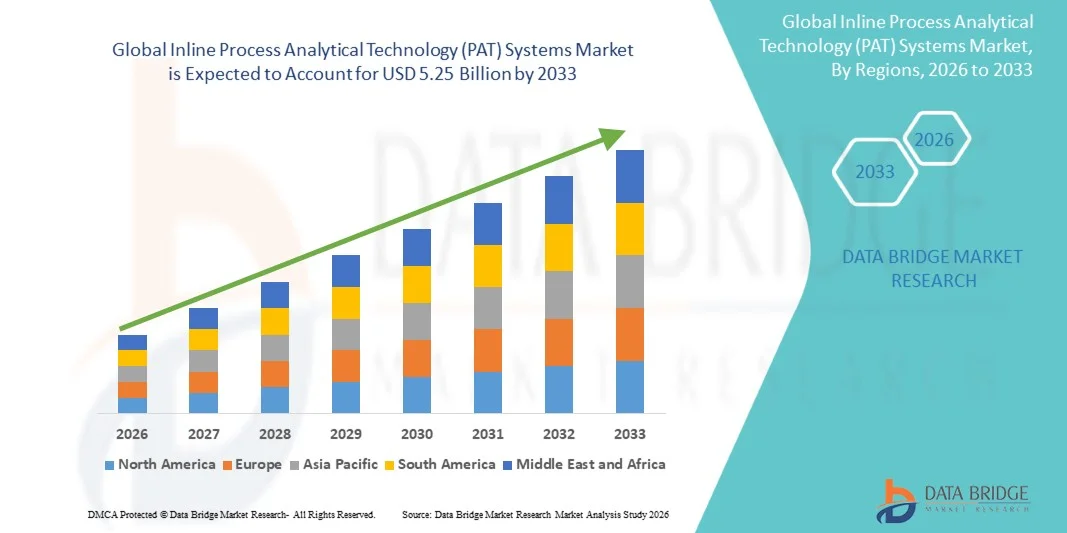
As per Data Bridge Market Research Analysis the Inline Process Analytical Technology (PAT) Systems Market was valued at USD 1.58 Billion in 2025 and is projected to reach USD 5.25 Billion by 2033, growing at a CAGR of 16.20% from 2026 to 2033. The market is witnessing robust growth driven by increasing adoption of continuous manufacturing, rising regulatory emphasis on Quality by Design (QbD), and growing demand for real-time process monitoring across pharmaceutical and biopharmaceutical production facilities.
The increasing need to improve manufacturing efficiency while reducing batch failures and operational costs is encouraging pharmaceutical manufacturers to integrate inline PAT systems into production workflows. Advancements in spectroscopy technologies, artificial intelligence-based data analytics, and Industrial IoT-enabled manufacturing platforms are enabling manufacturers to achieve real-time quality assurance, faster process optimization, and improved regulatory compliance.
Market Size & Forecast
- Global Market Value (2025): USD 1.58 Billion
- Expected Market Value (2033): USD 5.25 Billion
- Forecast CAGR (2026–2033): 20%
- Leading Region in 2025: North America
- Fastest Growing Region: Asia-Pacific
What are the Major Takeaways of Inline Process Analytical Technology (Pat) Systems Market?
- North America dominated the global inline PAT systems market with the largest revenue share of 38.42% in 2025, supported by widespread implementation of FDA PAT guidelines, advanced pharmaceutical manufacturing infrastructure, and high investment in digital manufacturing technologies.
- The Spectroscopy Systems segment led the market with a 43.15% share in 2025, driven by extensive deployment of NIR, Raman, and FTIR technologies for continuous process monitoring and quality control.
- Asia-Pacific is expected to be the fastest-growing region at a CAGR of 16.9% from 2026 to 2033, fueled by expanding pharmaceutical manufacturing capacity, increasing CDMO investments, and growing regulatory adoption across China, India, South Korea, and Singapore.
- Artificial Intelligence & Machine Learning Integration is the fastest-growing technology segment, projected to register a CAGR of 16.4%, reflecting increasing adoption of predictive analytics and automated process optimization.
- The Pharmaceutical & Biotechnology Companies segment dominates the end-user category with a 47.36% revenue share in 2025, supported by rising investments in biologics manufacturing, vaccine production, and continuous manufacturing facilities.
- Inline Deployment accounts for 61.84% of the market, preferred for its ability to provide uninterrupted real-time measurements without interrupting production workflows.
- The Process Monitoring application segment is the fastest-growing application category, registering a CAGR of 16.6%, driven by increasing focus on reducing manufacturing deviations and enabling real-time release testing.
Report Scope and Inline Process Analytical Technology (PAT) Systems Market Segmentation
|
Attributes |
Inline Process Analytical Technology (PAT) Systems Key Market Insights |
|
Segments Covered |
|
|
Countries Covered |
North America
Europe
Asia-Pacific
Middle East and Africa
South America
|
|
Key Market Players |
|
|
Market Opportunities |
· Increasing adoption of continuous pharmaceutical manufacturing and Industry 4.0 technologies · Growing implementation of AI-powered predictive analytics and real-time process optimization · Rising demand for biologics, cell & gene therapy manufacturing, and real-time release testing |
|
Value Added Data Infosets |
In addition to the insights on market scenarios such as market value, growth rate, segmentation, geographical coverage, and major players, the market reports curated by the Data Bridge Market Research also include import export analysis, production capacity overview, production consumption analysis, price trend analysis, climate change scenario, supply chain analysis, value chain analysis, raw material/consumables overview, vendor selection criteria, PESTLE Analysis, Porter Analysis, and regulatory framework |
What is the Key Trend in the Inline Process Analytical Technology (Pat) Systems Market?
Trend: Growing Adoption of Continuous Manufacturing and Smart Pharmaceutical Production
Pharmaceutical and biopharmaceutical manufacturers are increasingly adopting inline Process Analytical Technology (PAT) systems to support continuous manufacturing, improve product quality, and minimize production variability. Advanced spectroscopic techniques, AI-powered analytics, and Industrial IoT connectivity are enabling real-time monitoring of critical quality attributes (CQAs) and critical process parameters (CPPs). Manufacturers are leveraging inline PAT solutions to reduce batch failures, accelerate process optimization, and enable real-time release testing (RTRT), while digital manufacturing initiatives and Industry 4.0 technologies continue to enhance operational efficiency across pharmaceutical production facilities.
Inline Process Analytical Technology (PAT) Systems Market Dynamics
Key Market Driver: Increasing Adoption of Continuous Manufacturing and Regulatory Focus on Quality by Design (QbD)
The growing transition from traditional batch manufacturing to continuous pharmaceutical manufacturing is significantly driving demand for inline PAT systems. Regulatory agencies increasingly encourage manufacturers to implement Quality by Design (QbD) principles and real-time process monitoring to ensure consistent product quality and regulatory compliance. Pharmaceutical manufacturers, biotechnology companies, and CDMOs are deploying advanced spectroscopy, process sensors, and AI-enabled analytical platforms to optimize production efficiency, reduce manufacturing deviations, and accelerate product commercialization while meeting stringent global quality standards.
Key Restraint/Challenge: High Capital Investment and Complex System Integration
A major challenge for the global inline PAT systems market is the substantial investment required for implementing advanced analytical instrumentation and integrating these systems into existing manufacturing facilities. Deployment often requires specialized hardware, software validation, process redesign, regulatory documentation, workforce training, and continuous calibration. Small and medium-sized pharmaceutical manufacturers may face difficulties in adopting comprehensive inline PAT solutions due to high implementation costs, extended validation timelines, and the need for skilled analytical and automation professionals.
Key Market Opportunity: Integration of Artificial Intelligence and Digital Manufacturing Platforms
The integration of artificial intelligence, machine learning, cloud analytics, and digital twin technologies presents significant growth opportunities for the inline PAT systems market. AI-enabled PAT platforms can deliver predictive process monitoring, automated anomaly detection, adaptive process control, and real-time quality optimization. Growing investments in smart pharmaceutical factories, biologics manufacturing, personalized medicines, and cell & gene therapy production are creating new opportunities for advanced inline PAT systems capable of supporting highly automated and data-driven manufacturing environments.
How is the Inline Process Analytical Technology (Pat) Systems Market Segmented?
The inline process analytical technology (PAT) systems market is segmented on the basis of product type, measurement technique, component, application, end user, deployment, technology integration, and industry.
-
By Product Type
On the basis of product type, the Inline Process Analytical Technology (PAT) Systems Market is segmented into spectroscopy systems, chromatography systems, particle size analyzers, process mass spectrometers, sensors & probes, and others. The spectroscopy systems segment dominated the market with a 43.15% share in 2025 due to widespread adoption of Near-Infrared (NIR), Raman, and FTIR spectroscopy for real-time monitoring of pharmaceutical manufacturing processes. These systems provide rapid, non-destructive analysis and improve process consistency while supporting continuous manufacturing environments.
The process mass spectrometers segment is expected to witness the fastest CAGR of 16.6% from 2026 to 2033, driven by increasing demand for high-precision process analytics in biologics manufacturing, fermentation monitoring, and advanced pharmaceutical process control.
-
By Measurement Technique
On the basis of measurement technique, the global inline PAT systems market is segmented into Near-Infrared (NIR), Raman spectroscopy, UV-Visible spectroscopy, Fourier Transform Infrared (FTIR), mass spectrometry, and others. The Near-Infrared (NIR) segment dominated the market with a 38.72% share in 2025 owing to its rapid, non-invasive analytical capabilities, ease of implementation, and broad applicability across pharmaceutical manufacturing processes.
The Raman spectroscopy segment is anticipated to register the fastest CAGR of 16.6% during the forecast period owing to increasing adoption for continuous manufacturing, biologics production, and highly accurate chemical composition analysis.
-
By Component
On the basis of component, the global inline PAT systems market is segmented into hardware, software, and services. The hardware segment dominated the market with a 52.48% share in 2025 due to increasing investments in advanced analytical instruments, inline sensors, spectrometers, and process monitoring equipment across pharmaceutical manufacturing facilities.
The software segment is expected to witness the fastest CAGR of 16.4% from 2026 to 2033, supported by growing adoption of AI-driven analytics, cloud-based monitoring platforms, and digital manufacturing solutions.
-
By Application
On the basis of application, the global inline PAT systems market is segmented into process monitoring, quality assurance & quality control, continuous manufacturing, process optimization, and real-time release testing. The process monitoring segment dominated the market with a 36.84% share in 2025 due to increasing emphasis on real-time manufacturing visibility, reduction of process deviations, and compliance with regulatory quality standards.
The real-time release testing segment is projected to witness the fastest CAGR of 16.8% during the forecast period owing to increasing regulatory acceptance of continuous quality verification and accelerated product release strategies.
-
By End User
On the basis of end user, the global inline PAT systems market is segmented into pharmaceutical & biotechnology companies, contract development & manufacturing organizations (CDMOs), research & academic institutes, food & beverage manufacturers, and chemical & petrochemical companies. The pharmaceutical & biotechnology companies segment dominated the market with a 47.36% share in 2025 due to increasing investments in biologics manufacturing, vaccine production, and advanced pharmaceutical process automation.
The CDMOs segment is expected to witness the fastest CAGR of 16.5% from 2026 to 2033, driven by rising outsourcing of pharmaceutical manufacturing and increasing implementation of continuous manufacturing technologies.
-
By Deployment
On the basis of deployment, the global inline PAT systems market is segmented into inline, at-line, and online. The inline segment dominated the market with a 61.84% share in 2025 due to its capability to provide uninterrupted real-time measurements without interrupting manufacturing operations, improving production efficiency and quality assurance.
The online segment is expected to register the fastest CAGR of 16.3% during the forecast period owing to growing integration with centralized manufacturing execution systems and cloud-based process monitoring platforms.
-
By Technology Integration
On the basis of technology integration, the global inline PAT systems market is segmented into artificial intelligence & machine learning, Industrial IoT integration, cloud-based analytics, and digital twin integration. The Industrial IoT integration segment dominated the market with a 35.28% share in 2025 due to increasing implementation of connected manufacturing systems and smart factory initiatives.
The Artificial Intelligence & Machine Learning segment is anticipated to witness the fastest CAGR of 16.4% from 2026 to 2033, driven by increasing deployment of predictive analytics, automated process optimization, anomaly detection, and intelligent quality management solutions.
Which Region Holds the Largest Share of the Inline Process Analytical Technology (Pat) Systems Market?
North America dominated the inline process analytical technology (PAT) systems market and accounted for the largest revenue share of 38.42% in 2025, supported by the strong presence of global pharmaceutical manufacturers, widespread implementation of continuous manufacturing technologies, and stringent regulatory frameworks encouraging Process Analytical Technology (PAT) adoption. The region also benefits from significant investments in biopharmaceutical production, advanced automation infrastructure, and increasing integration of artificial intelligence and Industrial IoT across pharmaceutical manufacturing facilities. Growing emphasis on real-time release testing, Quality by Design (QbD), and digital manufacturing continues to strengthen North America's leadership position in the global market.
U.S. Inline Process Analytical Technology (PAT) Systems Market Insight
The U.S. inline process analytical technology (PAT) systems market is witnessing strong growth due to increasing investments in pharmaceutical automation, biologics manufacturing, and continuous production technologies. The country's well-established pharmaceutical and biotechnology industry, combined with growing adoption of AI-powered process monitoring, spectroscopy-based analytical systems, and digital manufacturing platforms, is driving market demand. In addition, regulatory support for Quality by Design (QbD) and real-time release testing is accelerating the deployment of advanced inline PAT solutions across pharmaceutical manufacturing facilities.
Europe Inline Process Analytical Technology (PAT) Systems Market Insight
The Europe inline process analytical technology (PAT) systems market remains a significant contributor to global revenue, driven by robust pharmaceutical manufacturing capabilities, increasing investments in smart manufacturing technologies, and stringent regulatory compliance requirements. The widespread implementation of continuous manufacturing, advanced spectroscopy systems, and automated quality control solutions is supporting market expansion across the region. Growing focus on sustainable pharmaceutical production, digital transformation, and operational efficiency continues to accelerate the adoption of inline PAT systems throughout Europe.
U.K. Inline Process Analytical Technology (PAT) Systems Market Insight
The U.K. inline process analytical technology (PAT) systems market is experiencing steady growth, supported by increasing investments in pharmaceutical research, biologics development, and advanced manufacturing technologies. Rising demand for automated quality monitoring, process optimization, and real-time analytical solutions is encouraging pharmaceutical companies to integrate inline PAT systems into production environments. Furthermore, the growing adoption of AI-driven analytics, cloud-based manufacturing platforms, and Industry 4.0 initiatives is strengthening the country's position as a key innovation hub for pharmaceutical process automation.
Germany Inline Process Analytical Technology (PAT) Systems Market Insight
The Germany inline process analytical technology (PAT) systems market is expanding steadily due to the country's strong pharmaceutical manufacturing base, advanced engineering capabilities, and increasing focus on smart factory implementation. Pharmaceutical manufacturers are increasingly deploying inline spectroscopy, process sensors, and automated analytical platforms to improve production efficiency, regulatory compliance, and product consistency. Continuous innovation in industrial automation, digital manufacturing, and precision analytical technologies is further supporting market growth across Germany.
Asia-Pacific Inline Process Analytical Technology (PAT) Systems Market Insight
The Asia-Pacific inline process analytical technology (PAT) systems market is expected to witness rapid growth, driven by expanding pharmaceutical manufacturing capacity, increasing investments in biologics production, and rising adoption of continuous manufacturing technologies across China, India, Japan, South Korea, and Singapore. Growing regulatory harmonization, increasing healthcare expenditure, and rapid modernization of pharmaceutical production facilities are supporting regional market expansion. Additionally, the growing presence of contract development and manufacturing organizations (CDMOs) and government initiatives promoting advanced manufacturing are accelerating inline PAT system adoption throughout the region.
Japan Inline Process Analytical Technology (PAT) Systems Market Insight
The Japan inline process analytical technology (PAT) systems market is witnessing consistent growth due to rising investments in pharmaceutical innovation, precision manufacturing, and biologics production. Pharmaceutical companies and research organizations are increasingly implementing advanced spectroscopy technologies, automated process monitoring systems, and AI-enabled analytics to enhance manufacturing quality and operational efficiency. Moreover, Japan's strong emphasis on technological innovation and high-quality pharmaceutical production continues to contribute to market growth.
China Inline Process Analytical Technology (PAT) Systems Market Insight
The China inline process analytical technology (PAT) systems market is growing rapidly, driven by expanding pharmaceutical manufacturing infrastructure, increasing investments in biotechnology and biosimilars, and strong government support for advanced manufacturing technologies. The growing adoption of smart factory solutions, Industrial IoT platforms, AI-enabled process monitoring, and continuous manufacturing systems is significantly boosting market demand. In addition, rising domestic pharmaceutical production, increasing regulatory focus on product quality, and rapid digital transformation are positioning China as one of the fastest-growing markets for inline process analytical technology (PAT) systems globally.
Which are the Top Companies in Inline Process Analytical Technology (Pat) Systems Market?
The Inline Process Analytical Technology (PAT) Systems industry is primarily led by well-established companies, including:
- Thermo Fisher Scientific Inc. (U.S.)
- Danaher Corporation (U.S.)
- Agilent Technologies, Inc. (U.S.)
- Bruker Corporation (U.S.)
- Shimadzu Corporation (Japan)
- HORIBA, Ltd. (Japan)
- Sartorius AG (Germany)
- Merck KGaA (Germany)
- ABB Ltd. (Switzerland)
- Siemens AG (Germany)
- Emerson Electric Co. (U.S.)
- Yokogawa Electric Corporation (Japan)
- Endress+Hauser Group (Switzerland)
- Mettler-Toledo International Inc. (U.S.)
- Metrohm AG (Switzerland)
- PerkinElmer Inc. (U.S.)
- ZEISS Group (Germany)
- Carl Zeiss AG (Germany)
- Kaiser Optical Systems, Inc. (U.S.)
- JASCO Corporation (Japan)
- Malvern Panalytical Ltd. (U.K.)
- Waters Corporation (U.S.)
- KAX Group (Sweden)
- BÜCHI Labortechnik AG (Switzerland)
- Repligen Corporation (U.S.)
- Optimal Industrial Technologies Ltd. (U.K.)
- SynTQ Ltd. (U.K.)
- Sartorius Stedim Biotech (France)
- Hamilton Company (U.S.)
- Eppendorf SE (Germany)
- PendoTECH (U.S.)
- Foss Analytical A/S (Denmark)
- BioPAT (Sartorius AG) (Germany)
- Axiom Analytical, Inc. (U.S.)
What are Latest Developments in Inline Process Analytical Technology (Pat) Systems Market?
- In March 2025, Thermo Fisher Scientific Inc. introduced an enhanced generation of inline Raman spectroscopy solutions designed for continuous pharmaceutical manufacturing. The upgraded platform delivers improved spectral resolution, faster real-time data acquisition, and seamless integration with manufacturing execution systems (MES). The innovation enables pharmaceutical manufacturers to strengthen process monitoring, improve batch consistency, and accelerate Quality by Design (QbD) implementation, reinforcing Thermo Fisher Scientific's leadership in pharmaceutical analytical technologies.
- In February 2025, Sartorius AG expanded its BioPAT portfolio by introducing advanced inline analytical solutions integrated with AI-powered process analytics for biopharmaceutical manufacturing. The new system enables continuous monitoring of critical quality attributes (CQAs), predictive process optimization, and enhanced automation for biologics production. This development strengthens Sartorius' position in smart bioprocessing while supporting pharmaceutical manufacturers transitioning toward digital manufacturing environments.
- In October 2024, ABB Ltd. launched an upgraded industrial process analytics platform featuring enhanced Industrial IoT connectivity and cloud-enabled process monitoring capabilities. The solution enables real-time visualization of manufacturing performance, predictive maintenance, and automated quality monitoring across pharmaceutical production facilities. This innovation expands ABB's digital manufacturing portfolio while supporting Industry 4.0 adoption throughout regulated life sciences industries.
- In September 2024, Agilent Technologies, Inc. introduced next-generation inline spectroscopy software designed to improve continuous pharmaceutical manufacturing through advanced chemometric modeling and automated process control. The platform delivers improved analytical accuracy, faster model development, and enhanced regulatory compliance, enabling manufacturers to optimize production efficiency while reducing manufacturing deviations.
- In June 2023, Emerson Electric Co. collaborated with leading pharmaceutical manufacturers to expand deployment of advanced inline process analytical technologies integrated with DeltaV automation systems. The collaboration focused on improving continuous manufacturing performance, enabling real-time release testing, and supporting digital transformation initiatives through intelligent process automation and advanced analytics.

- Interactive Data Analysis Dashboard
- Company Analysis Dashboard for high growth potential opportunities
- Research Analyst Access for customization & queries
- Competitor Analysis with Interactive dashboard
- Latest News, Updates & Trend analysis
- Harness the Power of Benchmark Analysis for Comprehensive Competitor Tracking
Data collection and base year analysis are done using data collection modules with large sample sizes. The stage includes obtaining market information or related data through various sources and strategies. It includes examining and planning all the data acquired from the past in advance. It likewise envelops the examination of information inconsistencies seen across different information sources. The market data is analysed and estimated using market statistical and coherent models. Also, market share analysis and key trend analysis are the major success factors in the market report. To know more, please request an analyst call or drop down your inquiry.
The key research methodology used by DBMR research team is data triangulation which involves data mining, analysis of the impact of data variables on the market and primary (industry expert) validation. Data models include Vendor Positioning Grid, Market Time Line Analysis, Market Overview and Guide, Company Positioning Grid, Patent Analysis, Pricing Analysis, Company Market Share Analysis, Standards of Measurement, Global versus Regional and Vendor Share Analysis. To know more about the research methodology, drop in an inquiry to speak to our industry experts.
Data Bridge Market Research is a leader in advanced formative research. We take pride in servicing our existing and new customers with data and analysis that match and suits their goal. The report can be customized to include price trend analysis of target brands understanding the market for additional countries (ask for the list of countries), clinical trial results data, literature review, refurbished market and product base analysis. Market analysis of target competitors can be analyzed from technology-based analysis to market portfolio strategies. We can add as many competitors that you require data about in the format and data style you are looking for. Our team of analysts can also provide you data in crude raw excel files pivot tables (Fact book) or can assist you in creating presentations from the data sets available in the report.













