What is the Integrated Facility Management Market Size and Growth Rate?
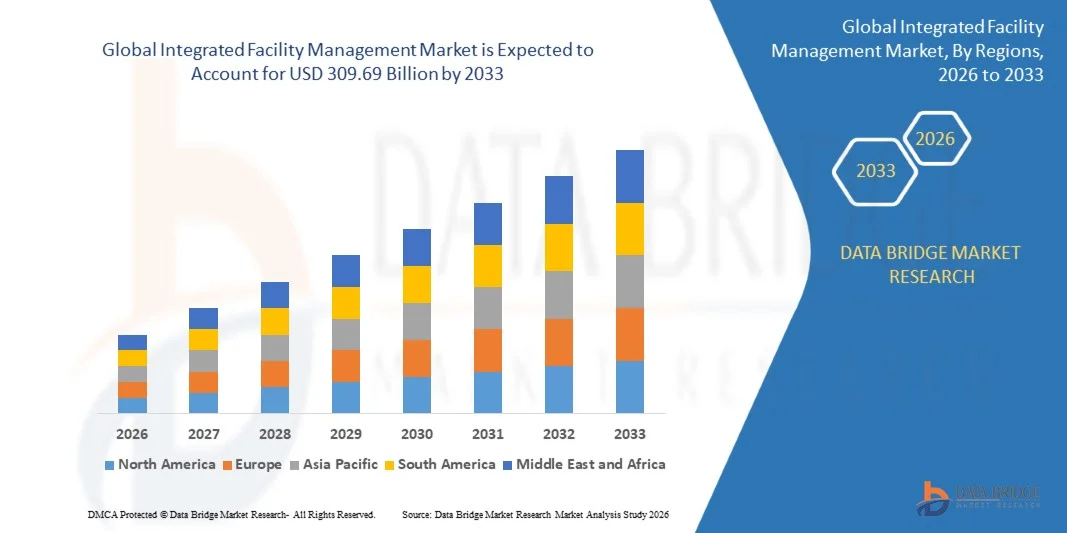
- As per Data Bridge Market Research analysis, the integrated facility management market was valued at USD 178.90 billion in 2025 and is projected to reach USD 309.69 billion by 2033, growing at a CAGR of 7.10% from 2026 to 2033.
- The market is experiencing consistent growth driven by rising demand for outsourced single-provider services, increasing adoption of smart building and AI-enabled platforms, and expanding applications across commercial real estate, healthcare, manufacturing, and government facilities.
- The increasing shift toward outsourcing non-core operations, data-driven building management, and energy-efficient workplaces, combined with growing integration of IoT sensors, analytics, and mobile work-order platforms, is supporting market adoption. Integrated facility management is being applied across offices, hospitals, factories, data centers, and campuses, offering organizations greater convenience in coordinating maintenance, cleaning, security, and facility management services through integrated workplace management and smart building solutions.
Market Size & Forecast
- Global Market Value (2025): USD 178.90 Billion
- Expected Market Value (2033): USD 309.69 Billion
- Forecast CAGR (2026–2033): 7.10%
- Leading Region in 2025: North America
- Fastest Growing Region: Asia-Pacific
What are the Major Takeaways of the Integrated Facility Management Market?
- North America dominated the integrated facility management market with the largest revenue share of 33.80% in 2025, supported by mature outsourcing practices, large commercial real estate portfolios, and a strong base of global service providers and technology vendors.
- Asia-Pacific is expected to be the fastest-growing region at a CAGR of 9.30% from 2026 to 2033, fueled by rapid urbanization, expanding commercial and industrial construction, and rising adoption of outsourced services.
- The maintenance management segment led the market with a 32.40% share in 2025, driven by regulatory compliance, asset uptime needs, and demand for planned and predictive maintenance.
- Energy & sustainability management is the fastest-growing solution, projected to register a CAGR of 9.20%, reflecting rising demand for energy efficiency, carbon reduction, and sustainability reporting.
- The on-premises segment dominated the deployment category with a 52.10% revenue share in 2025, led by data security needs and established enterprise systems.
- Large enterprises accounted for 68.30% of the market share in 2025, preferred for multi-site portfolios, scale benefits, and single-point accountability.
- The SME segment is the fastest-growing organization size, with a CAGR of 9.60%, driven by cloud-based platforms, flexible contracts, and the need to reduce operating costs.
Report Scope and Integrated Facility Management Market Segmentation
|
Attributes |
Integrated Facility Management Key Market Insights |
|
Segments Covered |
|
|
Countries Covered |
North America
Europe
Asia-Pacific
Middle East and Africa
South America
|
|
Key Market Players |
|
|
Market Opportunities |
|
|
Value Added Data Infosets |
In addition to the market insights such as market value, growth rate, market segments, geographical coverage, market players, and market scenario, the market report curated by the Data Bridge Market Research team includes in-depth expert analysis, import/export analysis, pricing analysis, production consumption analysis, and pestle analysis. |
What is the Key Trend in the Integrated Facility Management Market?
- Integrated facility management is increasingly evolving from bundled cleaning and maintenance contracts into technology-led workplace and asset performance services, combining sensors, data platforms, artificial intelligence, and skilled service delivery under one provider.
- For instance, in July 2026, according to Mitie’s announcement of its recommended acquisition by OCS, Mitie’s Mozaic360 data and AI insight platform already supports more than 140 strategic customers, showing how leading providers are building technology-enabled service models
- Critical infrastructure and data center services are gaining prominence, as providers expand skilled engineering teams to operate and maintain mission-critical facilities that require strict uptime, cooling, and power reliability.
- Clients are increasingly consolidating suppliers, as organizations compare providers on service integration, performance data, sustainability outcomes, and cost transparency while moving from fragmented contracts to bundled or integrated models.
- For instance, in July 2026, according to CBRE’s second-quarter results, critical infrastructure services revenue within its Building Operations & Experience segment rose 68%, driven by strong growth in data center solutions and contributions from the Pearce Services acquisition completed in November 2025
- As artificial intelligence, predictive maintenance, sustainability targets, and provider consolidation continue to advance, integrated facility management is expected to expand beyond traditional services into data-driven workplace, energy, and asset optimization.
What are the Key Drivers of the Integrated Facility Management Market?
- The growing preference for outsourcing non-core operations has significantly increased demand for single-provider facility services that reduce vendor complexity and improve accountability across multi-site portfolios.
- For instance, in April 2026, according to CBRE’s first-quarter results, Building Operations & Experience revenue rose 20%, with facilities management revenue up 17% and enterprise facilities management growing by double digits, led by the technology, industrial, and life sciences sectors.
- Corporate real estate teams, hospitals, manufacturers, and public bodies are adopting integrated models to control costs, meet compliance duties, improve workplace experience, and gain single-point visibility into building performance.
- For instance, in April 2026, according to JLL’s first-quarter results, Workplace Management revenue reached USD 3.58 billion, up 10% year over year, illustrating continued client demand for outsourced workplace and facility services.
- With organizations pursuing cost savings, sustainability targets, and better workplace experience, integrated facility management can gain wider adoption, contract scope, and renewal rates across commercial, healthcare, industrial, and public sector portfolios.
What Factors Are Challenging the Growth of the Integrated Facility Management Market?
- Integrated facility management is a labor-intensive business, so wage inflation, workforce shortages, and fixed-price contracts can reduce margins and limit investment in technology.
- For instance, in April 2026, according to GOV.UK and the Low Pay Commission, the U.K. National Living Wage rose 4.1% to GBP 12.71 per hour for workers aged 21 and over, increasing labor costs for cleaning, security, and catering contracts.
- These cost pressures can squeeze margins on long-term fixed-price agreements, while complex contract mobilization and difficulty integrating multiple service lines may delay savings and reduce client satisfaction.
- Data security, interoperability with legacy building systems, and limited digital skills among frontline staff further restrict growth, requiring providers to invest in training, secure platforms, and system integration that may increase operating costs.
- For instance, in September 2026, according to the IFMA job board, U.S. facilities managers had a median age of 52.7 compared with 42.1 for all employed people, and job openings still exceeded hires in July 2026, highlighting succession and talent shortages in the profession.
- The combination of rising labor costs, talent shortages, integration complexity, and cybersecurity concerns can constrain adoption among cost-sensitive buyers and smaller providers, particularly where fragmented in-house or single-service contracts already meet basic needs.
How is the Integrated Facility Management Market Segmented?
The integrated facility management market is segmented on the basis of solution, deployment mode, organization size, and end user.
- By Solution
On the basis of solution, the integrated facility management market is segmented into maintenance management, asset & space management, energy & sustainability management, project & real estate portfolio management, and others. The maintenance management segment dominated the market with 32.40% share in 2025, supported by regulatory compliance, asset uptime requirements, and demand for planned and predictive maintenance. Providers manage heating, cooling, electrical, plumbing, fire safety, and lift systems across large portfolios. Computerized work-order platforms improve response times and reporting. Aging buildings and stricter safety rules further strengthen demand. Condition-based monitoring and mobile technician tools are improving efficiency and reducing unplanned downtime.
The energy & sustainability management segment is projected to register the fastest growth at a CAGR of 9.20% from 2026 to 2033, driven by increasing demand for energy efficiency, carbon reduction, and sustainability reporting. Building owners are using metering, analytics, and automation to reduce consumption and meet net zero commitments. Integrated providers offer energy audits, retrofits, and performance contracts alongside daily operations. Regulation and investor expectations are increasing the need for verified data. Advances in artificial intelligence and building controls are improving savings and creating new service revenue.
- By Deployment Mode
On the basis of deployment mode, the integrated facility management market is segmented into on-premises and cloud. The on-premises segment dominated the market with 52.10% share in 2025, supported by data security needs, compliance requirements, and established enterprise systems. Large organizations often keep facility, access, and building control systems within private environments. Integration with existing building management and security platforms is easier in controlled settings. Long-term vendor relationships and customization requirements also support this model. Government, healthcare, and defense clients continue to prefer local control of sensitive data.
The cloud segment is projected to register the fastest growth at a CAGR of 10.80% from 2026 to 2033, driven by scalability, lower upfront costs, and rapid deployment of analytics and mobile tools. Cloud platforms allow providers to monitor multiple sites, standardize reporting, and update features quickly. Remote monitoring and mobile work-order applications improve service speed. Subscription pricing makes advanced tools accessible to smaller clients. Improved security certifications and hybrid architectures are increasing confidence among cautious buyers.
- By Organization Size
On the basis of organization size, the integrated facility management market is segmented into large enterprises and SMEs. The large enterprises segment dominated the market with 68.30% share in 2025, driven by multi-site portfolios, complex compliance duties, and the benefits of scale. Large organizations prefer a single accountable provider with global reach and consistent service standards. Long-term contracts, performance guarantees, and data reporting support adoption. Dedicated real estate and procurement teams manage sourcing programs. Established relationships with global providers continue to reinforce this segment's leadership.
The SME segment is projected to register the fastest growth at a CAGR of 9.60% from 2026 to 2033, supported by cloud-based platforms, flexible contract terms, and the need to reduce operating costs. Smaller organizations lack in-house facility teams and increasingly buy bundled services. Software-as-a-service tools provide affordable work-order, space, and asset management. Regional providers are adding technology to compete. Awareness of energy savings and compliance obligations is also encouraging adoption.
- By End User
On the basis of end user, the integrated facility management market is segmented into real estate & infrastructure, healthcare, BFSI, manufacturing, government, and others. The real estate & infrastructure segment dominated the market with 31.70% share in 2025, supported by large commercial portfolios, tenant experience priorities, and demand for cost-efficient operations. Owners and occupiers outsource maintenance, cleaning, security, and energy management to specialist providers. Office, retail, logistics, and mixed-use assets need consistent standards across locations. Growth of data centers and life sciences space is creating further opportunities. Established client relationships continue to reinforce this segment's leadership.
The healthcare segment is projected to register the fastest growth at a CAGR of 9.40% from 2026 to 2033, driven by expanding hospital capacity, infection control requirements, and pressure to reduce non-clinical costs. Providers outsource cleaning, catering, engineering, and security to focus on patient care. Compliance with strict hygiene and safety standards increases demand for experienced operators. Aging populations are expanding clinics and care facilities. Data-driven maintenance and energy programs are improving reliability and sustainability.
Which Region Holds the Largest Share of the Integrated Facility Management Market?
- North America dominated the integrated facility management market with the largest revenue share of 33.80% in 2025, supported by mature outsourcing practices, large commercial real estate portfolios, and a strong base of global service providers and technology vendors.
- The region also benefits from high awareness of outsourcing benefits, large corporate real estate portfolios, and strong investment in data centers, healthcare, and life sciences facilities. Increasing adoption of smart building technologies and sustainability programs continues to strengthen North America’s position in the global market.
U.S. Integrated Facility Management Market Insight
The U.S. integrated facility management market is witnessing strong growth due to large commercial real estate portfolios, rising outsourcing, and strong demand from technology, industrial, and life sciences clients. The country’s mature service provider base, along with increasing adoption of AI-enabled work-order platforms, energy analytics, and mobile tools, is driving demand for integrated solutions. In addition, growing data center construction, aging buildings, and sustainability goals are accelerating adoption across commercial, healthcare, and public facilities.
Canada Integrated Facility Management Market Insight
Canada’s integrated facility management market is witnessing steady growth, driven by increasing demand for cost optimization, operational efficiency, and sustainable building management. Organizations are adopting integrated services encompassing maintenance, security, cleaning, energy management, and space optimization. Growing investments in smart buildings, digital facility management platforms, and energy-efficient infrastructure are supporting market expansion. However, labor shortages, rising operating costs, and complex regulatory requirements remain key challenges, creating opportunities for technology-enabled facility management providers.
Asia-Pacific Integrated Facility Management Market Insight
The Asia-Pacific integrated facility management market is expected to witness rapid growth, driven by rapid urbanization, expanding commercial and industrial construction, and rising adoption of outsourced services across countries such as China, India, and Japan. Growing foreign investment, expanding data centers, and increasing demand for professional building management are supporting regional market expansion. In addition, the region’s large hospital, airport, and campus projects are accelerating availability and adoption of integrated models.
China Integrated Facility Management Market Insight
The China integrated facility management market is growing rapidly, driven by large-scale commercial development, expanding industrial parks, and increasing focus on professional property operations. Growing multinational presence and rising hospital and data center capacity are significantly boosting market demand. In addition, strong domestic service providers, smart building programs, and government support for green buildings are positioning China as a key growth market across Asia-Pacific.
Japan Integrated Facility Management Market Insight
The Japan integrated facility management market is witnessing consistent growth due to aging buildings, high service quality expectations, and rising interest in energy efficiency. Property owners, corporations, and healthcare operators are increasingly adopting outsourced maintenance and building management. Moreover, strong demand for reliability, disaster preparedness, and technology-enabled operations is further contributing to market growth in Japan.
Which are the Top Companies in Integrated Facility Management Market?
The integrated facility management industry is primarily led by well-established companies, including:
- CBRE Group, Inc. (U.S.)
- Jones Lang LaSalle Incorporated (U.S.)
- Sodexo (France)
- ISS A/S (Denmark)
- Compass Group PLC (U.K.)
- Cushman & Wakefield plc (U.S.)
- Mitie Group plc (U.K.)
- OCS Group Limited (U.K.)
- Coor Service Management Group AB (Sweden)
- EMCOR Group, Inc. (U.S.)
- ENGIE SA (France)
- Aramark (U.S.)
- Johnson Controls International plc (Ireland)
- Honeywell International Inc. (U.S.)
- Siemens AG (Germany)
- Schneider Electric SE (France)
- International Business Machines Corporation (U.S.)
- Oracle Corporation (U.S.)
- Accruent, LLC (U.S.)
- MRI Software LLC (U.S.)
What are Latest Developments in Integrated Facility Management Market?
- In July 2026, OCS announced a recommended acquisition of Mitie in a deal valuing the U.K. facilities group at approximately GBP 3.1 billion and creating a combined business with revenues of around GBP 8.5 billion. Mitie shareholders would receive up to 221.6 pence per share, a premium of nearly 45%, reflecting consolidation and the value of technology-enabled services.
- In June 2026, Sodexo secured a five-year contract worth more than AUD 100 million to deliver integrated village and industrial cleaning services for Westgold Resources. The award strengthens the company’s position in remote and resource-sector facility services in Australia.
- In May 2026, ISS reached an agreement to acquire Tomagruppen AS, a Norwegian facilities services company, as part of its growth in the Nordic region. The transaction expands local service capacity and supports the company’s strategy of building scale in integrated facility services.
- In November 2025, CBRE completed the acquisition of Pearce Services, a critical infrastructure services provider, which has contributed to rapid growth in its Building Operations & Experience segment. The deal strengthens CBRE’s capabilities in data center operations and mission-critical facility support.
- In September 2025, ISS was awarded a six-year integrated facilities management contract with the Australian Department of Defence. The contract covers delivery of integrated facilities management services and underlines continued public sector demand for outsourced facility operations.

- Interactive Data Analysis Dashboard
- Company Analysis Dashboard for high growth potential opportunities
- Research Analyst Access for customization & queries
- Competitor Analysis with Interactive dashboard
- Latest News, Updates & Trend analysis
- Harness the Power of Benchmark Analysis for Comprehensive Competitor Tracking
Data collection and base year analysis are done using data collection modules with large sample sizes. The stage includes obtaining market information or related data through various sources and strategies. It includes examining and planning all the data acquired from the past in advance. It likewise envelops the examination of information inconsistencies seen across different information sources. The market data is analysed and estimated using market statistical and coherent models. Also, market share analysis and key trend analysis are the major success factors in the market report. To know more, please request an analyst call or drop down your inquiry.
The key research methodology used by DBMR research team is data triangulation which involves data mining, analysis of the impact of data variables on the market and primary (industry expert) validation. Data models include Vendor Positioning Grid, Market Time Line Analysis, Market Overview and Guide, Company Positioning Grid, Patent Analysis, Pricing Analysis, Company Market Share Analysis, Standards of Measurement, Global versus Regional and Vendor Share Analysis. To know more about the research methodology, drop in an inquiry to speak to our industry experts.
Data Bridge Market Research is a leader in advanced formative research. We take pride in servicing our existing and new customers with data and analysis that match and suits their goal. The report can be customized to include price trend analysis of target brands understanding the market for additional countries (ask for the list of countries), clinical trial results data, literature review, refurbished market and product base analysis. Market analysis of target competitors can be analyzed from technology-based analysis to market portfolio strategies. We can add as many competitors that you require data about in the format and data style you are looking for. Our team of analysts can also provide you data in crude raw excel files pivot tables (Fact book) or can assist you in creating presentations from the data sets available in the report.